








Bitcoin under pressure—has Sun's involvement with WBTC triggered a trust crisis?
TechFlow Selected TechFlow Selected
Bitcoin under pressure—has Sun's involvement with WBTC triggered a trust crisis?
Who Can Bring BTC into DeFi and Unlock Trillions in Liquidity?
 Navigating Web3 tides with focused insights
Author: Terry
Have you heard of WBTC?
Veterans who lived through DeFi Summer will surely be familiar with it. As one of the earliest stablecoins launched back in 2018, WBTC played a leading role in bringing Bitcoin liquidity into the DeFi and Ethereum ecosystems in 2022.
However, WBTC has recently faced a crisis of trust—on August 9, BitGo announced a joint venture with Hong Kong-based BiT Global, planning to migrate WBTC’s BTC management address to a multi-sig controlled by this new joint entity, which is backed by Justin Sun.
This sparked widespread market debate over the future security of WBTC's control, though Justin Sun responded that WBTC remains unchanged from before, with real-time audits conducted entirely by custodians Bit Global and BitGo following the same prior procedures.
Yet within just six days of this news breaking, Crypto.com and Galaxy alone redeemed over $27 million worth of Bitcoin, indicating lingering market skepticism. This article explores the operational mechanics of WBTC and examines the current state of decentralized Bitcoin-backed stablecoins.
The Mechanism Behind the WBTC Controversy
To understand the core of this trust crisis, let’s first briefly review how WBTC maintains its stability.
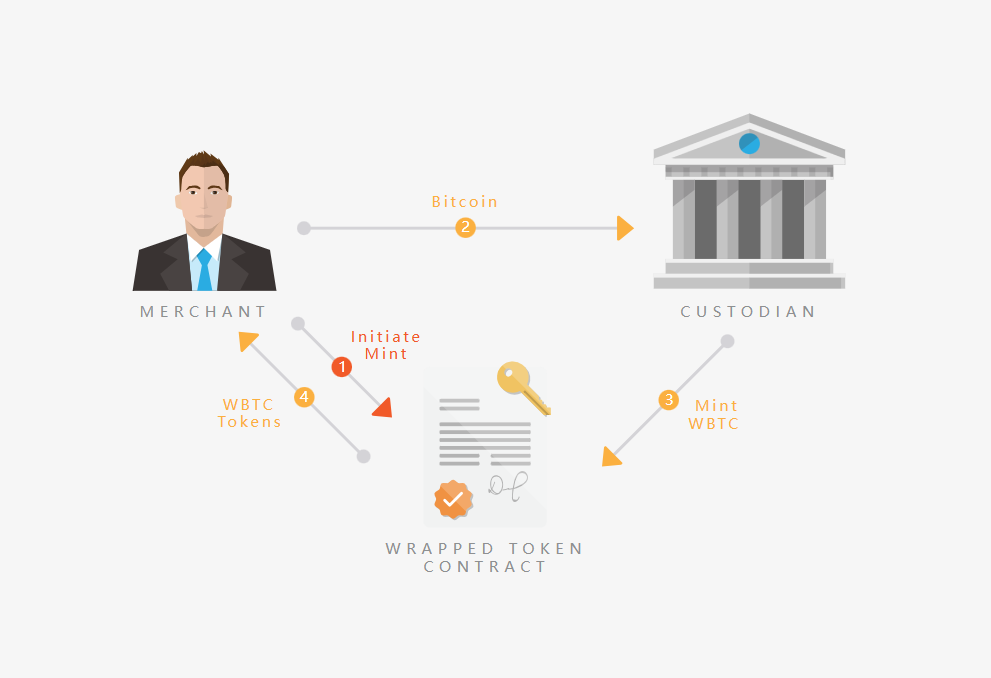
As an ERC20 token on Ethereum backed 1:1 by fully collateralized Bitcoin, WBTC operates via a consortium model, somewhat akin to a traditional two-tier banking system. Between the custodian (previously only BitGo) and end users exist “merchants” (authorized, multiple parties).
The custodian receives and securely holds deposited Bitcoin, then mints an equivalent amount of WBTC tokens upon receipt, releasing them to designated Ethereum addresses; the reverse burn process works similarly.
Merchants act as retail intermediaries, directly serving users by conducting required KYC/AML checks, verifying identities, and facilitating WBTC purchases and redemptions—thereby acting as a bridge that significantly enhances WBTC’s circulation and trading in the market.
Source: WBTC Official Website
This means the custodian fundamentally determines the credibility of WBTC minting, burning, and custody—it is a completely centralized entity. Users must fully trust that the custodian will not engage in fraudulent activities and will strictly adhere to rules for issuing and destroying WBTC.
For example, if the custodian receives 100 BTC but issues 120 WBTC, or re-pledges the held BTC for other uses, it undermines the entire system’s balance and foundational trust.
Particularly concerning is potential over-issuance, which could decouple WBTC’s value from its actual Bitcoin backing, causing market chaos, investor panic, and potentially collapsing the entire stablecoin mechanism.
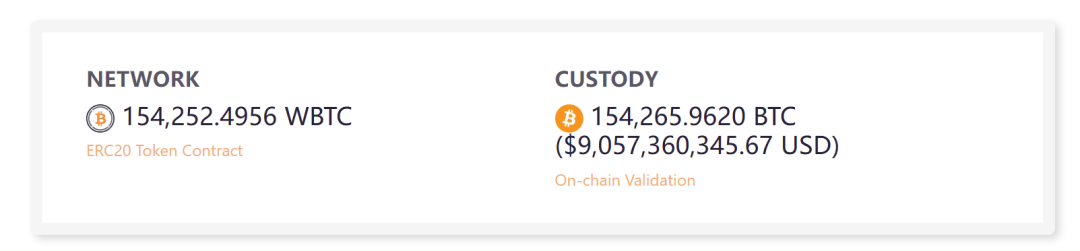
Until now, BitGo was the sole custodian of WBTC. As a well-established crypto custodian, BitGo had largely passed the test of time and market conditions, providing relatively stable support for WBTC’s growth. Data shows over 154,200 WBTC have been issued network-wide, valued at more than $9 billion—evidence of market confidence in BitGo.
Source: WBTC Official Website
In essence, the crisis stems from transferring WBTC’s reserve asset multi-sig authority from BitGo to a joint venture controlled by Justin Sun. Given the centralized nature of the model where trust hinges entirely on the custodian’s reliability—and given widespread distrust toward Justin Sun—the market reaction was inevitable.
No matter how much Justin Sun reassures the public about WBTC’s security mechanisms, for many crypto investors, the principle of “not standing beneath a crumbling wall” seems deeply ingrained—prompting large-scale withdrawals by whales like Shen Yu.
This incident highlights WBTC’s inherent centralization risks, prompting calls for decentralized alternatives to reduce overreliance on centralized custodians. Especially through blockchain technology, reducing single points of failure and human manipulation can enhance the safety and reliability of BTC-backed stablecoin systems.
The Rise and Fall of Decentralized BTC Projects
Since the previous bull cycle, various decentralized BTC stablecoin solutions have emerged as key innovation areas. Projects like renBTC and sBTC surged in popularity, becoming vital conduits for Bitcoin to enter DeFi ecosystems, channeling large BTC capital into Ethereum and unlocking diversified yield opportunities for BTC holders.
But after successive market cycles, most once-prominent projects have since collapsed.
First, renBTC—the most prominent decentralized alternative to WBTC—represented a fully decentralized BTC stablecoin solution. Its issuance process involved users depositing native BTC into a designated RenBridge gateway as collateral, with RenVM using smart contracts to issue equivalent renBTC on Ethereum.
The project also had close ties to Alameda Research (which actually acquired the Ren team), a notable feature that became a double-edged sword. When FTX collapsed, Ren inevitably suffered severe consequences—not only losing operational funding but also experiencing massive capital outflows.
Despite attempted recovery efforts, the latest official update from the Ren Foundation dates back to September 2023. At this point, the project is effectively brain-dead.
Next, sBTC by Synthetix was a Bitcoin synthetic asset generated through SNX staking, and was once a major decentralized BTC-pegged token. However, in early 2024, Synthetix fully deprecated non-USD spot synthetic assets on Ethereum, including sETH and sBTC, preventing broader adoption across DeFi.
The most interesting currently active project is Threshold Network’s tBTC. Yes, it evolved from the well-known tBTC of Keep Network—Threshold Network being the merged entity of Keep Network and NuCypher.
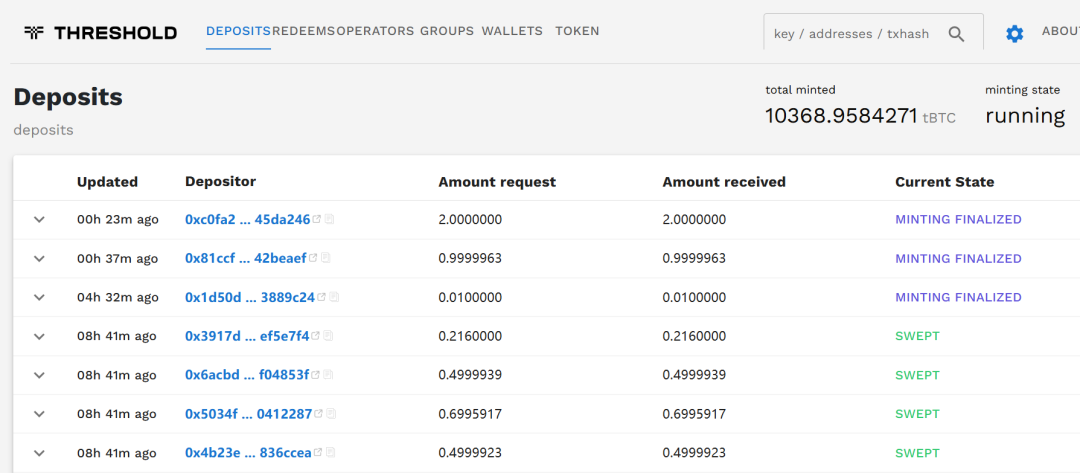
tBTC replaces centralized intermediaries with a randomly selected group of node operators on the network. These operators jointly secure deposited Bitcoin using Threshold cryptography—put simply, user funds are controlled by majority consensus among operators.
At the time of writing, tBTC has a total supply exceeding 10,000 tokens, valued at nearly $600 million—up from fewer than 1,500 six months ago, showing rapid growth.
Source: Threshold Network
In summary, competition among these models centers on asset security. This WBTC controversy has exposed growing demand for decentralized stablecoins. Whether tBTC or similar future projects, they must continue improving their decentralized designs while ensuring asset security to meet market and user expectations.
A New Solution via Bitcoin L2?
In fact, whether today’s WBTC and tBTC, or past projects like renBTC and sBTC, they all share one common trait: they are ERC20 tokens.
The reason is both simple and unavoidable: only by bridging to the Ethereum ecosystem and leveraging its rich DeFi applications can Bitcoin’s liquidity be effectively unlocked. In a sense, Bitcoin—with a market cap of $1.16 trillion (as of CoinGecko data on August 15, 2024)—remains crypto’s largest “dormant capital pool.”
Hence, starting with DeFi Summer in 2020, WBTC and renBTC became primary attempts to unlock Bitcoin liquidity: users stake BTC to receive wrapped tokens, bridging liquidity into the Ethereum ecosystem to participate in DeFi and other on-chain use cases via integration with Ethereum.
This reliance on Ethereum persisted until 2023, when the Ordinals-fueled boom ignited a resurgence in the Bitcoin ecosystem—finally offering a new path forward. Bitcoin Layer 2s now offer new possibilities, enabling users to directly engage in smart contract applications—including staking, DeFi, social platforms, and even complex financial derivatives—on Bitcoin-based L2s, greatly expanding Bitcoin’s utility and value.
Take Stacks’ sBTC (same name as Synthetix’s sBTC) as an example: a decentralized 1:1 Bitcoin-backed asset allowing BTC to be deployed and moved between Bitcoin and the Stacks L2, and used directly as gas in transactions without needing additional cryptocurrencies.
Theoretically, sBTC offers higher security than traditional wrapped tokens on Ethereum, as its security is partially guaranteed by Bitcoin’s hashing power—reversing transactions would require attacking Bitcoin itself.
In this regard, sBTC introduced by Bitcoin L2s like Stacks serves as a partial replacement for the traditional “wrapped token + Ethereum” model, introducing smart contracts into the Bitcoin ecosystem and bringing Bitcoin into DeFi in a decentralized manner.
As Bitcoin L2s continue evolving with technological innovation, new models like sBTC may gradually erode the market share of wrapped tokens such as WBTC, further enhancing Bitcoin’s liquidity and application scope.
Conclusion
Looking back, the “wrapped token + Ethereum” model since 2020 hasn’t scaled significantly, attracting limited BTC inflows—making it merely a version 1.0 approach to unlocking Bitcoin liquidity.
To be fair, if we treat Bitcoin simply as a high-quality multi-trillion-dollar asset pool, there may be no need to reinvent the wheel with Bitcoin L2s. The existing EVM-based ecosystem and DeFi use cases enabled by “wrapped tokens + Ethereum” might suffice. Indeed, most current Bitcoin L2 logic isn’t fundamentally different from earlier methods of wrapping BTC into ERC20 tokens like tBTC or renBTC for use in EVM ecosystems.
Yet from the perspective of native security and maximizing Bitcoin’s ecosystem value, the emergence of Bitcoin L2s holds significant importance: better securing Bitcoin assets and keeping value within the Bitcoin ecosystem rather than letting it leak entirely into Ethereum’s domain.
Join TechFlow official community to stay tuned
Telegram:https://t.me/TechFlowDaily
X (Twitter):https://x.com/TechFlowPost
X (Twitter) EN:https://x.com/BlockFlow_News
 白话区块链
白话区块链









