








Over $200 million liquidated in crypto market; what are the reasons behind the flash crash?
TechFlow Selected TechFlow Selected
Over $200 million liquidated in crypto market; what are the reasons behind the flash crash?
Crypto and stock markets face "mixed fortunes," with declining demand for leveraged long BTC futures and stablecoins, potentially leading to a drop in Bitcoin's price.
 Navigating Web3 tides with focused insights
Author: Felix, PANews
Overnight, the calm price movements of recent days abruptly ended as cryptocurrencies such as Bitcoin and Ethereum suddenly dropped. Bitcoin fell to its lowest level since early August market panic, dipping close to $56,000. This decline triggered a new wave of liquidations in crypto positions—primarily longs—turning the broader market red.
According to Coinglass data, liquidations reached $222 million over the past 24 hours (as of 11:30 on August 16), with $175 million in long positions liquidated, including $161 million within the last 12 hours. Bitcoin accounted for the highest liquidation volume, exceeding $79 million in the past day, followed by Ethereum at approximately $70 million.
The market has since recovered slightly, with Bitcoin trading around $58,000, Ethereum near $2,580, and SOL hovering around $140.
Leveraged Long BTC Futures and Declining Stablecoin Demand May Be Behind the Drop
At present, there is no obvious catalyst for the sharp decline. U.S. equities surged following Wednesday evening's latest Consumer Price Index (CPI) report, while Bitcoin and Ethereum experienced significant volatility, suggesting the drop may not be tied to macroeconomic factors. Some analysts believe declining demand for leveraged long BTC futures and stablecoins contributed to the price drop.
Since August 8, Bitcoin has been trading in a narrow range, unable to break above $62,000, while consolidating support at $58,000. This consolidation reflects growing uncertainty among traders, especially given that BTC futures funding rates remain negative—indicating weak leveraged demand from buyers.
In addition, on August 15, USDT traded at a 0.2% discount in China, marking the lowest level for this indicator in three months, signaling weakening demand for cryptocurrencies. This stands in stark contrast to August 6, when traders were paying a 2% premium for USDT.
Based on BTC derivatives metrics and stablecoin demand in China, regaining the $62,000 level appears difficult. However, historical data shows that retail traders typically react to market moves rather than anticipate them, so a breakout cannot be entirely ruled out.
Analysts Bearish on Ethereum
Coincidentally, prior to the market plunge, some analysts had already turned bearish on Ethereum, with predictions it could reach new lows near $1,600.
McKenna, partner at Arete Capital, wrote in an X post on August 15: "I don't see ETH breaking through $2,800–$2,900; instead, I expect it to trade sideways during parts of August and September."
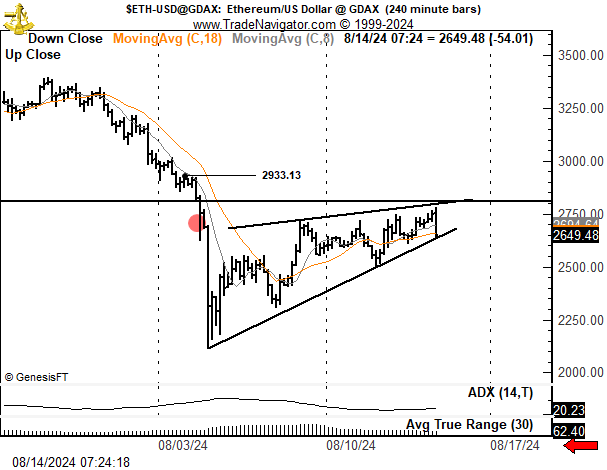
Meanwhile, analyst Peter Brandt noted two potential scenarios for ETH based on chart patterns: a five-month rectangle and a rising wedge. The first scenario involves ETH rising above $2,960. The second sees the rising wedge pattern collapsing into a bearish continuation, pushing ETH down to $1,650—the downside target of the rectangle pattern.
Bitcoin Shows 'Bearish Crossover'
Anonymous cryptocurrency trader Mags wrote in an X post: "A bearish crossover has appeared on Bitcoin’s daily chart, with the 50-day moving average falling below the 200-day MA, signaling short-term weakness." This is the second bearish crossover since Bitcoin bottomed at $15,500. The previous one occurred in September 2023, when prices hovered around $25,000. After several weeks of sideways movement, prices reclaimed the moving averages, leading to a bullish crossover and a strong upward rebound.
Tony Sycamore, market analyst at IG, added: "Bitcoin needs to reclaim the 200-day moving average to stabilize and open the door for testing resistance near the trend channel around $70,000."
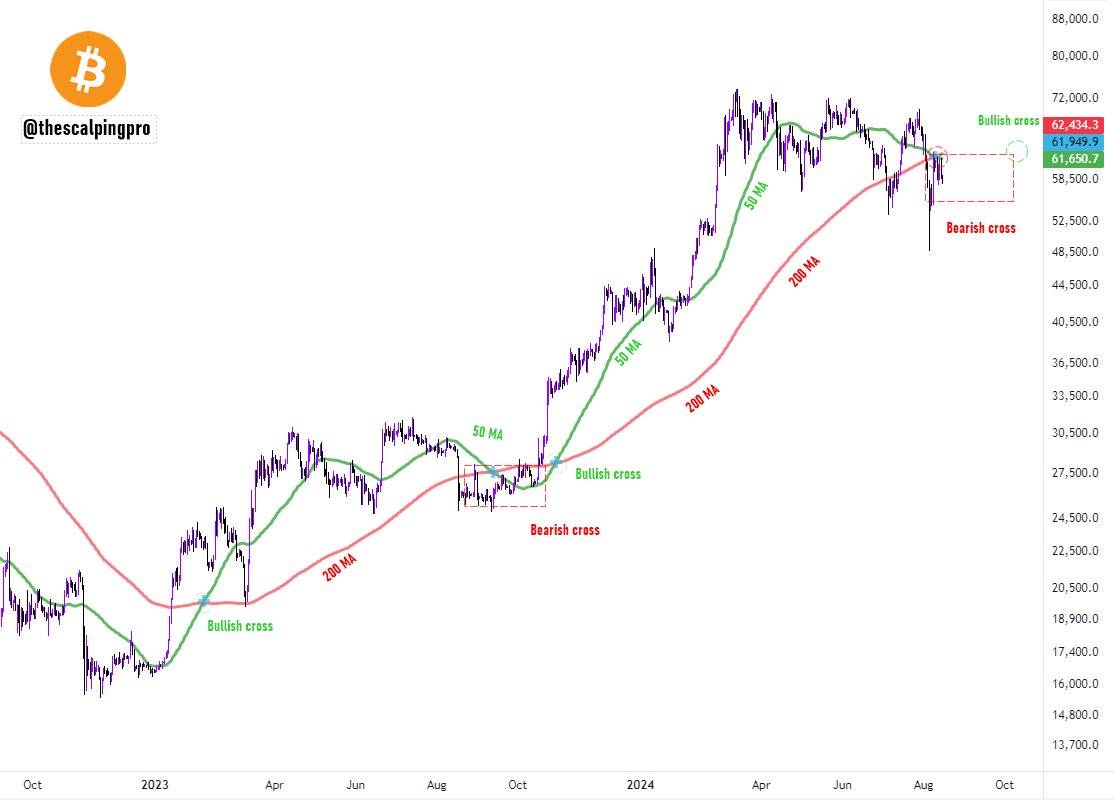
However, trader Mags noted that death crosses have historically been positive signals. Each time this pattern occurred in the past, Bitcoin rose about 50% four months later.
In September 2023, Bitcoin’s 50-day MA crossed below the 200-day MA at a price of $26,578. Just four months later, the price increased by 49% to $39,518.
In July 2021, the 50-day MA was at $34,671, while the 200-day MA stood at $44,680. Again, just four months after the crossover, Bitcoin surged 54% to $54,813.
Despite Market Downturn, Positive Catalysts Continue to Emerge
It's understandable that bulls are frustrated with recent price action, as positive catalysts continue to emerge without corresponding price reactions.
One key positive driver is the rebound in U.S. equities. The stock market rally is partly attributed to the near-certainty of an upcoming Fed easing cycle. For over two weeks, short-term rate markets have priced in a 100% probability of the Fed's first rate cut occurring in September. While past monetary easing cycles have proven beneficial for cryptocurrencies, prices have yet to respond in this cycle.
Additionally, U.S. inflation in July dropped to 2.9%, the lowest annual rate since 2021. Meanwhile, Preston Caldwell, chief U.S. economist at Morningstar, stated Thursday that multiple analysts predict the Fed will begin implementing "aggressive" rate cuts starting in September to stimulate the U.S. economy.
U.S. markets have also shown strength recently, with the Nasdaq Composite Index rising 2.34% over the past 24 hours, and the S&P 500 and Dow Jones Industrial Average up approximately 1.61% and 1.39%, respectively. Both the Nasdaq and S&P 500 have now returned to levels seen before the early-August market jitters.
Another seemingly positive catalyst is the accelerating institutional adoption of Bitcoin. Nate Geraci, president of ETF Store, noted that the latest batch of 13F filings (as of June 30) shows 1,924 institutional holders in spot Bitcoin ETFs. Despite Bitcoin’s price decline from April to June, this number exceeds the first-quarter figure of 1,479.
Moreover, an increasing number of public companies are tapping capital markets to boost their Bitcoin holdings. Marathon Digital (MARA)—already involved in Bitcoin mining—raised $300 million in convertible bonds this week and immediately used the proceeds to purchase over 4,000 Bitcoins at around $59,000 each. Semler Scientific (SMLR), a medical device manufacturer that announced its Bitcoin treasury plan months ago, received SEC approval this week to proceed with financing worth over $150 million, with proceeds earmarked for further Bitcoin purchases.
Join TechFlow official community to stay tuned
Telegram:https://t.me/TechFlowDaily
X (Twitter):https://x.com/TechFlowPost
X (Twitter) EN:https://x.com/BlockFlow_News
 PANews









