Stablecoin Landscape in Flux? Tether Faces Regulatory and Competitive Pressures as New Players Enter the Arena
TechFlow Selected TechFlow Selected
Stablecoin Landscape in Flux? Tether Faces Regulatory and Competitive Pressures as New Players Enter the Arena
Under fierce pressure from both new and established players, the top-ranking "big spender" Tether is accelerating its diversified business development.
 Navigating Web3 tides with focused insights
By Nancy, PANews
Stablecoins are the cornerstone of liquidity in the crypto ecosystem, making competition exceptionally fierce. Amid aggressive moves by both new and established players, Tether—the long-time market leader—is accelerating its diversification efforts, while regulatory trends continue to reshape the market landscape.
New Profit Highs Driven by Traditional Assets, Accelerating Diversified Business Expansion
Tether remains the "cash cow" of the stablecoin space. According to Tether's Q2 audit report, Tether Holdings achieved a net profit of $5.2 billion in the first half of 2024, setting a new all-time high. Its net operating profit for Q2 alone reached $1.3 billion—the highest quarterly profit in its history. This performance puts Tether’s earnings close to those of major traditional financial giants: approximately 72.5% of Goldman Sachs’ H1 profit ($7.17 billion) and 80.2% of Morgan Stanley’s ($6.48 billion). Remarkably, Tether achieves this with only about 100 employees—averaging $50 million in profit per employee over six months—compared to roughly 45,000 at Goldman Sachs and 80,000 at Morgan Stanley.
However, Tether's impressive profitability primarily stems from high-yield traditional assets. Per its disclosures, Tether holds over $97.6 billion in U.S. Treasury securities—the highest level ever—and ranks among the top three global buyers of short-term U.S. Treasuries, exceeding the national holdings of countries like Germany, the UAE, and Australia. With rising U.S. interest rates driving higher Treasury yields, Tether’s income has surged accordingly.
Despite USDT maintaining a dominant position—holding nearly 70% of the market share and serving over 300 million users globally—it faces increasing pressure from competitors. According to DeFiLlama, the total stablecoin market cap rose nearly 28.4% year-to-date (as of August 15) to $166.96 billion. During this period, rival stablecoins grew faster than USDT’s 27.2% increase: USDC expanded by ~42.3%, USDe by over 239.5%, and PYUSD by nearly 227.2%.
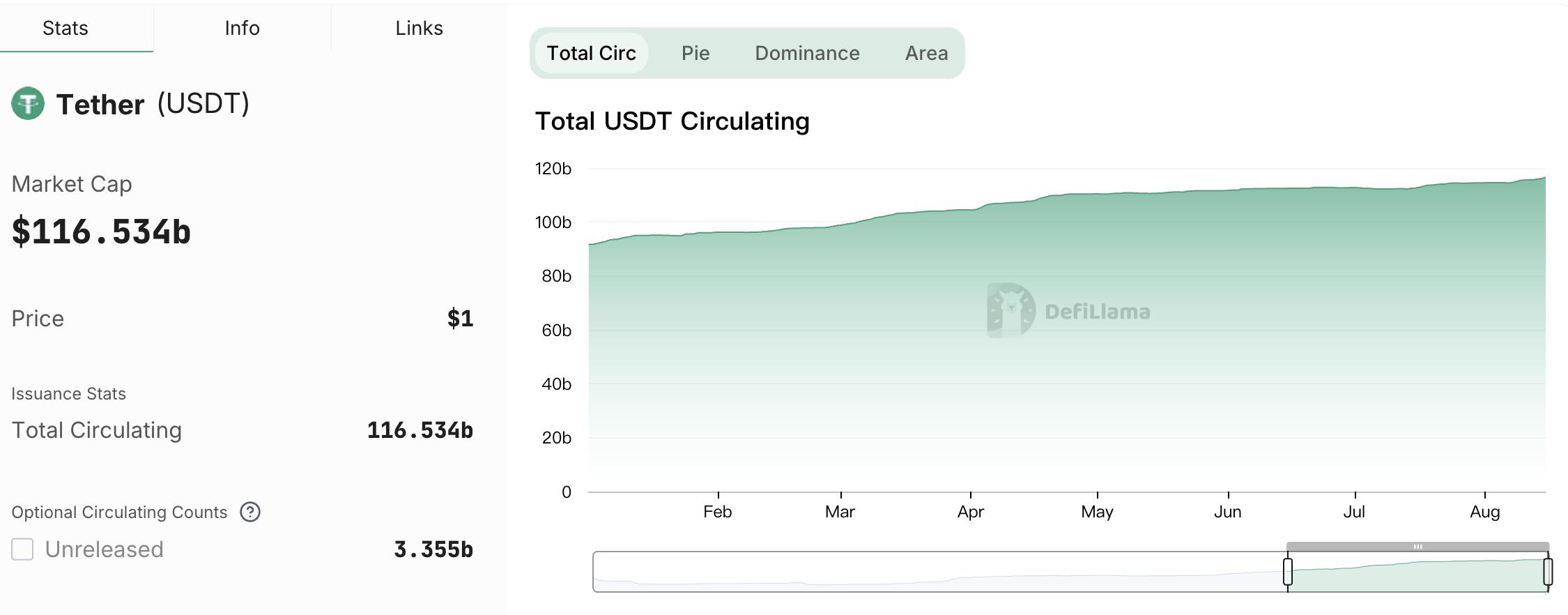
In response, Tether has rolled out strategic adjustments. Within the stablecoin domain, it has refined cross-chain support strategies, prioritizing community-driven blockchains. In June, it launched XAU₮, a new synthetic dollar platform backed by physical gold stored in Switzerland through TetherGold’s over-collateralization. However, CoinGecko data shows that as of August 15, XAU₮’s market cap stood at $600 million—just 0.5% of USDT’s size. Additionally, Tether has partnered on various USDT-related initiatives to expand reach, such as teaming up with Uquid to launch a “1 USDT Store,” which recorded over 47,000 transactions within just ten days of launch.
On another front, Tether is aggressively pursuing its vision of becoming a “builder of financial ecosystems.” Since announcing in April the creation of four new divisions—data, finance, energy, and education—to expand beyond USDT, Tether has launched a series of rapid initiatives.
In emerging sectors like AI, Tether is not only developing decentralized AI models but has also invested in biotech firm Blackrock Neurotech and data center operator Northern Data Group, committing more than $2 billion in total.
This week, Tether CEO Paolo Ardoino emphasized that Tether is financially robust, having generated approximately $11.9 billion in profits over the past two years. The company currently earns a 5.5% return on its reserves and plans to enter uncharted territories like AI to compete with tech giants including Microsoft, Google, and Amazon. Ardoino also recently revealed plans to launch a new open-source project, though few details were shared—he stressed it will be a key component of Tether’s future ecosystem.
In education, Tether has formed partnerships to promote blockchain and AI learning: collaborating with the Vietnam Blockchain Association, signing an MoU with BTguru to advance digital asset education in Turkey, and launching a joint “Blockchain and Digital Assets” education program with National Taipei University of Technology.
Tether is also intensifying investments across its ecosystem, with its investment arm expecting to deploy over $1 billion in the next 12 months. Examples include a $100 million investment to acquire shares in publicly listed miner Bitdeer, becoming its second-largest shareholder, and a $18.75 million strategic investment in regulated blockchain financial institution XREX Group to boost USDT-based cross-border payments in emerging markets and develop innovative compliance technologies.
Potential EU Exit Due to New Stablecoin Rules, Tether Increases Compliance Spending
Regulatory compliance remains a persistent challenge for Tether. With the European Union’s Markets in Crypto-Assets (MiCA) regulations for stablecoins now in effect, any stablecoin processing over one million transactions daily or exceeding €200 million ($215 million) in value must obtain authorization to operate in the EU—posing significant compliance hurdles for major stablecoins like USDT.
As a result, several crypto platforms have taken action: for example, exchange Bitstamp delisted Tether’s euro-pegged stablecoin EURT and other stablecoins. A blog post from the Bretton Woods Committee suggested non-compliant stablecoins could “disappear” from the EU market in the medium term. JPMorgan noted in a research report: “Increasingly stringent stablecoin regulation could pose a major threat to Tether’s market dominance. Failure to comply may undermine its leading position.”
According to Tether’s transparency page, as of August 15, the circulating supply of EURT exceeded €28.26 million, making it the second-largest after USDT. In contrast, Circle—USDT’s main competitor—has already become the first global stablecoin issuer licensed under MiCA in the EU.
Ardoino responded by stating that Tether is formulating a formal strategy for the European market, but criticized the regulation, arguing it threatens not only stablecoins but the broader banking system. MiCA mandates that at least 60% of a stablecoin’s reserves be held in EU-based bank accounts—a rule Ardoino warns could heighten systemic risk. Given banks operate on fractional reserves, they remain vulnerable to runs; he cited the 2023 collapse of Silicon Valley Bank as a cautionary tale, suggesting the requirement could negatively impact large-scale stablecoin issuers.
In practice, Tether has been ramping up compliance efforts. Beyond previously reported increases in lobbying expenditures amid tightening global regulation, Tether recently announced plans to double its workforce over the next year to strengthen capabilities in compliance and other areas, aiming for around 200 employees by mid-2025.
More Players Enter the Stablecoin Arena
The stablecoin赛道 is no stranger to competition. Recently, a wave of new entrants—from native crypto protocols to traditional financial institutions—have entered the race.
sGYD
The stablecoin project Gyroscope announced the launch of Savings GYD (sGYD), a yield-bearing version targeting annual returns of 12%-15% for token holders, depending on market conditions.
RLUSD
Ripple has begun beta testing its new USD-pegged stablecoin RLUSD on both the XRP Ledger (XRPL) and Ethereum mainnet, with plans to expand to additional blockchains and DeFi protocols over time. RLUSD is fully backed 1:1 by cash deposits, short-term U.S. government bonds, and other cash equivalents. These reserves will be audited by third-party accounting firms, with monthly attestations published by Ripple.
sGYD
DeFi protocol Gyroscope also announced this month the launch of its yield-generating stablecoin variant, Savings GYD (or sGYD), aiming to deliver 12%-15% annualized yield to holders. Yields are derived from assets backing the tokens, which are deposited into isolated vaults utilizing various DeFi investment strategies.
HKDR
HKDR, a Hong Kong dollar-pegged stablecoin launched by OSL Group, will integrate with Chainlink’s Cross-Chain Interoperability Protocol (CCIP), enabling secure and reliable cross-chain transfers and expanding user access. OSL will leverage Chainlink’s Proof of Reserves (PoR) to provide reliable on-chain verification of HKDR’s reserves. OSL’s subsidiary, OSL Innovation Limited, has been admitted into the Hong Kong Monetary Authority’s (HKMA) stablecoin issuer sandbox program, where it will test multiple use cases for HKDR, including digital asset trading and cross-border trade payments.
Jingdong Stablecoin
In July, JD.com announced plans to issue a Hong Kong dollar-pegged cryptocurrency stablecoin in Hong Kong. The JD stablecoin, pegged 1:1 to the HKD, will be issued on public blockchains and backed by highly liquid and trusted assets held securely in segregated accounts at licensed financial institutions. Regular disclosures and audit reports will ensure reserve integrity. JD Blockchain Tech (Hong Kong) is among the participants in the HKMA’s stablecoin issuer sandbox initiative.
XUSD
XUSD is a USD-pegged stablecoin launched by StraitsX, a digital asset payment infrastructure provider. It holds an MPI license from the Monetary Authority of Singapore (MAS), allowing it to offer comprehensive digital payment services.
USDH
DeFi protocol Hermetica launched USDH in July, a Bitcoin-backed stablecoin redeemable at any time for $1 worth of Bitcoin. Designed as a non-custodial solution, it aims to eliminate Bitcoin users’ reliance on centralized exchanges or fiat-backed stablecoins on alternative chains.
USBD
USBD is a Bitcoin-backed stablecoin developed by Bima Labs. It can be minted by providing Bitcoin liquidity staking and restaking tokens as collateral, accepting collateral from multiple blockchains including Bitcoin, Bitcoin layer-2 networks, EVM-compatible chains, and Solana. Bima Labs announced in July a $2.25 million seed round led by Portal Ventures.
Beyond these, entities such as French financial institution SG Forge, stablecoin firm StablR, European asset management giant DWS, and crypto market maker DWF are either preparing for or have already obtained stablecoin issuance licenses. As regulatory battles unfold and new entrants accelerate their entry, the stablecoin landscape is poised for further transformation.
Join TechFlow official community to stay tuned
Telegram:https://t.me/TechFlowDaily
X (Twitter):https://x.com/TechFlowPost
X (Twitter) EN:https://x.com/BlockFlow_News
 PANews