Tether's 10th Anniversary: Earning Nearly $30 Million Daily, Yet Still Facing the Risk of "Being Eliminated"?
TechFlow Selected TechFlow Selected
Tether's 10th Anniversary: Earning Nearly $30 Million Daily, Yet Still Facing the Risk of "Being Eliminated"?
The stablecoin space, this "lucrative chunk," has never lacked predators.
 Navigating Web3 tides with focused insights
Author: flowie, ChainCatcher
Editor: Marco, ChainCatcher
Last week, Tether released its Q2 2024 financial report. Tether's net operating profit reached $1.3 billion in Q2, with a total profit of $5.2 billion for the first half of 2024—setting a new record high.
A six-month profit of $5.2 billion equates to nearly $30 million earned per day—a figure unmatched by many public companies. However, despite its stellar earnings performance, Tether may not be as strong as the financials suggest.
On June 30, the EU’s newly enacted MiCA regulation took effect, meaning Tether’s stablecoin officially faces delisting across Europe. Major crypto exchanges including Binance, OKX, Uphold, and Bitstamp have announced the removal of nearly all USDT trading pairs in the European region due to this legislation.
In contrast, rival Circle has already obtained legal authorization under MiCA to sell its two stablecoins, USDC and EURC, throughout Europe.
Europe is the largest region in terms of cryptocurrency adoption. According to a recent study by CoinWire, cumulative crypto trading volume in Europe accounts for 37.32% of the global market.
Circle is now capturing a significant share of market previously dominated by Tether. A CCData report shows that after the European regulations took effect, trading volume for USDC pairs on centralized exchanges increased by over 48%.
Since its founding in 2014, Tether has weathered multiple crypto collapses and regulatory FUDs, growing into a behemoth. But is Tether now “too big to fail,” or does it still face a real risk of being pushed out?
USDC trading volume repeatedly surpasses USDT
As the bull market gains momentum, stablecoin market capitalization continues to rise. According to the latest report from CCData Research, stablecoin markets have seen ten consecutive months of growth as of the end of July.
USDT, the largest stablecoin by market cap, is also growing and dominates nearly 70% of stablecoin trading. However, an increasingly important signal is that USDC—the main competitor to USDT—has seen substantial increases in both market cap and trading volume since first exceeding USDT in monthly trading volume in December 2023. In fact, USDC has repeatedly far surpassed USDT in trading volume during 2024.
Data jointly released by Visa and Allium Labs shows that on March 24, 2024, USDC’s weekly closing trading volume was almost five times that of USDT. On April 21, 2024, USDT’s weekly trading volume shrank to $89 billion, while USDC surged to $455 billion.
According to Kaiko’s analysis, the rising popularity of USDC may stem from users’ increasing adoption and preference for regulated stablecoins.
USDC’s relatively compliant and regulated nature makes it the preferred choice for large institutional clients entering the crypto space.
This year, BlackRock launched its tokenized fund BUIDL, which is pegged 1:1 to the U.S. dollar and allows investors to hold a yield-generating “security” similar to an interest-bearing stablecoin. To ensure investors can conduct 24/7/365 subscriptions and redemptions, BlackRock partnered with Circle to establish a smart contract-controlled USDC liquidity pool.
After the European regulations took effect in July, USDC’s trading volume saw another surge. CCData data shows that after centralized exchanges delisted USDT pairs in Europe, trading volume for USDC pairs rose 48.1% to $135 billion—reaching a record high.
Beyond centralized exchanges, USDC’s growth on several active public blockchains this year is also noteworthy.
In August last year, Circle received investment and support from Coinbase, which announced the launch of USDC on six new chains.
On Base, the blockchain developed by Coinbase, USDC holds 91% of the total stablecoin supply. Base does not support USDT. Data from June 18 showed that USDC’s supply on Base grew by over 1000% in the previous 90 days.
On Solana, Bankless shared a set of data on X indicating that “USDC accounts for approximately 70% of the total stablecoin supply on Solana, and the trading volume ratio between USDC and USDT on Solana this week was 19:1.”
Bankless attributed USDC’s dominance on Solana to strategic initiatives by Circle and the Solana Foundation to incentivize developers and promote exchange integrations.
For example, platforms within the Solana ecosystem such as Solend Protocol and Superteam distribute developer rewards in USDC, while Circle’s Cross-Chain Transfer Protocol (CCTP) and Web3 services incentives on Solana are further driving USDC adoption.
After the European crisis, is regulatory compliance still a potential time bomb?
Criticism of Tether over regulatory compliance issues has never ceased.
Besides the EU’s MiCA regulation, the U.S. Senate’s proposed Lummis-Gillibrand Payment Stablecoin Bill introduced in April has also been flagged by multiple institutions as a threat to Tether.
The Lummis-Gillibrand Payment Stablecoin Bill requires stablecoins with issuance exceeding $1 billion to comply with banking-level regulations and encourages greater bank participation in the stablecoin market.
S&P Global Ratings pointed out that most USD-pegged stablecoin issuers—including USDT, the market leader—are currently not subject to U.S. regulations. However, if the bill passes, it could bring more banks into the stablecoin space and challenge Tether’s dominant position.
A recent JPMorgan report also noted that U.S. crypto regulatory enforcement has intensified in recent months. Ahead of the upcoming presidential election, the payment stablecoin bill stands a good chance of passing—favoring compliant U.S.-based stablecoins and threatening Tether’s leadership.
Deutsche Bank’s report has also raised questions about Tether’s operational stability and transparency.
Although Tether’s transactions mainly occur in emerging markets outside the U.S., America remains one of the most critical markets in crypto. If Tether fails to adapt, it risks losing access to this vital market.
Whether driven by anticipation of regulatory trends or competitive concerns, several crypto founders have warned this year that Tether may be the next target of regulatory crackdowns.
In May, Ripple CEO Brad Garlinghouse revealed on a podcast that after the collapse of FTX and the imprisonment of former CEO SBF, followed by Binance’s former CEO CZ being convicted and sentenced, the SEC’s next regulatory target is Tether.
Brad was subsequently attacked by Tether CEO Paolo Ardoino, sparking a multi-day public feud.
Ripple recently announced its own dollar-pegged stablecoin, leading Paolo to accuse Ripple of spreading false claims as a competitive tactic.
But Brad insisted it wasn’t intentional malice, stating that the U.S. government has clearly signaled its intent to strengthen oversight over USD-backed stablecoin issuers—and as the largest player, Tether is naturally on their radar.
In March, after Arthur Hayes’ family office Maelstrom invested in the new stablecoin protocol Ethena, Arthur published a detailed blog post explaining why the Federal Reserve, U.S. Treasury, and politically connected major U.S. banks want to dismantle Tether.
Arthur argued that Tether’s fully reserved banking model contradicts the Fed’s goal of reducing bank reserves to combat inflation.
Moreover, Tether is simply too big. It is now one of the largest holders of U.S. Treasuries. The growth of Tether and similar crypto-market-focused stablecoins poses risks to the U.S. Treasury market.
Additionally, Tether is too profitable—it threatens to draw competition from traditional banks.
An analyst at Maelstrom created a speculative balance sheet and income statement for Tether showing that revenue per employee reaches $62 million—profitability that even the eight largest “too big to fail” U.S. banks like JPMorgan struggle to match.
In the coming year, key crypto jurisdictions including Hong Kong, Singapore, Japan, the UK, and the UAE are expected to roll out comprehensive stablecoin regulations.
With global regulations gradually taking shape, whether Tether truly faces an existential threat remains uncertain—for now.
Some argue the U.S. government has no incentive to target Tether.
Glassnode analyst Checkɱate stated that USDT effectively functions as a de facto U.S. CBDC and believes Tether operates with tacit approval from the U.S. government. “USDT absorbs U.S. Treasury debt, thereby supporting U.S. fiscal policy,” he said.
Regarding relations with regulators, Tether CEO Paolo has previously countered Brad by asserting that Tether actively cooperates with law enforcement agencies worldwide.
Over the past three years, Tether has blocked 339 requests, 158 of which came from U.S. law enforcement agencies.
Some believe that just like the U.S. dollar, how USDT is misused matters less than cooperation with authorities; as long as Tether complies with freezing orders, its perceived risk isn’t as high as imagined.
Tether has not made any clear public statements regarding how it plans to respond to Europe’s delisting or other potential threats. However, it appears Tether is attempting to reduce reliance on unilateral U.S. control.
In June, Tether made a strategic investment of $18.75 million in XREX Group, a blockchain-based financial institution focused on compliance.
XREX Group founder Huang Yaowen revealed in a media interview that following this investment, Tether and XREX will collaborate with the Unitas Foundation to launch XAU1.
XAU1 is a unit coin backed by excess reserves of Tether Gold (XAUt) and pegged to the U.S. dollar value, offering stablecoin users a robust financial alternative and an inflation-hedging tool.
The goal of launching XAU1 is to maintain the familiar dollar-denominated pricing system while gradually neutralizing the dollar’s dependence on unilateral U.S. control. “Because Tether clearly understands that the profits earned from U.S. Treasury yields are controlled by the Federal Reserve, not themselves, they’ve decided to use 80–85% of those profits to buy gold from Swiss mints,” Huang explained.
In addition, Tether is seeking growth beyond stablecoins, expanding into areas such as Bitcoin mining, AI, and education.
To cope with regulatory pressure, Tether is also increasing its lobbying expenditures. Data from nonprofit OpenSecrets shows that iFinex, Tether’s parent company, increased its lobbying spending by over 150% in 2023.
Stablecoins: a lucrative prize with no shortage of predators
Beyond regulatory risks, Tether also faces no shortage of challengers.
At the beginning of last year, BUSD—the long-standing third-largest stablecoin—was abruptly removed from the market due to pressure from the U.S. SEC. Yet the stablecoin space quickly welcomed several replacements.
Web2 payments giant PayPal launched its stablecoin PYUSD, while Binance’s FDUSD emerged rapidly as a potential successor to BUSD. Meanwhile, established DeFi blue-chips like Curve, Aave, and Frax are actively launching native stablecoins, and new yield-bearing stablecoins leveraging LSD and RWA have also emerged.
This year, BlackRock’s tokenized fund BUIDL—similar to an interest-bearing stablecoin—also signals institutional interest in the highly profitable stablecoin business.
Additionally, some innovative stablecoin protocols continue to gain traction. USDe from Ethena is a new type of stablecoin backed by Ethereum derivatives. Since launching on mainnet in February, it has achieved a market cap exceeding $3 billion within six months, making it the fourth-largest stablecoin after Dai.
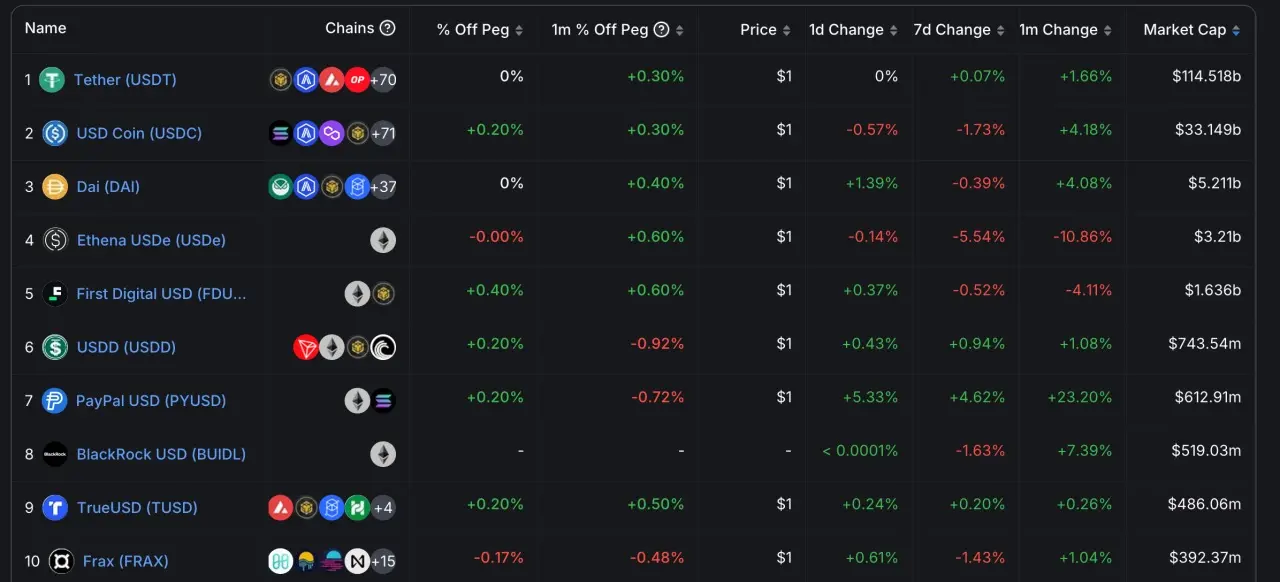
Ethena’s investor roster reads like a who’s who of the industry. In February, Ethena secured a $14 million funding round led by Dragonfly, Brevan Howard Digital, and Arthur Hayes’ family office Maelstrom, with participation from PayPal Ventures, Franklin Templeton, Avon Ventures, Binance Labs, Deribit, Gemini, and Kraken, reaching a $300 million valuation. Last July, Ethena had already raised $6.5 million in a round led by Dragonfly.
This perhaps reflects a broader sentiment among market players and investors: although Tether and Circle currently dominate the stablecoin landscape, the market structure remains highly susceptible to disruption. Issues around compliance, centralization risk, and how yields are distributed to users continue to create opportunities for new entrants to challenge the status quo.
Join TechFlow official community to stay tuned
Telegram:https://t.me/TechFlowDaily
X (Twitter):https://x.com/TechFlowPost
X (Twitter) EN:https://x.com/BlockFlow_News
 ChainCatcher 链捕手