








HTX Ventures Releases 2024 Mid-Year Investment Report, Focusing on Six Investment Areas
TechFlow Selected TechFlow Selected
HTX Ventures Releases 2024 Mid-Year Investment Report, Focusing on Six Investment Areas
Despite the market slowdown, we remain confident in the second half of 2024. By adhering to our long-term strategy and supporting front-end development, we have already seen the positive flywheel effect brought by a successful business model and ecosystem.
 Navigating Web3 tides with focused insights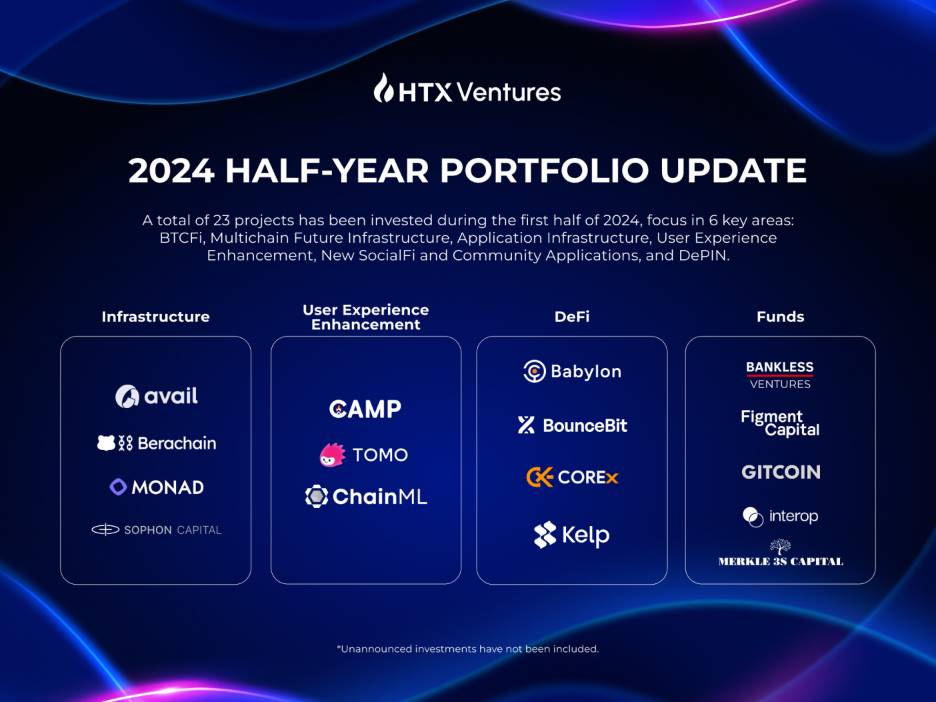
Overview
In the first half of 2024, the cryptocurrency market experienced significant growth and innovation. This report outlines HTX Ventures’ strategic investments and partnerships driving blockchain technology and Web3 ecosystem development, while providing insights into investment opportunities for the second half of 2024.
“HTX Ventures achieved outstanding results in the first half of 2024. We actively sought investment opportunities and carefully selected projects that support critical ecosystems, user experience, and infrastructure—elements we believe are essential for the long-term development of Web3,” said a managing partner at HTX Ventures. “Despite market slowdowns, we remain confident about the second half of 2024. By adhering to our long-term strategy and supporting front-end development, we have already observed a positive flywheel effect from successful business models and ecosystems. This success will inspire more entrepreneurs, drive innovation, and ultimately lead to a thriving ecosystem over time.”
HTX Ventures is the global investment arm of HTX (formerly Huobi), integrating investment, incubation, and research to identify the world’s most talented and innovative teams. HTX Ventures currently supports over 300 projects across multiple blockchain domains, with several high-quality projects already listed on the HTX exchange.
Market Context
Macroeconomic Environment
Since late 2023, the crypto market has seen notable growth throughout the first half of 2024. The approval of Bitcoin ETFs opened the door to traditional finance, injecting substantial liquidity and stabilizing Bitcoin’s price between $60,000 and $70,000, up from an average of $40,000. Additionally, the U.S. SEC's approval of ETH ETFs marks the beginning of the ETF era for cryptocurrencies, significantly lowering the entry barrier for investors. However, this may also bring increased regulatory scrutiny and artificial volatility. As a major risk asset class, crypto ETFs are likely to show stronger positive correlation with other financial markets such as equities and bonds, potentially making their price movements more susceptible to manipulation by Wall Street.
On another front, the Federal Reserve’s interest rate policy continues to heavily influence the crypto market. Interest rates directly affect dollar liquidity—and by extension, stablecoin supply—impacting the volatility of Bitcoin and other major cryptocurrencies. The Fed remains cautious about rate cuts. According to the dot plot and economic projections released after the June 2024 FOMC meeting, one to one-and-a-half rate cuts (around 25 basis points) are expected in 2024, with a projected 100-basis-point reduction in 2025. While lower rates imply looser liquidity, the overall monetary easing will be limited. This could lead to liquidity fragmentation in the crypto market, where capital is diverted away from non-U.S. risk assets and U.S. equities.
Commentary on August 5 Global Market Sell-Off
The current market downturn was triggered by Japan’s rate hike and deteriorating U.S. tech earnings and labor data, leading to excessive pessimism and a flight from risk assets to safe-haven assets—a classic recession trade. However, the U.S. economy has not yet entered an actual recession. More data—including July and August CPI and PCE figures, ISM manufacturing and non-manufacturing indices, and PMI readings—will be needed to clarify the real picture. These upcoming indicators will help determine whether the market’s bearish sentiment is overdone or correctly anticipates a downturn, offering clearer guidance for the Fed’s future monetary decisions. Currently, markets are overly optimistic about rate cuts (pricing in around 100 bps of cuts across three meetings by year-end), but the Fed is unlikely to adjust policy before September (any change would be highly bullish). Moreover, uncertainty is heightened due to the upcoming U.S. election.
Given this assessment, we believe crypto investors should avoid both excessive pessimism and blind selling, as well as chasing rallies. Now is an ideal time to uncover undervalued but high-quality business models. Position sizes should remain moderate, leverage should be avoided, and investors should continuously update their views based on incoming economic data to gain greater conviction.
Project Development
On the development front, Ethereum’s Dencun upgrade in early 2024 enhanced the ETH ecosystem, improving Layer 2 usability and competitiveness while unlocking new opportunities for rollup-based chains. EigenLayer’s innovative business model introduced new use cases and revenue streams for secure networks like Ethereum and sparked renewed exploration of Bitcoin applications. The integration of AI agents with blockchain brings advantages of transparency and automated execution to service requesters, offering a vision of future AI integration.
HTX Ventures 2024 Investment Focus:
In this market cycle, HTX Ventures has actively identified and supported cutting-edge technologies and emerging business models. Driven by a mission to advance blockchain technology, HTX Ventures provides comprehensive support to projects expanding the scope of Web3.
In the first half of 2024, HTX Ventures made 23 strategic investments across infrastructure, DeFi, Bitcoin ecosystem, AI, DePIN, SocialFi, and other sectors, with a strong focus on infrastructure and foundational layer protocols. HTX Ventures is impressed by the growing talent pool within the Web3 developer community, especially collaborations between seasoned Web3 developers and Web2 professionals addressing real-world user needs. We look forward to partnering with passionate teams to build a more user-friendly Web3 ecosystem.
We are watching and believe will continue to deliver returns and momentum in the second half of 2024 are three key areas: BTCFi, multi-chain infrastructure, and user experience enhancement.
BTCFi: Unlocking Value in Network Security and Token Liquidity
Bitcoin Decentralized Finance, or BTCFi, refers to bringing decentralized financial functions into the Bitcoin ecosystem. Bitcoin remains the most decentralized and secure blockchain network. However, due to its lack of smart contract functionality, it cannot host decentralized applications (dApps) like Ethereum or other public chains. As a result, Bitcoin has largely been used as “digital gold” with limited utility beyond holding.
In early 2024, Ordinals and Runes explored new use cases within the Bitcoin ecosystem, demonstrating market interest in expanding Bitcoin’s utility. However, we believe Bitcoin’s potential in DeFi remains largely untapped. Currently, BTCFi’s total value locked (TVL) stands at nearly $1.2 billion, representing only 0.09% of Bitcoin’s total market cap. In contrast, major smart contract platforms show much higher TVL-to-market-cap ratios: Ethereum at 14%, Solana at 6%, and Ton at approximately 3%. Even at a conservative 1% ratio, BTCFi has the potential for tenfold growth.
HTX Ventures focuses on Bitcoin scaling solutions and token staking protocols, which we believe can provide Bitcoin holders with greater flexibility and utility, unlocking the value of Bitcoin currently stored as “digital gold.”
- Inspired by EigenLayer, Babylon builds an infrastructure enabling proof-of-stake (PoS) systems to leverage Bitcoin’s staked capital to enhance their network security. The platform uses a modular design and slashing mechanisms, allowing PoS systems—including blockchains, Layer 2s, data availability (DA) layers, and oracles—to incorporate Bitcoin as a staking and restaking asset.
- While similar in structure to EigenLayer, Babylon’s ecosystem differs significantly. Like EigenLayer, it will spawn numerous LRT, AVS, and DA projects—already seeing dozens such as StakeStone, Uniport, Chakra, Lorenzo, Bedrock, and pSTAKE Finance, reminiscent of last year’s excitement around EigenLayer projects like Renzo and Puffer. However, unlike Ethereum’s ecosystem, which previously had strong narratives in DeFi and Layer 2, Babylon acts as a catalyst directly on Bitcoin’s base layer, activating massive dormant liquidity and potentially accelerating the development of BTC DeFi, increasing capital efficiency. Babylon is vital for revitalizing the Bitcoin ecosystem, serving as a foundational layer for many BTCFi protocols and returning Bitcoin to the DeFi spotlight.
- Unlike Babylon, BounceBit is a centralized Bitcoin restaking infrastructure providing a foundation for various restaking products, backed by regulated custodians Mainnet Digital and Ceffu.
- BounceBit Chain is designed as a showcase for restaking products within the BounceBit ecosystem—a PoS Layer 1 where validators stake both BTC and BounceBit’s native token, creating a dual-token system that leverages Bitcoin’s native security and is fully EVM-compatible. By offering Bitcoin restaking services, it supports key ecosystem infrastructure like cross-chain bridges and oracles. Through its innovative CeFi + DeFi framework, BounceBit enables Bitcoin holders to earn yield across multiple networks while delivering a seamless user experience.
- HTX Ventures was one of the earliest ecosystem partners of Core, a Bitcoin-secured, EVM-compatible blockchain that leverages Bitcoin’s network security to deliver high transaction throughput (TPS) while maintaining decentralization. We believe Core offers one of the best environments for developing BTCFi applications and are working closely with the ecosystem to realize this vision.
This led us to invest in COREx, a flagship V3-style decentralized exchange built on the Core ecosystem. Positioned as the gateway and liquidity hub for Core’s future, COREx stands out for its user-friendly design (requiring minimal learning curve), robust social features, and advanced trading monitoring and AI advisory capabilities.
Multi-Chain Future Infrastructure
Competition among blockchains, especially Layer 1s, remains intense. In the previous cycle, isolated Layer 1s created a zero-sum game—once developers and users committed to a chain, switching became difficult. Without access to other EVM-based Layer 1s or Layer 2s, users often relied on insecure cross-chain solutions like bridges. Except for top-tier chains, most Layer 1s face relatively low user activity, capital flow, and liquidity. Ethereum leads the Layer 1 ecosystem, retaining most of the liquidity and users, but suffers from high fees, low efficiency, and technical bottlenecks.
New Layer 1 developers now embrace a multichain future. While remaining EVM-compatible or interoperable with other Layer 1s, they specialize in solving specific pain points or delivering superior UX in targeted domains. Rather than replacing each other, these chains increasingly complement one another, paving the way toward a more modular and efficient future with smoother base-layer communication.
- Monad is a Layer 1 blockchain platform known for uniquely re-architecting the Ethereum Virtual Machine (EVM) to overcome Ethereum’s throughput limitations, enabling mass adoption of decentralized applications (DApps).
As a representative parallel-EVM Layer 1, Monad offers massive scalability—processing more transactions in less time, reducing fees and congestion—while leveraging Ethereum’s existing user base and liquidity. Combining Ethereum’s flexibility with Solana’s performance, Monad achieves over 10,000 TPS, 1-second block times, and instant finality, all while maintaining full backward compatibility with EVM and key Ethereum infrastructure.
- Avail is building a unified layer to solve the growing problem of rollup fragmentation at scale. Avail DA, as a foundational data availability layer, employs technologies from Ethereum’s danksharding roadmap, including KZG commitments and Data Availability Sampling (DAS).
Avail DA is one of the fastest and most cost-effective data availability solutions on the market. By combining its DA layer with cross-chain interoperability and robust security via Avail Nexus and Avail Fusion, Avail is building a unifying layer for Web3. Avail Nexus addresses fragmentation through proof aggregation on Avail’s scalable DA layer, enabling permissionless interoperability. Security is enhanced through multi-asset staking in Avail Fusion.
- Berachain is an EVM-compatible Layer 1 built on Cosmos SDK, launched in late 2021, focused on solving DeFi liquidity issues. It features a Proof of Liquidity (PoL) consensus mechanism and a three-token economic model designed to sustain long-term on-chain liquidity.
Validators are incentivized to stake whitelisted assets like BTC, ETH, and stablecoins in validator vaults. Similar to dPoS, users can delegate deposits to specific validators, providing liquidity to on-chain protocols and earning a share of DeFi protocol revenues and $BERA tokens in return. The more deposited, the higher the rewards—fueling rich liquidity for Berachain’s DeFi ecosystem.
- Sophon is a zkSync “superchain” or Layer 2 network being built using Matter Labs’ modular open-source ZK Stack framework, focusing on the泛 entertainment sector as a modular public chain project. Targeting entertainment, gaming, music, art, ticketing, and betting, Sophon aims to become a high-performance modular chain dedicated to the泛 entertainment industry.
At its core, Sophon leverages ZK Stack toolkits to rapidly develop its own modular public chain as the execution layer, with settlement still on Ethereum and the data availability layer using (to be announced). This combination enables fast deployment of modular chains, reduces development costs, and delivers low fees, high speed, and strong scalability.
User Experience Enhancement
Regardless of use case or technology, the end user remains central. In this domain, Apple reigns supreme in customer experience. For Web3 to achieve mainstream adoption, combining cutting-edge technology with excellent user experience—as Apple does—is crucial. HTX Ventures considers product experience and operational excellence a cornerstone of our investment criteria. We are particularly interested in projects that onboard new users into Web3. Currently, social interaction, fan communities, and gaming are key drivers of broader adoption. HTX Ventures invests in communities, education, SocialFi, and GameFi to build a more user-friendly ecosystem:
Camp Network is a modular Layer 2 blockchain aiming for mass Web3 adoption in culture, music, gaming, film, social media, sports, and live events. It uses a “digital backpack” to leverage offline engagement data from social and streaming apps—where most users’ digital identities reside today—to help consumer apps better understand and reward valuable behaviors. With a strong business development and operations team, Camp Network has the potential to bring high-quality user communities into Web3.
Tomo:
Tomo is an all-in-one Web3 social app that transforms users’ online presence into a universal social wallet, enabling authentic, spam-free connections and financial incentives. Tomo allows direct interaction with creators, participation in private discussions, and exploration of next-gen digital art via Tomoji. By embedding financial incentives into social interactions, Tomo redistributes value between creators and audiences in a novel way.
ChainML is an AI and ML development lab that recently launched Theoriq—a platform built on composability, scalability, and community-driven governance. Theoriq’s AI agent foundation layer aims to counter monopolistic control of AI agent technology and integrate its capabilities into emerging Web3 frameworks. The protocol introduces a Web3-enabled consumption layer and an open AI agent marketplace, effectively democratizing access to AI technology. This approach enhances transparency and aligns with Web3 principles, contrasting sharply with the centralized models of incumbent tech giants.
Theoriq’s core advantages include: security (via computation challenges with proofs, staked collateral through reputation systems, and multi-party game-theoretic security), cost efficiency (significantly lower overhead compared to ZKML), and scalability. In the future, it could enable a shared economy for deep learning applications—aggregating global GPU computing resources to address current GPU shortages. Its proof system ensures AI inference is genuinely executed, while token economics incentivize global GPU contributors.
Other Trends We’re Watching
Application-Oriented Infrastructure Projects
Building a thriving project ecosystem requires solid foundational infrastructure. Beyond the Bitcoin ecosystem, two key infrastructure areas we are currently focused on are FHE (Fully Homomorphic Encryption) and AI.
FHE (Fully Homomorphic Encryption)
- FHE technology can be applied to transaction privacy and AI data privacy. Compared to alternatives like ZK and mixers in transaction privacy, FHE natively supports smart contracts and is EVM-compatible. In AI privacy, FHE protects sensitive input data when using AI products like ChatGPT. Given that most governments regulate AI primarily around data security and privacy—and considering major AI companies are U.S.-based while AI represents immense productivity—avoiding AI is not viable. Multiple FHE projects are expected to launch by year-end or Q1 next year, potentially enabling practical applications in AI data privacy, further bridging AI and crypto, and serving as alternatives to mixers for transaction privacy. The main challenge for FHE today is performance; to address this, companies like ZAMA are introducing FHE hardware acceleration. Promising players in this space include Fhenix and ZAMA.
AI
- AI has become integral to daily life and work. Integrating AI with blockchain can resolve existing pain points such as opaque trading systems and manual intervention. The convergence of crypto and AI can economically solve AI industry challenges through token incentive models—engaging global workers in data labeling, synthetic data generation, FHE-protected privacy, and decentralized compute networks.
HTX Ventures believes the AI Agent direction highlighted by Vitalik Buterin is particularly worth watching in H2 2024. AI Agents can perceive environments, think independently, and take actions to achieve goals. Supported by large language models, they can understand natural language, plan decisions, and execute complex tasks. They can act as virtual assistants, learning user preferences through interaction and offering personalized solutions. Even without explicit instructions, AI Agents can autonomously solve problems, boost efficiency, and create new value. This segment is closest to end users, most likely to go viral, and capable of generating significant traffic.
Another promising direction is breakthroughs at the data layer: IMO, or Initial Model Offering—the **monetization** of real-world AI models. Unlike abstract ICOs, IMOs correspond directly to tangible AI models rather than issuing worthless tokens. Currently, the AI industry is dominated by closed-source models, leaving many open-source models struggling to monetize. For open-source AI to thrive, securing funding is key. IMO aims to provide a new asset issuance mechanism to help open-source AI developers raise funds for sustainable development.
New-Gen SocialFi and Community-Driven Applications
- Currently, four types of community-driven projects (ecosystems) are worth watching: Solana’s Blockchain Links (Blinks) and its ecosystem, the legacy social project FriendTech, the rising SocialFi platform Farcaster built on Base, and the TON ecosystem.
Farcaster and TON demonstrate significant potential in the future crypto market through their unique ecosystems and strong technical support. Farcaster has established a powerful social layer based on a decentralized social graph and memecoin economics, while TON has solidified its position in SocialFi and GameFi through strategic investments and technical deployment. Meanwhile, Solana’s recent launch of Blink is gaining traction in the social space, and this trend is expected to strengthen in the second half of 2024. These developments present new opportunities for investors.
Beyond standalone community projects, HTX Ventures is also bullish on SocialFi and GameFi projects built atop the Farcaster and TON ecosystems, which can leverage existing social infrastructures for rapid growth and ease of use.
DePIN
- Decentralized Physical Infrastructure Networks (DePIN) are reshaping the blockchain landscape through innovative use of existing infrastructure and data-centric business models. Going beyond traditional IoT frameworks, DePIN stands out with decentralized efficiency and cost-effectiveness, playing a key role in integrating privacy-enhancing technologies like zero-knowledge proofs and AI. As a leading DePIN platform, Solana exemplifies the integration of high-performance blockchain technology with physical networks, promising significant economic returns and pioneering new ways to merge technology with real-world applications.
In the second half of 2024, HTX Ventures will continue exploring high-potential projects, supporting cutting-edge technologies, critical infrastructure, and applications that significantly improve usability, user experience, and Web3 user growth. This includes AI Agents, DeFi, SocialFi, GameFi, DePIN, Ethereum, Layer 1 and Layer 2 solutions, and the Bitcoin ecosystem.
If you have a promising project or wish to collaborate, please contact us at [email protected]
------------------
About HTX Ventures
HTX Ventures is the global investment arm of HTX, integrating investment, incubation, and research to identify the world’s most exceptional and visionary teams. As an industry pioneer with over 11 years of blockchain experience, HTX Ventures excels at identifying frontier technologies and emerging business models. To drive growth within the blockchain ecosystem, we provide comprehensive support to portfolio projects, including fundraising assistance, resource access, and strategic guidance.
HTX Ventures currently supports over 300 projects across diverse blockchain sectors, with several high-quality projects already listed on the HTX exchange. Additionally, as one of the most active FOF funds, HTX Ventures invests in 30 leading global funds and collaborates with top-tier blockchain funds such as Polychain, Dragonfly, Bankless, Gitcoin, Figment, Nomad, Animoca, and Hack VC to co-build the blockchain ecosystem.
Join TechFlow official community to stay tuned
Telegram:https://t.me/TechFlowDaily
X (Twitter):https://x.com/TechFlowPost
X (Twitter) EN:https://x.com/BlockFlow_News
 @Ventures_HTX


