









A Deep Reflection on Airdrop Policies: The Era of Getting Rich from Farming is Over
TechFlow Selected TechFlow Selected
A Deep Reflection on Airdrop Policies: The Era of Getting Rich from Farming is Over
The era of getting rich quick through speculation is over; people should seek meaningful, value-driven alternatives for their future.
 Navigating Web3 tides with focused insights
Author: defioasis, Wu Shuo Researcher
Editors: Faust, Bai Ding, Geek web3
The airdrop scene recently experienced a major earthquake. ZKsync, LayerZero, and Blast—once highly anticipated—officially launched their TGEs in June, turning what was expected to be a feast for airdrop hunters into the birth of the "largest anti-farming event in history" and the "biggest Sybil database ever." Additionally, Binance MegaDrop penalized users who used multiple KYC accounts to claim rewards. Farmers not only got farmed themselves but were also labeled as Sybils, suffering double losses and widespread frustration. The once-popular path to quick riches through airdrops has now been completely derailed.
Airdropped token quantities have been underwhelming, while the broader market remains persistently weak. Most airdropped tokens peaked at listing and then plummeted, leaving countless farmers with net losses. But is this chaos a temporary phase, or an inevitable outcome as the industry matures?
Addressing these questions, this article analyzes the current state and future trends of the airdrop landscape using recent controversial cases such as ZKsync’s airdrop, LayerZero’s anti-Sybil measures, and Blast’s points system. We conclude that the era of getting rich by farming is over. It's time to abandon illusions and seek more meaningful, value-driven opportunities.
ZKsync Airdrop: Matthew Effect, Insider Allocations, and Neglect of Early Users
Among the most notable TGEs and airdrops this year was ZKsync’s June airdrop. Although its airdrop allocation accounted for about 17% of total token supply—a relatively high percentage compared to other well-known projects—the distribution details and outcomes sparked community backlash, primarily due to three reasons.
First, the airdrop exhibited a clear Matthew effect. Despite ZKsync claiming to be “generous” with community rewards, among its over 6 million active addresses, only around 70,000 qualified for the airdrop—just 10%. This qualification rate ranks near the bottom among major Ethereum Layer2 projects that have conducted TGEs.
Moreover, while most airdrop participants received meager rewards, 23.9% of the airdrop went to just 9,203 addresses (1.3% of recipients), each receiving nearly 100,000 tokens (~$27,000). As a result, the gap between the lowest and highest rewards reached up to 100x.
These figures indicate that ZKsync’s reward mechanism heavily favored a small number of top-tier players.
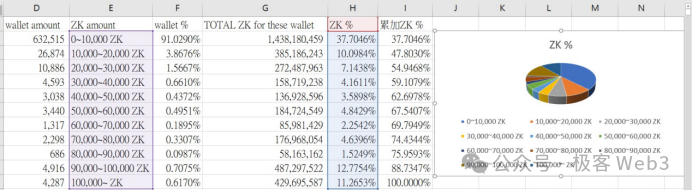
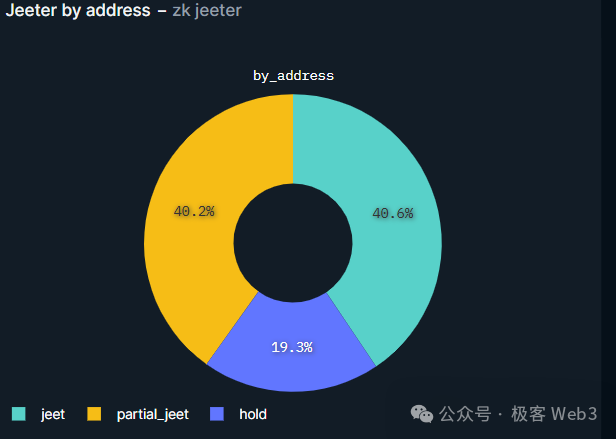
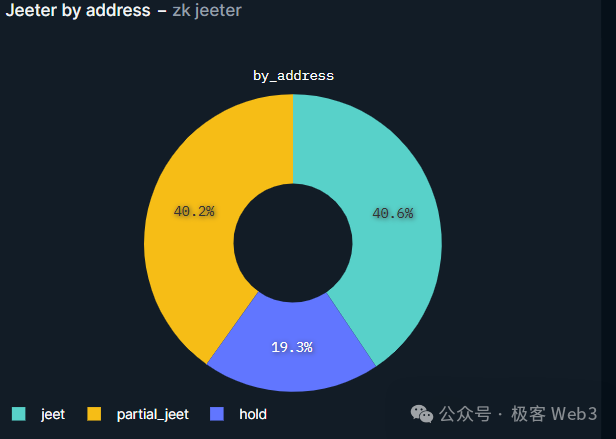
Post-analysis revealed that ZKsync allocated most tokens to users with large on-chain assets, OGs, or contributors, likely aiming to encourage long-term holding. However, results were disappointing: according to Nansen data as of June 30, only 19.3% of the top 100,000 addresses continued holding their ZK tokens; the rest partially or fully sold off.
Second, beyond the skewed weight distribution, the airdrop was accused of containing "insider allocations" ("rat holes"). For example, holders of PudgyPenguins, MiladyMaker, Degen, and Bonsai—who had no direct interaction with ZKsync’s ecosystem—still qualified for airdrops, often receiving larger amounts than active users. These suspected pre-allocated wallets significantly diluted genuine user shares, sparking strong community resentment.
Interestingly, it wasn’t just farmers criticizing ZKsync—multiple ecosystem projects joined the protest. Several whitelisted NFT projects found themselves excluded from dedicated ecosystem airdrops, while obscure Twitter meme projects like LongMao and Long—with fewer than 10,000 followers—received allocations, raising suspicions.
Additionally, long-standing ecosystem projects like Zerolend and Element publicly complained about unfair treatment. In contrast, Aave, Ethena, and even projects not yet launched on the ecosystem received allocations, with Aave receiving the largest share. ZKsync allocated 0.5% of FDV (~$20 million) to support Aave’s social product Lens—more than its public $15 million raise.
For these reasons, many community members and projects questioned ZKsync’s allocation process, citing lack of transparency and fairness.
Third, despite operating for four years since mainnet launch, early loyal users gained no advantage in this airdrop. Of ZKsync’s seven bonus criteria, early ZKsync Lite users met only two. If they didn’t later interact with ZKsync Era, they didn’t qualify at all.
These are the key concerns raised by the community. ZKsync justified the flawed outcome by citing efforts to avoid bot and Sybil attacks. Yet its actual Sybil filtering was incomplete.
An advanced Sybil farmer @k1z4 claimed to have received 660,000 tokens across 350 wallets. Over 3,300 addresses previously flagged as Sybils by Arbitrum still received rewards, and more than 130 million airdropped tokens went to addresses on LayerZero’s Sybil list.
Unlike EigenLayer, which adjusted its distribution under community pressure, ZKsync took no corrective action, ignored community grievances, and ultimately lost public trust. Since peaking in March, ZKsync’s mainnet activity has steadily declined, accelerating sharply after TGE.
LayerZero: Releases the Largest-Ever Sybil List
Unlike ZKsync, which kept rules opaque and offered post-hoc justifications, LayerZero adopted a transparent approach from the start—publicizing its airdrop rules, allocation plan, and anti-Sybil methods, actively listening to community feedback to ensure fair distribution. Co-founder Bryan Pellegrino engaged extensively on social media, demonstrating deep respect for the community.
However, the project’s biggest controversy wasn’t the distribution rules—but the Sybil issue.
After announcing its snapshot on May 1, LayerZero launched a two-month Sybil review. The first round, with Nansen and Chaos, filtered obvious Sybil behaviors like scripted actions, syncers, and address clustering. Then came a second round—community reporting. Users could report others’ Sybil behavior and receive a portion of the reported account’s airdrop as bounty.
Since Sybil addresses would be publicly listed—impacting future airdrop eligibility—this reporting system sparked intense debate and criticism.

Community reporting isn’t new—projects like Connext, Hop, and Safe used it before. But unlike past cases, LayerZero didn’t wait until after opening airdrop queries. Instead, it included all historically used addresses—around 6 million—triggering immediate backlash.
During the initial GitHub reporting phase, the community fought back with DDoS attacks and mass false reports, temporarily suspending the bounty hunter’s GitHub account. Later moved to a deposit-based platform, the flood of reports still delayed LayerZero’s progress, preventing completion before airdrop queries opened.
In effect, the community reporting system unleashed unprecedented creativity, achieving near-unparalleled Sybil detection coverage. Key patterns identified included:
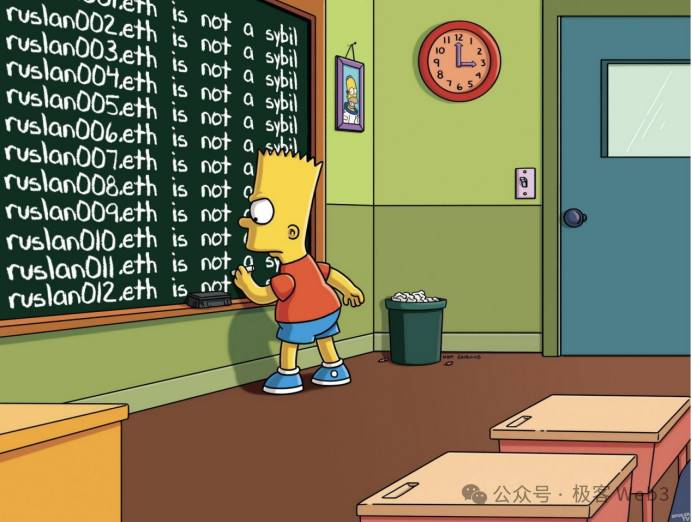
1. ENS domain registration patterns. One case involved ENS addresses starting with "ruslan" and ending with "001–104"—reported as a cluster controlled by a single entity. This cluster received large airdrops on ZKsync, strongly indicating Sybil behavior. This case drew attention to ENS registration as a forensic clue.
2. Clues from non-EVM chains and testnets. While Sybil farmers act cautiously on EVM chains, their behavior on non-EVM ecosystems may reveal links. Hunters traced connections via Aptos, Solana, Starknet wallets. Testnet activity also provided valuable leads.
3. On-chain voting patterns. One hunter analyzed voting correlation on StargateDAO Snapshot, identifying 7,404 Sybil addresses across 211 clusters based on behavioral similarity, first vote timing, and voting intervals.
Social media accounts also served as evidence. Post content, mutual follows, and even invite link sequences helped identify potential Sybil accounts. Though not universally accepted, these clues remain significant.
If behavioral similarity is used to infer Sybil status, even multi-account individuals without direct links may be flagged over time due to pattern repetition. However, these methods rely on inference rather than direct proof, risking false positives. Thus, LayerZero allowed appeals after publishing its list to reduce misidentification.
In summary, a complex game emerged among bounty hunters, users, and farming studios. Studios that self-reported received 15% of original rewards; bounty hunters earned 10% of the reported account’s airdrop. To avoid wasted effort, hunters targeted only addresses eligible for airdrops.
Ultimately, at TGE, LayerZero distributed only 8.5% of tokens to a community of 1.2 million—too little for too many. Even top 5% users received modest rewards, and neither self-reporters nor bounty hunters profited significantly—confirmed by leaked data.
Furthermore, LayerZero confiscated 10 million tokens from Sybil addresses. Though the final list hasn’t been published, prior rounds suggest at least 1 million addresses will be listed—the largest Sybil database in Web3 history. This triggered an unprecedented purge, making farmers extremely cautious about interacting with pre-TGE projects, causing many to abandon farming on cross-chain bridges like Hyperlane, Bungee, and LiFi.

Redefining "Sybil"
After LayerZero’s crackdown, ZkLink, Linea, and Drift followed suit, spreading the witch hunt to other ecosystems—even affecting staking and validator nodes. However, definitions of “Sybil” vary across projects, leaving ambiguity between real users and Sybils.
Though tools like Nomis and Trustalbas offer authenticity metrics, many projects fail to distinguish Farmers from Sybils, directly labeling certain farming behaviors as Sybil. For instance, Wormhole classified volume-sweeping trades as spam and treated them as Sybil behavior, confiscating related rewards;
Similarly, LayerZero labeled common farming apps like Merkly, L2Pass, and L2Marathon as “Sybil applications,” categorizing frequent users, those minting low-value NFTs, or conducting micro cross-chain transfers as Sybils. However, LayerZero only downgraded—rather than blacklisted—users performing sub-$1 cross-chains or low-quality NFT transfers, a more reasonable approach.
Blast: Points-Based Airdrops Collapse
As an alternative to interactive airdrops, points systems have long been controversial. Uncertainty, opacity, and arbitrary rule changes plague them. In Eigenlayer and Drift Protocol, users' real-money staking yielded points that weren’t counted toward airdrops. Etherfi saw point devaluation and outright point theft;
On the other hand, even with transparent points, future dilution remains unpredictable. Linea’s multi-round Odyssey campaign exemplifies this—points could be diluted by extended TGE timelines or additional events. Users liken such tactics to emotional manipulation or “PUA.”
Blast pioneered the points-based model, offering two types: regular points from deposits, and gold points from on-chain interactions. Initially, only regular points existed. After mainnet launch, Blast suddenly introduced gold points. Regular points scaled with asset amount and duration; gold points required continued post-launch interaction. Gold points could multiply regular points up to 120x.
Initially, people assumed regular points at mainnet launch would determine airdrops. But after deposit campaigns ended, Blast unveiled the gold points system—catching everyone off guard.
First, Blast was among the first to adopt points-based airdrops, where early, long-term stakers were supposed to benefit most. But the 120x multiplier for gold points infinitely diluted rewards for early users who locked large amounts.
Second, the gold points system required users to keep all staked assets within Blast for ongoing interaction. Since no snapshot was taken at launch, regular points kept accruing based on current balances. If users withdrew most funds, leaving only a small amount for interaction, their base regular points growth slowed dramatically, severely reducing gold points impact. This was a classic “anti-farm” maneuver.
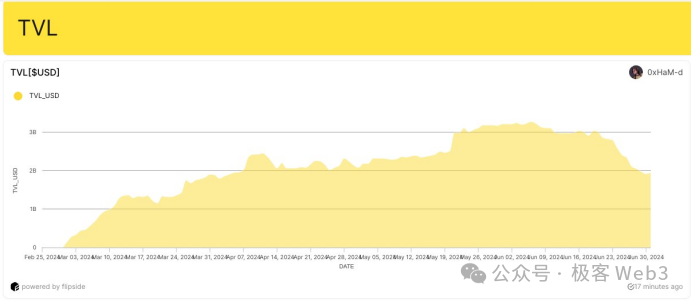
In short, Blast meticulously engineered a system that drastically reduced farmer returns while attempting to lock user assets on its chain—but users rejected it. Within 10 days of the announcement, Blast’s TVL dropped by $1 billion—down a third.
Endless referrals, interactions, and deposits eventually turned points systems into contests of social influence and wealth. KOLs leveraged their reach to invite users and gain airdrop weight effortlessly, while whales dominated deposit-based point games. Sun Yuchen secured 4.26% of EigenLayer’s Season 1 airdrop.
When points projects stop honoring points, and points get diluted or voided by Sybil checks, such models become increasingly unpopular. Blast’s massive anti-farm move made more people unwilling to sacrifice opportunity costs for uncertain, intangible points. The rise of points systems began with TieShun—and may end with him too.
The Decline of the Airdrop Scene
The dream of getting rich through airdrops burned bright for four years since DeFi Summer—but now it’s fading. Since年初, growing KOL followings and rapidly expanding farming studios signaled overheated interest. Conversely, individual airdrop yields have declined exponentially. From Wormhole and Starknet to Taiko, LayerZero, and ZKsync, average per-address rewards have visibly shrunk within just six months.
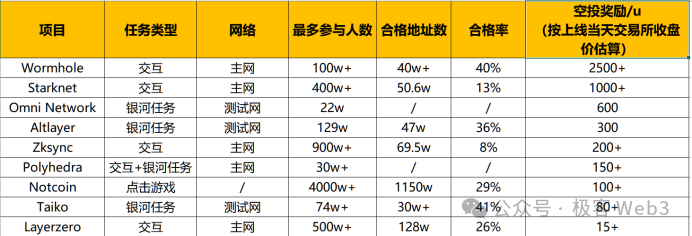
Market and sentiment factors contributed to poor post-TGE price performance. Community disappointment stems from low input-output ratios, while negative secondary market sentiment reflects investor dissatisfaction with low liquidity and high FDV projects.
Looking back, communities reacted strongly to long-interactive projects like ZKsync, LayerZero, and Taiko—especially when punished post-airdrop. In contrast, Avail, Dymension, and Celestia faced little backlash for airdropping to non-ecosystem users because recipients incurred minimal cost—an unexpected windfall.
In essence, airdrops were meant to attract real users with expected rewards. Farming was never desired by projects. Recent anomalies stem from long-standing misaligned incentives between farmers and projects.
Farmers invest time and money in meaningless interactions, expecting large returns. Projects prefer rewarding those who genuinely contribute to reputation and growth. These goals conflict. Years ago, scarce anti-Sybil resources and low barriers made farming profitable by default. Many farmers left immediately after claiming rewards, defeating the purpose.
LayerZero exemplifies this: usage plummeted post-airdrop (see below). Today’s so-called anomalies and shifts appear to be a return to fundamentals—no longer letting those who contributed nothing to the ecosystem profit.
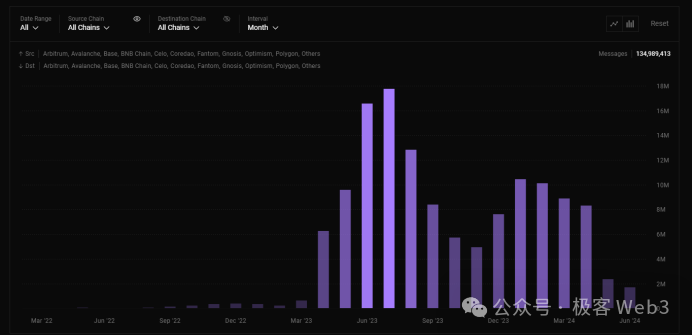
(Image source: @Axel_bitblaze69)
Jupiter co-founder previously stated that airdrops are gifts to early users—not rewards, loyalty programs, or growth tactics. Yet after Arbitrum’s airdrop, massive studio inflows disrupted the balance between early users and projects. Bryan Pellegrino emphasized that contributions aren’t mandatory, and earning airdrops is never guaranteed.
Today’s widespread “anti-farming” has cooled the gold rush, shattering illusions of artificial prosperity. For projects, ecosystem building is returning to rationality—they must consider how to attract genuine users while minimizing automated Sybil damage. Whether light filtering or excessive hunting, both risk community backlash. For farmers, the high-reward, free-money era is over. Lowering expectations and abandoning dreams of instant wealth through on-chain farming is the truly wise choice.
Either way, airdrops suffer from either scarcity or inequality. With Web3 market capacity nearing saturation and farming rampant, getting rich through airdrops is now a mirage.
Join TechFlow official community to stay tuned
Telegram:https://t.me/TechFlowDaily
X (Twitter):https://x.com/TechFlowPost
X (Twitter) EN:https://x.com/BlockFlow_News
 吴说区块链
吴说区块链









