









ZKApps 101: A Comprehensive Overview of ZK Applications and Their Current Development Status
TechFlow Selected TechFlow Selected
ZKApps 101: A Comprehensive Overview of ZK Applications and Their Current Development Status
Why should you pay attention to ZKApps now?
 Navigating Web3 tides with focused insights
Author: YIWEI
Translation: TechFlow

Executive Summary
-
The current zero-knowledge (ZK) ecosystem can be classified along two main axes: whether it operates as an application or infrastructure, and whether it prioritizes privacy or focuses on utility and scalability.
-
Within these categories, ZK applications (ZKApps) are apps that leverage zero-knowledge proofs to enhance both privacy and utility. ZKApps have the potential to improve our lives in areas such as credentials, payments, and biomedical engineering.
-
Investment trends and on-chain data indicate growing demand for zero-knowledge proofs (ZKPs), with adoption already beginning among end users.
-
Technical advances in cryptographic proof systems and decentralized proving infrastructure have made ZKApps more practical and feasible. These developments have lowered the barriers to ZKP generation and verification, making ZKApps accessible to a broader audience.
1. Introduction
Why Should We Care About ZKApps Now?
In the blockchain and Web3 space, excitement around zero-knowledge (ZK) technology has persisted for years and continues into the second half of 2024. As Vitalik Buterin stated: “Although further infrastructure development and prover optimization are needed, ZK will clearly be the endgame within 10 years.” ZK is widely seen by industry insiders as a promising solution to the blockchain trilemma—the challenge of balancing security, scalability, and decentralization without sacrificing any one of them.
Fueled by this momentum, many investors—even those without technical expertise—may have heard terms like SNARKs, STARKs, and KZG, which represent complex technical domains, especially within Ethereum-focused research and development. Yet from a consumer perspective, a fundamental question inevitably arises: “I know ZK is an impressive technology, but when can we actually use products leveraging it? And is this technology mature enough to replace existing non-Web3 solutions?”
A few years ago, the answer might have been: “Not yet, we don’t know.” As Vitalik noted, the infrastructure and cryptographic proof technologies required to run practical ZK-based applications (ZKApps) were still insufficient, posing significant development challenges. However, as of 2024, despite ample room for improvement, substantial technical progress has been made, laying the foundation for commercializing ZKApps. We now need to shift focus toward identifying where ZK technology is truly needed and how it can be used to improve quality of life. From an investor’s standpoint, studying future classifications of widely adopted ZKApps may also reveal new investment opportunities.
In this joint ZK research by Presto Research and Ocular VC, we provide an overview and outlook of the ZKApp industry, combining market trend analysis with cutting-edge technical insights from both research teams. In Section 2, we introduce the current ZK adoption landscape and highlight which ZK infrastructures and ZKApps are gaining traction. Section 3 focuses on the evolution of ZKApps, discussing their necessity and real-world benefits. In Section 4, we examine investment trends and on-chain data analysis as of 2024, explaining why ZKApps are poised to become the next major trend. Finally, in Section 5, we explore the R&D efforts and technological achievements in infrastructure that have made ZKApps practical and positioned them for mainstream adoption.
2. Current ZK Adoption Landscape
The current ZK adoption landscape can be categorized along multiple dimensions, but here we broadly classify based on two criteria: whether the service functions as infrastructure or application, and whether it emphasizes privacy or utility.
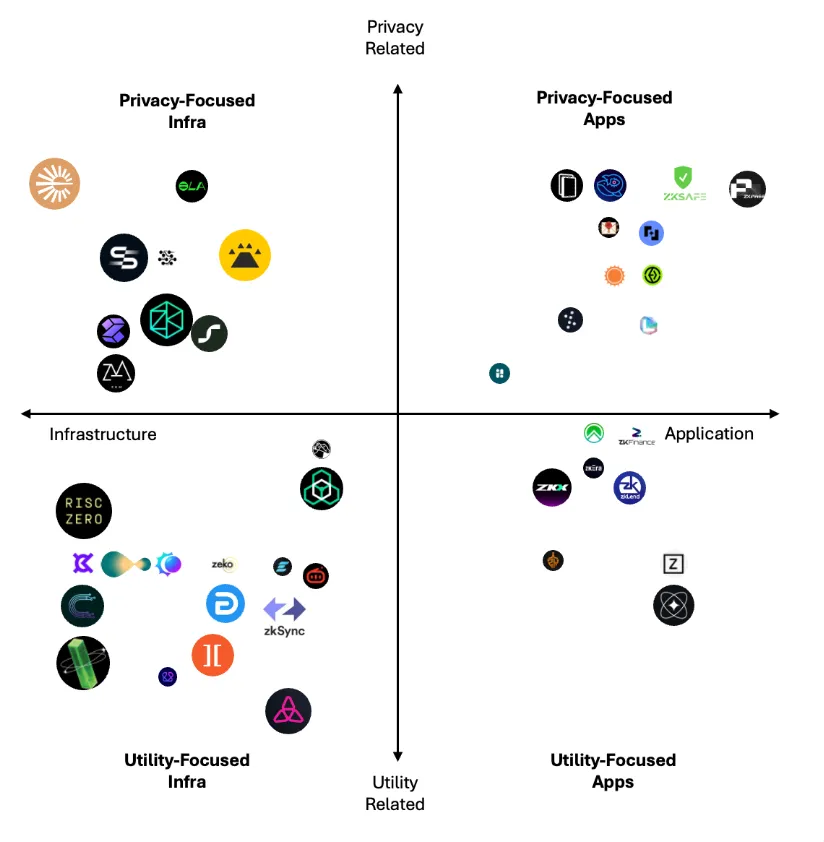
Figure 1: Current ZK Adoption Ecosystem
Source: Ocular VC
2.1. ZK Infrastructure
Type 1: Privacy-Focused Infrastructure
Services in this category primarily aim to address privacy issues within ZK systems, as many ZKP providers may still have the capability to inspect transactions, creating risks of sensitive data exposure. In other words, privacy leaks often occur during the process where clients submit transactions to a ZKP provider to generate a proof. Therefore, privacy-focused infrastructure can be provided through the prover layer (explained further in Section 5.2) and virtual machine (VM) components to enhance access control and ensure end-to-end data privacy. Representative examples include Ingonyama, Succinct, and Espresso.
Type 2: Utility-Focused Infrastructure
ZK technology not only enhances privacy but also improves the utility of ZKApps. A prime example is ZK L2s (i.e., ZK-rollups). It's well known that very few current ZK L2s guarantee end-to-end transaction privacy. However, ZK L2 chains like Taiko, zkSync, Intmax, and Zeko leverage the succinctness of ZK technology to significantly boost blockchain scalability by aggregating the validity of thousands of transactions into a single ZK proof submitted to L1. Another utility-focused use case is the prover layer. The prover layer consists of entities that provide computational power, enabling users with weaker devices to participate in ZKP generation and verification. Currently, services such as RiscZero, Cysic, Irreducible, and Aligned Layer operate in this space.
2.2. ZK Applications
Type 3: Privacy-Focused Applications
Privacy-focused applications are typically the first use cases that come to mind when thinking about “ZK applications.” These services primarily utilize the zero-knowledge property of ZK technology and prioritize privacy. This feature is widely applied in fields involving sensitive personal information, such as KYC, authentication, and credentials, to protect user privacy. Notable projects currently include zkPass, Lumina, 0xKYC, and zkMe. This domain is also expanding into secure wallets and email, with examples including ZKSafe and zkEmail.
Type 4: Utility-Focused Applications
Utility-focused applications primarily operate on top of ZK L2s. Currently, decentralized finance (DeFi)-related applications such as decentralized exchanges (DEXs) and lending platforms dominate this category. Although ZK L2s do not guarantee privacy, these applications leverage their utility to offer fast and low-cost transaction processing, which is crucial in DeFi. Prominent applications currently in operation include zkFinance, ZKX, zkEra Finance, zkLend, and eZKalibur.
3. ZKApps: Origins and Evolution
3.1. The Road to the Modern ZK Ecosystem
Zero-knowledge proofs (ZKPs) have emerged as a transformative technology in the blockchain industry, offering revolutionary advances in privacy and scalability. Originating in cryptographic research, ZKPs have evolved from theoretical concepts into practical ZK applications (ZKApps), significantly shaping landscapes in decentralized finance (DeFi), cybersecurity, and beyond.
Origins of ZKPs
The concept of ZKPs was first introduced by Shafi Goldwasser, Silvio Micali, and Charles Rackoff in 1985. Initially, it was a theoretical breakthrough in cryptography, demonstrating the ability to prove knowledge of something without revealing the knowledge itself. ZKPs are particularly useful in authentication systems involving passwords, allowing verification without exposing the password. Notably, companies like Cloudflare have already adopted ZKP mechanisms, using trusted hardware for secure network authentication.
Transition to Blockchain Technology
The integration of ZKPs with blockchain technology marked a pivotal moment in their evolution. One early adopter was Zcash, which introduced ZK concepts into its payment system to ensure end-to-end transaction privacy. ZKPs allow transactions to be verified without revealing the sender, receiver, or amount (i.e., confirming the sender has sufficient funds and no double-spending occurred). This use case highlighted the potential of directly integrating ZKPs into blockchain platforms, presenting a compelling application.
Momentum grew with the initial deployment of Ethereum L2 solutions such as zkSync and Starknet. These platforms leveraged ZKPs as scaling solutions to address the common bottleneck of low TPS rates in blockchain systems. In these contexts, the successful implementation of ZKPs sparked interest in developing more practical applications that leverage existing infrastructure to enhance privacy and efficiency.
As infrastructure has consolidated and matured in recent years, attention has increasingly turned to ZKApps. We discuss the details and benefits of ZKApps in the following section.
3.2. Defining ZKApps and Their Benefits
As briefly introduced in Section 2, we define ZKApps as applications that use ZKPs and ZK infrastructure to generate transactions, with primary goals of 1) protecting user privacy and/or 2) improving efficiency.
Applications focused on privacy tend not to store transaction data on public chains (e.g., KYC procedures, genetic testing, and confidential personal data), which presents compelling use cases. By leveraging ZKPs, this data can be securely stored in local databases without public disclosure, yet globally verifiable (e.g., proving Alice’s blood type is B, proving Bob is over 20 years old). This approach is particularly advantageous for privacy-sensitive applications requiring accountability and transparency. Projects exploring this area include zkPass, nuAuth, and BioSnark.
Bhutan, a small Asian country between India and China, has recently implemented a nationwide digital identity infrastructure using ZKPs. This approach enables the government to manage data more efficiently while ensuring cross-border verification without violating other countries’ data privacy regulations.
Interestingly, this use of ZKPs could extend further into credit lending systems and authentication mechanisms, fostering trust in international cooperation and shared digital services. For instance, USDT loans could leverage ZKPs to protect and verify off-chain credit. This method could further facilitate issuing uncollateralized loans using stablecoins on-chain. Such applications of ZKPs could revolutionize credit assessment and loan disbursement, enhancing security and trust while expanding financial inclusion.
There are still underexplored areas such as GambleFi, where this approach could be particularly beneficial. ZKPs enable fair, cheat-resistant gambling by cryptographically verifying outcomes and actions without exposing underlying data. For example, betting pools can be created where users’ contributions and winnings remain anonymous, yet the total pool size and distribution are verifiable. These advantages could attract more users to GambleFi by enhancing trust and delivering a more private and scalable gambling experience.
Of course, the use of ZKPs is not limited to these examples. Beyond the above use cases, ZKPs could be introduced into social media to protect content creators’ anonymity, and even top players who don’t want to share their speedrun strategies might welcome the adoption of this technology. Thus, ongoing research explores how ZKPs can deliver more advanced services across various aspects of daily life compared to existing methods, with many more use cases expected to emerge.
4. Analysis: Why ZKApps Are the Next Trend
In this section, we use data analysis to explore why the ZK industry’s main trend is shifting from infrastructure to applications. In Section 4.1, we analyze investment trends in 2024 to explain why ZKApps represent the next promising frontier. In Section 4.2, we use on-chain data as evidence to examine rising customer demand for actual ZKApps.
4.1. Investment Trends
Reviewing the investment history of the ZK industry reveals that most major investments have concentrated on ZK infrastructure (such as ZK L1/L2 and hardware acceleration), including projects like zkSync, Starknet, Aleo, and Cysic. Cumulative investment in this market has exceeded $1 billion, with many projects preparing product launches in the coming quarters. This trend continued into 2024, evidenced by the strong performance of the top five ZK-related funding rounds (see Figure 2), four of which exceeded $15 million. Notably, four of the top five deals were related to the prover layer, and one to an L2 solution.
So why is the prover layer receiving so much attention? As discussed in Section 3, the prover layer is a critical component supporting the growing demand for ZKPs, enabling users with less powerful devices to participate in ZKP generation and verification. Increased demand for the prover layer indicates a significant rise in ZKP demand, suggesting more people are looking to generate transactions via ZK L1/L2 chains.
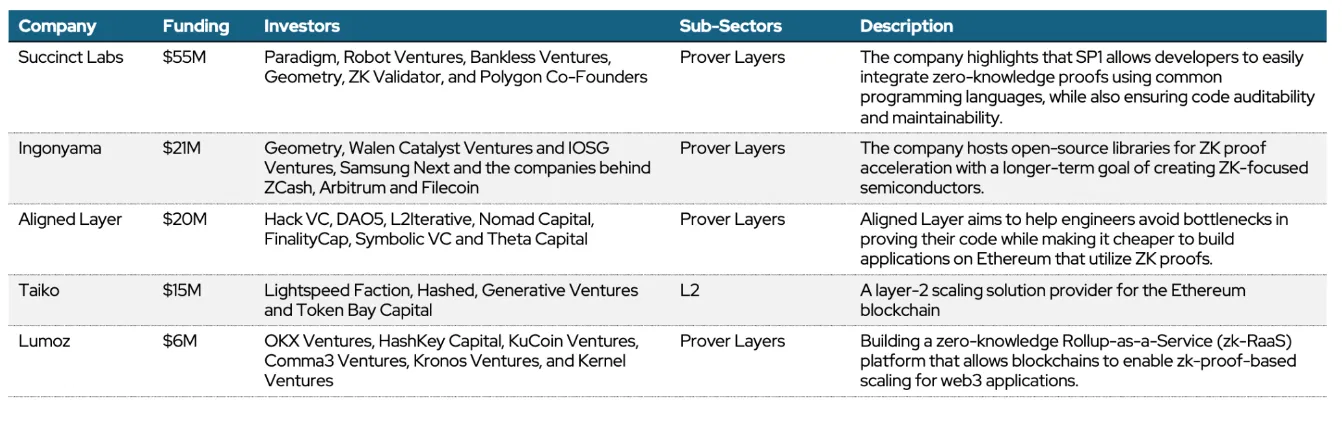
Figure 2: ZK Investment Trends in 2024
Source: Cointelegraph, The Block, Ocular VC
There are two possible explanations for increased transaction demand on ZK L1/L2 chains. The first is growing demand for ZKApps, leading to more transactions being submitted to base ZK chains. The second is that mainnet launches of ZK L1/L2 chains over the past two years have significantly increased transfer volumes on ZK chains, thus raising transaction counts. Regardless of which explanation holds, the outlook for ZKApps remains positive. In the former case, it means more people want to use ZKApps; in the latter, increasing usage of base ZK chains fosters ecosystem maturity and infrastructure development, creating a favorable environment for ZKApp development.
4.2. On-Chain Data Analysis
Now, let’s directly confirm the rising demand for ZKApps through on-chain data analysis. Data shows that cumulative fees spent on ZKP verification processes have exceeded $198 million over the past 1.5 years, indicating a significant increase in ZKP demand compared to previous years. More importantly, this growth is primarily driven by demand for ZKApps. By breaking down ZKP verification fees between infrastructure and ZKApps, we find that ZKApps’ share has risen from 40% historically to 70–80% in 2024. This data confirms that the recent surge in ZKP demand is largely attributable to ZKApps.
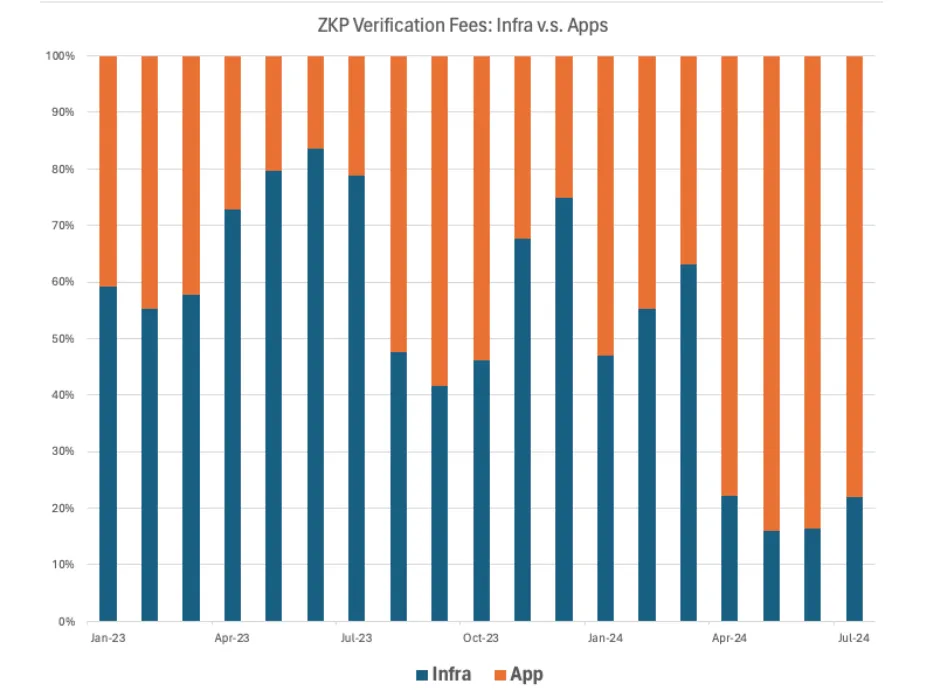
Figure 3: ZKP Verification Fee Dynamics
Source: dune.xyz@nebra, Ocular VC
5. Technological Advances Making ZKApps a Reality
So far, we’ve explored the definition of ZKApps, identified key use cases worth watching, and discussed why the ZK industry’s main trend is shifting toward applications. The feasibility of these ZKApps clearly depends on technological advancements that make them practically viable. As previously mentioned, ZK infrastructure has matured, and ZKApps capable of effectively leveraging these technologies are poised to become mainstream in the blockchain/Web3 industry in the coming years. So, what specific advances have made this possible, and what developments lie ahead?
5.1. ZK Proof Systems
First, we must discuss progress in ZK proof systems. Due to their complexity, it can be difficult for non-technical individuals to understand which cryptographic techniques are used in which processes and how improvements enhance ZK proof systems. Therefore, in this section, we highlight notable advances in ZK proof systems and use intuitive analogies to illustrate these changes. In short, these advances bring two main benefits: "increased functionality support" and "optimized computation."
Supporting More Functionality: Domain-Specific Languages (DSLs)
Domain-specific languages (DSLs) in ZK proof systems are programming languages specifically designed to handle particular tasks within the ZK ecosystem. These languages greatly enrich ZKP creation by providing customized syntax and features optimized for ZK operations. Currently, DSLs such as Leo, Zinc, Cairo, Noir, and ZoKrates are under research and development to support more features like mutable variables, conditional statements, and arrays.
This is akin to Bob needing to prove to Alice that he baked a cake using a legitimate recipe, without revealing the recipe itself. First, Bob needs to prepare his recipe, which should include all high-level steps and ingredients required to make the cake (e.g., mix ingredients into batter, then bake). It would be even better if Bob could use more sophisticated ingredients and cooking techniques in his recipe (see Figure 4)!
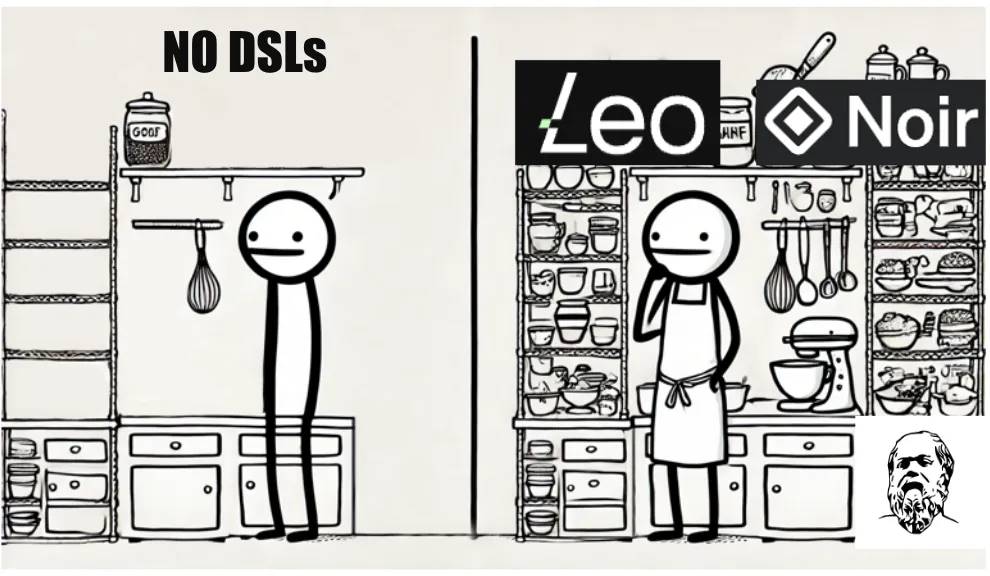
Figure 4: DSLs Enable Richer ZKP Functionality
Source: DALL E, Presto Research
Optimizing Computation: Arithmetization, Proof Systems (IOP + FCS)
After writing a program in a DSL, it undergoes arithmetization and proof systems (including Interactive Oracle Proofs (IOP) and Functional Commitment Schemes (FCS)) to be converted into ZKPs. A common challenge in these processes is minimizing computational overhead to make ZKP generation and verification accessible to more people.
In efforts to reduce computational overhead, the most intuitive approach is reducing the field size in the proof system. Here, field size refers to the size of the mathematical field used in ZKP generation. Simply put, it represents the total number of possible values available for creating secret codes; larger field sizes make guessing the code harder but increase generation time. Famous cryptographic proof systems like Groth16, Plonk, and Halo2—some of which may be familiar even to those unfamiliar with ZKPs—typically use 256-bit field sizes. However, with technological advances, recent systems like Goldilocks and Plonky3 use field sizes of 31 to 64 bits without compromising security. The state-of-the-art Binius proof system goes further, using just 1 bit (zero and one) as its field size, dramatically increasing computational speed.
5.2. Decentralized Proving Infrastructure
The second noteworthy technological advancement is the development of decentralized proving infrastructure. While progress in ZK proof systems optimizes and simplifies the proof generation and verification process by reducing computation, decentralized proving infrastructure allows individuals to outsource powerful computing resources for ZKP generation.
Currently, there are two primary approaches to implementing decentralized proving infrastructure in the ZK industry. The first is building a dedicated internal proving layer on a ZK-based chain; the second is operating an outsourced proving layer that handles ZKP generation requests from various chains and applications.
Internal Proving Layer
In the internal proving layer model, the ZKP-generating entity (i.e., the prover) is affiliated with a specific chain. The biggest bottleneck for internal proving layers lies in bootstrapping: because chain developers cannot economically provide seamless proving layers for all network users, protocols are typically deployed to incentivize individuals or groups with computational capacity to join the proving layer by offering native tokens as rewards.
A representative project operating an internal proving layer is Aleo, a ZK Layer 1 blockchain. Similar to Bitcoin’s Proof-of-Work (PoW), Aleo requires provers to generate ZKPs for each block that meet a specific threshold (the “proof target”). If the total accumulated proof exceeds the “Coinbase target,” coinbase rewards (Aleo tokens) are distributed proportionally based on each prover’s contribution. This miner-prover protocol incentivizes faster software and hardware development for ZKPs and achieves decentralization of the proving ecosystem through broad reward distribution.
Outsourced Proving Layer
On the other hand, the outsourced proving layer exists outside blockchains and provides computational power upon request from various ZK-based chains and ZKApps. Think of it as a modular blockchain like Celestia, but specialized for ZKP generation. These outsourced proving layers typically operate as “proof markets”: clients submit transactions requiring ZKP generation, and provers bid to offer their proof services, including their capacity and cost for generating ZKPs.
Representative projects currently operating outsourced proving layers include =nil and Gevulot. =nil maintains an order book for each circuit, containing user buy orders and prover sell orders. Price discovery for proof generation is managed through this order book mechanism. Gevulot operates under a Proof-of-Stake (PoS) model: provers must stake collateral and complete PoW tasks to join. Beyond bidding, proof generation tasks are randomly assigned via verifiable random functions (VRFs) to ensure fairness.
However, the outsourced proving layer approach faces a major issue: transaction data included in proof requests is exposed when submitted to provers, making end-to-end privacy difficult to maintain. To address this, projects like Marlin and zkPass leverage secure enclave execution environments (environments that protect data integrity) to ensure no privacy leakage during ZKP generation.
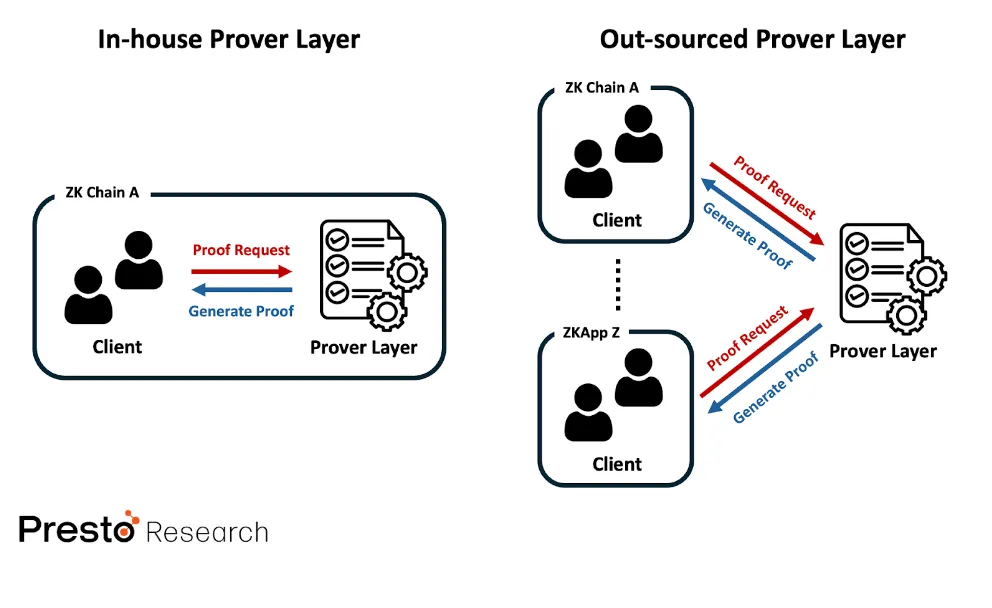
Figure 5: Overview of Decentralized Proving Infrastructure
Source: Presto Research
Conclusion
So far, we’ve examined the overall adoption landscape of the ZK industry, the benefits ZKApps can deliver, evidence that the industry’s main trend is shifting from infrastructure to ZKApps, and the technological advances enabling the rise of ZKApps. Advances in cryptographic proof systems and decentralized proving infrastructure are paving the way for faster, more economical use of ZKApps, bringing zero-knowledge technology closer to everyday life.
The blockchain/Web3 industry is often criticized for developing overly hyped technologies aimed more at attracting investors than addressing real market needs. To overcome this criticism, developers must advance technology in ways that genuinely improve our lives; however, for users, it is equally important to continuously assess where this technology can be effectively applied. We hope this article provides readers with a broad understanding of ZKPs and ZKApps and inspires deeper independent research (DYOR) into this emerging sector.
In upcoming collaborative reports from Presto Research and Ocular VC, we will review a series of cutting-edge ZK-related projects (e.g., private convolution, client-side proving, privacy-preserving proving layers) that will launch atop the technological advances discussed in this article. Stay tuned!
Join TechFlow official community to stay tuned
Telegram:https://t.me/TechFlowDaily
X (Twitter):https://x.com/TechFlowPost
X (Twitter) EN:https://x.com/BlockFlow_News








