35 "Dead" Crypto VC Projects Autopsy Report: Raised Over $1.1 Billion in Funding, DeFi, NFTs, and Gaming Have Highest Failure Rates
TechFlow Selected TechFlow Selected
35 "Dead" Crypto VC Projects Autopsy Report: Raised Over $1.1 Billion in Funding, DeFi, NFTs, and Gaming Have Highest Failure Rates
This article compiles 35 projects that raised over $5 million but have since shut down, from last year to the present.
 Navigating Web3 tides with focused insights
By Nancy, PANews
On July 30, ZKX, a derivatives DEX in the Starknet ecosystem, announced it would cease operations due to severe financial imbalances, sparking backlash and criticism from the community. This comes just over a month after the protocol publicly announced a strategic funding round of $7.6 million. In fact, amid tightening liquidity, rising financial risks, and broader industry downturns, the survival rate for crypto projects has plummeted—even for those once heavily backed by capital. According to a report by CoinGecko released earlier this year, since 2024 alone, 14,039 cryptocurrencies have "died," exceeding 50% of all known tokens, with the majority launched during the 2020–2021 bull market. During the previous bull cycle, approximately 70% of around 11,000 crypto projects have already ceased operations.
This article compiles 35 projects that raised over $5 million and subsequently shut down between last year and now, including several once backed by prominent investors or affiliated with major corporations, primarily across NFT, DeFi, and gaming sectors. Among these defunct projects are both fading veterans and sudden casualties, most of which collapsed due to financial difficulties, poor market conditions, regulatory pressure, or low product adoption.
Shut-down Projects Raised Over $1.1 Billion Combined; DeFi, NFTs, and Gaming Face Survival Crisis
Although the crypto market has increasingly become one dominated by capital influence, fundraising success alone does not guarantee survival through market cycles. According to incomplete data compiled by PANews, since 2023, 35 crypto projects that each raised over $5 million have shut down, collectively securing nearly $1.17 billion in funding, averaging about $34 million per project. The top three highest-funded among them—Voice, Prime Trust, and LINE NFT—raised over $600 million combined.
"Riding the hype feels great—until the post-mortem." While there are certainly examples of projects surviving industry turbulence, the investment landscape remains brutally unforgiving. By sector, DeFi, NFTs, and gaming bear the brunt, having attracted significant capital narratives. Failed projects in these three areas account for 22.8%, 11.4%, and 8.5% respectively of the total, with total funding amounts of approximately $170 million, $530 million, and $35 million—making up roughly 62.8% of the total funding raised by all failed projects on this list.
Behind these large funding rounds were numerous high-profile VCs such as Coinbase Ventures, Paradigm, Binance Labs, Sequoia China, Circle Ventures, Galaxy Digital, a16z, Polychain Capital, and the now-defunct Alameda Research and Three Arrows Capital. Notably, Coinbase Ventures, Alameda Research, Three Arrows Capital, and Polychain were particularly frequent backers of failed ventures, each investing in at least three or more of the failed projects—an outcome likely tied to their aggressive investment strategies.
In terms of founding timelines, projects launched between 2020 and 2021 had the highest failure rate, accounting for about 61.7% of the total sample and raising over $430 million collectively. Of these, 16 failed projects originated in 2021, mostly within DeFi and NFT sectors.
Under the Crypto Collapse Wave, These Factors Became Key Triggers
In an ever-evolving crypto environment, these project failures serve as stark warnings to the industry. Overall, the vast majority of collapses stemmed from market cooling, financial distress, increasing regulation, and insufficient product adoption.
Market conditions play a critical role in determining whether a project survives or fails, especially during prolonged bear markets where simply staying alive becomes a challenge. According to PANews’ analysis, at least five projects halted operations directly due to adverse market conditions.
Take the NFT market, for example. After the initial frenzy faded, the NFT space has continued its downward trend, with demand steadily weakening. A recent report from data tracker CryptoSlam shows monthly NFT sales have dropped to $393 million—the lowest since November 2023. Amid shrinking trading volumes, shutdown waves have become inevitable across NFT platforms—even those backed by strong institutional support and substantial funding.
For instance, LINE NFT, the NFT marketplace operated by Japanese telecom giant LINE, ceased services after only two years despite raising approximately $150 million. Similarly, NAEMO Market, backed by Bithumb’s metaverse subsidiary Bithumb Meta, shut down due to continuous losses since launch, wiping out around $7.3 million invested by major South Korean firms including LG CNS (a subsidiary of LG), CJ OliveNetworks (under CJ Group), and Dreamus (affiliated with SK Square). Recur, an NFT brand experience platform that raised $55 million, also closed after more than two years due to unforeseen challenges in the NFT market and shifting commercial dynamics.
Meanwhile, while funding can temporarily alleviate operational pressures, the absence of a sustainable and viable business model ultimately limits long-term viability. According to PANews’ data, more than seven projects explicitly cited unsustainable cost structures—where expenses far exceeded revenue and even surpassed total funding—as the reason for closure.
ZKX, for example, raised $12.1 million across two funding rounds but still chose to wind down operations due to an inability to establish economic sustainability. As the founder revealed, key factors behind the decision included extremely low user engagement, a token generation event (TGE) that fell short of expectations, and revenues insufficient to cover salaries and basic operating costs. Moreover, the current token value could no longer support the protocol's ongoing development. This situation is further exacerbated by retail investor resistance toward VC-heavy tokens—a growing sentiment driven by massive upcoming token unlocks that have eroded trust in VC-backed projects during this bull run, turning what was meant to be support into an invisible constraint on growth.
The same issue affected liquid staking platform ClayStack, which, despite over three years of operation, six product audits, and a seed round of $5.2 million, announced gradual shutdown in May due to resource constraints and poor product-market fit. Via Protocol, a cross-chain liquidity aggregation protocol that raised $1.2 million, also terminated operations due to unsustainable server costs.
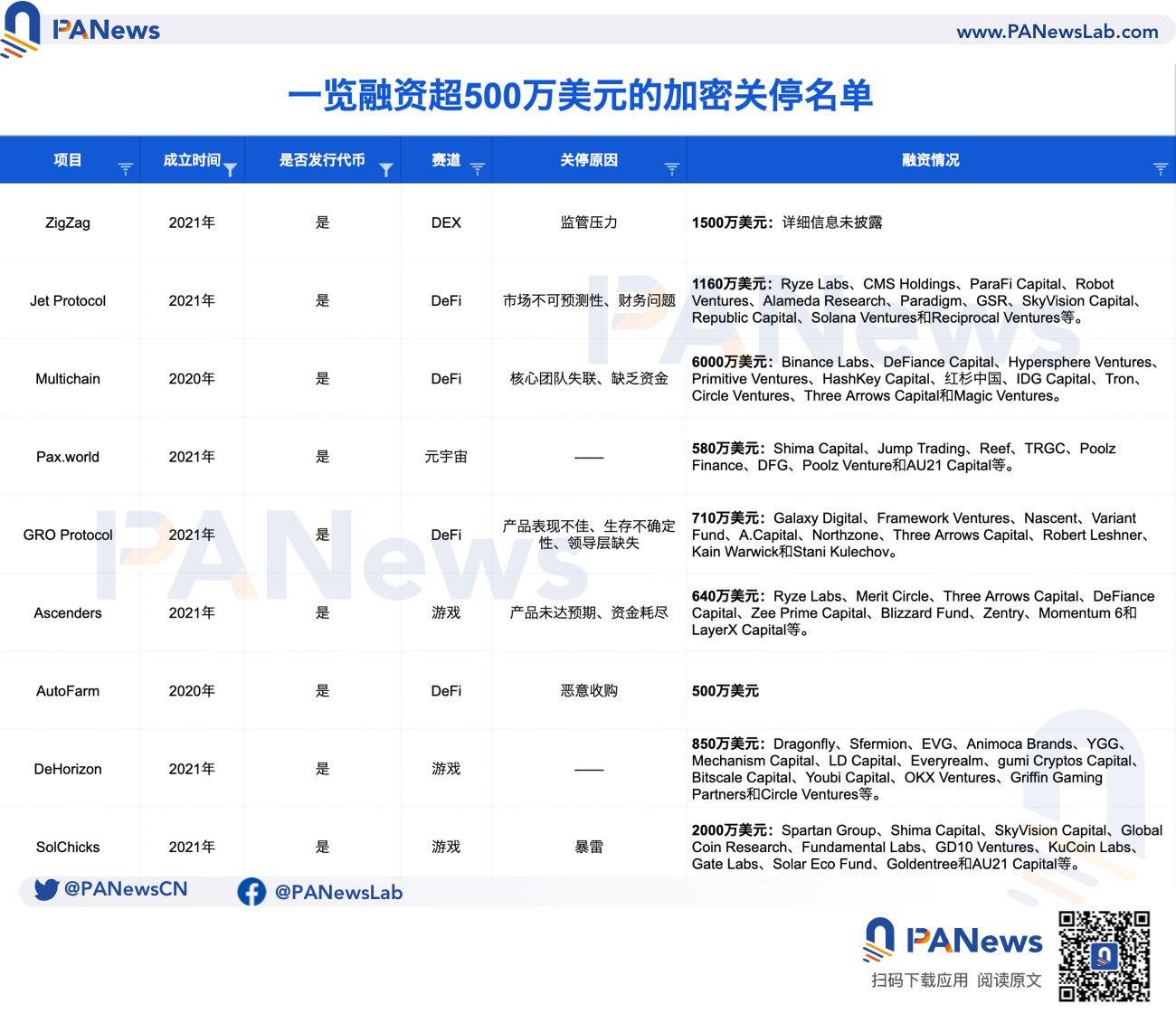
Financial distress has significantly undermined project sustainability, sometimes leading directly to insolvency. At least five of the failed projects listed here collapsed primarily due to funding shortfalls. Examples include Jet Protocol, which raised $11.6 million from Paradigm and others; Superdao, a DAO creation platform; and the blockchain game Ascenders—all of which shut down due to fiscal crises.
Additionally, regulatory compliance has emerged as a major hurdle for crypto projects. As the crypto industry grows, global regulators have intensified scrutiny, imposing stricter compliance requirements. At least five projects in our dataset ceased operations due to regulatory pressure. For example, Nocturne, a privacy protocol founded in 2023 and backed by Bain Capital Crypto, Polychain, Bankless Ventures, Hack VC, Robot Ventures, and Vitalik Buterin with $6 million in funding, decided to gradually shut down in June—following in the footsteps of other privacy-focused protocols that halted operations under similar regulatory strain. Another case is Pillow, a crypto investment app that raised $21 million but ultimately vanished amid regulatory uncertainty.
Of course, some projects collapsed due to black swan events such as core team disappearances, hacking incidents, or investment blowups. Among the 35 shut-down projects, several collapsed without warning, with some token issuers causing significant losses to investors. For instance, the metaverse gaming ecosystem DeHorizon and the metaverse project Pax.world shut down without any official announcement, leaving their tokens nearly worthless and never listed on centralized exchanges.
Notably, although they shut down for various reasons, some projects that voluntarily closed implemented responsible exit strategies—unlike rug pulls. For example, ZKX liquidated all open market positions and returned funds to users’ trading accounts, while LINE NFT fully refunded all listed assets upon closure.
Join TechFlow official community to stay tuned
Telegram:https://t.me/TechFlowDaily
X (Twitter):https://x.com/TechFlowPost
X (Twitter) EN:https://x.com/BlockFlow_News
 PANews