








How Elixir, the liquidity powerhouse valued at $800 million, became DeFi's savior?
TechFlow Selected TechFlow Selected
How Elixir, the liquidity powerhouse valued at $800 million, became DeFi's savior?
As a key DeFi infrastructure component, Elixir—having witnessed both the glory and challenges of DeFi—has the potential to revitalize DeFi in the foreseeable future, continuously reshaping market expectations.
 Navigating Web3 tides with focused insights
Written by: TechFlow
This bull market is indeed a bit different—far from the past glory of “limitless on-chain capital and constant sector rotation.” The market no longer moves in unison; the only apparent consensus seems to be 'no one will bail each other out.' After enduring a long bear market, liquidity in the crypto space is already parched. Now, just as bulls emerge, instead of a flood of capital, liquidity has become even more fragmented.
As an indispensable component of the crypto ecosystem, DeFi naturally hasn't escaped this current liquidity curse:
Liquidity is scattered across protocols, and decentralized exchanges (DEXs) are unable to deliver a comprehensive trading experience due to insufficient liquidity.
Faced with DeFi’s current liquidity challenges, decentralized market-making protocol Elixir has something to say.
Elixir aims to address DeFi's liquidity issues through decentralization, integrating multiple DeFi protocols to consolidate liquidity and offer users an efficient, secure, and transparent trading environment.
To date, Elixir has partnered with over 30 DeFi protocols and plans to launch its mainnet in the second half of the year, alongside its decentralized dollar stablecoin, deUSD.
This article will explore Elixir in depth, helping readers understand how it leverages innovative mechanisms and technology, collaborates with leading DeFi protocols to tackle existing liquidity problems, and details the mechanics, advantages, and future outlook of Elixir’s decentralized dollar, deUSD.
DeFi Fragmentation Hurts Everyone
As the hub for value exchange in the DeFi world, demand for decentralized exchanges continues to grow. From the early days of "simple and rough but usable," to today’s expectation of "high speed and seamless user experience," DEXs are increasingly competing fiercely to retain existing users and attract new ones.
Orderbook-based DEXs, as one solution, offer smooth, low-slippage trading experiences thanks to their robust liquidity architecture. As on-chain trading experience becomes increasingly important, orderbook DEXs are gaining greater prominence in the market.
However, as market attention fragments and DeFi projects operate in silos, valuable liquidity is repeatedly divided. Relying solely on professional market makers can no longer meet the growing demand for high-volume, low-slippage trading. Effectively consolidating fragmented liquidity is no easy feat.
Likewise, for many native DeFi users, using DEXs isn’t just about trading—the real appeal lies in earning additional income beyond simple swaps. While orderbook DEXs perform well, the profits from providing liquidity go almost entirely to invited market makers. Many users watch the market for orderbook DEXs grow larger, yet they’re left unable to participate or earn a share—only able to stand by helplessly.
Elixir identifies this natural dual-sided need—protocols needing capital, users seeking higher yield—and positions itself accordingly: channeling user funds into various DeFi protocols.

Elixir: The Pinnacle of On-Chain Liquidity Aggregation
How does Elixir respond to market needs?
As a modular DPoS network, Elixir leverages a unique network architecture and liquidity management algorithms to break down the invisible barrier between on-chain users and DEXs. It enables users to directly provide liquidity to multiple orderbook DEXs while creating new profit opportunities for users—letting every participant experience being a market maker and achieving win-win outcomes for both protocols and users.
Elixir’s vision is strong, and its real-world performance is impressive. Since launch, Elixir has maintained high growth and delivered solid metrics across the board.
To date, nearly $200 million has been deposited into the Elixir protocol, processing over 261 million transactions.

Team Background and Funding
Elixir’s sharp insights and exceptional execution stem from a dedicated elite team:
Founder Philip Forte
Former partner at BlockVenture and advisor to Solana, Moonbeam, Flow Network, and Magic.
Partner Cole Petersen
Contributing writer for Forbes’ DeFi section and investor in 3AC, Neuralink, and 20 other startups.
CTO Chris Gilbert
Former Chief Engineer at Tokensoft and IDEXX.
COO: Tim Wang
Previously led Hudson River Trading’s crypto venture investments. Over 10 years of traditional finance experience, including investment banking at J.P. Morgan, private equity at Lightyear Capital, and venture capital at Eniac Ventures. Angel investor in over 30 crypto projects.
Additionally, Elixir’s potential to improve DeFi liquidity has already gained recognition in the primary market:
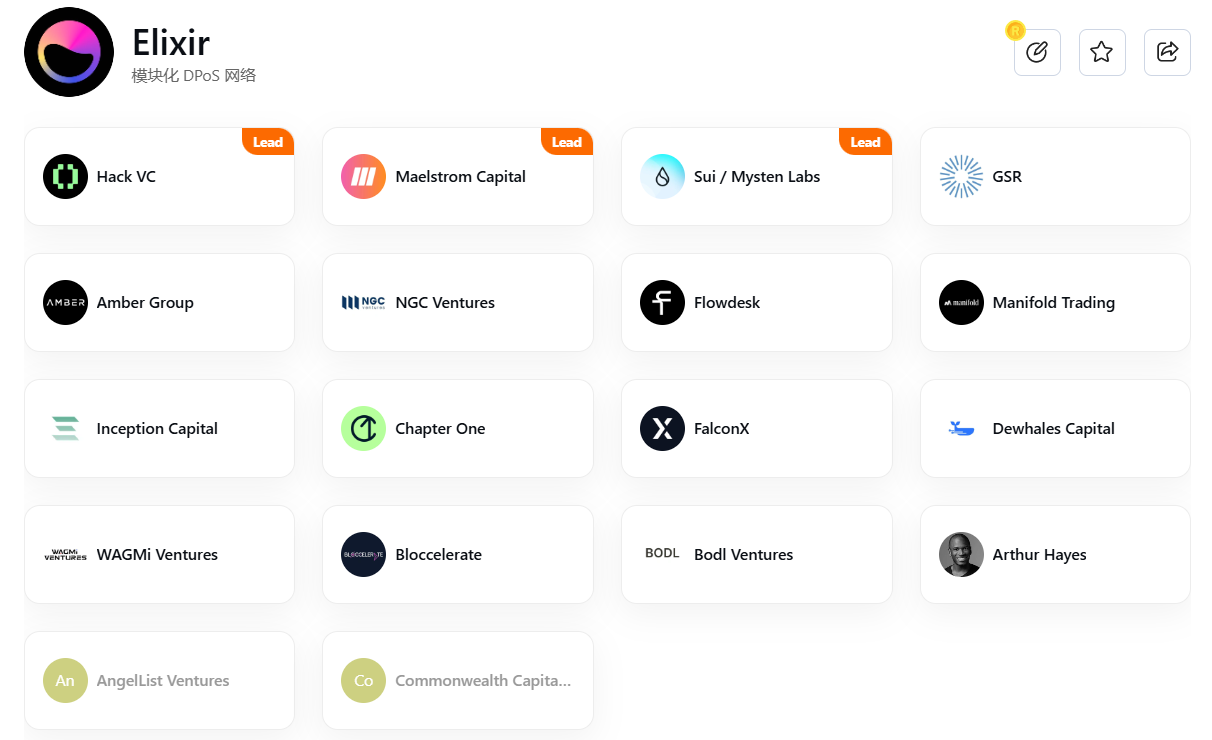
In March 2024, Elixir announced an $8 million funding round led by Maelstrom Capital and Mysten Labs, with participation from GSR, AmberGroup, and others. Including previously disclosed rounds, total funding now reaches $17.6 million.
Broad Recognition: Elixir’s Expanding Partnership Map
Currently, Elixir has integrated with over 30 leading DEXs such as Vertex, RabbitX, Bluefin, Apex, and Orderly. Through Elixir, users can provide liquidity to orderbook DEX trading pairs. LP providers benefit from diversified staking rewards via Elixir’s LP incentives or partnership reward programs.
Looking ahead, Elixir plans to integrate with prominent DeFi protocols like Pancakeswap, Paradex, and Synfutures, further expanding its ecosystem—a future worth anticipating.

The number of partners has not compromised Elixir’s quality of liquidity provision.
Thanks to its superior liquidity aggregation and ecosystem collaboration capabilities, Elixir has supplied over $1.25 billion in capital capacity to orderbook exchanges, providing close to or exceeding 50% of liquidity for popular platforms like Bluefin, RabbitX, Orderly Network, and Vertex.

Elixir’s performance so far proves that its mission to enhance DeFi liquidity is more than just words. These outstanding results are made possible by Elixir’s unique technical architecture.
Mastering Liquidity Management: Elixir’s Technical Edge
Efficient liquidity integration relies on Elixir’s sophisticated network architecture. This architecture consists of two systems: off-chain and on-chain.
-
Off-Chain System
First, Exchange Data Sources collect market data from various exchanges. These sources hold read-only credentials and subscribe to real-time data feeds. They then broadcast this data to Data Aggregators.
Data Aggregators gather data from multiple exchange sources, combine them into a deterministic data framework, cryptographically sign the data to ensure integrity and immutability, and finally broadcast the signed data to validators and audit nodes.
Validator Network operates via a Delegated Proof-of-Stake (DPoS) mechanism. Validators verify data correctness, requiring 66% consensus to confirm validity. Users delegate their stake to validators, and those holding the most stake receive the largest rewards and participate in consensus. This ensures decentralization and security.
Relay Infrastructure uses secure enclave technology (with plans to transition to MPC infrastructure) to manage exchange API keys. Relay nodes check whether encrypted order proposals have achieved 2/3 consensus, then sign and send these orders to exchanges. This system bridges off-chain and on-chain operations, ensuring all trades are verified and signed.
-
On-Chain System
Audit Nodes receive data frames and order proposals from data aggregators and relay nodes. They execute strategies to verify proposal correctness. If malicious activity is detected, audit nodes invoke on-chain functions in the Controller to take action. They ensure data and transaction accuracy.
Controller is a smart contract managing staking, rewards, and penalties. In disputes, it checks for 2/3 consensus among active validators and penalizes malicious actors. The Controller enforces fairness and security via on-chain smart contracts.
Elixir’s architecture tightly integrates off-chain and on-chain systems to ensure efficient data processing and secure transaction validation. The validator network achieves decentralization via DPoS, the relay infrastructure guarantees data integrity, and audit nodes plus the controller add layers of security and fairness. This multi-layered design allows Elixir to deliver efficient, secure, and reliable services in a decentralized environment.
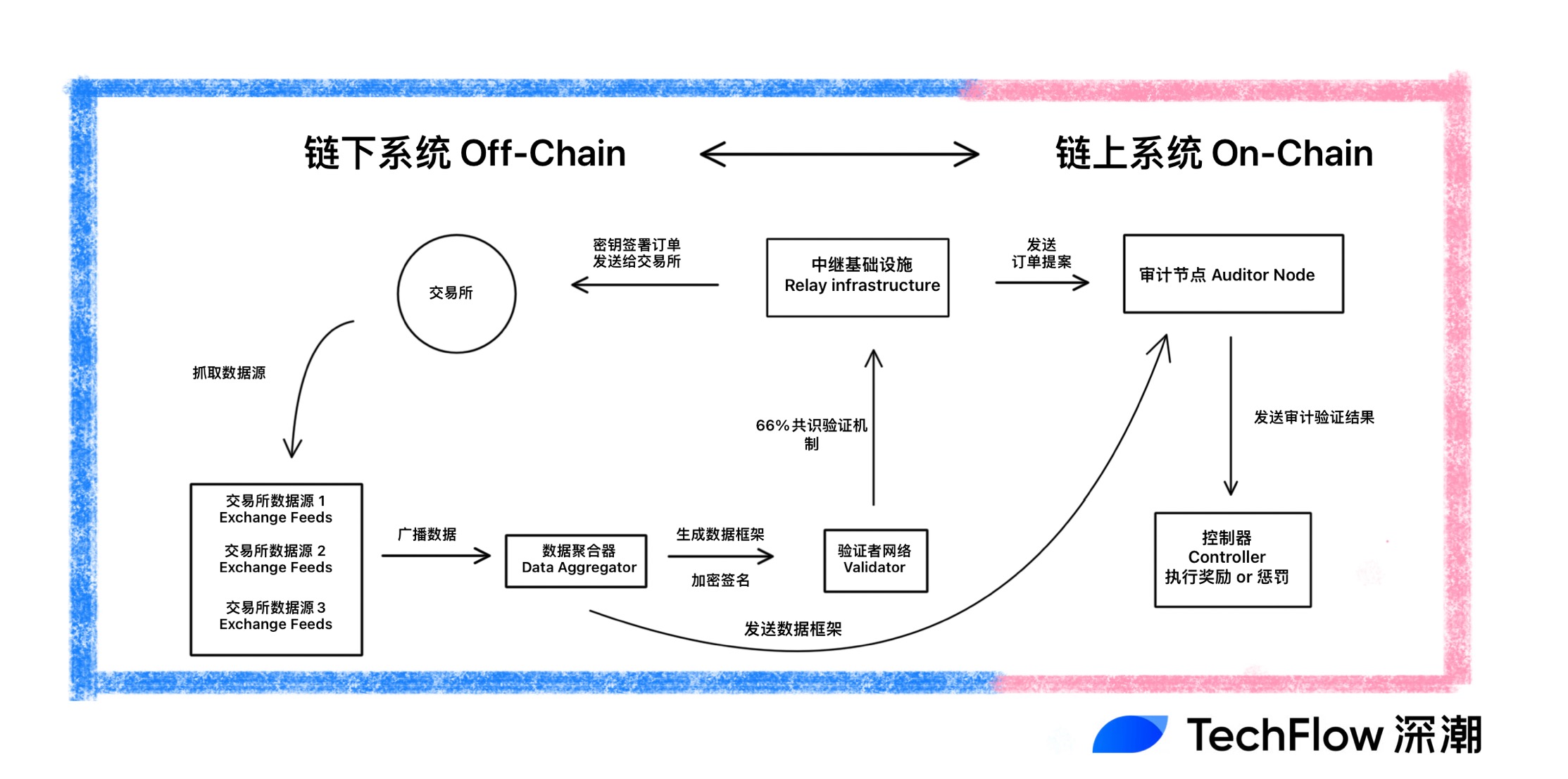
Figure: Elixir Network Architecture Workflow
Additionally, Elixir employs advanced algorithmic market-making techniques to manage and optimize liquidity supply. Its core strategy includes a variant of the infinite Avellaneda-Stoikov algorithm, which uses a random walk model to determine quote timing, delivering a CEX-like experience for traders and optimal LP conditions for liquidity providers.
To prevent market manipulation and gaming, Elixir introduces randomness into its algorithms and uses SGX secure enclaves to generate random numbers. These numbers are synchronized among validators via verifiable random functions.
Through a combination of unique network architecture and algorithmic liquidity management, Elixir offers an innovative liquidity provision model—ensuring efficiency and security while acting as a bridge between DeFi projects, enhancing interoperability and liquidity flow.
Recently, Elixir plans to launch deUSD, a collateralized synthetic dollar, aiming to further improve partner liquidity and boost returns for liquidity contributors.
Stable Value and Diverse Yields: Why Synthetic deUSD Matters
As DeFi becomes a key pillar of on-chain activity, synthetic assets are gaining increasing importance. In the blockchain world, synthetics directly track the value of underlying assets, eliminating complex intermediate steps and saving users transaction fees and slippage. As an effective tool to minimize friction, synthetic assets have taken root in crypto, with rising market caps and broad ecosystem adoption. Various on-chain protocols now treat synthetics as vital components of liquidity sourcing.
Synthetic dollar assets enable unified liquidity management and address poor inter-protocol coordination. Even if DeFi protocols differ, a synthetic dollar—pegged 1:1 to USD—is universally accepted.
Recognizing the value of synthetic assets for DeFi liquidity, Elixir is launching deUSD, a fully collateralized synthetic dollar.
Resilient to Market Volatility: deUSD’s Price Stability Mechanism
Currently, deUSD is backed by stETH, with support for additional collateral types planned. Its standout feature is the use of a delta-neutral strategy and dynamic asset allocation to mitigate price volatility risks of collateral.
How does the delta-neutral strategy work?
Anyone can mint deUSD by depositing stETH. For every stETH deposited, an equivalent short position in ETH is opened in the market. This short position captures positive funding rates, generating additional yield for deUSD.
When funding rates turn negative, deUSD dynamically adjusts its asset composition based on the balance of the OCF (Open Collateral Fund, supporting deUSD’s value) to maintain price stability.
Specifically:
In negative funding rate environments, borrowing increases and OCF balance gradually declines.
As OCF drops, deUSD adjusts its asset mix—reducing exposure to long-term base yields and increasing allocations to sDAI and other stable-yield assets.
For example, when OCF hits the 100% high-water mark, deUSD’s composition is “80% long-term strategy + 20% sDAI / stable-yield assets.”
When OCF drops to 75%, the mix shifts to “70% long-term strategy + 30% sDAI / stable-yield assets.”

Clearly, unlike conventional “stablecoins,” deUSD was designed from day one with a unique stability mechanism—to enhance user and partner experience within the ecosystem. Users gain peace of mind when providing liquidity, and partner protocols enjoy stable, reliable liquidity regardless of market swings.
Powered by Elixir Protocol: deUSD Is Truly Decentralized
The powerful validator network is at the heart of the Elixir protocol. Comprising over 13,000 independent global nodes, each actively participates in transaction validation and consensus. This decentralized validator network eliminates single points of control, shielding the protocol from centralized interference and ensuring transparency and security.
Backed by Elixir’s validator network, users can mint or redeem deUSD simply by interacting with smart contracts—no centralized approval required. User minting power rests entirely in their own hands, guaranteeing full decentralization throughout the process.
As a core product of the Elixir protocol, every deUSD transaction is supported by the validator network, making it a truly decentralized and stable digital asset.

Figure: Current Global Validator Node Count of Elixir
Beyond its robust validator network, Elixir leaves ample room for innovation around deUSD. High interoperability enables deUSD to freely circulate across chains and protocols, offering broad utility and strong value capture. The protocol’s scalability also allows deUSD to evolve with user and market demands, ensuring long-term, stable operation.
A Positive Flywheel: Elixir Can’t Stop with deUSD
-
Offers accessible and diversified yield options for users
Leveraging Elixir’s powerful resource integration, deUSD abstracts products and exchanges across multiple public chains into a single yield-generating asset. This reduces complexity for deUSD holders when operating across different blockchains and exchanges, simplifying asset management and turning more institutions and individuals into potential liquidity providers. deUSD acts like a universal pass within Elixir’s ecosystem—users can leverage it across multiple platforms and chains via Elixir, enabling seamless cross-chain interactions.
-
Protocols prefer stable-value collateral
Compared to volatile assets like ETH, deUSD—with its built-in price stability—is likely more appealing to decentralized exchanges. This “stability” benefits not only the platform but also reflects responsibility toward users. Several partners already accept deUSD as collateral, and it is expected to become the primary liquidity asset for orderbook DEXs within the ecosystem.
Moreover, Elixir’s long-term plan includes extending this staking mechanism to centralized exchanges that accept deUSD as collateral. This would allow users to utilize deUSD not only on DEXs but also on select CEXs for trading and lending, unlocking additional yield and opportunities.
deUSD introduces new use cases for Elixir, providing users with stable and diverse yield channels, significantly boosting overall liquidity and competitiveness for both Elixir and its partners.
Elixir’s Ecosystem Has Vast Potential—How Can You Participate?
With its ability to aggregate massive liquidity and introduce a synthetic dollar, Elixir appears well-prepared for DeFi’s next chapter. So how can on-chain users get involved?
Apothecary
In March, Elixir launched the Apothecary campaign, rewarding users with points (“Elixirs”) for contributing to Elixir’s liquidity network. With mainnet launch approaching, now is still a great time to start staking.
Users can participate in Apothecary by completing profile information and providing liquidity. See the Apothecary page for details.
Complete Profile:
-
Go to the Apothecary participation page
-
Connect wallet
-
Link social media accounts to receive welcome points

Provide Liquidity:
-
Visit Elixir’s liquidity page: https://agg.elixir.xyz
-
Connect wallet
-
Select a trading pair and provide liquidity

deUSD Staking Rewards (Coming Soon)
Upon mainnet launch, users can choose to withdraw their staked ETH or directly mint it into deUSD. Unwithdrawn ETH in contracts will be automatically converted into an equivalent amount of deUSD.
Elixir is also boosting deUSD staking rewards, increasing total Apothecary points from 20 million to 50 million. deUSD stakers will receive 3x points, and users providing liquidity for deUSD/USDC on Curve will earn 5x points.
Once deUSD launches, an 8-week deUSD Farming program will begin, delivering substantial staking rewards in a short period.
New Partnerships Ahead?
Back in April, Elixir tweeted a cryptic teaser image隐约 showing the Pendle logo. Notably, Elixir had previously used similar hints to clearly signal upcoming partnerships.
It now seems certain that Elixir will integrate with Pendle. Given the imminent deUSD launch, it’s reasonable to expect Pendle will accept deUSD as collateral—making deUSD’s TVL performance highly anticipated.
Similarly, Elixir recently posted another teaser on X, featuring a pixelated dYdX logo. With mainnet launch near, integration with dYdX seems imminent. As dYdX joins, Elixir’s partnership map will expand further, connecting more top-tier projects and shaping DeFi’s future.


Conclusion
In this atypical bull market, limited liquidity and fragmented attention have prevented any meaningful “sector rotation.” Once-promising tokens remain dormant, each waiting for their moment.
Though no clear sector-wide rally has emerged to lift token prices, DeFi Summer never truly ended—financial innovation on-chain has continued. DeFi may no longer sit at the center of the crypto universe, but after years of market testing, it has evolved from a trendy tool into a crucial, irreplaceable source of yield for many on-chain players—even whales.
As a key DeFi infrastructure component, Elixir—having witnessed both DeFi’s highs and lows—has the potential to revitalize the space and redefine market expectations.
Furthermore, deUSD will bring more liquidity, users, and open interest into Elixir’s partner exchanges and DeFi protocols, ultimately helping DeFi become “great again.”
In the risky yet opportunity-rich world of crypto, innovation and improvement are never too late.
Learn more:
Elixir Official Website: https://www.elixir.xyz/
Elixir Twitter: https://x.com/elixir
Elixir Telegram Community:
https://t.me/elixir_network
Elixir Documentation: https://docs.elixir.xyz/
Apothecary Campaign:
https://www.elixir.xyz/apothecary
Join TechFlow official community to stay tuned
Telegram:https://t.me/TechFlowDaily
X (Twitter):https://x.com/TechFlowPost
X (Twitter) EN:https://x.com/BlockFlow_News
 深潮TechFlow


