What financial licenses are required for a Web3 payment startup?
TechFlow Selected TechFlow Selected
What financial licenses are required for a Web3 payment startup?
Different jurisdictions have adopted varying strategies to balance innovation and regulation, reflecting their unique regulatory priorities and financial ecosystems.
 Navigating Web3 tides with focused insights
Authors: Liu Honglin, Bai Qin, ManQin Law Firm
In today’s interconnected world, cross-border payments are a key driver of global trade, facilitating international transactions and economic growth. As businesses expand internationally, the efficiency and cost-effectiveness of payment systems become increasingly critical. The traditional bank-dominated landscape is rapidly evolving due to the rise of digital currencies and stablecoins.

Digital currencies offer innovative solutions to the high costs and long processing times associated with cross-border payments. Stablecoins, in particular, bridge the gap between the volatility of cryptocurrencies and the stability required for everyday transactions. Because stablecoins are pegged to fiat currencies like the U.S. dollar, they enable faster and more secure transfers, making them an ideal choice for global enterprises.
However, while the widespread adoption of digital currencies simplifies operations, it also brings regulatory challenges. Governments and financial authorities worldwide are struggling to keep pace with technological advancements. Bai Qin, head of ManQin's Hong Kong office, will explore in this article the regulatory environments in Hong Kong, Singapore, the European Union, and the United States, focusing on the various licensing requirements relevant to cross-border payments in these jurisdictions.
Hong Kong
Hong Kong leads in innovation within digital payments, supported by a robust regulatory framework. The Hong Kong Monetary Authority (HKMA) is the primary regulator overseeing payment systems, stored value facilities (SVFs), and e-money. Meanwhile, Hong Kong Customs regulates money service operators (MSOs).

Below is a summary of the main payment-related licenses in Hong Kong:
-
Stored Value Facility (SVF) License
-
Money Service Operator (MSO) License
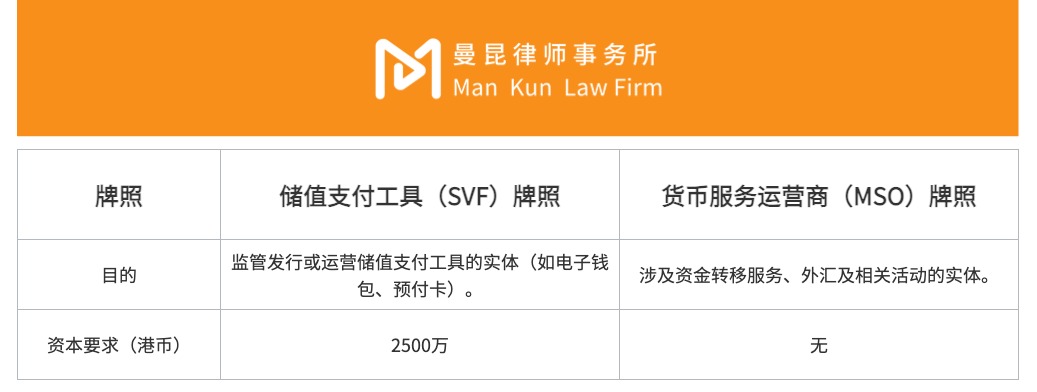
Notably, under Hong Kong’s anti-money laundering regulations, there are several exemptions from the MSO license requirement:
-
Authorized institutions (e.g., banks);
-
SFC-licensed corporations operating money services incidental to their core business;
-
Authorized insurers conducting money services incidental to their core business;
-
Authorized insurance brokers offering money services as part of their core business;
-
Appointed insurance agents providing money services related to their principal activities;
-
Holders of SVF licenses whose money services are ancillary to their main operations; or
-
System operators or settlement institutions of designated retail payment systems whose money services are incidental to system operation or settlement.
Currently, the HKMA website lists 12 companies holding SVF licenses:
-
33 Financial Services Limited
-
Alipay (Hong Kong) Limited
-
Autotoll Limited
-
ePaylinks Technology Co., Limited
-
HKT Payment Limited
-
Octopus Cards Limited
-
PayPal Hong Kong Limited
-
RD Wallet Technologies Limited
-
TNG (Asia) Limited
-
UniCard Solution Limited
-
WeChat Pay Hong Kong Limited
-
Yintran Group Holdings Limited
Additionally, licensed banks in Hong Kong may be recognized as SVF license holders if they issue or assist with SVFs and receive approval from the HKMA. Currently, these banks include:
-
Bank of China (Hong Kong) Limited
-
Bank of Communications (Hong Kong) Limited
-
Dah Sing Bank, Limited
-
The Hongkong and Shanghai Banking Corporation Limited
The limited number of SVFs in Hong Kong reflects the rigorous and highly specialized nature of the SVF licensing process, which is specifically designed for entities managing SVFs such as e-wallets and prepaid cards. Licensees must adhere to strict capital requirements, operational standards, and consumer protection measures to ensure secure handling of digital funds and compliance with anti-money laundering regulations.
In contrast, over one thousand companies in Hong Kong hold MSO licenses. The MSO framework is more flexible and applies to a wide range of monetary activities such as remittances and currency exchange, supporting a broader variety of business models. In our recent article on OTC crypto trading, we noted that OTC virtual asset businesses in Hong Kong cannot convert between virtual assets but are allowed to provide conversion services between virtual assets and fiat currencies, provided they obtain an MSO license.
How do stablecoins fit into Hong Kong’s regulatory framework for cross-border payments?
Stablecoins represent a significant innovation in finance, particularly gaining traction in cross-border payments. The HKMA’s regulatory framework includes a dedicated sandbox for stablecoin projects, allowing companies to test their stablecoin solutions in a controlled environment before full deployment. This sandbox approach enables issuers to address potential regulatory and operational issues in a monitored setting—crucial for integrating stablecoins into the cross-border payment ecosystem. On July 18, 2024, participants including RD InnoTech, HKT Limited, Standard Chartered Bank (Hong Kong) Limited, Animoca Brands, and Zondacore Technology (Hong Kong) Limited entered the sandbox. Each participant is expected to demonstrate:
-
A genuine interest and viable plan for issuing fiat-referenced stablecoins
-
A specific plan for participating in the sandbox
-
A reasonable prospect of meeting regulatory requirements
Once Hong Kong’s stablecoin regulatory regime becomes effective, it will be especially important for overseas companies engaged in stablecoin activities (such as issuers, agents, and intermediaries) without authorization in Hong Kong to ensure they do not actively market their fiat-referenced stablecoins to the Hong Kong public. Such activity would trigger licensing obligations. The HKMA will consider multiple factors to determine whether someone is “actively marketing” fiat-referenced stablecoins to the Hong Kong public, including but not limited to:
-
Language used in marketing materials
-
Whether content targets individuals residing in Hong Kong
-
Whether websites use Hong Kong domain names
The HKMA’s evolving approach to stablecoin regulation reflects broader international trends toward alignment and enhanced financial stability. Recent global regulatory discussions and frameworks—such as guidelines from the Basel Committee on Banking Supervision and recommendations from the Financial Action Task Force (FATF)—have influenced Hong Kong’s strategy. The HKMA’s framework aims to balance innovation promotion with stringent regulatory standards, ensuring Hong Kong remains a competitive and secure fintech hub.
Singapore
Singapore is renowned for its forward-thinking approach to digital finance, led by the Monetary Authority of Singapore (MAS). MAS provides clear guidelines to regulate digital payments, ensuring a secure and innovative financial environment. The cornerstone of this framework is the 2019 Payment Services Act, which consolidates payment regulations and establishes a comprehensive licensing regime covering various payment services, including digital and cryptocurrency transactions. Additionally, the Payment Services (Amendment) Act, effective January 4, 2021, addresses emerging risks in the digital payment token space, expands the scope of the original act, and imposes additional measures on token service providers to mitigate money laundering and terrorism financing risks and safeguard customer assets.

Singapore offers three main categories of licenses for payment service providers:
-
Major Payment Institution (MPI) License
-
Standard Payment Institution (SPI) License
-
Money-Changing (MC) License
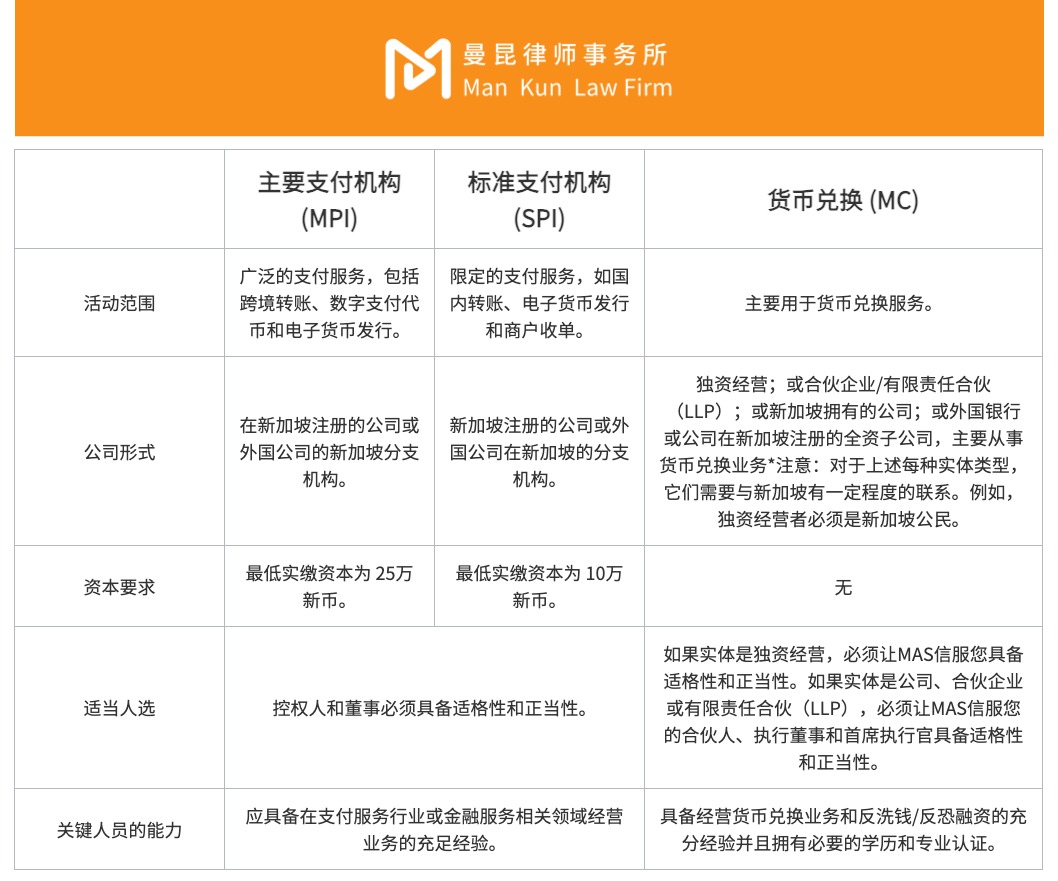
Under the MPI license, companies can conduct multiple payment services without being subject to the following transaction volume or float thresholds:
-
Monthly transaction value of SGD 3 million per payment service (excluding e-money issuance and money-changing services)
-
Monthly transaction value of SGD 6 million for two or more payment services (excluding e-money issuance and money-changing services)
-
Daily outstanding e-money balance of SGD 5 million
Conversely, if a payment business operates within these threshold limits, it may apply for an SPI license.
As a leading financial center, Singapore plays a pivotal role in the global financial ecosystem. Its strategic location and strong infrastructure make it an ideal destination for enterprises looking to leverage digital currencies.
The adoption of digital currencies and stablecoins in Singapore is steadily growing, driven by a tech-savvy population and a supportive regulatory environment. Stablecoins are particularly popular due to their efficiency and lower transaction costs, making them attractive to both consumers and businesses engaged in cross-border trade. However, the MAS has expressed concerns about price volatility in cryptocurrencies and has taken increasingly firm measures to curb speculative behavior among retail investors.
European Union
The Markets in Crypto-Assets Regulation (MiCA) represents a significant step by the European Union toward a unified regulatory framework for digital currencies and crypto-assets. MiCA aims to provide clear guidelines for the issuance, trading, and custody of cryptocurrencies and other digital assets, ensuring consistency across all 27 member states. This regulation seeks to enhance legal clarity, protect consumers, and promote innovation in the digital asset space, while addressing potential risks such as market manipulation and fraud.

Businesses involved in crypto-asset services must obtain authorization from the relevant national regulatory authority in their home country. Once authorized, they can operate throughout the EU based on the principle of mutual recognition, meaning their license is valid across the entire bloc.
Companies operating Web3-based digital payment systems in Europe typically require the following licenses under MiCA and existing frameworks:
-
Crypto-Asset Service Provider (CASP) License. For businesses offering services such as cryptocurrency exchanges, wallets, or payment processing using digital assets.
-
E-Money Institution (EMI) License. For companies maintaining electronic accounts, facilitating payments, and transferring cash. An EMI license demonstrates a company’s ability to operate securely and transparently within the e-money ecosystem and ensures compliance with applicable financial regulations. Therefore, if a service involves issuing e-money—such as stablecoins or digital wallets—an EMI license is required.
-
Payment Institution (PI) License. For companies providing digital payment and money transfer services that do not involve issuing e-money.
Some companies in Europe hold all three licenses, enabling them to offer a broad range of services including crypto trading, e-money issuance, and digital payment facilitation. This allows greater flexibility across different financial activities.
The harmonized regulatory environment created by MiCA has significant implications for cross-border digital payments. It enables businesses to leverage digital currencies more effectively, streamline payment processes, and reduce transaction costs. A clear regulatory framework supports the growth of digital payment solutions and strengthens trust among participants. This reinforces the EU’s leadership position in integrating digital currencies into global commerce and enhances its competitiveness in international markets.
For example, Bitpanda, a prominent fiat-to-crypto broker in the European Union, obtained a payment provider license in 2019 under Austrian financial regulations and pan-European fund management laws. Recently, Bitpanda partnered with Deutsche Bank in Germany to enable real-time payments through an API-based account solution, giving Bitpanda access to German International Bank Account Numbers (IBANs).
What is the status of stablecoins under the new MiCA, and what are the related licensing requirements?
Under MiCA, stablecoins are categorized into two main types serving as means of payment and exchange:
Electronic Money Tokens (EMTs) are crypto-assets whose value is stabilized by anchoring to a single fiat currency—for example, Circle’s USD Coin. EMTs are based on distributed ledger technology and backed by real-world assets.
Under the MiCA framework:
-
All EMTs are supervised and regulated by the European Banking Authority (EBA), requiring issuers to hold an e-money license.
-
Issuers must be registered in an EU member state and obtain a MiCA license.
-
EMT issuers must have a registered office in the EU.
-
All EMT issuances must publish a white paper, including those qualifying for EMT exemptions.
However, EMT licensing does not apply when:
-
The average outstanding amount of the EMT does not exceed EUR 5 million, and persons responsible for management have not been convicted of any financial crime; or
-
The EMT is used solely for specific payment transactions:
-
Within a limited network of service providers or for a limited range of goods or services (e.g., usable only at specific retail stores); or
-
For digital goods and services where the operator is not merely an intermediary but adds value—for instance, by providing access or search functionality—provided the goods and services are exclusively digital.
By comparison, Asset-Referenced Tokens (ARTs) stabilize their value by referencing multiple assets—such as fiat currencies, physical commodities, cryptocurrencies, or a mix thereof—for example, a basket of currencies, commodities, or other crypto assets. Examples include PAXCG and DIAM.
Under the MiCA framework:
-
Must be registered in an EU member state and obtain MiCA authorization.
-
All ARTs are supervised by the European Securities and Markets Authority (ESMA), unless deemed "significant."
-
ART issuers must have a registered office in the EU.
-
ARTs not pegged to the euro are restricted to preserve the monetary sovereignty of the EU.
-
All ART issuances require a white paper, including those qualifying for ART exemptions.
Similarly, ART licensing is not required when:
-
The ART is issued exclusively to qualified investors and can only be held by them; or
-
The total value of ARTs issued does not exceed EUR 5 million over a 12-month period, and the issuer is not linked to another exempted issuer.
Are the regulatory requirements the same for all types of EMTs and ARTs? Not exactly. If EMTs or ARTs are classified as "significant" by the EBA, they face additional requirements:
-
Supervision by the EBA;
-
Maintenance of remuneration and liquidity management policies; and
-
Stricter reserve requirements and liquidity stress testing.
An EMT or ART is considered “significant” if it meets at least three of the following criteria:
-
More than 10 million holders.
-
Market capitalization or reserve asset size exceeding EUR 5 billion.
-
Average daily transaction count exceeding 2.5 million, with average transaction value exceeding EUR 500 million.
-
Issuer designated as a “gatekeeper” under the Digital Markets Act.
-
Significance of the issuer’s international activities, particularly in payments and remittances.
-
Interconnectedness of the ART or EMT and its issuer with the financial system.
-
The issuer operates at least one additional ART or EMT and provides at least one crypto-asset service.
United States
In the United States, digital payment companies must navigate a complex regulatory landscape to operate legally. Primarily, they are required to obtain money transmitter licenses, which most states mandate for any company engaging in money transmission activities—including digital payments. Each state has its own specific requirements and regulations, making compliance intricate. Additionally, businesses must register with the Financial Crimes Enforcement Network (FinCEN) as a money services business. This federal registration covers activities such as money transmission, exchange, and dealing.

Depending on the specific services offered and the states in which they operate, companies may need additional state-level licenses. For example, the Office of the Comptroller of the Currency (OCC) has recently begun granting special-purpose national bank charters to fintech firms, allowing them to operate across state lines under a single federal license. This initiative aims to provide digital payment companies with a clearer regulatory framework and streamline operations. Furthermore, individual states such as New York and California have their own specialized agencies—like the New York State Department of Financial Services (NYDFS) and the California Department of Financial Protection and Innovation (DFPI)—that enforce state-specific rules and issue licenses for digital payment activities.
The U.S. regulatory environment for digital payments continues to evolve in response to emerging technologies and financial innovations. For instance, proposed federal legislation seeks to establish clearer classification and regulatory guidance for digital assets, including stablecoins and cryptocurrencies. This evolving framework aims to strike a balance between fostering innovation and protecting consumers, ensuring digital payment systems operate within a secure and well-defined regulatory context. As a result, industry participants must stay informed about current and upcoming regulatory changes to maintain compliance and adapt to the shifting landscape.
Conclusion
As illustrated in this article, each jurisdiction examined adopts distinct strategies to balance innovation with regulation, reflecting their unique regulatory priorities and financial ecosystems. Hong Kong’s framework highlights a blend of innovation and strict regulatory oversight through targeted licensing for stored value facilities and money service operators, along with a regulatory sandbox approach for stablecoin initiatives. Singapore’s Payment Services Act offers a broad and streamlined regulatory model for diverse payment activities, incorporating strong anti-money laundering and counter-terrorism financing safeguards. The EU’s MiCA and the revised Payment Services Directive (PSD2) provide a comprehensive regulatory structure for digital payments and electronic money, promoting market integration while ensuring consumer protection. In the United States, the intricate web of federal and state regulations—including money transmitter licenses and FinCEN registration—underscores the complexity of operating across multiple jurisdictions. Navigating these diverse regulatory landscapes requires a deep understanding of regional requirements and proactive compliance efforts to ensure businesses can efficiently manage their cross-border digital payment operations within secure and regulated frameworks.
Join TechFlow official community to stay tuned
Telegram:https://t.me/TechFlowDaily
X (Twitter):https://x.com/TechFlowPost
X (Twitter) EN:https://x.com/BlockFlow_News