Why didn't Trump mention Web3 in his speech?
TechFlow Selected TechFlow Selected
Why didn't Trump mention Web3 in his speech?
Bitcoin is "useful through being useless," while Ethereum is "useful through being useful."
 Navigating Web3 tides with focused insights
Author: Meng Yan's Thoughts on Blockchain
Trump’s 50-minute speech at the Bitcoin conference in Nashville on July 27 has been hailed as another milestone event for the crypto industry. But afterward, someone did a tally and found that Trump didn’t mention Ethereum, blockchain, or Web3 at all. The one time he seemed to reference Vitalik was later discovered to be a mishearing.
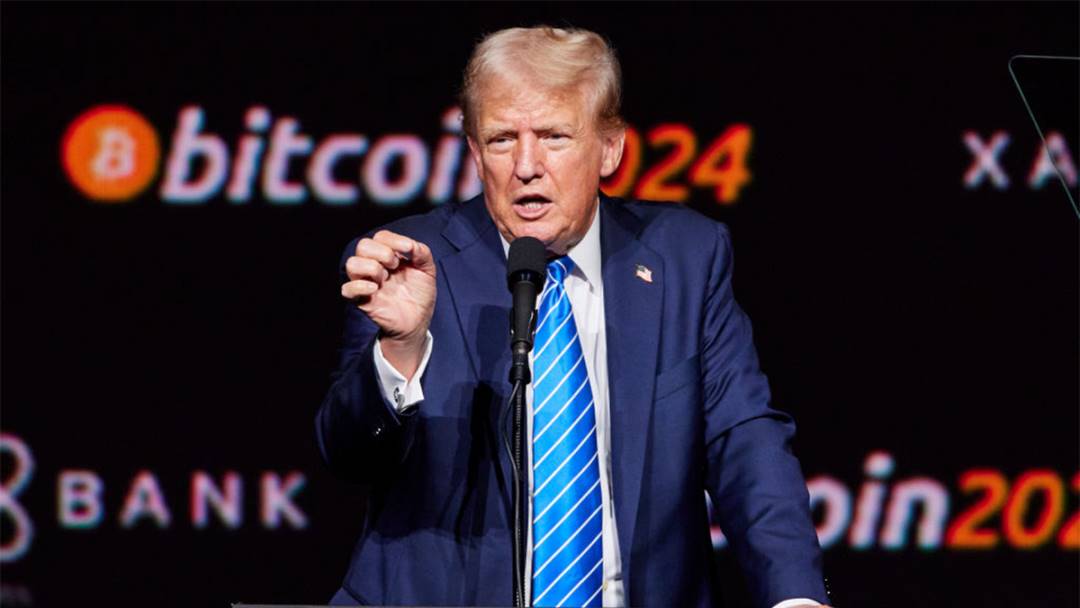
Why didn’t Trump bring up Web3? Of course, I don’t know the exact reason—I’d have to ask the guy who wrote his speech, reportedly David Bailey, CEO of Bitcoin Magazine. But if you place this event within the broader context of the entire crypto industry, it’s actually not hard to understand.
In short, Trump’s speech essentially reflected the views of the progressive Bitcoin maximalist camp.
Bitcoin and Ethereum are the two dominant leaders in the crypto space, often compared side by side. Yet they are fundamentally different—so much so that they represent two entirely distinct schools of thought: Bitcoin embodies “usefulness through uselessness,” while Ethereum stands for “usefulness through utility.”
Bitcoin aims to be digital gold—the benchmark of value in the digital world—and nothing more. It has no other purpose, especially no functional use. Precisely because it lacks utility, you cannot analyze it from a utilitarian perspective or measure its value using conventional metrics. This makes Bitcoin invincible—you simply can't conceive of a logical way to defeat it. On the flip side, Bitcoin leaves little room for application development or ecosystem building. You can hardly build anything on top of it. Many Bitcoin supporters insist repeatedly that Bitcoin is, and should remain, the first and only blockchain application—that it fully captures the legitimate value of blockchain technology, that everything blockchain should do, Bitcoin already does, and anything beyond Bitcoin is unnecessary. These views typify the dogmatic stance of Bitcoin maximalism. This is, of course, an extreme form of admiration for Bitcoin, but it also reflects a resignation to Bitcoin’s inability to serve as infrastructure supporting broader value creation.
Ethereum is different. Its original goal was to become a "world computer," and today it positions itself as the settlement layer for the digital economy—a specialized computer, something useful from the outset designed as foundational infrastructure. This is Ethereum’s strength, but also its vulnerability. Because it is useful, its utility can be measured and broken down into various metrics—performance, total value locked (TVL), number of users, throughput, etc. Since Ethereum has utility, in theory, if someone builds a blockchain that outperforms Ethereum across all these dimensions, then it would be a more useful blockchain and could potentially replace Ethereum. Since 2017, countless “Ethereum killer” narratives have emerged, some achieving high valuations—at least temporarily—precisely because of this logic.
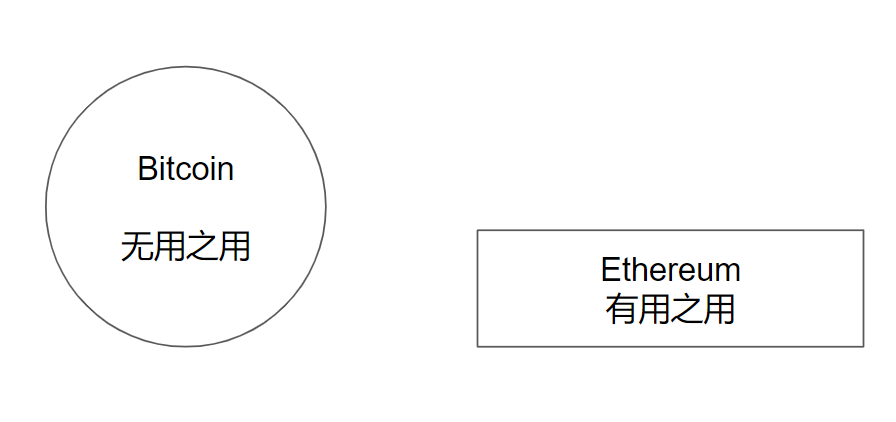
So we might compare them like this: Bitcoin is like a solid sphere—complete and self-contained—but you can’t build structures on top of it. Ethereum is like a flat platform, offering excellent conditions for building upper layers, yet inherently more fragile than Bitcoin.
Trump’s speech, though long, merely revolved around Wall Street’s Bitcoin-centric logic, spiraling upward in reinforcing the idea: affirming Bitcoin’s status as digital gold, expressing confidence in its value, and promising supportive policies if elected—wave after wave, but no more than that. He didn’t touch on any other aspects, certainly not on how blockchain could transform internet application paradigms.
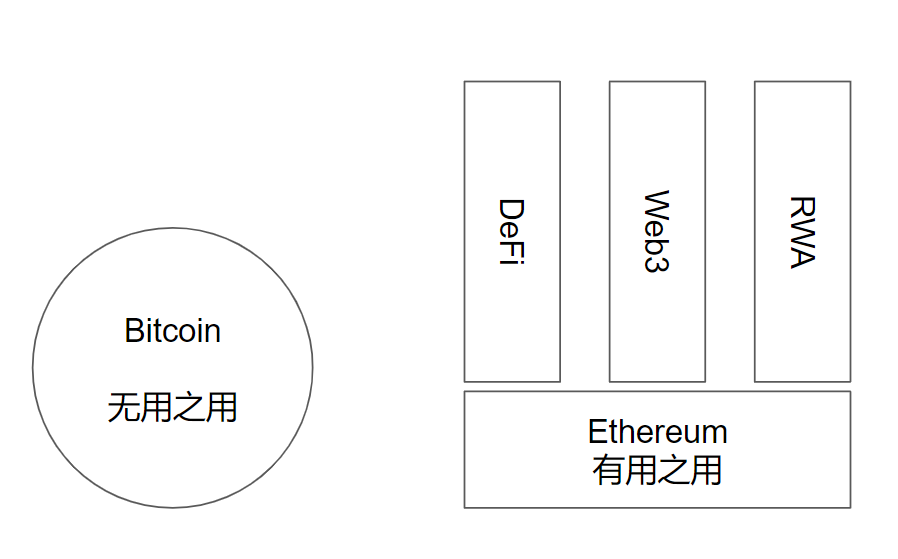
Bitcoin and Ethereum offer different promises: Bitcoin seeks to secure its position as digital gold and keep growing its market cap. Ethereum lays the groundwork, providing support for applications such as DeFi, Web3, and RWA.
I don’t think Trump personally understands the industry in such detail. Therefore, his speech mainly reflects the long-standing position of the Bitcoin Magazine crew: finally, we’ve established Bitcoin as a mainstream, compliant asset; now we can bring all the financial products and services that exist around traditional assets like gold and apply them to Bitcoin. Wall Street likes this narrative. As long as clients want to trade, there are commissions to earn.
By contrast, creating new technologies, tools, platforms, and application paradigms—that’s Silicon Valley’s domain. So initiatives like building DeFi, Web3, RWA, or enterprise blockchains on Ethereum can’t expect enthusiastic support from Wall Street right away. You need to prove their viability first, and only then will Wall Street jump in.
Of course, this doesn’t mean that Trump’s statements—if actually implemented—would hold no significance for DeFi, Web3, or RWA. Their impact would still be substantial. First, a massive influx of capital into digital assets would naturally spill over into these higher-level ecosystems. Second, Trump’s suggestion about replacing the SEC leadership is particularly intriguing. While Gary Gensler may be unpopular, to be fair, during his tenure he has largely given Bitcoin a green light, refraining from excessive interference. From a Bitcoin standpoint alone, even if you wouldn’t give him top marks, his performance has certainly been acceptable. Where Gensler has truly been conservative is in his strong resistance toward the Ethereum ecosystem, especially Web3. For instance, Hester Peirce’s “Token Safe Harbor” proposal was drafted but shelved indefinitely under his watch, severely hindering Web3 development. Therefore, replacing Gensler might not matter much for Bitcoin, but could actually benefit Web3.
If the U.S. wants to become a haven for Web3, the SEC’s stance matters far more than Wall Street’s. Only by allowing Web3 projects to naturally and reasonably use tokens for user incentives and governance, while implementing effective regulation and firmly cracking down on scammy token issuers and fraudsters, can Web3 gain a sustained development cycle and build real business momentum. Only then can this industry finally break free from its boom-and-bust cycles.
I don’t know how deeply Trump grasps these issues, but it seems unlikely that Kamala Harris would move in this direction. The more someone believes they represent the forward march of history, the more reckless they tend to be when infringing on individual freedoms and rights. Thus, this U.S. election truly carries significant implications for the Web3 industry. Let us wait and see.
Join TechFlow official community to stay tuned
Telegram:https://t.me/TechFlowDaily
X (Twitter):https://x.com/TechFlowPost
X (Twitter) EN:https://x.com/BlockFlow_News
 Yan Meng