How Credible Are Trump's Promises at the Bitcoin Conference?
TechFlow Selected TechFlow Selected
How Credible Are Trump's Promises at the Bitcoin Conference?
Trump's True "Love" for Bitcoin or Just "Playing Along"?
 Navigating Web3 tides with focused insights
Author: Wu Huoqiu Jiaozhu
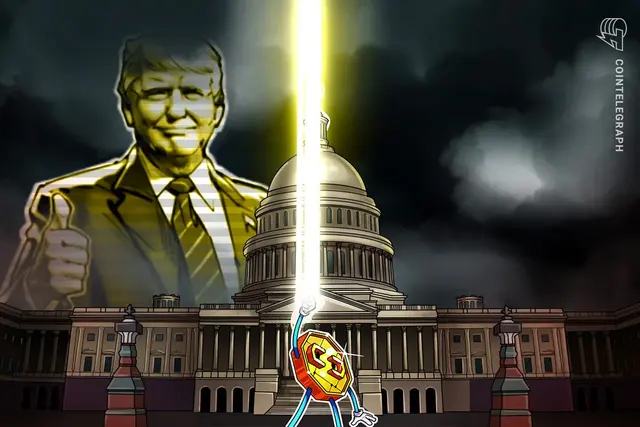
Recently, Trump attended the 2024 Bitcoin Conference as a top-tier guest, delivering a series of promises that, to crypto enthusiasts, sounded like nothing short of "sweet talk." He expressed near-unreserved affection for Bitcoin—claiming its market cap would surpass gold, vowing to remove the SEC chair if elected due to their crypto-hostile stance, and pledging to retain government-staked Bitcoin as a strategic reserve. It was almost as if he said outright, "Let America go ALL in on Bitcoin." The audience responded with thunderous applause. With appearances from figures like Trump, this year’s conference became the most high-profile Bitcoin summit in history.
"ETFs, SEC, interest rate hikes, elections…" As we observe how these focal points—centered almost entirely in the United States—have sequentially exerted massive influence over the crypto market, it's clear that the U.S. has emerged as the dominant force, effectively holding the "pricing power" over Bitcoin and other digital assets. The upcoming U.S. presidential election will have particularly profound implications for the crypto market, prompting the crypto community to closely monitor developments in American politics.
Trump’s repeated gestures of goodwill toward crypto assets have been seen by many as positive news, while others believe it’s merely performative—a calculated move to win votes. Some even suspect he’ll “pull up his pants and walk away” once elected, or worse, “burn the bridge behind him.” So, just how credible are Trump’s sweet words? Who is right? To answer this, we must examine the platforms and values of America’s two major political parties—the Republicans and Democrats…
Why Are Bitcoin, Trump, and the Republican Party Aligned?
Many assume that in an election year marked by partisan divide, crypto users and voters face suppression under the Democrat-led administration. Thus, Trump’s outreach serves to attract more votes and generous donations ahead of the election. This logic makes perfect sense—but it also raises concerns about whether the Republicans and Trump himself might abandon their pro-crypto stance after securing victory. History offers numerous precedents of such betrayal.
However, such worries may be overstated. Many people only see one side of the story. A crucial context often overlooked is the long-standing principles and values of the Republican Party to which Trump belongs.
In short, the core values shared by the Republican Party and Trump determine the general direction of future policy. These include support for free markets, individual economic freedom, conservative social views, a certain degree of right-leaning conservatism, advocacy for technological innovation, emphasis on personal privacy and security, and opposition to centralized monetary control and excessive financial regulation. Overall, those on the political right tend to be more supportive of technological innovation and market autonomy.
It’s not hard to see that Bitcoin’s foundational idea—returning financial power to individuals—aligns perfectly with the Republican ideals of personal and market freedom. Moreover, Bitcoin is viewed as both an emerging technology and a new investment opportunity, making it naturally favored and supported by conservatives.
We can also see this alignment in Elon Musk, who shares similar views on Bitcoin’s value proposition. In a recent interview, Musk stated he is a believer in American values. While he previously supported Democrats, he now backs Republicans—not out of partisan loyalty, but because he seeks the party that best represents his vision of American values. Currently, he believes the Republican Party better embodies meritocracy, avoids the misuse of DEI (Diversity, Equity, and Inclusion—a hallmark of left-wing ideology), and upholds fundamental American principles like individual liberty. That’s why he now supports the GOP.
Of course, Trump’s speech at the Bitcoin Conference was rather effusive—his promises likely come with caveats. After all, his current goal is primarily electoral gain. Once in office, complex trade-offs will inevitably dilute these pledges, and implementing new policies will surely spark debate.
Finally, the muted market reaction following Trump’s speech speaks volumes. Everyone knows the rule: don’t listen to what he says—watch what he actually does.
Why Aren't Democrats as Enthusiastic About Bitcoin?
As the current ruling party, the Democratic Party’s actions in recent years have made their stance clear. Despite some softening ahead of the election, key figures—including Biden, the SEC chair, and current presidential nominee Kamala Harris—appear largely unenthusiastic about Bitcoin.
Again, it comes down to values. As Musk noted earlier, Democrats clearly lean left in both ideology and policy. Some critics have even labeled them “far-left.” Democratic priorities include environmental impact and sustainability, financial inequality and social justice, and stronger regulatory oversight—all reflecting a worldview that prioritizes collective and public interests over individual freedoms and rights.
Given this left-leaning framework, Bitcoin’s core philosophy—decentralization, personal sovereignty, limited government intervention—is inherently at odds with Democratic values. Hence, figures like Biden and Harris are naturally less inclined to embrace Bitcoin.
No Matter Who Wins, the Historical Momentum Cannot Be Stopped
1) There Are Pro-Crypto Voices Within the Democratic Party
While the Democratic Party leans left, not everyone subscribes to extreme leftist views. The majority remain pragmatic and issue-focused. In fact, Democrats have already signaled intentions to shift toward the political center on market and financial regulation, distancing themselves from far-left positions.
For example, in the vote to overturn SAB 121—the controversial accounting rule hostile to crypto—Republicans passed the resolution in the House 228–182, while Democrats in the Senate approved it 60–38. Though ultimately vetoed by Biden, this shows there is significant pro-Bitcoin sentiment within the Democratic ranks. As crypto gains global traction and mainstream acceptance, further progress is likely.
2) Core American Values
For years, many believed Bitcoin would be swiftly banned as a direct challenge to dollar hegemony. Even if the U.S. couldn’t fully outlaw it, it could marginalize it. Yet it didn’t happen—not only because of Bitcoin’s inherent anti-fragility, but also because Americans struggle to act against their own core values.
America once banned private ownership of gold. But many saw this as a violation of individual liberty and property rights. Its repeal in 1974 was widely celebrated as a restoration of economic freedom and personal rights. While the ban served a purpose during the Great Depression, in hindsight it’s largely viewed as a failed policy—one that restricted freedom without solving underlying economic issues.
Today, Americans understand they cannot easily repeat that history with Bitcoin. First, past failures serve as cautionary tales. Second, unlike physical gold, Bitcoin exists as digital code—impossible to regulate without invasive surveillance into every citizen’s private data.

If the U.S. were to crack down on Bitcoin—a system built on freedom and individual empowerment—it would first have to dismantle the very symbol of liberty itself. In truth, no matter how divided Democrats and Republicans may be, neither would dare tear down the Statue of Liberty—the enduring emblem of freedom, democracy, and the American Dream. These core values are the foundation upon which America stands.
Conclusion
Amidst controversy, cryptocurrencies like Bitcoin continue to grow and evolve. No matter who wins the election, the momentum of history cannot be reversed. Just look: Bitcoin becoming a reserve asset is now just one thin sheet of paper away…
Join TechFlow official community to stay tuned
Telegram:https://t.me/TechFlowDaily
X (Twitter):https://x.com/TechFlowPost
X (Twitter) EN:https://x.com/BlockFlow_News
 白话区块链
白话区块链