








Establishing a Web3 airdrop farming studio: What legal risks should you be aware of?
TechFlow Selected TechFlow Selected
Establishing a Web3 airdrop farming studio: What legal risks should you be aware of?
Web3 airdrop farming studios currently operate in a legal and regulatory gray area, and such studios must properly manage relationships with project teams, clients, and employees.
 Navigating Web3 tides with focused insights
Authors: Shao Shiwei, Zhang Zihao
With the rapid development of blockchain technology and the growing prosperity of the cryptocurrency market, numerous innovative business models have emerged in the Web3 space, among which "airdrop farming studios" stand out as a typical example. These studios participate in promotional campaigns and airdrops launched by project teams to generate returns for themselves and their clients.
Friends planning to establish airdrop farming studios often ask Attorney Shao whether this kind of venture is legally viable. After all, they frequently see online stories about people striking it rich overnight through airdrop farming, which naturally sparks interest—especially if they have some idle funds on hand. If this business proves reliable, they might consider pooling resources with a few close friends to start a side hustle and share future profits.
However, many are new to concepts like crypto, USDT, and Web3, and thus unsure whether setting up such a studio carries legal risks—and if so, where those risk boundaries lie.
So what legal risks should an airdrop farming studio pay attention to during operations?
What Is an Airdrop Farming Studio?
"Airdrop farming," or "airdrop hunting," refers to users participating in early-stage interactions with Web3 projects to qualify for airdrop rewards. Once the project officially launches, the team distributes tokens to eligible users. Users can then cash out by selling these tokens either over-the-counter or after they are listed on exchanges.
At first glance, it may seem that project teams are being "milked" by users. In reality, however, earning airdrop rewards requires users to meet specific criteria set by the project—engaging in various activities that help test for bugs and maintain platform activity. The project team then uses this user-generated data (such as active user counts, transaction volumes, frequency, and TVL) to demonstrate traction to investors and secure higher valuations in fundraising rounds.
Originally intended as incentives for early adopters, airdrops have given rise to a specialized industry in China: airdrop farming studios. These studios mass-register accounts (purchasing large quantities of so-called "triplets"—Gmail addresses, Twitter, and Discord accounts), bind them according to project requirements, and complete designated tasks to mimic real user behavior and maximize chances of receiving future airdrops.
Nevertheless, projects employ Sybil detection mechanisms to identify suspicious accounts. If flagged as a Sybil (typically referring to one individual or entity controlling multiple fake identities to manipulate systems or defraud others—a practice known as a Sybil attack)—users risk disqualification from airdrop eligibility.
What Are the Risks of Running an Airdrop Farming Studio?
1. Where Do Legal Risks Lie?
Is operating an airdrop farming studio even permissible? Currently, this falls into a gray area under Chinese law. Domestic regulations explicitly prohibit Initial Coin Offerings (ICOs) as fundraising vehicles. However, airdrop farming is considered a user-side activity, analogous to players completing tasks in a game to earn in-game item rewards based on platform rules. Moreover, during interaction phases, users only accumulate points—not actual tokens—and projects make no binding commitments regarding token distribution, thereby sidestepping direct classification as an ICO under current regulatory frameworks.
Although the September 24, 2021 notice (referred to below) highlights legal risks associated with virtual currency investment and trading activities, its language remains overly broad and vague. Does "airdrop farming" equate to "virtual currency investment and trading"? If so, would disputes arising from such activities incur civil or criminal liability? Based solely on this document, no definitive conclusion can be drawn.
Notice on Further Preventing and Managing Risks Related to Cryptocurrency Trading Speculation
Yinfa [2021] No. 237
(iv) Participation in virtual currency investment and trading activities entails legal risks. Any legal person, unincorporated organization, or natural person investing in virtual currencies and related derivatives violates public order and good customs; such civil acts shall be deemed invalid, and losses incurred thereby shall be borne by the participants themselves. Cases suspected of disrupting financial order or endangering financial security will be investigated and dealt with by competent authorities according to law.
Therefore, we cannot assess the legality of establishing an airdrop farming studio in isolation. Instead, we must examine whom the studio interacts with—employees, clients, and project teams—and analyze the dynamic operational and legal risks that may arise from these relationships.
2. Business Risks of Airdrop Farming Studios
"When the wind blows, even pigs can fly." Is now still a good time to launch an airdrop farming studio? Probably not. According to an interview article, airdrop farming studios first appeared around 2020–2021[1]. Early adopters may have reaped substantial rewards, but as more participants enter the space, competition intensifies—and both project teams and hackers are increasingly aware of this group.
Running an airdrop farming studio is far from the idealized scenario of zero-cost participation followed by passive income. It involves significant investments of time, effort, and money. Studios must constantly scout and screen promising projects, monitor developments long-term, and engage consistently across platforms according to each project’s unique requirements. Some projects require staking USDT, ETH, or other tokens in digital wallets. Additionally, every on-chain interaction incurs gas fees. Crucially, project teams retain final discretion over token distribution—whether, how, and in what form tokens are issued is rarely contractually guaranteed at the outset. As a result, frequent changes in policy and broken promises ("rug pulls") targeting farming studios are common.
Under the following circumstances, months or even years of hard work could yield zero returns:
-
The project team decides not to issue airdrops;
-
Airdrop earnings fall short of gas fee expenditures;
-
Accounts are flagged as Sybils (e.g., due to consistent on-chain behavior patterns or transfers between multiple wallet addresses);
-
Wallets are compromised (via leaked private keys or seed phrases, malware infection, or phishing link clicks);
-
Minimum interaction thresholds set by the project are not met;
-
...
3. Potential Dynamic Legal Risks
As discussed above, airdrop farming studios face certain policy uncertainties and are far from risk-free ventures. When a project will launch its token and how much reward a studio might receive remain uncertain. Consequently, both self-farming and providing airdrop farming services for others carry potential "dynamic" legal risks.
(1) If a studio hires employees to farm airdrops on its behalf, the following risks may arise:
Employees may abscond with tokens, secretly install malware, or accidentally click phishing links—any of which could cause the studio's hard-earned assets to vanish overnight.
Can the studio report such incidents to the police? This raises complex questions: Would the studio be recognized as a victim? Are the gains obtained through airdrop farming considered legally acquired property protected by law? Real-world cases abound:
(2) Given the high operational barriers and need for sustained engagement, some studios offer third-party airdrop farming services in addition to farming for themselves.
Charging service fees for time-intensive work is reasonable. However, if users ultimately receive no rewards due to unforeseen reasons and relationships deteriorate, mass reports of fraud could follow. From a judicial perspective, could this be interpreted as raising funds from the public to engage in virtual currency investment activities? It's hard to say definitively.
For instance, in January 2024, Beijing’s Fengtai police released a case titled “First-Ever! Fengtai Economic Crime Investigation Unit Cracks Blockchain Game Fraud Case.” Industry insiders revealed that the involved blockchain game was a legitimate Web3 project. Allegedly, conflicts arose between project developers and investors (the supposed “victims”), prompting the investors to file fraud complaints—leading to the project team being charged with contract fraud.
Additionally, misappropriating client funds during the farming process—even if done by an employee—can lead to serious consequences. If discovered (through leaks, audits, etc.), the studio may face civil liability at minimum and criminal prosecution at worst. Even if an employee committed the act, legally, the business owner typically bears ultimate responsibility.

In summary, running an airdrop farming studio for internal profit keeps risks contained within the organization. In contrast, offering third-party farming services introduces external parties who may suffer losses, thereby increasing legal exposure. If such services are pursued, it is advisable to sign written委托 contracts with clients. While such agreements cannot fully eliminate or exempt legal risks, they do clarify mutual obligations, ensure clients understand potential risks, filter out irrational users, and reduce the likelihood of future disputes.
4. Legal Risks in Cryptocurrency On/Off-Ramping
This risk isn't unique to airdrop farming studios—it applies to anyone converting cryptocurrencies into fiat or vice versa. Eventually, token rewards received from projects need to be cashed out.
During withdrawal, receiving illicit funds—even unknowingly—can result in frozen bank accounts at best, or accusations of aiding information network criminal activities (helping info crime, or “Bangxin zui”) or concealing criminal proceeds (“掩隐罪”) at worst. For details, readers may refer to previous articles by Attorney Shao. In short, exercise caution when selecting counterparties for off-ramping and conduct proper KYC procedures.
Final Thoughts
Overall, Web3 airdrop farming studios currently operate in a regulatory gray zone, requiring careful management of relationships with project teams, clients, and employees.
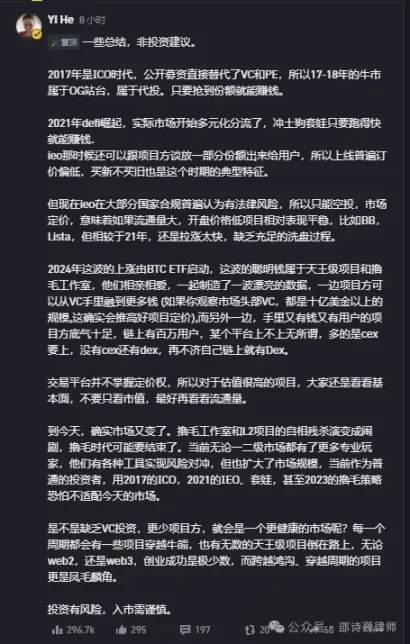
Just last month, Binance co-founder He Yi shared her views on airdrop farming studios (see image below). This underscores that as markets mature, early high-profit opportunities are likely to diminish. Studios should therefore adopt long-term, diversified business strategies.
Join TechFlow official community to stay tuned
Telegram:https://t.me/TechFlowDaily
X (Twitter):https://x.com/TechFlowPost
X (Twitter) EN:https://x.com/BlockFlow_News










