Solana rolls out new technologies one after another—what's different about "Solana 2.0"?
TechFlow Selected TechFlow Selected
Solana rolls out new technologies one after another—what's different about "Solana 2.0"?
What drove Solana's strong performance in Q2?
 Navigating Web3 tides with focused insights
Text by: BitPush Asher Zhang
Solana has successively launched three innovative technologies—Actions, Blinks, and ZK Compression—sparking widespread market discussion. What are the key features of these three new Solana technologies? Why has Solana performed so strongly in Q2, and what factors have driven its growth? And how will Solana evolve in the future?
What Are Actions, Blinks, and ZK Compression, and How Innovative Are They?
On June 24, Mert Mumtaz, CEO of Helius—a Solana ecosystem development platform—announced on X that ZK Compression was being introduced to Solana. The following day, June 25, the Solana Foundation unveiled two new features: Solana Actions (transactions) and Solana Blinks (blockchain links). With this series of new functionalities launching, Solana once again became a major talking point in the crypto space. So, what exactly are the technological innovations behind Actions, Blinks, and ZK Compression?
Solana Actions is an API designed to enable websites to interact with the Solana blockchain, facilitating on-chain activities such as transfers, voting, and donations. As a standardized API, it returns transactions on the Solana blockchain that can be previewed, signed, and sent across various contexts—including QR codes, buttons + widgets (UI elements), and web pages. Users can send various transaction instructions via Actions, such as transferring assets or purchasing tokens. Developers can also leverage Actions to invoke and execute smart contracts, enabling complex on-chain logic. With high performance, low latency, and great flexibility, Actions simplify application development and user transactions on Solana, support smart contract execution, and lay a solid foundation for Solana’s entry into the SocialFi domain.
Blinks represent a tangible manifestation of Actions, taking forms such as QR codes, URLs, or clickable buttons. Blinks can transform any Solana Action into a shareable format across messaging platforms, allowing compatible clients (like browser wallet extensions or bots) to display additional interactive functions. When using Blinks, users don’t need to navigate to the underlying dApp behind the visual element (e.g., QR code or URL) to perform actions—they can complete tasks directly within their current platform interface, making interactions extremely convenient and simple.
What is ZK Compression? It leverages a process called state compression, enabling developers to use Solana's ledger space more economically instead of the costlier account space for storing certain data types. ZK Compression stores hashes of off-chain data on-chain while keeping the actual data off-chain, using state trees for verification. This approach significantly reduces demand for on-chain storage, lowering costs and improving overall scalability. By adopting ZK Compression, the Solana ecosystem can efficiently handle large volumes of data and offer developers more flexible storage options, accelerating blockchain application innovation. According to Solana’s official documentation, ZK Compression is defined as "a new primitive built on Solana that helps developers and users build applications at scale."
From a technical perspective, Actions and Blinks together form a suite of developer-friendly integration tools, helping blockchain apps achieve Web2-like usability. ZK Compression primarily aims to reduce development costs. Overall, all three innovations—Actions, Blinks, and ZK Compression—are geared toward enabling mass adoption of Solana. However, there are still limitations—for example, Blinks currently only work on desktop platforms.
Crypto influencer Haotian commented that (the launch of Blinks, etc.) faces many practical challenges. While embedding interactive payment links directly into Twitter may improve user experience, issues such as mobile vs. desktop compatibility, user confusion and trust barriers when clicking links, and potential security risks behind such links fundamentally hinder short-term deep adoption. In his view, it remains unclear what “compelling” incentive will drive Blinks’ adoption. For instance, users rely on Telegram bots to quickly participate in token launches—but what would motivate them to use Blinks? Use cases like voting, mini-games, or tipping don’t appear strong enough to serve as primary drivers.
Solana Shines in Q2—Which Ecosystem Protocols Made the Difference?
Overall, the crypto market saw lackluster performance in Q2. However, the MEME coin frenzy on Solana emerged as one of the few bright spots, making the Solana ecosystem stand out during this period. The most notable contributor was the pump.fun protocol, whose popularity further fueled Solana’s DeFi activity.
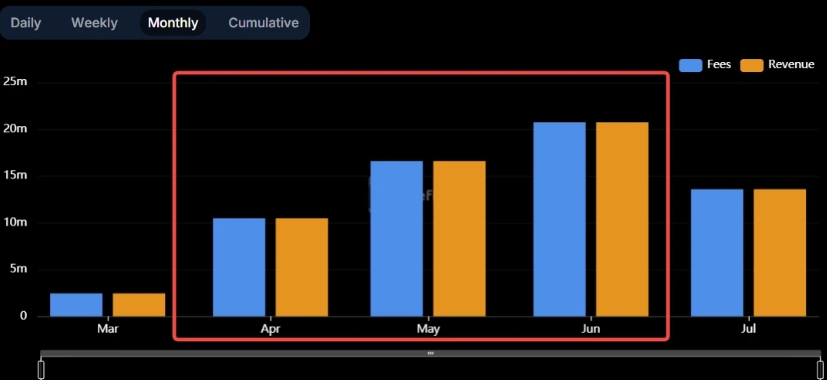
pump.fun ignited the Meme coin craze on Solana. As a meme coin launchpad, pump.fun allows users to easily create meme tokens without needing to provide liquidity. In May, several celebrities launched their own tokens on pump.fun, sparking a celebrity-driven meme coin trend on Solana. According to DefiLlama data, pump.fun generated $48 million in revenue during Q2, averaging $525,000 per day.
pump.fun indirectly boosted on-chain activity on Solana. Data from Dune shows that in Q2 alone, over 1 million transactions were made deploying meme coins on the pump.fun platform. Active addresses and new user registrations showed consistent growth throughout the quarter, with daily active addresses averaging over 60,000 by June. Correspondingly, non-voting transaction fees saw a significant rise in their share of total Solana network fees.
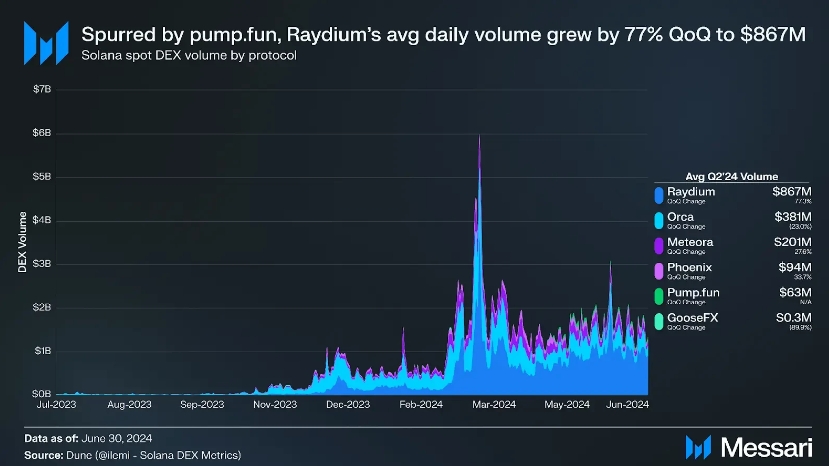
As on-chain trading surged, Solana’s DeFi ecosystem also gained momentum. During Q2, DEX trading volume on Solana spiked, with spot DEX daily trading volume increasing 32% quarter-on-quarter to reach $1.6 billion. Notably, Raydium has been the biggest beneficiary of the meme coin launchpad pump.fun, as all liquidity from pump.fun’s bonding curve automatically migrates to Raydium once a token hits the $69,000 market cap threshold.
Jupiter also saw significant increases in both spot trading volume and derivatives TVL during Solana’s meme-fueled boom. From Q1 through mid-Q2, Jupiter accounted for over 50% of DEX trading volume. Beyond spot markets, derivatives trading on Solana also grew notably. Zeta Markets, a perpetual DEX on Solana, saw its average daily perpetual contract trading volume surge 212% quarter-on-quarter in Q2, reaching $82 million.

How Will Solana Evolve in the Future?
Solana has stood out in this bull market cycle, consistently capturing attention and delivering surprises. Initially, the DePIN sector within the Solana ecosystem drew strong market expectations, producing leading projects such as Render and Helium. Later, top-tier projects emerged in categories like fully on-chain gaming and AI. Recently, amid broad market weakness, the MEME sector brought Solana back into the spotlight, with projects like WIF and BONK gaining prominence.
Most recently, Solana announced plans for a 2.0 upgrade, signaling continued long-term potential. Looking at Solana’s ecosystem map, the launch of Solana Mobile highlights its commitment to mobile integration. Currently, Solana Mobile 1 has reached 20,000 users, while pre-orders for Solana Mobile 2 have exceeded 50,000 units. This provides DePIN projects with a direct distribution channel, helping overcome initial user acquisition hurdles. DePIN will remain a core pillar of Solana’s future development.
Beyond DePIN, Solana’s key strategic move is clearly toward Web2 integration. In December 2023, the Firedancer validator launched, paving the way for Solana’s mass adoption. Earlier, Solana integrated with PayPal, establishing a payment gateway. Now, with the emergence of new technologies like Actions, Blinks, and ZK Compression, Solana is advancing further toward large-scale adoption.
Overall, Solana boasts technical advantages such as high performance. As its technology matures, Solana’s next phase focuses squarely on achieving mass adoption. Currently, Solana’s initiatives are largely centered on continuously lowering barriers for both developers and end-users.
Join TechFlow official community to stay tuned
Telegram:https://t.me/TechFlowDaily
X (Twitter):https://x.com/TechFlowPost
X (Twitter) EN:https://x.com/BlockFlow_News
 比推 BitpushNews