








Betting on the Future: Unlocking More Wealth Opportunities in Prediction Markets from Polymarket's Breakout
TechFlow Selected TechFlow Selected
Betting on the Future: Unlocking More Wealth Opportunities in Prediction Markets from Polymarket's Breakout
The surge in prediction markets to some extent reflects traders' most genuine emotions and the possibility of transforming anticipated events into trading behaviors.
 Navigating Web3 tides with focused insights
Vitalik Buterin has long been bullish on the potential of prediction markets to expand the daily use cases of cryptocurrency, publicly mentioning multiple times that he invested in Polymarket, which gained massive mainstream attention this year due to election-related topics. The act of betting on elections is historically deep-rooted—people were already placing bets on papal elections as early as the Middle Ages. Today, the contest between Trump and Democratic candidates has captured widespread public attention. However, since the U.S. explicitly prohibits wagering on political events, such activities have shifted toward crypto-based platforms like Polymarket. Its real-time results reflect users’ genuine sentiments, and public sentiment itself is increasingly treated as an important reference for our trading decisions. The prediction market赛道 (sector) is entering the public eye through a unique approach.
What Is a Prediction Market
Taking Polymarket as an example, the platform is essentially a binary options market. Traders can choose "yes" or "no" on a given topic and stake a certain amount. If their prediction is correct, they receive a fixed return; if wrong, they lose the staked amount. To date, Polymarket has completed three funding rounds totaling $74 million from individuals and institutions including Vitalik, Polychain, and Dragonfly.
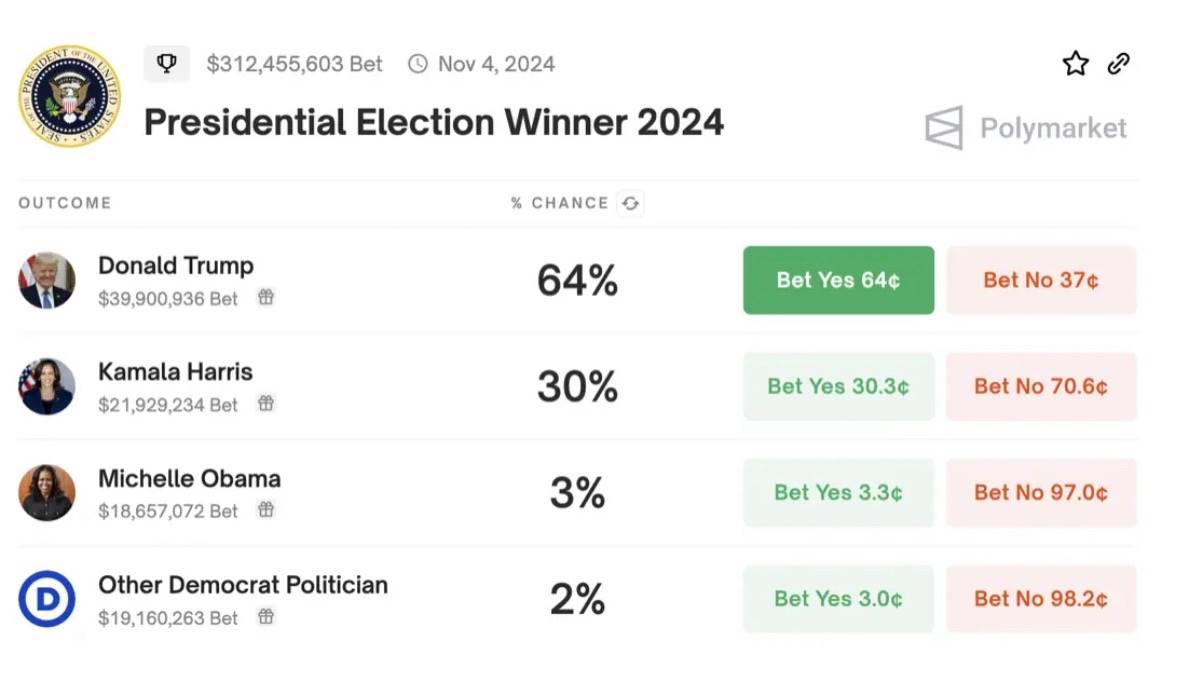
It is also a peer-to-peer betting platform—someone’s profit comes directly from another trader’s loss—while the platform earns revenue by charging transaction fees.
Current State of Prediction Markets
As shown in the chart, Polymarket's website traffic and number of unique visitors have undergone significant changes over the past year. Particularly after completing a new $35 million financing round in May this year, monthly active users, trading volume, and open interest all hit record highs. In May and June, both visits and unique visitors surged, reaching 733,689 visits and 220,956 people respectively. This growth trend coincides with the approaching U.S. presidential election, indicating surging user interest in political prediction markets.
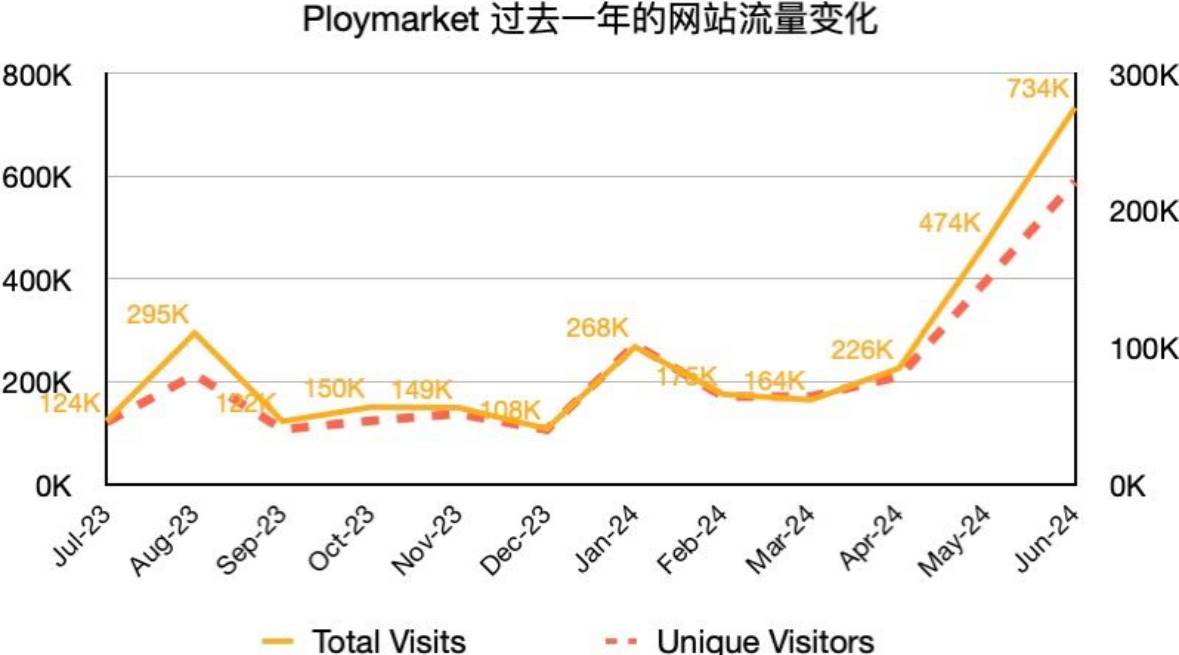
Data source: SimilarWeb
Since the beginning of 2024, Polymarket’s TVL has skyrocketed from around $10 million at the start of the year to the current $67 million—an increase of +570%. Meanwhile, daily trading volume surpassed $27 million on July 1, with the number of daily trading users peaking near 7,000... These rapidly rising figures demonstrate that prediction market platforms are releasing strong appeal across the entire crypto ecosystem.
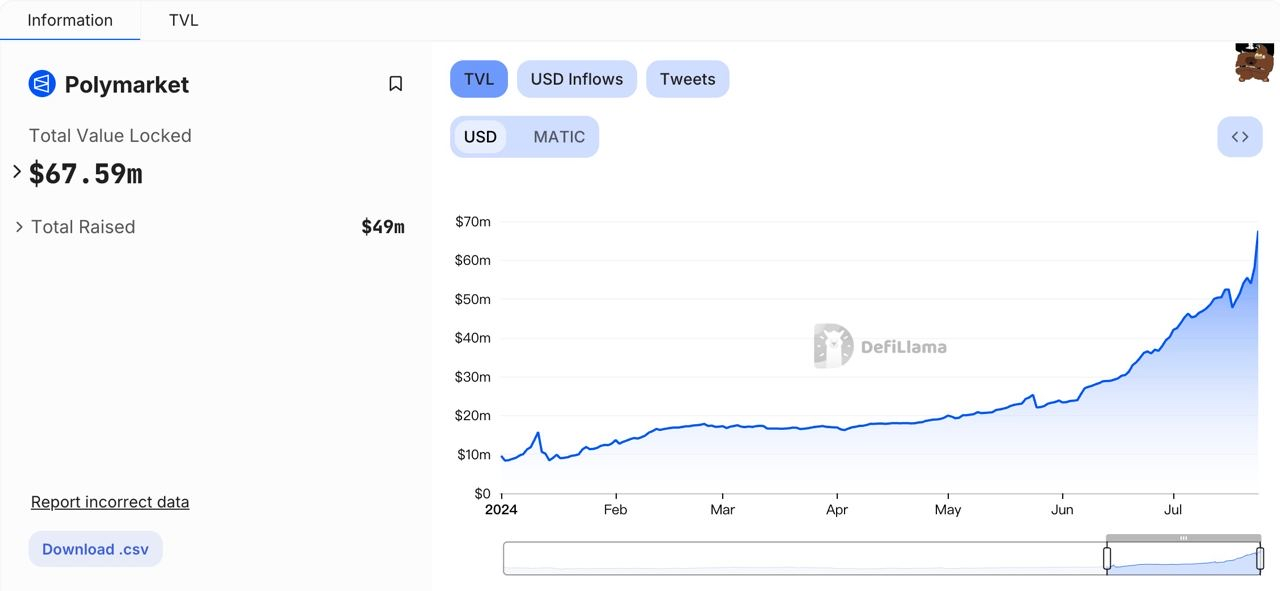
Source: DefiLlama
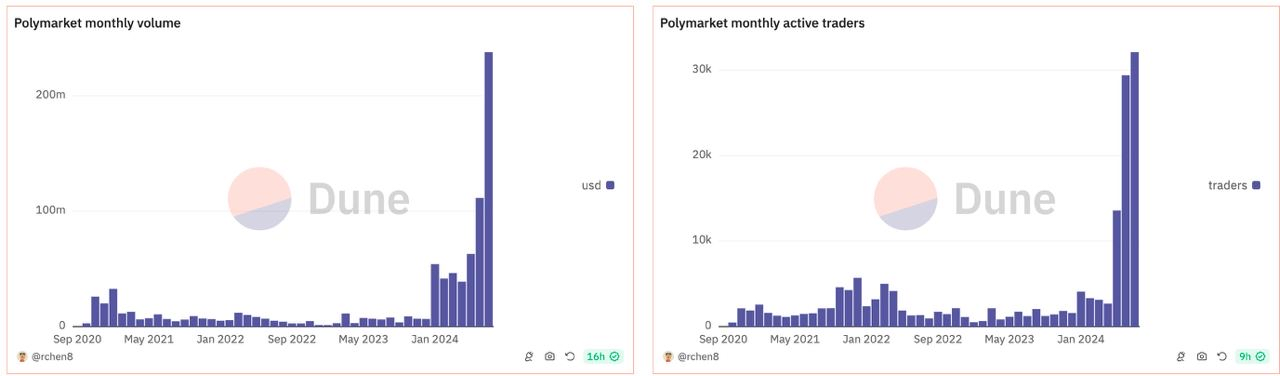
Source: Dune
How to Participate in Polymarket?
By visiting the official website polymarket.com, users can choose to trade or provide liquidity. The most popular prediction topic on the homepage is “Winner of the 2024 Presidential Election.” Each outcome starts trading at $0.50, and prices fluctuate based on how much users bet on either side, representing the current probability of the event occurring. A price of $0.50 implies a 50% chance of Trump being elected president—this probability has now risen to 61%. Meanwhile, total funds committed to this topic have exceeded $350 million.
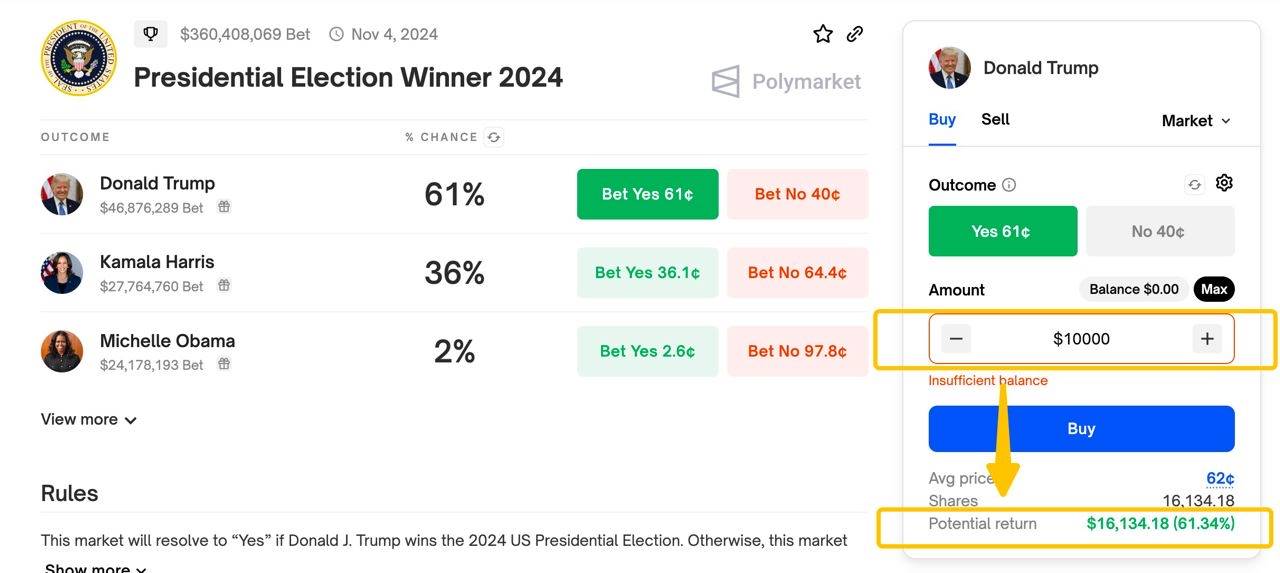
As shown in the image, users simply input their desired stake amount to instantly see potential payouts if their guess is correct—no need to understand the complex mechanisms behind the product. The front-end design is simple and intuitive, highly user-friendly. However, due to depth-of-market considerations, when large amounts are staked, the achievable return rate noticeably shifts. For example:
1. Betting $1,000 on Trump winning returns $1,615 (+61.51%) if he wins;
2. Betting $10,000 on Trump winning returns $16,131 (+61.34%), a relatively minor change;
3. Betting $1,000,000 on Trump winning returns only $1,369,041 (+36.90%), reducing the return rate from 61% to about 37%.
Although prediction markets may appear fun and potentially profitable, traders tend to lose money over time due to various factors such as incorrect bets, high friction costs, and low liquidity—their average returns are negative. Even if individual traders achieve notable profits in the short term, whether they can consistently predict correctly and remain profitable remains uncertain. After all, no one can be 100% sure every single bet will be right. Investors still face high risks on these markets and should proceed with caution.
Additionally, Polymarket offers a liquidity rewards program. Users earn more by placing limit orders that provide market liquidity—the closer the order price is to the market’s average price, the higher the earnings. Reward amounts also depend on the size of the order: larger stakes yield greater rewards.
Other Prediction Market Projects
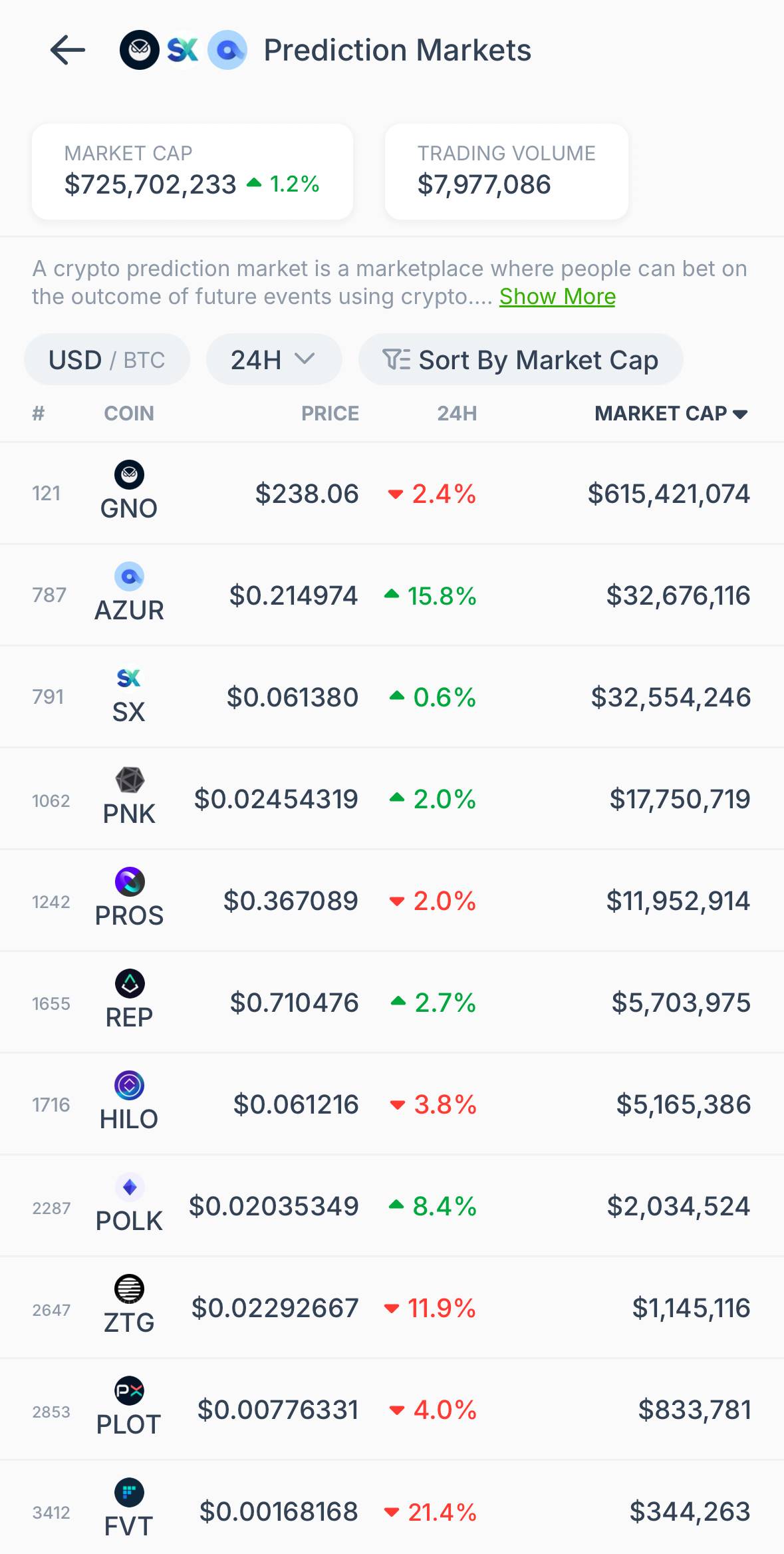
Polymarket isn’t the first project in the prediction market space. As early as 2015, Augur was established and raised $5.3 million—it’s an open global prediction market protocol allowing anyone to create markets for anything. Gnosis also started with prediction markets in its 1.0 version but has since evolved into a dApp incubator with its own suite of infrastructure including wallets and mainnet solutions.
Source: CoinGecko
Overall, the prediction market sector is still in its early stages, with few projects and a total market cap of around $700 million. According to CoinGecko’s prediction market category, only Augur (REP), finance.vote (FVT), Prosper (PROS), Handy (HANDY), Polkamarkets (POLK), and non-CEX-listed projects Zeitgeist (ZTG) and Hilo (HILO) have issued tokens. Their market cap rankings on CoinGecko are all beyond #1000.
Ecology Project Overview
1. Polygon Ecosystem:
• Polymarket: Flagship prediction market, launched on mainnet in 2020, allowing users to trade on political and real-time controversial topics—with rewards for correct predictions.
• Augur: Veteran prediction market, tradable on Ethereum
• UBet: Primarily focused on sports predictions
• YOLOrekt: Crypto price guessing
• Guesslot
• Reality Cards: NFT-formatted prediction platform
2. BNB Ecosystem:
• Prosper: Cross-chain prediction and hedging platform
• finance.vote: Cryptocurrency price prediction platform, also tradable on Ethereum
• AlphaOrBeta: Web3 prediction and polling network where users vote to predict outcomes—winners get ETH rewards, losers receive native tokens. Developed by OpinionLabs, it accumulated 100,000 users within two months of launching on BNB Chain, briefly becoming the top-ranked social project in Mantle’s ecosystem, ranking fourth on Arbitrum, and selected as a Most Valuable Builder by Binance Labs.
3. Polkadot Ecosystem:
• Zeitgeist: Active prediction market on Polkadot, having completed a $1.5 million seed round and $14 million in funding by end of 2022.
4. Solana Ecosystem:
• Hedgehog: Veteran prediction market, but no major updates since fundraising in 2021.
• JogoJogo: New 2024 project, AI-native prediction market on Solana where anyone can bet any amount on any topic and receive payouts.
• mash.trade: 2024 newcomer offering leveraged trading, fewer followers, product not yet mature.
5. Sei Ecosystem:
• PredX
• Kargo
6. Ton Ecosystem:
• Wagmi11: Focused on sports event predictions
7. Other L2s:
• BetBase: Prediction and betting platform on Base
• Expectium: Information prediction market on Starknet
CEX Experiments in Prediction Markets
Many centralized exchanges have launched similar prediction events:
• Binance once introduced Binance Futures NEXT: Users could invest up to 100 USDT each to vote, receiving 120 USDT back if correct, or a full refund if wrong. This model effectively allowed users to participate in promotional giveaways without risk of loss.
• LBank launched a contract related to SBF’s pardon in November 2023, offering up to 10x leverage. Buyers profited if SBF was pardoned, otherwise lost. This sparked intense debate.
• XT Exchange launched “Euro Cup Battle · Deciding the Peak on XT” during this year’s UEFA Euro, letting users predict the champion to share a huge prize pool. The event attracted over 5 million global users.
Future Outlook
From the data, Polymarket’s active user count and new registrations are growing rapidly. In just over 20 days since July, Polymarket’s monthly active trading users have exceeded 32,000, while new registrants surpassed 42,000. Many newly registered users are still observing and could soon become active participants. The surge in popularity of prediction markets reflects, to some extent, traders’ most authentic emotions and the possibility of converting anticipated events into tradable actions. This real-time reflection of public sentiment provides valuable data for analyzing and understanding market trends.
In the United States, such prediction-based trading platforms face strict regulations. According to a 2012 ruling, regulated markets cannot offer contracts on political events. This creates a significant market gap and development opportunity for emerging unregulated prediction markets—crypto platforms like Polymarket. While the strict regulatory environment introduces legal risks, it is precisely this regulatory gap that allows innovative companies room to enter and expand. For traders, this represents both opportunity and danger.
[Disclaimer] This article is for informational purposes only and does not constitute any investment advice. Investing involves risk; please proceed with caution. Readers should independently evaluate the content and bear full responsibility for their investment decisions and consequences.
Join TechFlow official community to stay tuned
Telegram:https://t.me/TechFlowDaily
X (Twitter):https://x.com/TechFlowPost
X (Twitter) EN:https://x.com/BlockFlow_News
 @XTexchange






