
Airdrop Fatigue? Web3 Explores New Paths to Sustainable Value
TechFlow Selected TechFlow Selected
Airdrop Fatigue? Web3 Explores New Paths to Sustainable Value
One option is to improve the existing airdrop model; another approach is to completely abandon token distribution and opt for alternative methods to incentivize users.
 Navigating Web3 tides with focused insights
By: Alex O’Donnell
Translation: Bitpush News
Over the past year, airdrops — tokens distributed freely to users — have dominated the cryptocurrency market.
Now, due to underperforming tokens and profit-driven user bases, airdrops are falling out of favor. Web3 protocols are beginning to question whether it’s time to adopt a new model.
Since 2023, airdrops have been everywhere. It seemed like every rising protocol in Web3 conducted one, from Arbitrum and Optimism to Celestia and EigenLayer. In total, over 30 major projects have launched token airdrops in the past 18 months.
This surge in activity was partly an overcorrection for the "crypto winter" of 2022, when a sharp market downturn forced many Web3 projects to delay their planned token launches.
“All these projects that were backlogged from 2021 and 2022 are finally launching now in the 2024 cycle,” said Tom Dunleavy, managing partner at crypto investment firm MV Global.
Airdrops entice native crypto investors with the lure of essentially free money, and high-profile drops generated massive hype. At the height of this year's frenzy, even rumors of an airdrop were enough to funnel billions of dollars into certain projects.
But there’s a problem: Airdrops rarely succeed. Token prices typically plummet after distribution, and benefits to protocols are often short-lived.
Have airdrops reached their limit?
The industry is starting to realize this. For the first time this year, interest in airdrops is waning, and protocols are considering alternative methods for launching tokens.
“I think we’ve reached peak airdrop,” said Jonathan Joseph, co-founder of SmartFunds, a real-world asset tokenization platform. “We need constructive models to bring liquidity to new protocols in a way that increases returns for all stakeholders.”
According to Aylo, an anonymous crypto researcher and founder of Alpha Please, 23 out of 31 tokens distributed through large-scale airdrops have lost value since their initial listing, sometimes severely. Excluding meme coins, only two airdropped tokens (about 6% of total airdrops) have outperformed Bitcoin.
“It has almost always been the correct choice to sell airdropped tokens for USD or BTC on launch day,” Aylo wrote in an X post.
Adding to holder frustration, the opaque off-chain point systems used to allocate airdropped tokens can be inherently contentious.
“When the airdrop comes, people feel cheated because the number of points doesn’t necessarily correlate with the number of tokens they receive,” Joseph told Cointelegraph.
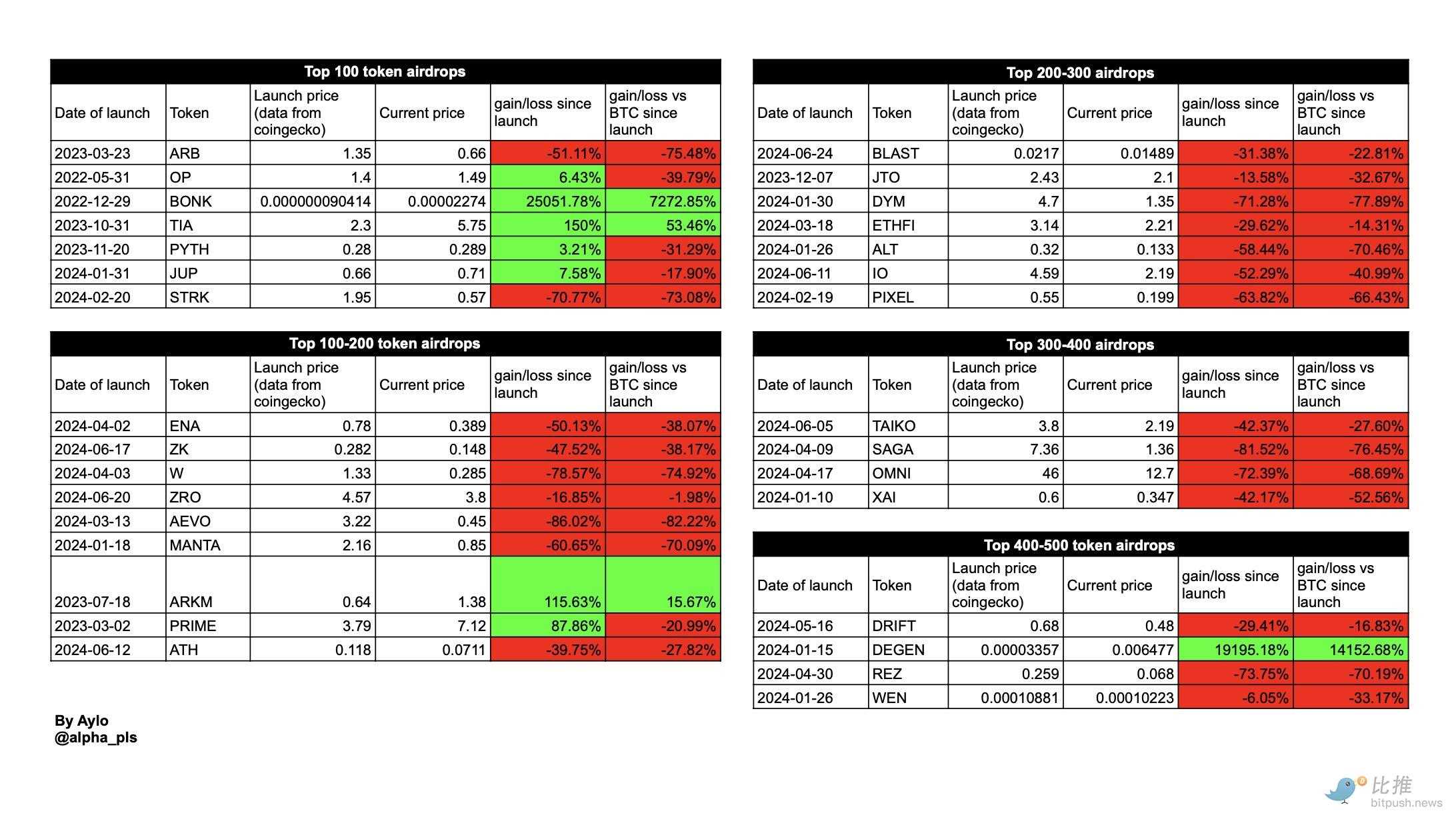
Protocols are also experiencing disappointment. Airdrops are an extremely expensive way to bootstrap users — often consuming 10% or more of a protocol’s total token supply — and they don’t always work.
The ongoing airdrop craze has spawned a small industry of airdrop farmers who jump from one protocol to another chasing free tokens. These farmers typically dump their tokens immediately after the airdrop, sending prices into a self-sustaining downward spiral.
“Many of these tokens have very low float, launching with less than 10% of supply circulating, so they’re much more volatile,” Dunleavy told Cointelegraph.
After completing an airdrop, projects often experience declines in users and total value locked (TVL), a metric for on-chain liquidity.
According to data from L2Beat, nearly every layer-2 protocol that conducted an airdrop since early 2023 saw net TVL outflows in the weeks following. One such layer-2, Blast, which distributed about a quarter of its total token supply, lost approximately 25% of its TVL within the first nine days after its airdrop.
“At the time of the airdrop, especially if the points system shuts off, you may see a reset of the supply-demand mechanism among users,” said Ken Deeter, partner at Electric Capital, a crypto venture fund.
Regulatory pressure impacts airdrops
Some airdrops have become more complicated due to regulatory pressure. EigenLayer, an Ethereum restaking protocol, sparked significant controversy by barring participants from over a dozen countries, including the United States, Russia, and China, from its highly anticipated EIGEN airdrop. It also prohibited recipients from transferring tokens for at least a year.
Airdrops emerged partly in response to the 2017 initial coin offering (ICO) boom, which triggered a regulatory crackdown as authorities deemed ICOs illegal securities offerings. To avoid a similar fate, airdrops often avoid mentioning any investment return or value accumulation.
“It’s such a twisted system,” said Cosmo Jiang, partner at Pantera Capital, a crypto-focused venture fund. “Now, if you have a token that explicitly has no value, it’s legal, but if you have a token that wants to return value or create value, it’s illegal. That’s clearly the opposite of what you want to achieve.”
The result, Jiang told Cointelegraph, is a flood of tokens “with no clear reason to exist.” He said the only sustainable solution is for the industry to shift toward tokens with meaningful value accrual mechanisms.
Easier said than done.
“The challenge with [tokens] is they serve a dual purpose,” Deeter told Cointelegraph. “On one hand, they’re marketing and user acquisition; on the other, long-term protocol governance. If you optimize for just one, it pulls you completely in the opposite direction.”
Alternatives to airdrops
One option is improving the existing airdrop model. Joseph said protocols should stop distributing large volumes of tokens all at once and instead lock tokens in smart contracts that gradually unlock over a year.
Pixelverse, an NFT and gaming platform on The Open Network (TON), implemented this strategy during its airdrop on July 18 with some success. The project locked its tokens in a staking contract, imposing penalties of up to 90% for early withdrawals. Pixelverse’s PIXFI token surged nearly 50% in trading price within hours of listing.
“Unlock schedules help align incentives because you have to selectively ask yourself, ‘Which assets do I care about during that 12-month period?’” Joseph said.
Another approach is to abandon token issuance altogether and opt for alternative ways to incentivize users.
According to sources familiar with the matter, at least one startup is preparing to launch a decentralized marketplace where crypto protocols can programmatically incentivize user behavior. The source declined to name the protocol, as it remains in pre-launch stages.
Soon, regulatory barriers to value-accruing token economies may begin to ease. In the United States, regulators are starting to greenlight transactional crypto products, former President Donald Trump is running a clearly pro-crypto presidential campaign, and current President Joe Biden may be forced to soften his stance on crypto. This could open opportunities for protocols to launch tokens with more sustainable value propositions for holders.
“I see that world coming,” Liang said. “If this industry is going to create real, sustainable value, then [tokens] will need to have some form of value accrual.”
Join TechFlow official community to stay tuned
Telegram:https://t.me/TechFlowDaily
X (Twitter):https://x.com/TechFlowPost
X (Twitter) EN:https://x.com/BlockFlow_News
 @Cointelegraph