








Polymarket, the crypto prediction market platform that both Vitalik and Trump have shared, faces what regulatory issues?
TechFlow Selected TechFlow Selected
Polymarket, the crypto prediction market platform that both Vitalik and Trump have shared, faces what regulatory issues?
Regulatory challenges and ethical issues facing encrypted prediction platforms have led to severe obstacles for their compliant development.
 Navigating Web3 tides with focused insights
Author: Shao Shiwei
On June 28, 2024, the first presidential debate between Biden and Trump drew global attention. Around the same time, on Polymarket—a globally renowned crypto prediction market platform strongly promoted by Vitalik Buterin (Vitalik Buterin)—engagement in U.S. election predictions surged. Platform data from June showed Trump’s probability of winning the election at 62%, while Biden’s stood at 23%.
Just days ago, on July 13 local time, a shooting incident occurred at a Trump campaign rally in Butler, Pennsylvania. A 20-year-old man fired up to eight rounds from an AR-style rifle, one bullet grazing past Trump’s ear. Following this assassination attempt, Trump’s odds of winning rose to 71% on Polymarket.
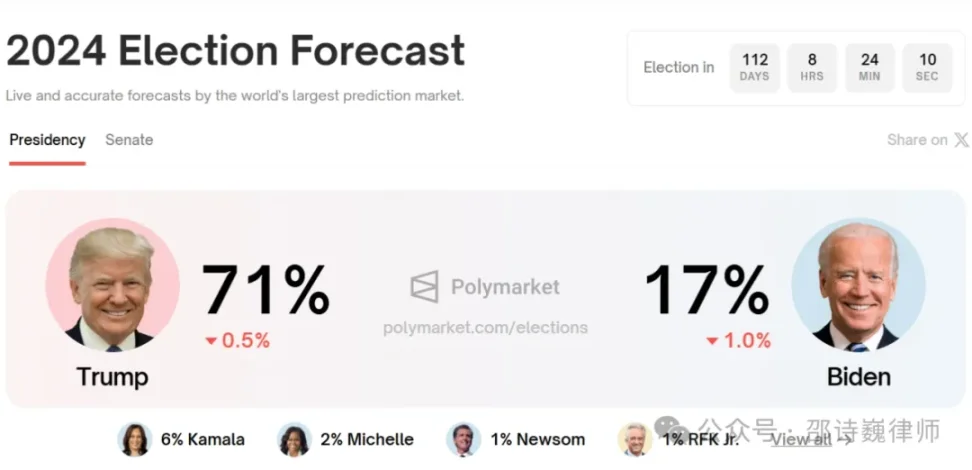
As a political figure skilled in leveraging social media, Trump has previously shared his Polymarket odds multiple times on Truth Social, the platform he founded. This not only helped manage his public image but also significantly boosted exposure for Polymarket.
However, are such crypto-based prediction markets compliant with regulations? This remains debatable.
What Is a Crypto Prediction Market?
A crypto prediction market is a decentralized DeFi protocol where anyone can trade outcomes of events via smart contracts when certain conditions are met. Simply put, users can use stablecoins to bet on the results of real-world events. If their prediction is correct, they earn returns; if incorrect, they lose their stake.
The first blockchain-based decentralized prediction market was Augur, launched on Ethereum in 2018. Ethereum co-founder Vitalik Buterin served as an advisor to its development team. Perhaps this is one reason why V God recently endorsed prediction platforms?
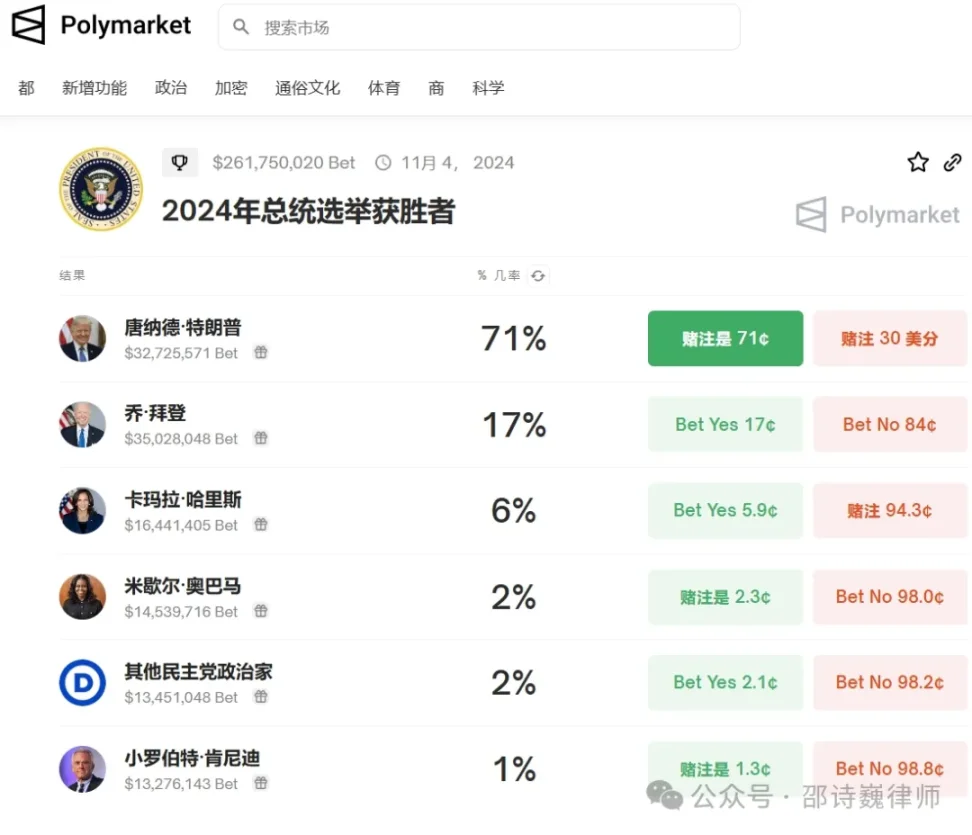
Currently, Polymarket ranks among the world's largest prediction market platforms. Its "Winner of the 2024 Presidential Election" market will close betting on November 5, 2024. To illustrate its popularity, nearly $261 million had been wagered on U.S. election predictions on the platform by July 16.
Of course, other major platforms exist in today’s prediction market landscape, including Gnosis, Azuro, Hedgehog, PlotX, and SX. Users have plenty of options available.
How Do Crypto Prediction Platforms Work?
The core mechanism of these platforms is binary prediction markets—users place bets to predict outcomes.
For example, in predicting who will win the 2024 U.S. presidential election, if a user believes Trump’s chances exceed 71%, they can buy “Yes” shares at $0.71 each. If Trump indeed wins the presidency, each “Yes” share becomes worth $1, yielding a profit of $0.29 per share. Conversely, holders of “No” shares will lose their entire stake.
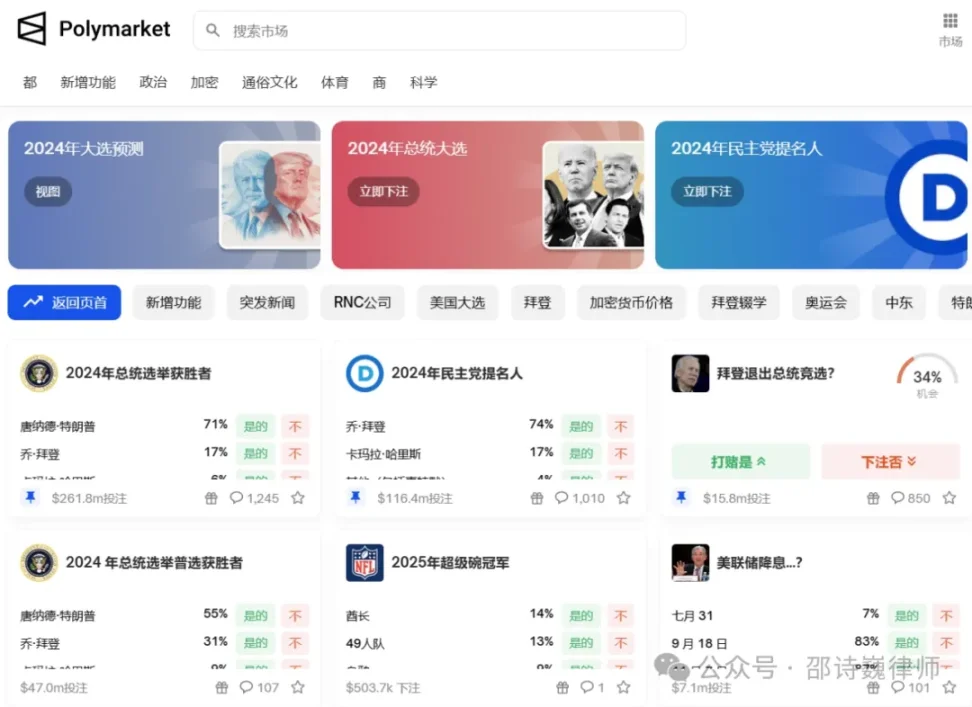
At its core, crypto prediction market platforms offer a binary options product. Users choose between two possible outcomes—"yes" or "no"—and that choice constitutes the option they hold.
Regulatory Analysis of Crypto Prediction Markets
Some may wonder—doesn’t this resemble gambling platforms, albeit with fewer game types? In reality, most jurisdictions haven’t clearly defined binary options products and generally maintain strict and cautious regulatory stances toward them.
1. Regulatory Stances Across Countries
United States
Over-the-counter binary options are fully banned. Currently, only two regulated exchanges—NADEX and Cantor—are permitted to offer binary options trading.
In 2022, the U.S. Commodity Futures Trading Commission (CFTC) sued Polymarket for failing to register as a Designated Contract Market (DCM) and Swap Execution Facility (SEF) under the Commodity Exchange Act (CEA). The platform paid a $1.4 million fine and committed to reducing services offered in the U.S.
United Kingdom
Previously, the UK government classified binary options as gambling and placed them under the Gambling Commission’s oversight. However, this approach failed to provide effective regulation or investor protection. In 2015, the UK began discussions to transfer regulatory authority over binary options from the Gambling Commission to the Financial Conduct Authority (FCA). This shift would formally categorize binary options as financial instruments rather than gambling products.
China
In China, binary options are not recognized as legitimate financial products. The Supreme People's Court's Guiding Case No. 146, “Chen Qinghao et al. Suspected of Operating a Casino,” explicitly categorized operating binary options websites as running a gambling operation. The court ruled that defendants, under the guise of “binary options” trading, recruited “investors” online outside of legally authorized futures trading venues, using future price movements of foreign exchange pairs as underlying assets. Profits or losses were determined solely by whether participants correctly predicted “up” or “down” movements, with winners receiving payouts and losers forfeiting their principal to the website (the house), regardless of actual price fluctuations. This mechanism essentially amounted to “betting big or small, winning or losing,” constituting gambling disguised as options trading. Such websites should therefore be deemed illegal gambling platforms.
2. Underlying Ethical Issues
Beyond regulation, prediction markets raise ethical concerns. For instance, some prediction questions previously sparked controversy among users. One X platform user asked, “Which stage of capitalism allows betting on someone else’s death?” and posted a screenshot of odds from a prediction market, triggering widespread criticism of the platform.
Moreover, prediction markets carry risks of market manipulation. Well-resourced participants could influence market outcomes through large capital injections, thereby harming the interests of other users.
Additionally, prediction markets encourage speculative forecasting of event outcomes, which may sometimes diverge from reality, potentially spreading misinformation. Especially during major societal events like pandemics, inaccurate predictions could mislead the public and even threaten social stability.
Conclusion
As blockchain-based platforms, crypto prediction markets leverage smart contracts to ensure fairness, transparency, and automated reward distribution. Compared to traditional online prediction platforms prone to behind-the-scenes manipulation, user experience tends to be better. Moreover, because users must invest real money to make predictions, such forecasts may be far more accurate than surveys or expert opinions. Nevertheless, as discussed earlier, regulatory challenges and ethical concerns pose serious obstacles to the compliant development of these platforms.
Join TechFlow official community to stay tuned
Telegram:https://t.me/TechFlowDaily
X (Twitter):https://x.com/TechFlowPost
X (Twitter) EN:https://x.com/BlockFlow_News






