The Evolution of Ethereum: Layer 2 Scaling and the Infinite Potential of One-Click Multi-Chain
TechFlow Selected TechFlow Selected
The Evolution of Ethereum: Layer 2 Scaling and the Infinite Potential of One-Click Multi-Chain
Against a backdrop of insufficient industry innovation, DeFi remains the primary application driving the emergence of Rollups.
 Navigating Web3 tides with focused insights
Author: YBB Capital Researcher Ac-Core
TL;DR
● Cross-chain asset transfers are complex and costly due to differing blockchain architectures and consensus mechanisms, lack of unified standards, and expensive validation processes, limiting asset liquidity. Third-party bridges face trust and security challenges; centralized bridges must maintain liquidity, passing costs to users. One-click chain deployment is a compromised solution for asset bridging, akin to solving the blockchain trilemma.
● In terms of market maturity, OP Stack and Superchain were early movers, with Base emerging as a successful representative. AggLayer benefits from native compatibility with Ethereum, making it easier to adopt, though ensuring the security and reliability of aggregation remains a challenge. Elastic Chain’s success depends on ZKsync's own ecosystem growth. From both market and technical perspectives, OP leads in the short term, while ZK holds long-term promise.
● Amid limited industry innovation, DeFi remains the primary application for Rollups. Currently, DePIN, RWA, and large-scale GameFi are unlikely to emerge on Rollups. SocialFi and NFT markets may appear on Rollups, but their market热度 remains uncertain. The Matthew effect applies broadly to blockchain—long-term focus should be on top-tier Rollups, while short-term attention lies in mid-to-lower tier projects.
1. Bridging the Islands: The Problem of Bridges
When performing cross-chain asset transfers, different blockchains have unique architectures, consensus mechanisms, state proofs, and state transitions. The lack of unified standards and interoperability introduces complexity into cross-chain communication and data exchange. These verification processes are often too expensive to execute on-chain, leading to the proliferation of multi-signature committees that attest to the state of counterpart chains. Currently, there is no universal decentralized standard or protocol enabling interoperability across all blockchains, restricting the free flow of assets between different chains.
Although numerous third-party bridge solutions have emerged to facilitate cross-chain asset transfers, they face significant cybersecurity challenges related to "trust." Even if centralized bridges ensure full security, they still need to maintain sufficient liquidity on each integrated chain, with associated costs passed on to users. There exists a current inability to achieve natively decentralized asset bridging and difficulty in trusting third-party bridges. To address this, ZKsync, Polygon, and Optimism have introduced their own more-native scalable multi-chain solutions: Elastic Chain, AggLayer, and Superchain Explainer, respectively.
2. ZKsync 3.0: Elastic Chain
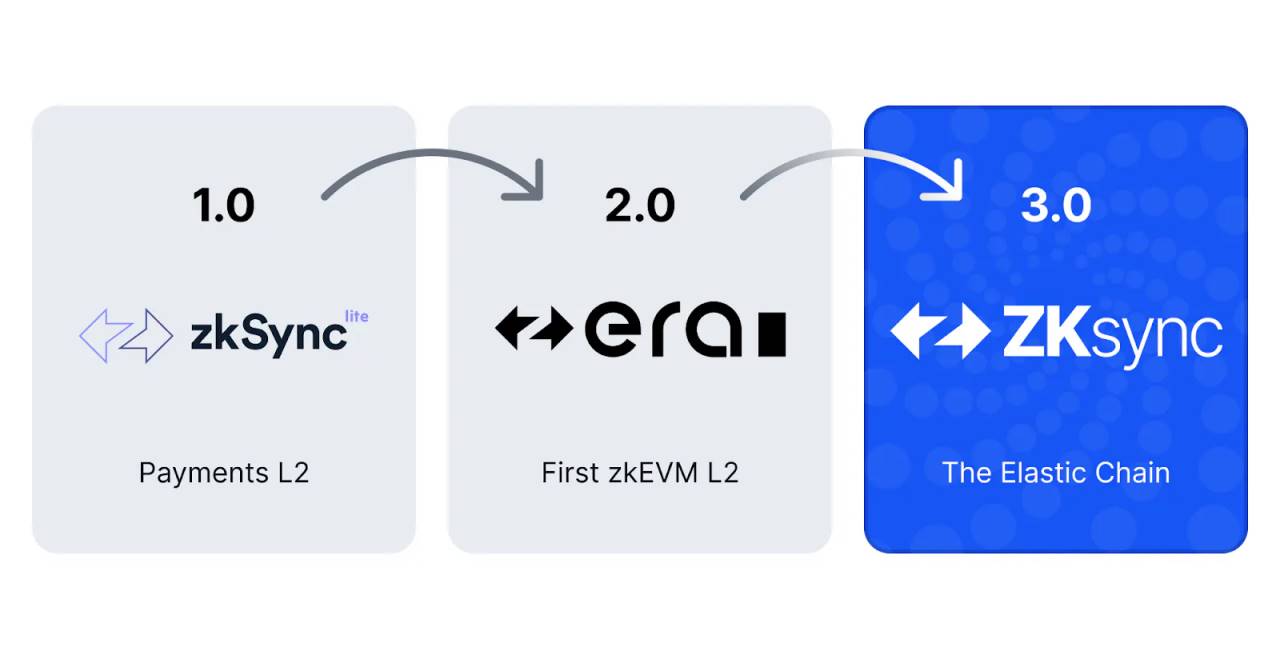
Image source: zksync.mirror
In 2023, Matter Labs, the core development company behind ZKsync, released ZK Stack—a toolkit allowing developers to build their own blockchains atop ZKsync technology. Essentially, these customized chains are interconnected via Elastic Chain, transforming ZKsync 3.0 from a single Ethereum L2 into The Elastic Chain.
The core protocol upgrade of ZKsync 3.0 was launched on June 7, 2024, marking the most complex upgrade to date. It reconfigured the ZKsync L1 bridge into a shared router contract to support an expanding network of interoperable ZK chains, enabling native, trustless, low-cost interoperability among chains built on the ZK Rollup framework ZK Stack.
According to Matter Labs: "Elastic Chain is an infinitely scalable network composed of ZK Chains (rollups, validiums, and volitions), secured through cryptographic verification methods, achieving seamless interoperability under a unified and intuitive user experience, aiming to make cross-ecosystem interactions within ZKsync smoother and more fluid."
2.1 Elastic Chain Architecture
Elastic Chain does not rely solely on ZK technology, nor can it be achieved by simply adding a ZK proof "patch" to non-ZK multi-chain systems. At a high level, the network consists of three key components: ZK Router, ZK Gateway, and ZK Chains.
1. ZK Router:
● Core Routing Mechanism: The ZK Router serves as the primary routing component in the ZKSync 3.0 architecture, responsible for managing and coordinating communication and data transfer between different chains and nodes in the network;
● Cross-chain Communication: Through efficient cross-chain communication protocols, the ZK Router ensures fast and secure data transmission between different chains, enhancing overall network interoperability and performance.
2. ZK Gateway (ZK Gateway / Entry-Exit Point):
● Entry and Exit Nodes: The ZK Gateway acts as the entry and exit point for the ZKSync 3.0 network, handling interactions between external blockchains (e.g., Ethereum mainnet) and the ZKSync network;
● Asset Bridging: Responsible for bridging and transferring assets between external blockchains and the ZKSync network, ensuring secure and efficient asset movement across chains;
● Transaction Aggregation: Aggregates user transactions into batches, generates zero-knowledge proofs, and submits them to the external blockchain for verification, reducing on-chain data load and transaction fees;
● Middleware: Can be understood as middleware deployed between Ethereum and ZK Chains, facilitating full interoperability among ZK Chains.
3. ZK Chains (the ZK Chains themselves): Ensure transaction validity and security by generating and verifying zero-knowledge proofs, then submit results to the ZK Router for aggregation and coordination. Connected via ZK Gateway and L1 smart contracts, these are fully independent, customizable rollups, validiums, or volitions built using ZKStack.
According to ZKsync, the Gateway is a key component of Elastic Chain, enabling seamless settlement of ZK Chains to Ethereum. Submitting proofs and data via the Gateway to Ethereum offers the following advantages:
● Cross-batch and cross-chain proof aggregation reduces L1 verification costs;
● State difference compression compresses small batch data sent to the Gateway and forwards it efficiently in large batches to L1;
● Faster finality achieved by verifying chain proofs and preventing contradictions, enabling low-latency cross-chain bridging, reinforced by staking from numerous validators. ZK Chains do not need to trust other chains;
● Liveness: Each ZK Chain's liveness is independently managed by its validators; the Gateway does not affect liveness, and chains can freely leave the Gateway;
● Censorship Resistance: Cross-chain forced transactions will be cheaper than regular L1 censorship-resistant transactions, making them more accessible to all users.
ZK Chains are not required to use the ZK Gateway—they can settle directly to Ethereum and may choose to leave the ZK Gateway network at any time without affecting their chain security. ZK Chains can freely switch between using the ZK Gateway and settling directly to Ethereum. The ZK Gateway will be operated by a decentralized, trustless cluster of validators to ensure network resilience and reliability. Participation in this decentralized validation process requires an ERC20 token. ZKSync network governance will designate a token for this purpose (potentially the ZK token).
Validators will earn bridge fees and charges per byte of state difference data published to the ZK Gateway. This incentivizes validators to join the ZK Gateway, as their income could grow exponentially with increasing on-chain value transactions. Meanwhile, due to recompression services provided by validators, settling data via the ZK Gateway will be cheaper than direct settlement on the Ethereum network—this may be why most ZK Chains might opt to join.
3. Polygon 2.0: AggLayer
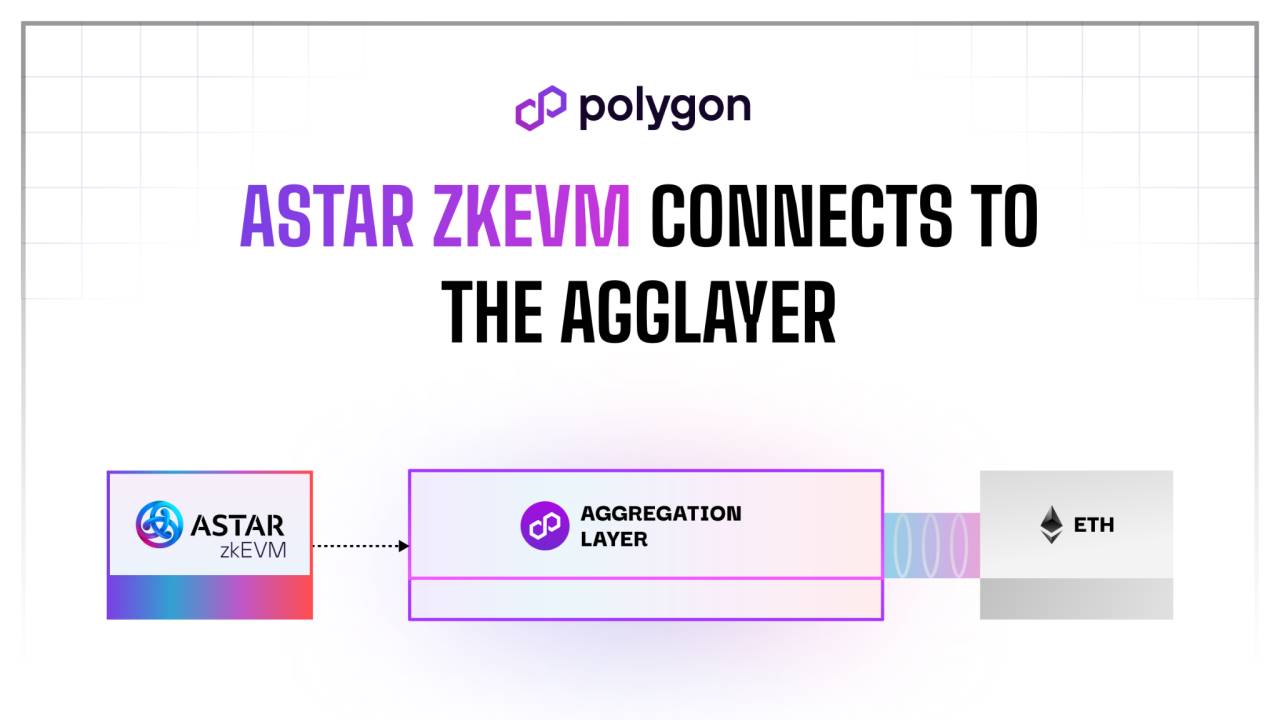
Image source: Polygon AggLayer
3.1 Design Origins of AggLayer
Similar to OP Stack and ZK Stack, blockchains built using the Polygon CDK can directly connect to AggLayer, leveraging its unified bridging and security services to achieve interoperability—forming the core architecture of Polygon 2.0.
AggLayer's core idea originates from the Shared Validity Sequencing design proposed by Umbra Research, aiming to enable atomic cross-chain interoperability among multiple Optimistic Rollups. By sharing a sequencer, the system can uniformly handle transaction sequencing and state root publishing across multiple rollups, ensuring atomicity and conditional execution.
Implementation Logic: Requires the following three components:
1. Shared Sequencer: Receives and processes cross-chain transaction requests;
2. Block Building Algorithm: The shared sequencer constructs blocks containing cross-chain operations, ensuring their atomicity;
3. Shared Fraud Proofs: Shares fraud proof mechanisms among related rollups to enforce cross-chain operations.
Since existing rollups already support bidirectional message passing between Layer 1 and Layer 2, Umbra only added a MintBurnSystemContract (Burn and Mint) to complete the three components.
Workflow:
1. Burn operation on Chain A: Callable by any contract or external account, records success to burnTree;
2. Mint operation on Chain B: After successful execution by the sequencer, recorded to mintTree.
Invariants and Consistency:
Merkle Root consistency: The Merkle roots of burnTree on Chain A and mintTree on Chain B must be equal, ensuring consistency and atomicity of cross-chain operations.
System Operation:
The shared sequencer is responsible for publishing transaction batches and attested state roots of two rollups to Ethereum. It can be centralized or decentralized (e.g., Metis). The sequencer receives transactions and builds blocks for Rollup A and B. For transactions on A interacting successfully with MintBurnSystemContract, it attempts the corresponding Mint transaction on B. If the Mint succeeds, both the Burn on A and Mint on B are included; if failed, both are excluded.
3.2 Core Components of AggLayer:
In Polygon 2.0’s AggLayer, the Unified Bridge and Pessimistic Proofs are the core components.
1. Unified Bridge
Technical Framework:
● Cross-chain Communication: The core of the Unified Bridge is seamless communication between different chains. It enables data and asset transfers between various Layer 2 solutions and the Ethereum mainnet via cross-chain communication protocols.
● Liquidity Aggregation: The bridge aggregates liquidity from different Layer 2 solutions, allowing users to move assets freely across chains without worrying about fragmented liquidity.
Implementation Logic:
● Message Passing: The Unified Bridge uses message-passing mechanisms for cross-chain communication. Messages contain transaction details and are relayed between chains via bridge protocols;
● Asset Locking and Release: When a user locks assets on one chain, the Unified Bridge releases equivalent assets on the target chain. This process uses smart contracts to ensure security and transparency;
● Interoperability Protocol: To ensure interoperability between chains, the Unified Bridge adopts standardized interoperability protocols defining how cross-chain transactions are processed, validated, and conflicts resolved.
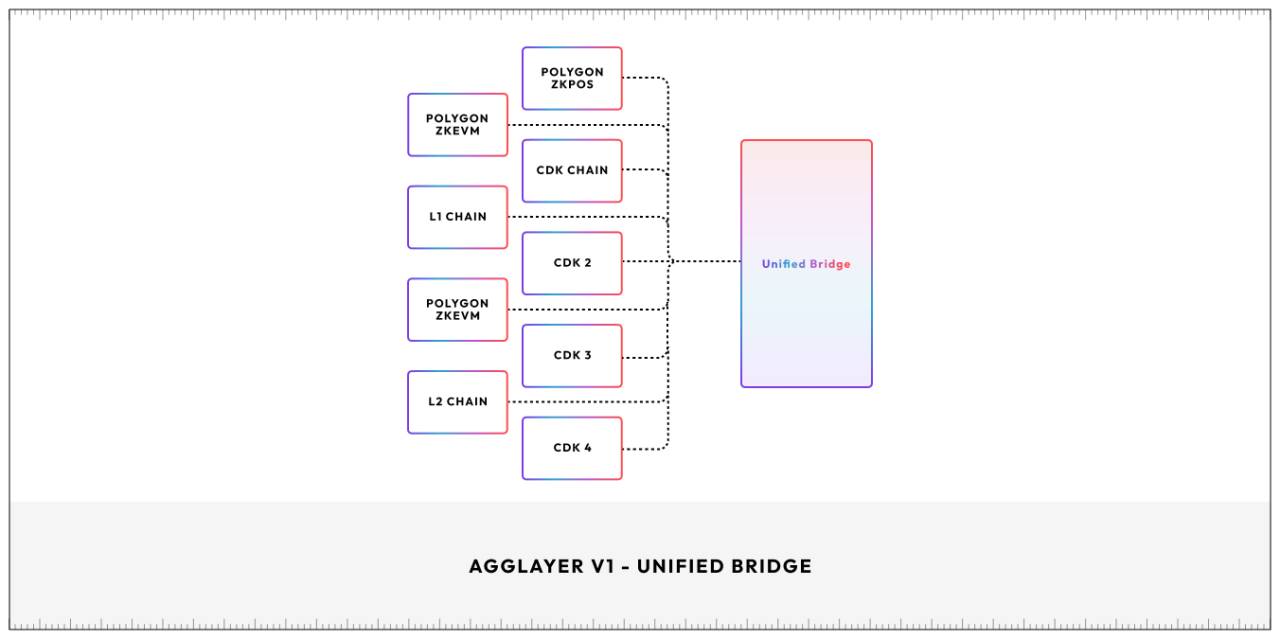
Image source: Aggregated Blockchains: A New Thesis
2. Pessimistic Proofs
Technical Framework:
● Security: Pessimistic Proofs serve as a security measure designed to prevent fraudulent transactions. They introduce additional verification steps during transaction validation to ensure all transactions are valid;
● Delayed Validation: Unlike Optimistic Proofs, Pessimistic Proofs assume transactions may be malicious and perform full validation before confirmation.
Implementation Logic:
● Initial Validation: Immediately after submission, the system performs preliminary checks including basic transaction data and signature validity;
● Deep Validation: After initial validation, transactions enter deep validation. The system invokes smart contracts to examine complexity and potential risks;
● Dispute Resolution: If issues arise during validation, a dispute resolution mechanism is triggered, allowing users and validators to submit additional proofs to resolve disputes and confirm transaction validity.
Through the Unified Bridge and Pessimistic Proofs, AggLayer delivers a highly secure, scalable, and interoperable blockchain environment. These components enhance system security and simplify cross-chain transactions, enabling users to interact seamlessly across chains. For further details, see YBB Capital’s previous article “From Modularity to Aggregation: Exploring the Core of Polygon 2.0’s AggLayer” (1)
4. Optimism: Superchain Explainer
In 2023, Optimism pioneered one-click chain deployment, starting with establishing a standard for a unified network via OP Stack. OP Stack serves as the launchpad for Ethereum scaling solutions—the Optimism Superchain—and functions as the hub for interaction and transactions among all L2s built on the OP Stack.
Most readers are likely familiar with OP Stack. In brief, the Optimism Superchain shares a common OP Stack development stack, bridge, communication layer, and security, ensuring coordinated communication among chains and enabling them to function as a single unit. This structure is divided into five distinct layers, each with specific purposes and functions:
● Data Availability (DA) Layer: Determines raw inputs for OP Stack-based chains, primarily sourced from Ethereum DA;
● Sequencing Layer: Controls how user transactions are collected and forwarded, typically managed by a single sequencer;
● Derivation Layer: Processes raw data into inputs for the execution layer, primarily using Rollup;
● Execution Layer: Defines system state structure and transition functions, with the Ethereum Virtual Machine (EVM) as the central module;
● Settlement Layer: Allows external blockchains to view the valid state of OP Stack chains via proof-based fraud proofs.
Compared to Elastic Chain and AggLayer, Optimism Superchain entered the market earliest, capturing significant share and producing Base, which dominates daily gas expenditure—visibly reflecting Base’s on-chain activity.
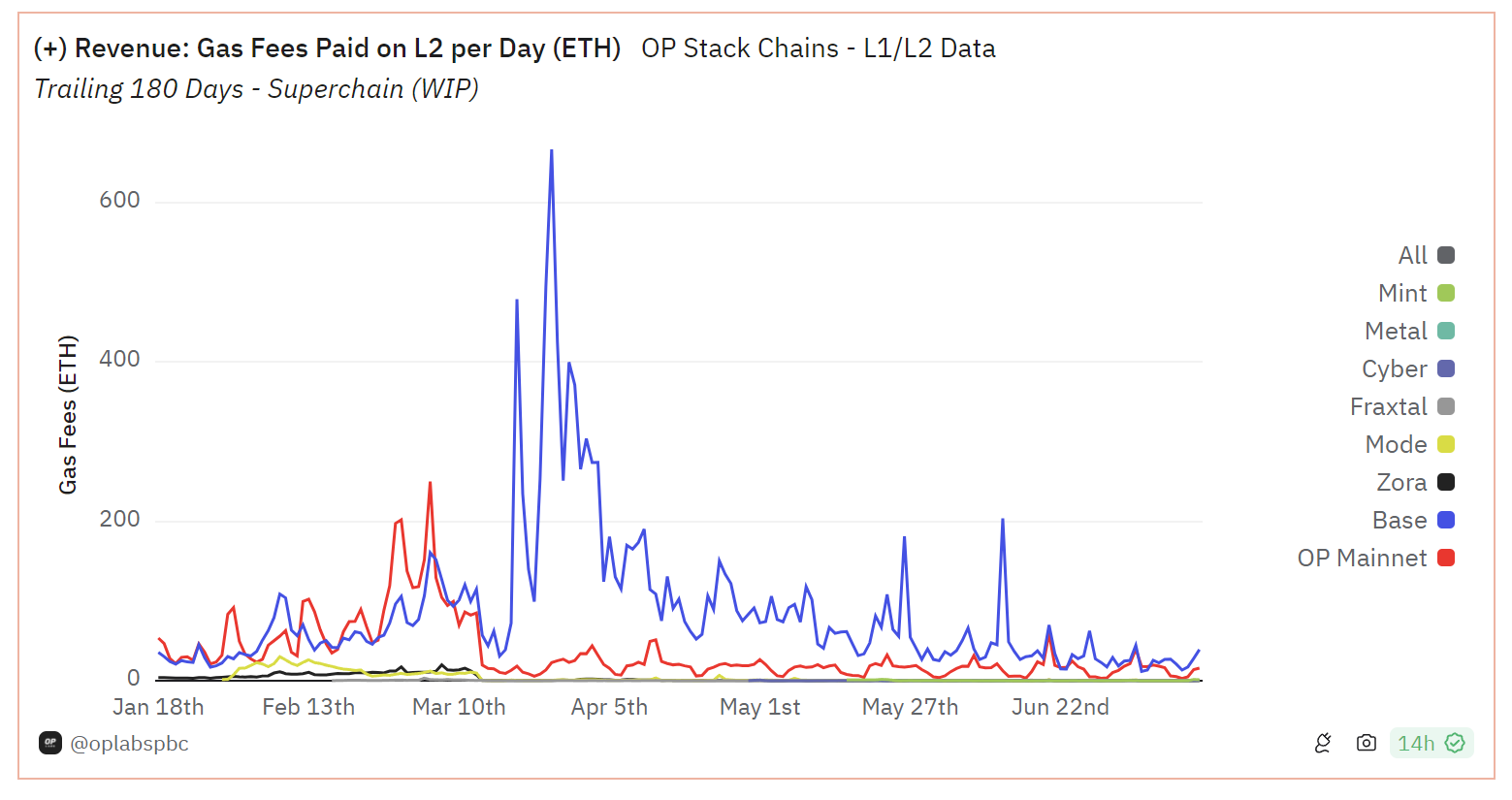
Image source: Dune Optimism - Superchain Onchain Data
5. Subjective Reflections on One-Click Chain Deployment
5.1 Perspectives on Competition Among AggLayer, Superchain, and Elastic Chain
(This section represents the author’s personal views only)
The above three scaling solutions extend their respective Rollup narratives. From a market maturity standpoint, OP Stack and Superchain captured early market share, with Base standing out as the most successful example.
AggLayer has an advantage in native compatibility, capable of running directly on the existing Ethereum network without major protocol modifications, making it more readily accepted by current Ethereum users and developers. This approach effectively leverages the existing Ethereum network, though the challenge lies in ensuring the security and reliability of the aggregation process.
Elastic Chain’s current assessment depends on ZKsync’s ecosystem development and community building. If ZKsync itself fails to grow, Elastic Chain may struggle to attract developers and sustain community enthusiasm later on. From both market and technical perspectives, OP leads in the short term, while ZK holds long-term potential.
Additionally, all three approaches inherit the inherent issue of Rollups—high centralization. Recently, the emergence of Based Rollup as a scaling solution may become a potential competitor. It hands sequencing directly to L1—Ethereum itself—eliminating the need for additional sequencers or complex validation steps. While this native scaling approach may introduce some MEV-related concerns, its future evolution warrants close attention.
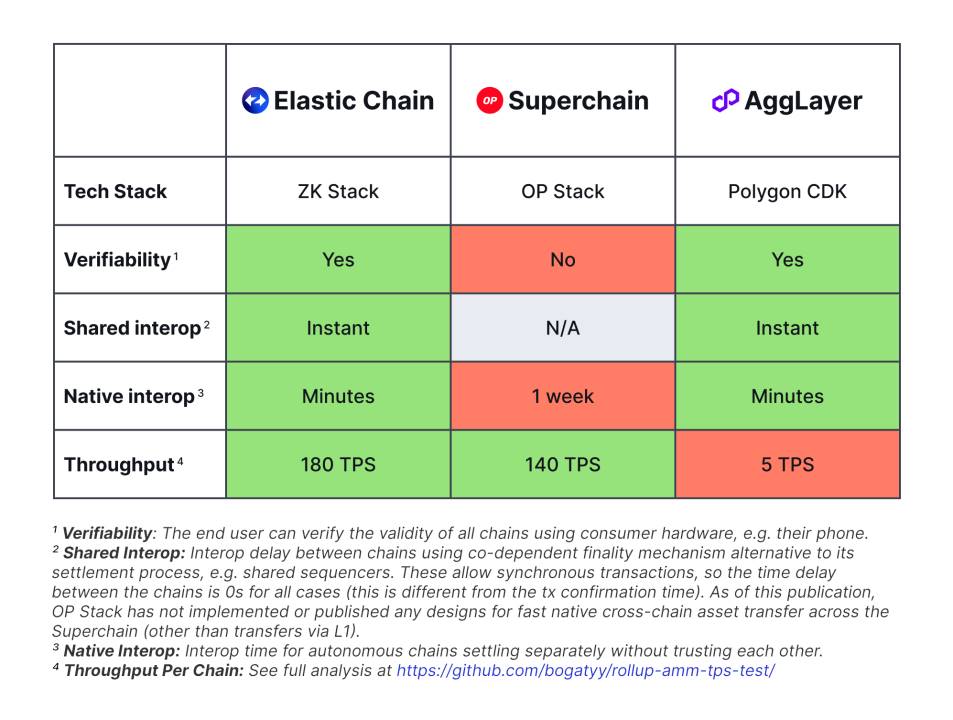
Image source: ZKsync - Introducing the Elastic Chain
5.2 Future Trends and Application Innovation in Rollups
Overall, driven by "one-click chain deployment," the number of Rollups—Ethereum’s dominant scaling method—will continue to grow. Even during Bitcoin’s 2023 ecosystem boom, its non-native scaling borrowed heavily from Ethereum’s scaling logic. Given limited market innovation, Rollup application innovation and impact may remain constrained.
For every VM chain, regardless of market shifts, TVL remains the primary metric, so the first applications to emerge will be various DeFi protocols. Additionally, SocialFi protocols and NFT marketplaces may appear.
In other sectors, DePIN struggles to develop on Rollups or L1s, with leaders likely emerging on Solana; RWA concepts have higher chances on L1s but lack confidence on Rollups; GameFi will appear, but major games will only succeed on Rollups dedicated to GameFi. Therefore, currently the most certain application category remains DeFi.
However, the Matthew effect in blockchain is evident. In a multi-chain era, resources will concentrate on top projects—“the rich get richer,” while weaker ones are eliminated.
Extended Links:
(1) From Modularity to Aggregation: Exploring the Core of Polygon 2.0’s AggLayer
References:
[1] Introducing the Elastic Chain
https://zksync.mirror.xyz/BqdsMuLluf6AlWBgWOKoa587eQcFZq20zTf7dYblxsU
[2] zkSync Protocol Upgrade v24: New precompiles, more blobs, Validiums, and more. #519
https://github.com/zkSync-Community-Hub/zksync-developers/discussions/519
Join TechFlow official community to stay tuned
Telegram:https://t.me/TechFlowDaily
X (Twitter):https://x.com/TechFlowPost
X (Twitter) EN:https://x.com/BlockFlow_News
 @YBBCapital