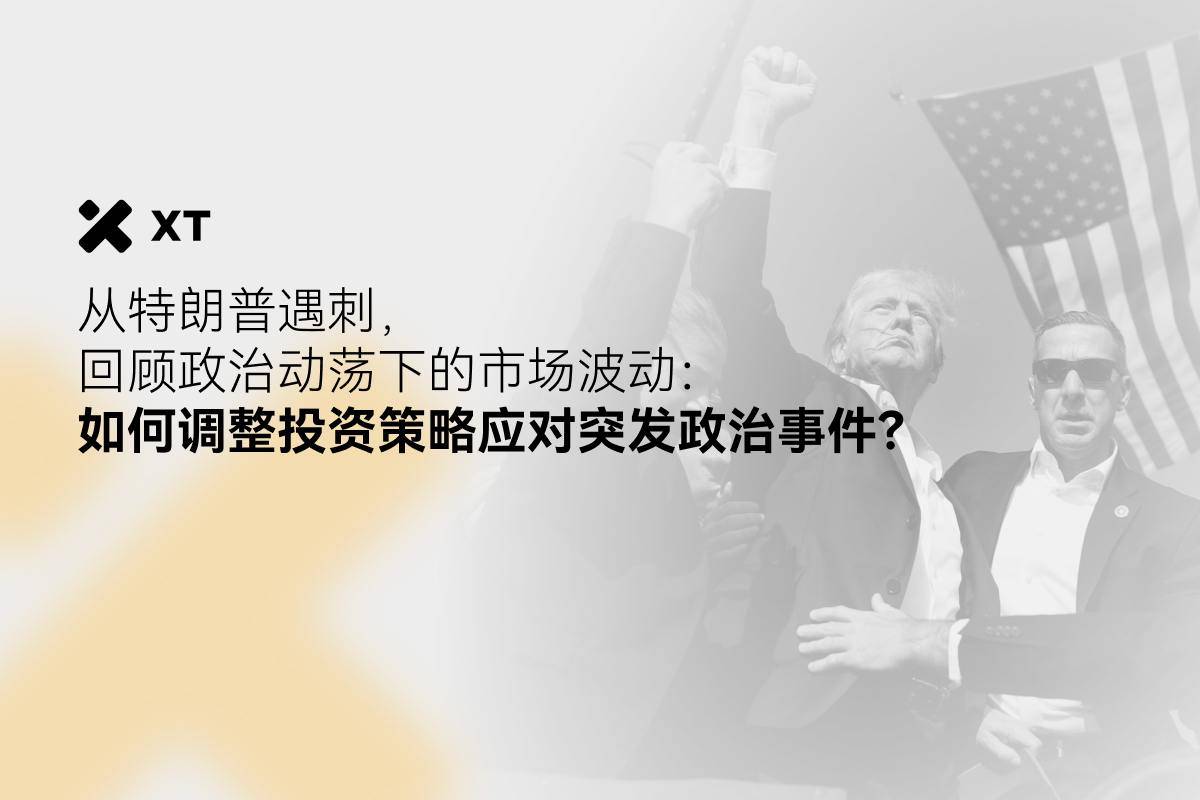
Revisiting Market Volatility Amid Political Turmoil: How to Adjust Investment Strategies in Response to Sudden Political Events, from the Perspective of Trump's Assassination Attempt?
TechFlow Selected TechFlow Selected
Revisiting Market Volatility Amid Political Turmoil: How to Adjust Investment Strategies in Response to Sudden Political Events, from the Perspective of Trump's Assassination Attempt?
The shooting incident is both a boon and a double-edged sword for the cryptocurrency market.
 Navigating Web3 tides with focused insights
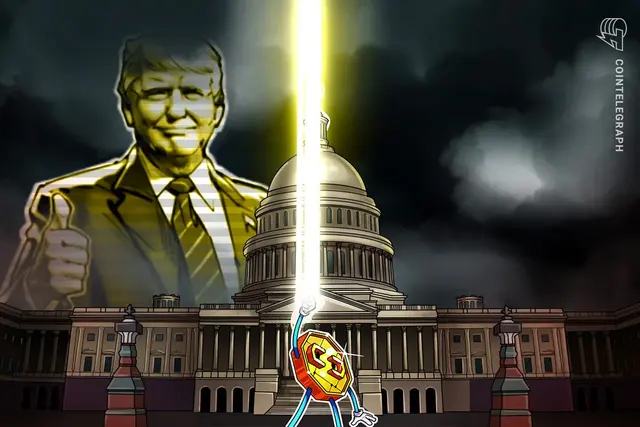
On July 13, 2024, a shocking incident occurred when former U.S. President Donald Trump was targeted by a gunman during a campaign rally in Pennsylvania. The shooter fired from a rooftop over a hundred meters away, with the bullet grazing above Trump’s right ear. The assassination attempt failed. Such attacks on political figures are not uncommon in American history, and fortunately, Trump only sustained minor injuries without serious harm. For investors, the key question lies in how such sudden political events impact financial markets. This article will review historical precedents of similar incidents and their short-term market effects, while also exploring the long-term implications of political instability.
U.S. Presidential Assassination Attempts and Risk Markets
On July 15—the first trading day after the assassination attempt—U.S. stocks surged across the board, closing at new highs. Political assassinations often have an ambiguous relationship with risk markets. Historically, ten U.S. presidents have been attacked, four of whom were killed. The last presidential assassination attempt occurred 43 years ago in 1981, when President Ronald Reagan survived being shot. Another notable case is the 1963 assassination of the 35th president, John F. Kennedy, who became the fourth U.S. president to be murdered in office.
Sudden, major events like presidential deaths typically cause sharp but short-lived volatility in financial markets. For example, in September 1955, President Eisenhower suffered a heart attack after playing golf, triggering a 6.5% single-day stock market plunge. Similarly, when JFK was assassinated in November 1963, the U.S. stock market immediately dropped by 3%, and trading was halted two hours early in his honor.
However, these sharp declines are often followed by rapid rebounds. By late October 1963—less than a month after Kennedy’s death—the stock market surged, recovering all losses within days and delivering a monthly gain of 35% for the Dow Jones Industrial Average. Likewise, after President Ronald Reagan survived an assassination attempt in March 1981, the stock market rose significantly.

Trump’s Survival Boosts His Election Odds
In a video clip captured by Twitter user @C3PMeme, it can be seen that Trump narrowly avoided the bullet thanks to turning his head toward a screen and leaning closer to the microphone.
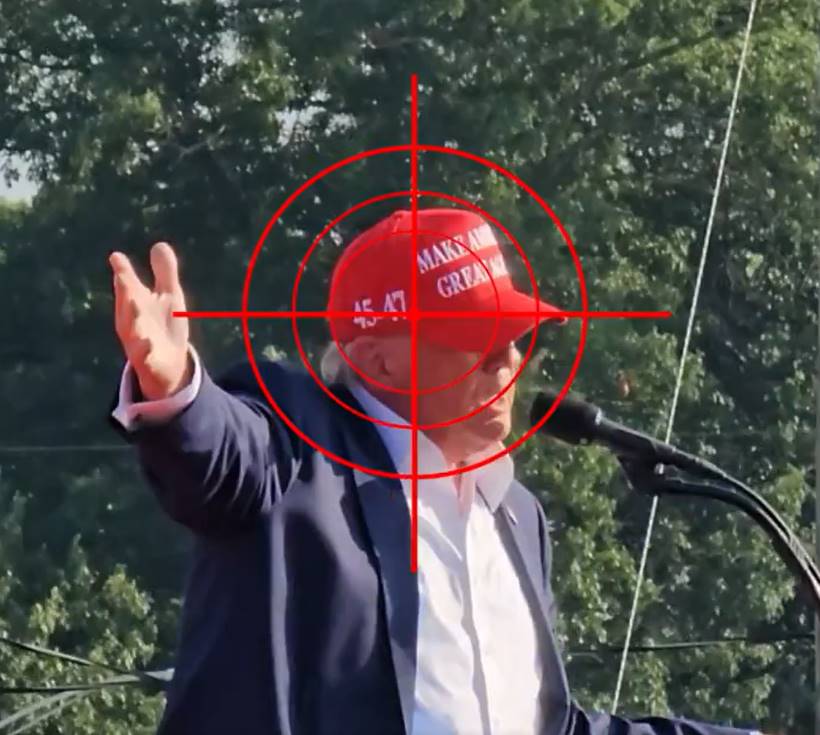
The shooter Thomas aimed directly at the center of Trump's head
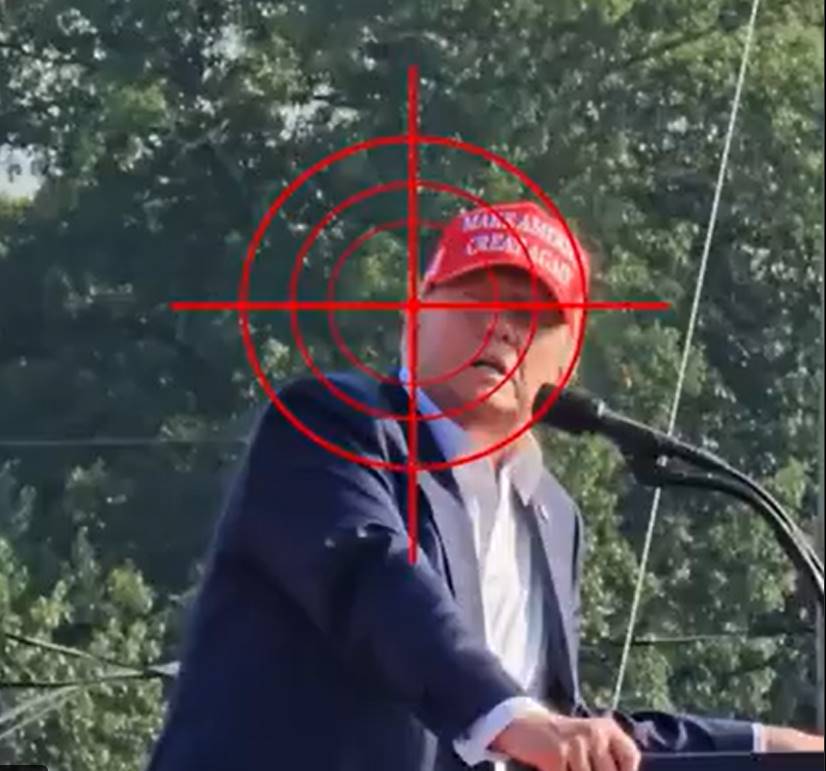
Trump escaped by tilting his head to look at the screen
Trump’s miraculous survival has further solidified his supporters’ belief that he is “chosen,” and his defiant chant of “Fight! Fight! Fight!” after being wounded cemented his image as a courageous warrior fighting for America. Even many business and social leaders who previously criticized him have now expressed support. Elon Musk led the way, posting six consecutive tweets backing Trump, calling him “the most resilient U.S. president since Theodore Roosevelt a century ago.” He later added: “I fully support President Trump and wish him a speedy recovery.”
Similarly, Mark Zuckerberg announced support for Trump. Meta, the parent company of Facebook, stated it would reinstate Trump’s Facebook and Instagram accounts in the coming weeks. This marks a significant shift, given Trump had repeatedly called "Facebook the enemy of the people" and had longstanding tensions with Zuckerberg.
According to data from the crypto prediction market Polymarket, Trump’s odds of winning the November U.S. election have risen from 60% before the incident to nearly 70%, reaching record highs. The RealClearPolitics (RCP) average of recent polls shows Trump’s chances at 47.1%, ahead of Biden’s 44.4%. Polls are expected to rise further, making Trump’s return to the White House increasingly likely.
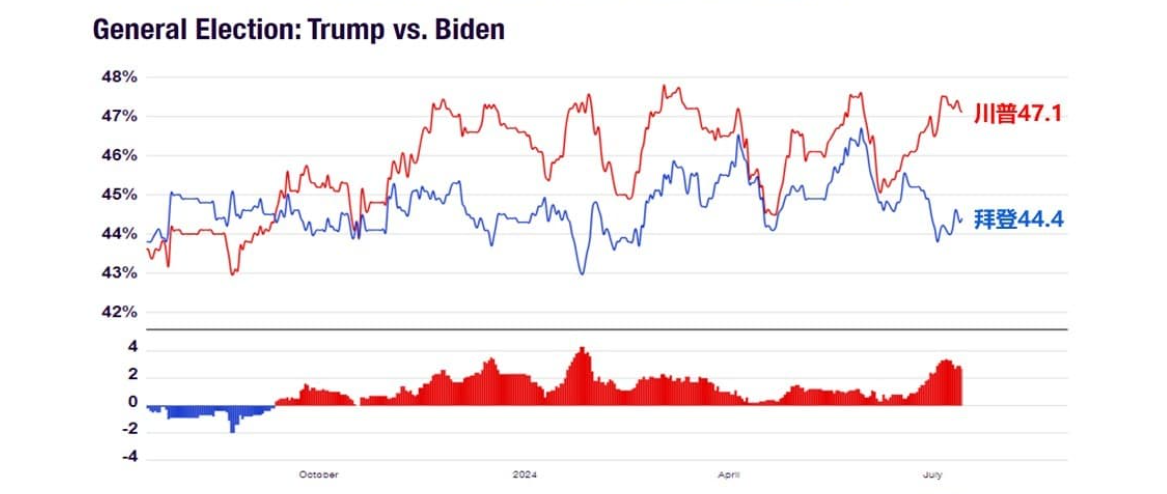
Polls show Trump leading Biden, source: RCP
If Trump wins the national vote in November, his political agenda will likely have long-term implications for the U.S. stock market. As a politician highly focused on stock performance, Trump is expected to continue pushing policies such as tax cuts, stronger tariffs, and tighter border controls. Investors should closely monitor how these policy shifts may affect the economy and corporations, adjusting investment strategies accordingly. While markets may sustain strong gains under a Trump presidency, they could also face increased uncertainty due to his policy direction.
The Encouraged Crypto Market
After two months of decline, Bitcoin found its strongest rebound catalyst in Trump’s survival. BTC rose from $58,000 to $65,000, pulling up altcoins across the board. But can this rally be entirely credited to Trump? Not exactly. The shooting occurred on a Sunday, when market liquidity is naturally low, so the price movement may have simply extended the previous Friday’s upward trend. Moreover, Thursday’s favorable CPI data already fueled traders’ strong bets on rate cuts, which could carry over into the weekend. Therefore, while the assassination attempt contributed to market sentiment, it was not the primary driver of the rally. Additional bullish factors include Germany completing its Bitcoin sell-off, the imminent approval of Ethereum spot ETFs, and capital returning to markets after the conclusion of the UEFA Euro tournament. Thus, while Trump’s survival did boost short-term sentiment, it acted more as a trigger than the core reason for price increases.
What the event truly amplified was emotional excitement and greater public support for Trump’s re-election. It also strengthened Americans’ backing for the Republican Party, which Trump represents. Given the GOP’s historically friendlier stance toward cryptocurrencies, this development bodes well for the long-term growth of the crypto industry. Hence, the potential impact of the assassination attempt extends beyond short-term market swings—it may deepen political alignment with the Republican Party and its policy platform, thereby shaping the crypto sector’s trajectory for years to come.
Short-Term Impact: Boosting Market Sentiment and Attracting Crypto Investors
Sudden events increase market volatility. News of a political assassination typically triggers anxiety, yet some traders interpret rising odds of a Trump victory as signaling expectations for fiscal, trade, and regulatory policies under his administration—such as looser financial regulation—that could improve liquidity and benefit risk assets. On July 13, the day of the attack, Bitcoin broke above $60,000 and continued climbing. During the Asian trading session on July 15, gold prices dipped, stock index futures moved slightly, the dollar rose modestly against most currencies, and U.S. Treasury futures fell. These cross-asset reactions reflect rapid shifts in market sentiment and expectations.
Long-Term Impact: Watch for Substantive Pro-Crypto Policies if Trump Wins
During Trump’s previous term, the so-called “Trump trade (Trumpflation)” drove strong gains in U.S. equities, especially in tech and financial sectors. As a prominent political figure supportive of cryptocurrencies, Trump’s re-election would likely benefit the crypto market. He may implement measures such as rate cuts, dollar depreciation, and export promotion to help small and medium-sized enterprises recover—conditions favorable to risk markets. Following the anticipated approval of Ethereum spot ETFs, Solana (SOL) ETFs could also become reality during a second Trump term, paving the way for a broader wave of crypto ETF approvals.
Emerging MEME Coins
Election-themed tokens remain a hot topic in the crypto space. Prior to the incident, meme coins like MAGA, MAGAHAT, and DJT had already gained traction. Unsurprisingly, the assassination attempt refocused speculative attention on blockchain-based tokens, resonating strongly with the emotionally driven nature of meme coins and sparking a frenzy of price surges. The influence of political events is now deeply permeating every corner of the crypto market. The legacy coin MAGA spiked over 50% following the shooting, while PEOPLE—a token tied to democratic ideals—rose more than 60% intraday. A new batch of election-themed tokens emerged, including EAR, FIGHT, and FEARNOT, now tradable on XT exchange.
• EAR
"Ear" stands for “The Ear Stays On,” symbolizing Trump’s injured right ear. The name draws inspiration from the Doge meme slogan “The Hat Stays On.” The token reached a peak market cap of $30 million but has since sharply declined to around $1.5 million as media attention fades.
CA: 2BUZ19fT8TYvPzhuvtCCp9ceu9eNRCmY11S4vSATpump
• FIGHT
After being wounded, Trump raised his fist and shouted “Fight!” three times to his supporters. Images and videos of Trump raising his fist chanting “Fight” flooded social media. The FIGHT token exists on both ETH and SOL chains, with current market caps of $55 million and $5 million respectively. The Solana-based FIGHT token achieved a 10x gain within two days of launching on XT exchange.
CA(ETH): 0x8802269d1283cdb2a5a329649e5cb4cdcee91ab6
CA(SOL): KMnDBXcPXoz6oMJW5XG4tXdwSWpmWEP2RQM1Uujpump
• FEARNOT
Trump posted “FEAR NOT” the day after the attack and later updated his campaign website with the phrase “Fear Not,” igniting emotional momentum among meme traders. Like EAR, FEARNOT briefly surpassed a $30 million market cap before falling back to around $4.8 million.
CA: 0x6135177a17e02658df99a07a2841464deb5b8589
Trump and His Political Philosophy
Trump and Biden differ sharply on taxation, trade, infrastructure, social welfare, and international affairs. As a businessman, Trump favors a low-interest-rate environment and has even declared that if re-elected, he will not reappoint Jerome Powell as Fed Chair in 2026. Although Powell may resist political pressure, other Fed members eager to replace him might challenge Powell’s stance in meetings, potentially increasing inflation expectations in the U.S.
Key Policy Differences Between Biden and Trump:
1. Fiscal and Tax Policy: Biden advocates higher taxes on high-income individuals and corporations, whereas Trump supports tax cuts.
2. Monetary Policy: Biden upholds central bank independence, while Trump prefers pressuring the Fed chair to pursue looser monetary policy.
3. Foreign Policy: Biden seeks to restore America’s traditional leadership role in global affairs and strengthen alliances. Trump leans toward unilateralism and strategic independence.
4. Immigration Policy: Biden supports more lenient immigration rules, while Trump pushes for stricter border control.
5. Economic Policy: Biden emphasizes government intervention in the economy, while Trump trusts market forces more.
What Is the “Trump Trade” (Trumpflation)?
|
Since Trump became the 45th U.S. president, the term “Trump trade” has frequently appeared in financial markets. It generally refers to market reactions driven by expectations of fiscal, trade, and regulatory policies during his presidency—such as tax cuts and deregulation—that lead to specific patterns of financial market movements. In essence, the “Trump trade” is a market phenomenon fueled by anticipation. ——Source: Minsheng Macro |
Trump’s combination of expansionary fiscal policy and protectionist trade measures intensified inflationary pressures in the U.S. and widened economic gaps between America and other nations. Some believe these policies would strengthen the dollar, as growing fiscal deficits could drive appreciation. However, historical data shows the opposite: when Trump took office in 2017, the U.S. Dollar Index stood at 101, but by the end of his term in 2021, it had fallen to 90. In contrast, the dollar appreciated significantly during Biden’s presidency amid pandemic-related dynamics.
Trump has long advocated reduced market regulation. Goldman Sachs analysts noted that Republican administrations tend to boost business and consumer confidence, potentially increasing spending and investment, improving corporate earnings outlooks, and supporting risk markets.
Today’s global economic landscape has changed dramatically, and history may not repeat itself. When Trump first won the presidency, the U.S. was in the eighth year of an economic recovery. Markets rallied immediately after his victory on expectations of tax cuts and deregulation. But conditions today are different: the world is entering a period of coordinated rate cuts and faces potential recession risks. If Trump reignites inflation, the Federal Reserve may be forced to pause or reverse rate cuts, endangering global economic recovery. The actual path of capital markets remains complex and uncertain.
Conclusion
The assassination attempt is a double-edged sword for the crypto market. On one hand, Trump has consistently voiced pro-crypto views, and the Republican Party overall favors lighter regulation—supportive of small businesses and potentially easing the current high-interest-rate environment, which benefits the crypto industry. On the other hand, excessive monetary easing could push the U.S. economy into recession, ultimately harming crypto markets. Overall, from July to September—before the election outcome is clear—the dominant market narratives will revolve around rate cut expectations and political developments. Notably, Trump is scheduled to speak at the Bitcoin Conference on July 24. While he has a performative personality, his support for cryptocurrency appears genuine. If Trump returns to power, official recognition of crypto could rise significantly. Investors should avoid FOMO-driven moves in the short term and instead wait to see whether he delivers real, substantive policies that benefit the crypto ecosystem.
Reference
3. From Kennedy to Trump: How Political Assassinations Have Shaped American History
4. Bull Market in Jeopardy? Revisiting the Origins of the Past 12 Bear Markets
5. The Electoral Trajectory After the Gunshot
[Disclaimer] This article is for informational purposes only and does not constitute any investment advice. Investing involves risk; please proceed with caution. Readers should independently evaluate the content based on their own circumstances and bear full responsibility for their investment decisions and outcomes.
Join TechFlow official community to stay tuned
Telegram:https://t.me/TechFlowDaily
X (Twitter):https://x.com/TechFlowPost
X (Twitter) EN:https://x.com/BlockFlow_News
 @XTexchange