Hack VC: The hacker that invests in hackers, the infrastructure powerhouse in crypto VC
TechFlow Selected TechFlow Selected
Hack VC: The hacker that invests in hackers, the infrastructure powerhouse in crypto VC
This article takes you through the story behind Hack VC and its Founder Partner, Alexander Pack.
 Navigating Web3 tides with focused insights
By: TechFlow

In 2024’s crypto market, there is one crypto VC you cannot afford to ignore.
It favors leading rounds—50% of its investments this year have been lead investments, including well-known projects such as io.net, Initia, AltLayer, and imgnAI;
It has a strong preference for infrastructure, with one-third of its portfolio dedicated to foundational projects such as Berachain, EigenLayer, Movement, Babylon, SUI, and Eclipse;
Beyond capital, it also provides technical support and access to developer communities, offering long-term empowerment to its portfolio companies;
This VC is called Hack VC.
True to its name, it is a group of tech-savvy investors who back hackers.
This article explores Hack VC and the story behind its founding partner, Alexander Pack.
From Hong Kong to Connecting East and West
In 2014, at just 22 years old, Alexander arrived in Hong Kong to work at Arbor Ventures, a fintech-focused venture capital firm. He also participated in Princeton’s Asian Teaching Fellowship. That same year, he made his first investment in cryptocurrency—before Ethereum existed, when crypto was not yet an established industry.
The following year, Alexander joined AngelList, the world’s largest equity crowdfunding platform, becoming the first analyst on its investment team. Within a year, he helped complete over 100 venture deals. During this time, he began angel investing—his first investment was $300,000 into Numerai, a project claiming to use AI to disrupt quantitative trading. It later evolved into a decentralized prediction market and hedge fund, issuing the NMR token and attracting investments from Placeholder and Paradigm.
During this period, Alexander also invested in Polychain Capital—an early connection that laid the foundation for a long-term partnership.
After leaving AngelList, Alexander joined Bain Capital as Director of Network Investments, where he helped launch the firm’s crypto investment practice, supporting 16 funds and 11 startups.
During this time, he met Feng Bo, founding partner of Cyzone Ventures, and together they invested in projects including Basis and several cryptocurrency exchanges.
In 2018, Alexander decided to go independent and co-founded the crypto venture fund Dragonfly Capital with Feng Bo, announcing a $100 million fund close in October.
Thanks to his prior network, the fund attracted backing from both Silicon Valley and Chinese tech firms from day one. His former boss at Bain Capital, Salil Deshpande, a16z co-founder Marc Andreessen and its crypto lead Chris Dixon, as well as Cyan Banister from Founders Fund and Olaf Carlson-Wee from Polychain, all participated.
In Asia, investors included Bitmain, OKX, HongShan China’s Shen Nanpeng, Baidu founder Robin Li, ZhenFund’s Xu Xiaoping, Dianping founder Zhang Tao, and Meitu founder Cai Wensheng.
In October 2019, at the Dragonfly Crypto Summit, HongShan China’s Shen Nanpeng posed a question: “Many years ago, when we started investing in the internet, investors didn’t label themselves as ‘internet funds’ or specialize in a narrow niche. But today, why are active investors in blockchain and crypto so specialized? Why do most focus exclusively on crypto and blockchain? What changed?”
Alexander Pack responded that crypto investing is unique for two main reasons. First, it revolves around technological trends requiring deep understanding and judgment of early-stage technologies. Second, investing in blockchain isn’t just about high-risk tech startups—it’s also about investing in an “asset”, which requires attention to factors like liquidity, volatility, and market dynamics. Moreover, the crypto market has been global from day one, demanding a globally-minded approach from investors.
Alexander stated that Dragonfly Capital aimed to be a bridge connecting Eastern and Western crypto ecosystems—helping Asian projects and investors access Western-developed technologies while enabling Western blockchain projects to enter Asian markets.
To succeed in crypto, globalization must be considered from day one—exactly as reflected in Dragonfly Capital’s slogan: “Global from Day One.”
In 2020, Alexander left Dragonfly Capital. According to a letter sent to LPs on April 27 that year, his departure stemmed from “differences in vision regarding the firm’s direction,” though he would continue managing the first fund as a part-time partner.
In 2021, Alexander co-founded the crypto fund Hack VC alongside Ed Roman, an independent GP and founder of Hack.Summit().
In the fall of 2021, Hack VC closed a $200 million crypto fund, backed by Sequoia Capital, Fidelity, Marc Andreessen and Chris Dixon from a16z, among others.
Alexander explained that the name Hack VC reflects their team culture: a group of hackers investing in other hackers.
Hack VC focuses on early-stage investments, specifically in the technological infrastructure that will bring crypto to the mainstream, maintaining a smaller, more agile fund size compared to many peers.
“For me, my favorite thing in the world is finding a brilliant founder with a completely new idea and investing right at the beginning—before there’s even a product or business plan, often during incubation. That becomes very hard when you raise too much capital.”
Favoring Lead Investments, Passionate About Infrastructure
In 2024, one word immediately comes to mind when discussing Hack VC: the active “lead investor.”
Following its $200 million fundraise in 2021, Hack VC announced another $150 million fund in February 2024.
With ample capital, Hack VC has frequently appeared in funding announcements—often as the lead investor.
From January 2024 to date, Hack VC has invested in 23 projects, 11 of which were led by them—nearly 50%. These include prominent names like io.net, Initia, AltLayer, and imgnAI…
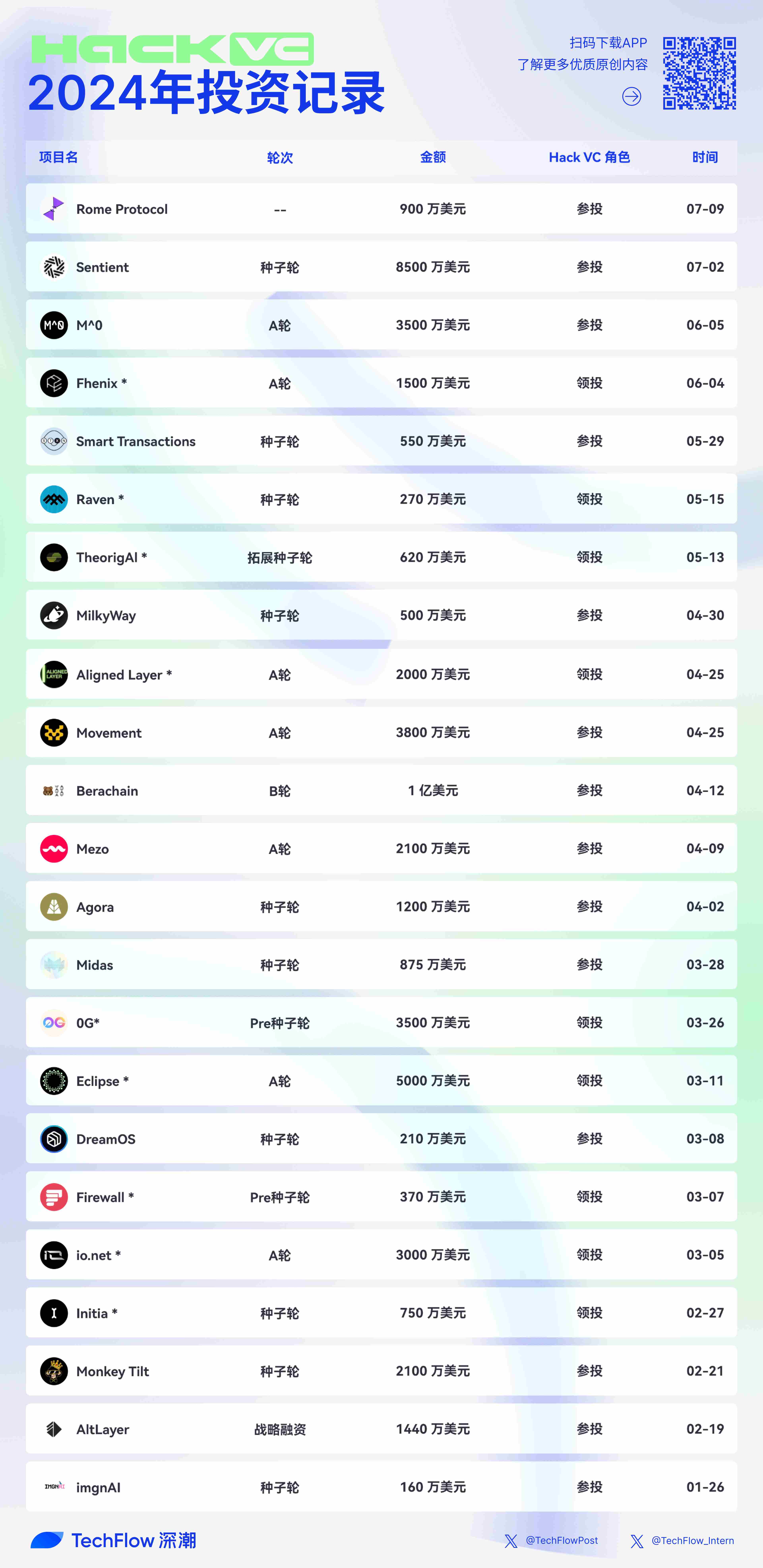
Historically, Hack VC has made 99 investments, 33 of which (one-third) are in infrastructure—earning it the nickname “infrastructure maniac” among crypto VCs. Notable examples include:
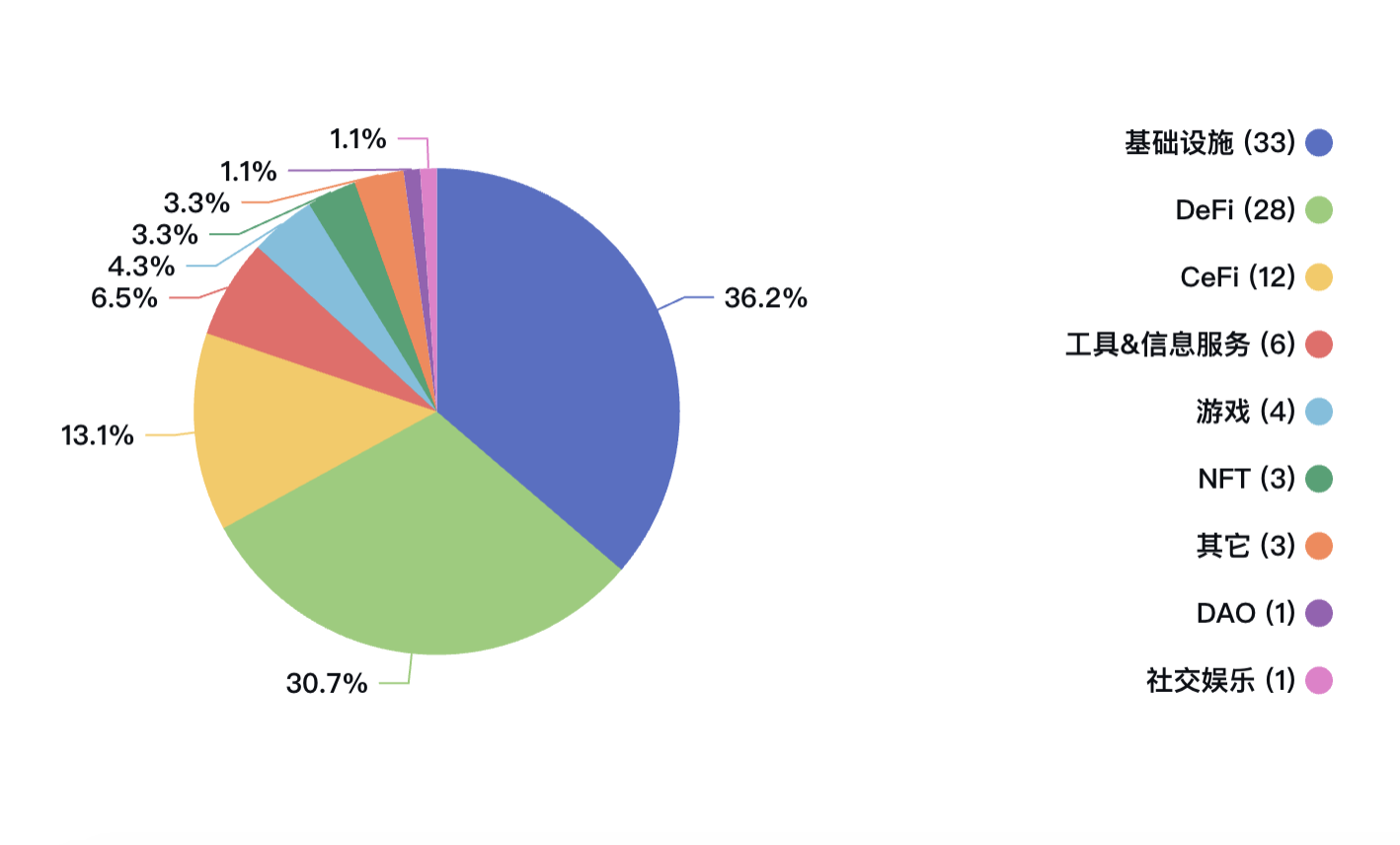
Data source: Rootdata
Eclipse: A modular rollup using SVM as the execution layer.
Initia: A Cosmos-based Layer 1 network that vertically integrates technology stacks to eliminate fragmentation across multi-chain systems, aiming to build a blockchain ecosystem akin to Apple’s.
Berachain: A DeFi-focused, EVM-compatible Layer 1 built on Cosmos SDK, utilizing Proof of Liquidity (PoL) consensus.
EigenLayer: A restaking protocol that reuses base-layer security (e.g., Ethereum) to enhance blockchain networks, allowing anyone to leverage Ethereum’s trust and security without building their own system from scratch.
Babylon: A Bitcoin restaking protocol that extracts Bitcoin’s security to empower all PoS blockchains without additional energy costs.
SUI: Developed by Mysten Labs, based on the Move smart contract language, aiming to be the first programmable blockchain platform at internet scale.
Movement: The first Layer 2 blockchain on Ethereum using the Move language, designed to improve smart contract security and efficiency.
Betting on infrastructure aligns perfectly with Hack VC’s consistent philosophy.
At the beginning of 2024, Alexander stated in an interview that Hack VC’s investment strategy is research-driven and focused on infrastructure, centered on three core categories:
Web3 Infrastructure: Foundational protocols and networks building the plumbing for the new internet.
Financial Infrastructure: Companies leveraging smart contracts and blockchain to build next-generation financial markets, especially in DeFi.
Web3 x AI: Companies building at the intersection of Web3 and generative AI.
Beyond L1 and other infrastructure, Hack VC openly expresses bullishness on the convergence of crypto and AI. Recently, founding partner Ed Roman published an article outlining four key directions in crypto-AI he believes in:
1. Decentralized AI training;
2. Using redundant AI inference computation to achieve consensus;
3. Web3-specific AI use cases: e.g., Web3 protocols using AI for risk scoring of DeFi pools, or Web3 games using AI to control non-player characters (NPCs);
4. Consumer-grade GPU DePIN.
Currently, Hack VC has invested in several notable crypto-AI projects:
0G: A modular AI public chain designed to address pain points for on-chain AI applications in the Web3 ecosystem, such as speed and cost efficiency.
Ritual: Merging the best principles of cryptography and AI to create an open, permissionless system for creating, distributing, and improving AI models.
io.net: A distributed computing network offering cheaper, faster, and more flexible GPU computing than traditional centralized services, providing machine learning engineers with access to near-infinite compute power.
Sentient: Founded by a Polygon co-founder, an AI platform relying on underlying blockchain protocols and incentive mechanisms.
Beyond infrastructure, Hack VC has also heavily backed DeFi and CeFi. It has made 28 investments in DeFi (28%) and 12 in CeFi (12%), including high-profile projects such as:
crypto exchange Bybit, crypto asset manager Amber, market maker Wintermute, decentralized derivatives platforms dYdX and Vertex, DEX aggregator 1inch, and collateral lending platforms MakerDAO and Compound…
Looking closely at Hack VC’s lead investments, many have also attracted top-tier crypto VCs. According to data, Hack VC’s most frequent co-investors are Polychain and Robot Ventures.
Hack VC enjoys “strong co-investment relationships” with other VCs, partly because Alexander has provided seed funding to over ten crypto funds, including Multicoin, Polychain, Paradigm, Standard Crypto, and Parafi.
Unique Value: Technology and Community
For any crypto VC, what truly sets them apart lies beyond capital.
Hack VC’s biggest differentiator is that it offers not only funding but also technical support and liquidity assistance throughout a protocol’s development.
Hack VC operates an internal tech platform called Hack.Labs, going beyond traditional investing by enabling its team of blockchain engineers and quantitative researchers to provide liquidity, stake assets, and contribute open-source code. As a result, Hack VC often plays not just an investor role, but that of a “core contributor” in many projects.
For founders, what else do they need besides capital and technical support?
Community—especially a developer community.
Hack VC’s co-founder Ed Roman is also the founder of hack.summit(), a global developer community. Since 2014, its hackathons have drawn over 130,000 participants from more than 150 countries. In April 2024, Hack.Summit() was held in Asia for the first time, hosted at Cyberport in Hong Kong.
Capital, tech platform, developer community—these correspond to Hack VC’s three pillars: VC Team, Hack.Labs, and hack.summit(). Together, they form a complete and powerful Hack VC.
So, what kind of crypto projects does Hack VC invest in?
Like traditional venture capital, crypto investing ultimately comes down to people—so founder background and capability are paramount.
As Alexander said, they prioritize referrals, case studies, and proven track records.
In traditional VC seed stages, founders often lack a performance history, making investment decisions challenging. But Alexander argues that in crypto, the situation is entirely different—due to the open-source nature of deep tech and the culture of public building, almost everyone has a track record, even at the seed stage.
“I love diving deep into what founders are building and why. I review their code and architecture, and seek feedback from other experts. I also value strong track records—whether through GitHub commits or academic research papers.
It’s not just about what they’ve done. I also look for qualities like honesty, integrity, and loyalty in founders—avoiding red flags is crucial.
Finally, I prioritize startups targeting large markets, consistent with our thesis-driven approach. This ensures the founders we back not only have skill but are building in the right environment.”
In summary, Hack VC prefers founders with proven success and startups with significant upside potential.
Join TechFlow official community to stay tuned
Telegram:https://t.me/TechFlowDaily
X (Twitter):https://x.com/TechFlowPost
X (Twitter) EN:https://x.com/BlockFlow_News
 深潮TechFlow