Messari Solana Q2 Report: Total Economic Value Grows 53% QoQ, Scalability and Blinks Solutions Rise to Prominence
TechFlow Selected TechFlow Selected
Messari Solana Q2 Report: Total Economic Value Grows 53% QoQ, Scalability and Blinks Solutions Rise to Prominence
In the second quarter, Solana continued to serve as one of the primary platforms for cryptocurrency activity.
 Navigating Web3 tides with focused insights
Author: Peter Horton
Translation: TechFlow
Key Takeaways
-
Pump.fun is a gamified token issuance platform that collected $48 million in fees during Q2. Raydium was the primary beneficiary of pump.fun—its daily trading volume increased 77% quarter-over-quarter (qoq) to $867 million, and its TVL (total value locked) rose 46% qoq to $991 million.
-
Dialect and the Solana Foundation launched Solana Actions and Blockchain Links (Blinks), enabling users to preview and execute transactions directly within various digital environments, first launching on X (formerly Twitter).
-
Institutional builders continue choosing Solana for payment use cases. PayPal expanded PYUSD to Solana, leveraging token extensions such as confidential transfers, while Stripe announced support for payments on Solana.
-
Several Solana ecosystem teams launched scaling solutions allowing users to stay on L1, including Light Protocol and Helius’s ZK compression, and MagicBlock’s MagicBlock Engine.
-
Spam transactions driven by memecoin activity and Ore mining caused network congestion at the beginning of Q2. This issue was mitigated through the Agave update leveraging stake-weighted Quality of Service (QoS), introducing new structural demand for SOL.
Primer
Solana (SOL) is an integrated open-source blockchain designed to synchronize global information at the speed of light. Solana optimizes latency and throughput at the expense of some verifiability. It achieves this through its novel timestamping mechanism known as Proof-of-History (PoH), the Turbine block propagation protocol, and parallel transaction processing. Since its mainnet launch in March 2020, several network upgrades have further enhanced performance and resilience, including QUIC, stake-weighted Quality of Service (QoS), and native fee markets.
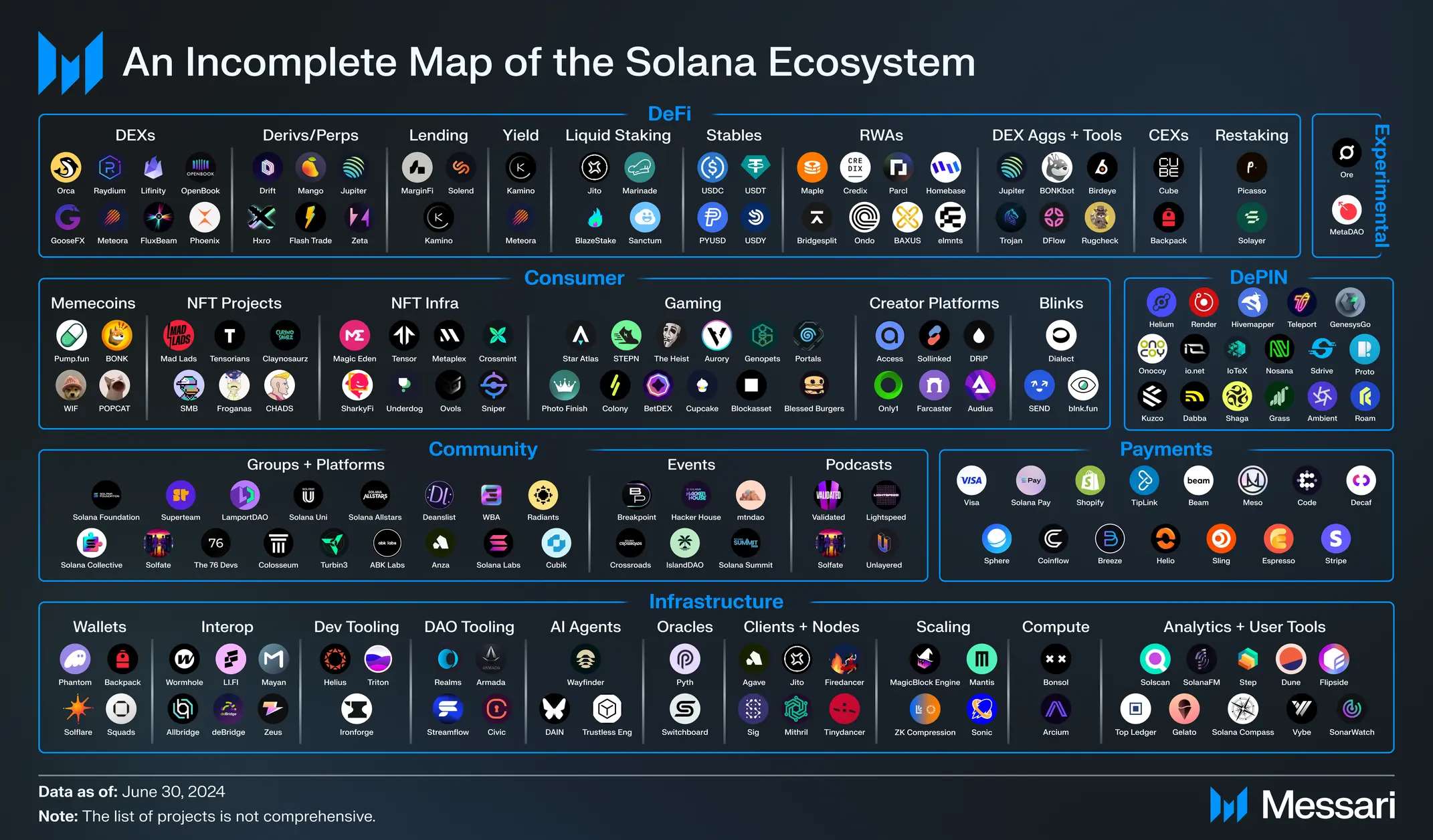
Network and ecosystem development and growth are supported by the non-profit Solana Foundation, Solana Labs, and numerous third-party organizations including Anza, Colosseum, Helius, and Superteam. Solana Labs raised over $335 million through private and public token sales. The Solana ecosystem hosts a growing number of projects across domains such as DeFi, consumer applications, DePIN, and payments.
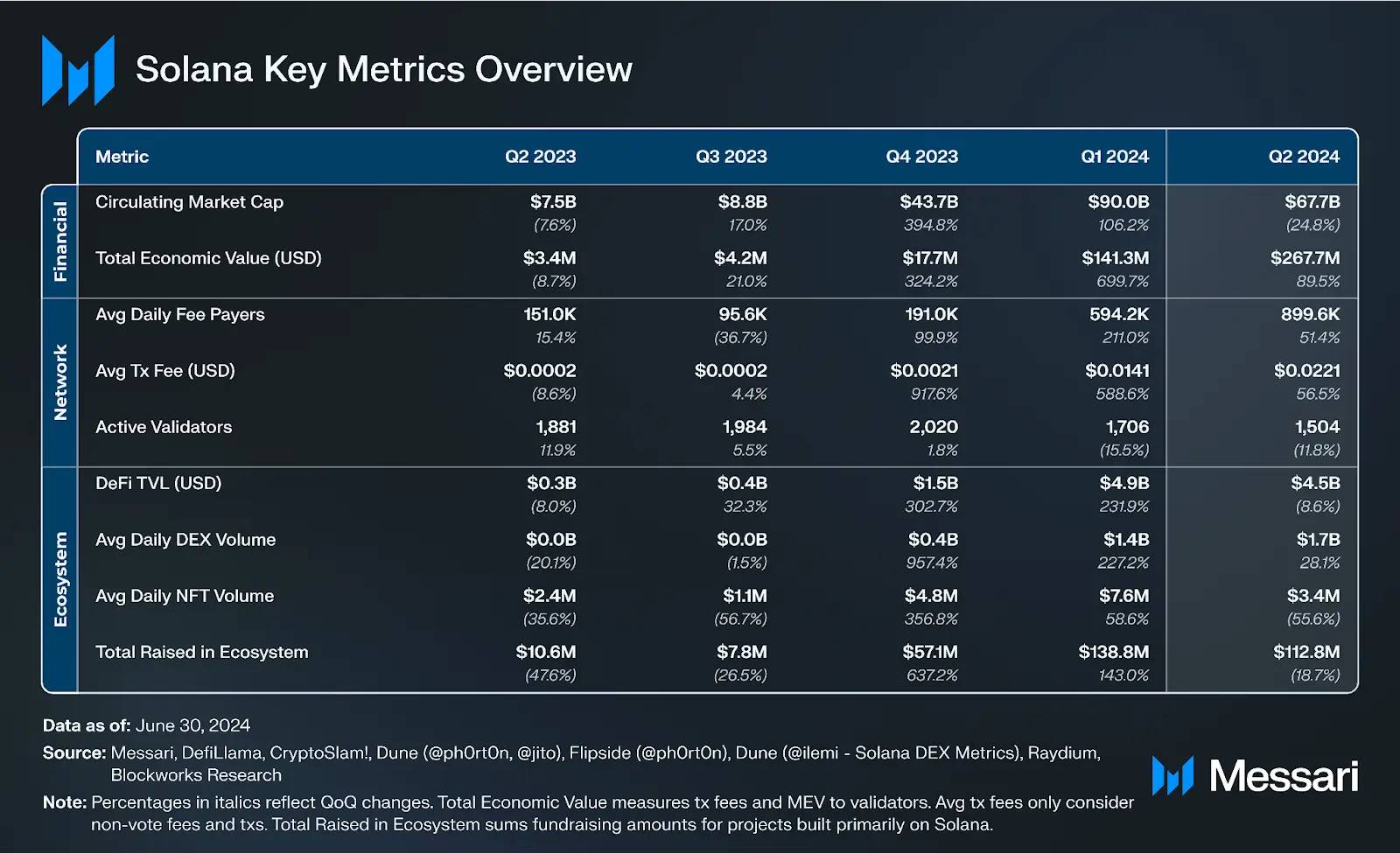
Key Metrics
Ecosystem Analysis
DeFi
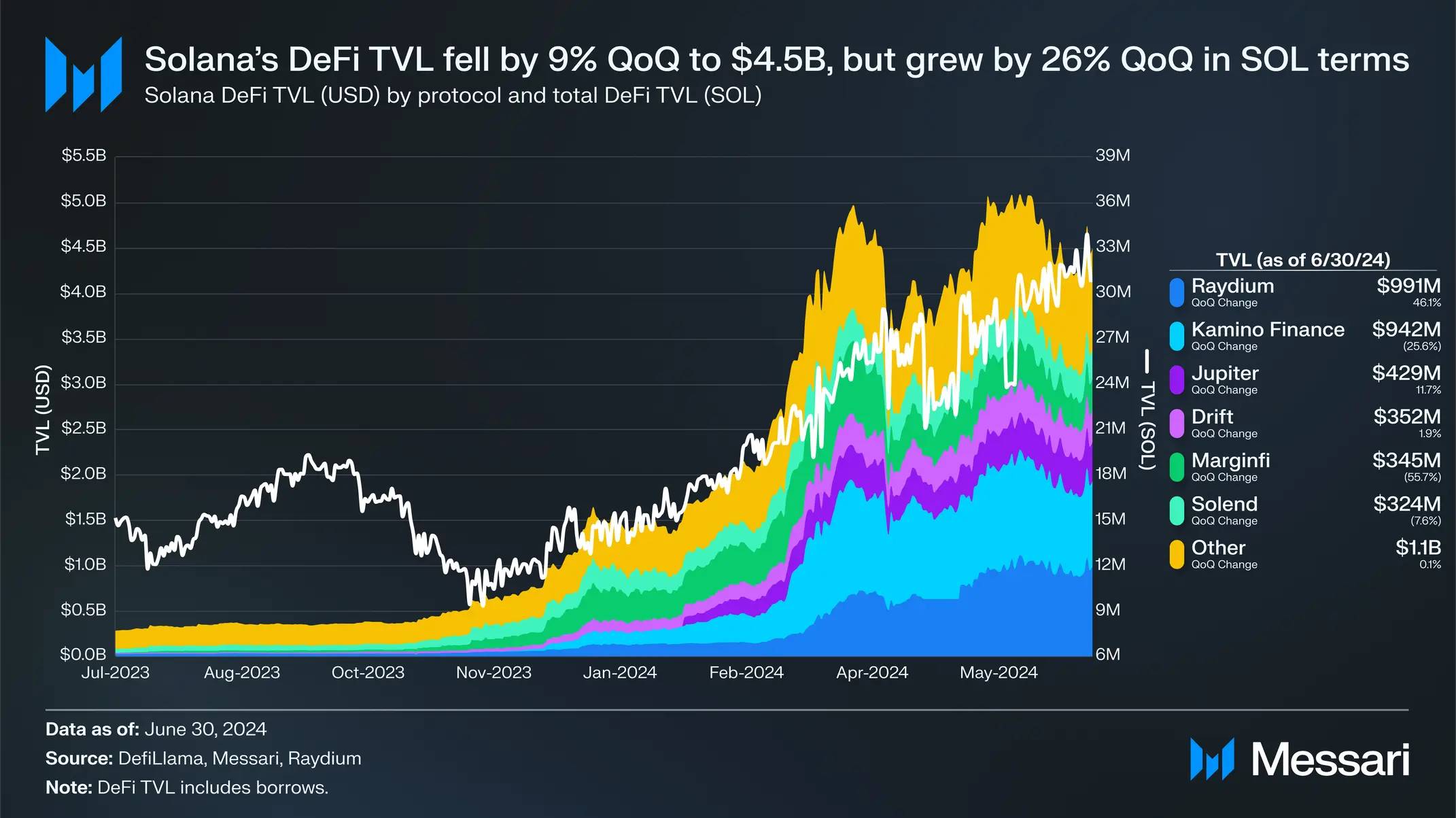
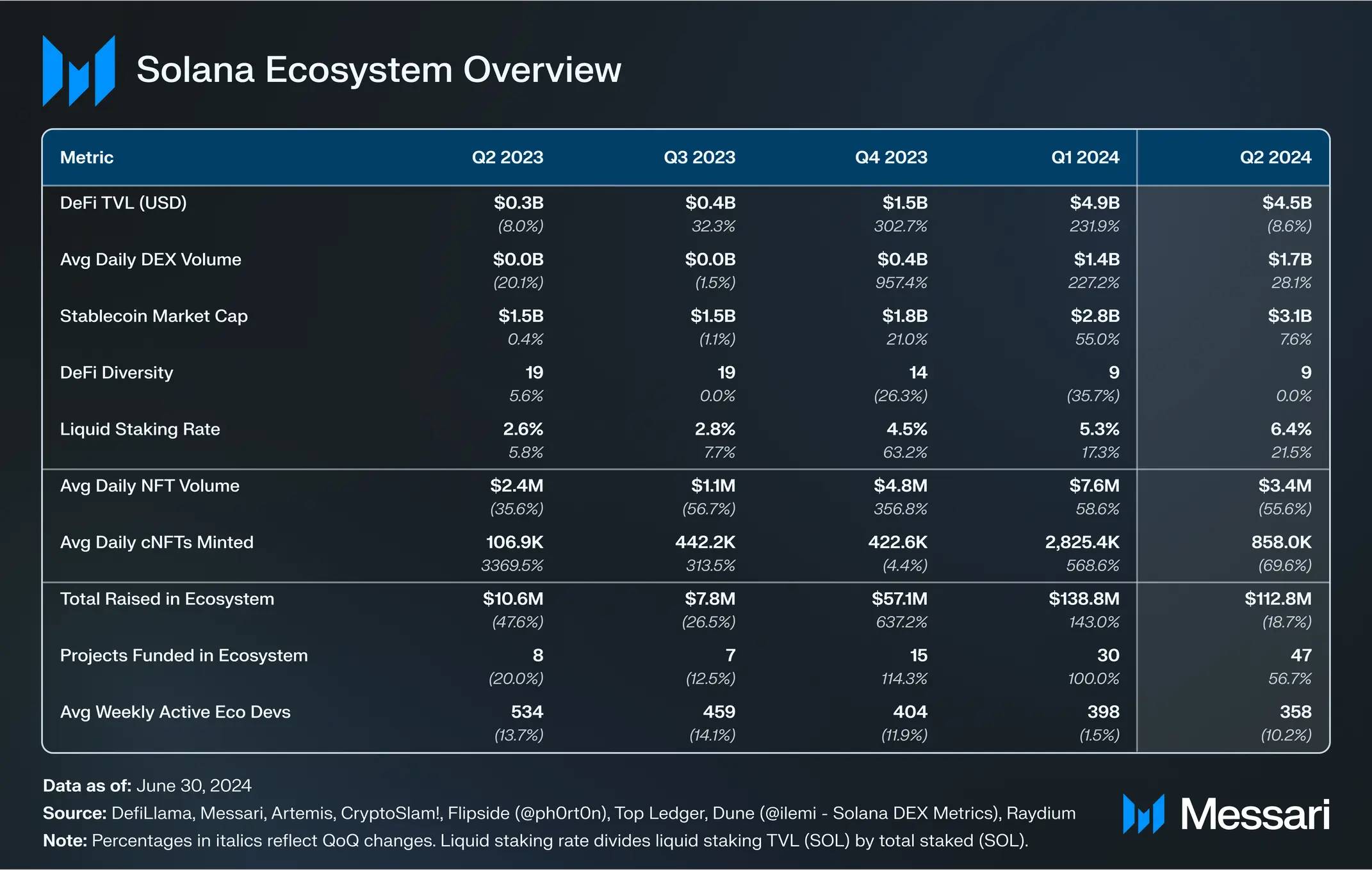
Solana’s DeFi TVL declined 9% qoq to $4.5 billion, ranking fourth among networks. However, DeFi TVL denominated in SOL increased 26% qoq, suggesting dollar-denominated declines were likely driven more by token price depreciation than capital outflows.
Lending
Kamino Lend’s TVL declined 26% qoq to $942 million. The decline followed strong growth in March when a future points snapshot was announced. Kamino launched its token on April 30, distributing 7.5% of total supply via airdrop. KMNO had a market cap of $33 million at quarter-end with 10% of supply circulating. In Q2, Kamino also added support for token extensions, enabling borrowers to repay debt using collateralized assets, and introduced a notification feature powered by Dialect.
After significant growth in the second half of 2023, MarginFi’s lending protocol lost TVL market share in the first half of 2024. Its TVL declined 56% qoq to $341 million, primarily due to withdrawals exceeding $200 million within 24 hours in April. This outflow responded to Twitter controversy and MarginFi leader Edgar Pavlovsky’s resignation, citing internal disputes. MarginFi’s points program has been running for over a year, leading to dissatisfaction among some users regarding lack of token issuance. Nonetheless, MarginFi successfully processed all withdrawals during the turmoil and saw some deposits return later. In Q2, MarginFi also introduced its liquidity layer and improved its onboarding experience.
DEXs
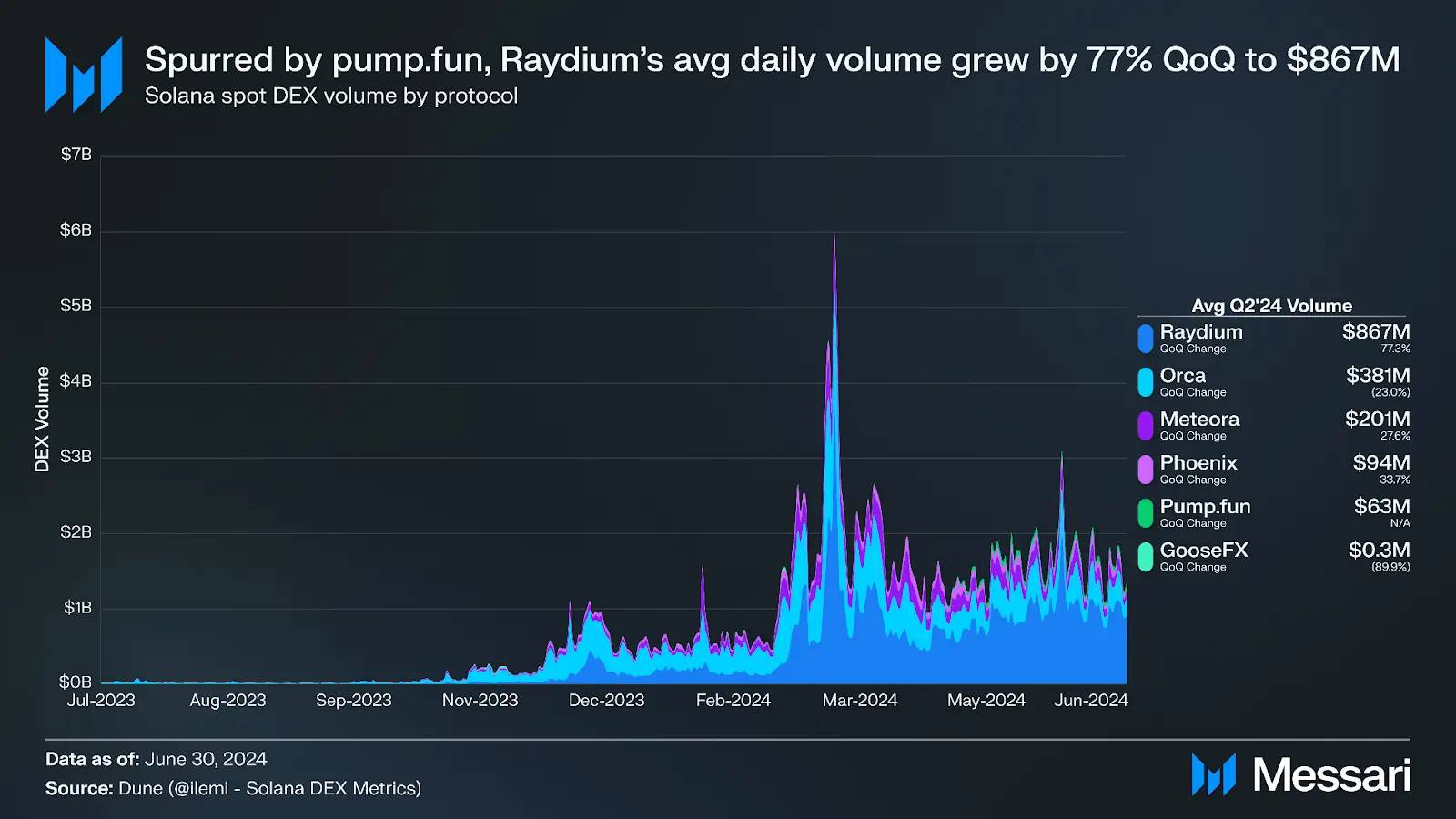
DEX volumes declined slightly from peak activity in March but remained elevated. Average daily spot DEX volume increased 32% qoq to $1.6 billion. DEX activity continued to be driven by memecoin trading, with WIF, MEW, POPCAT, and GME ranking among the top ten tokens by trading volume in Q2 token pairs.
In Q2, memecoin minting shifted toward pump.fun, a gamified token issuance platform that became one of the most widely discussed applications in crypto. During the quarter, it averaged $525,000 in daily fees. At the end of May, several celebrities began launching their own tokens on pump.fun, triggering a celebrity memecoin frenzy and drawing some criticism. Pump.fun’s popularity spawned forks such as Dexscreener’s Moonshot, Whales Market’s whales.meme, and Meme Royale.
Raydium was the primary beneficiary of pump.fun, as all liquidity from pump.fun bond curves migrates to Raydium once tokens reach market cap thresholds. Raydium’s average daily trading volume increased 77% qoq to $867 million, and its market share rose from 40% in Q1 to 54%. Its DeFi TVL also increased 46% qoq to $991 million, making it the highest TVL DeFi protocol on Solana. In Q2, Raydium also released its V3 user interface and launched a new constant product AMM program.
Jupiter remains the primary source of trades on Solana, accounting for 51% of spot DEX volume in Q2. However, its market share declined throughout the quarter, dropping to 37% in the final week, surpassed by Raydium’s 38%. Notable updates from Jupiter this quarter included:
-
Metropolis: At the end of June, Jupiter announced Metropolis, its V3 swap protocol upgrade. New features include immediate routing support for new tokens on Raydium, Meteora, and Orca; dynamic slippage settings; improved token search functionality; new token listing labels; and simplified user experience warnings.
-
Tokenomics Update Proposal: Jupiter founder meow shared a proposal to reduce JUP’s total supply by 30%, with 30% reductions each in team allocation and future airdrop distributions.
-
GUM: At the end of May, Jupiter announced its Giant Unified Market (GUM) initiative, partnering with RWA token issuers, market makers, and investors to bring more asset types on-chain.
-
Ultimate Acquisition: At the end of April, Jupiter acquired mobile wallet Ultimate and its team to support its planned Jupiter Mobile application.
Jupiter Perpetuals averaged $370 million in daily trading volume, up 13% qoq. Other major perpetual exchanges include:
-
Drift: Drift’s average daily perpetual trading volume declined 11% qoq to $127 million. Mid-May, the Drift Foundation launched the DRIFT token, airdropping 12% of total supply. The token governs the Drift DAO, composed of an elected security council, a Realms DAO managing general protocol development, and a Futarchy DAO allocating grants. DRIFT had a market cap of $76 million at quarter-end, with approximately 17% of tokens circulating.
-
Zeta: Zeta’s average daily perpetual trading volume increased 212% qoq to $82 million. Mid-May, it announced a $5 million raise led by Electric Capital and plans to build a dedicated rollup on Solana. At quarter-end, Zeta launched its token, airdropping 10% of total supply. ZEX had a market cap of $18 million at quarter-end, with approximately 16% of tokens circulating.
-
FlashTrade: After fully launching last quarter, FlashTrade gained traction at the end of Q2, averaging $104 million in daily trading volume in March.
Stablecoins
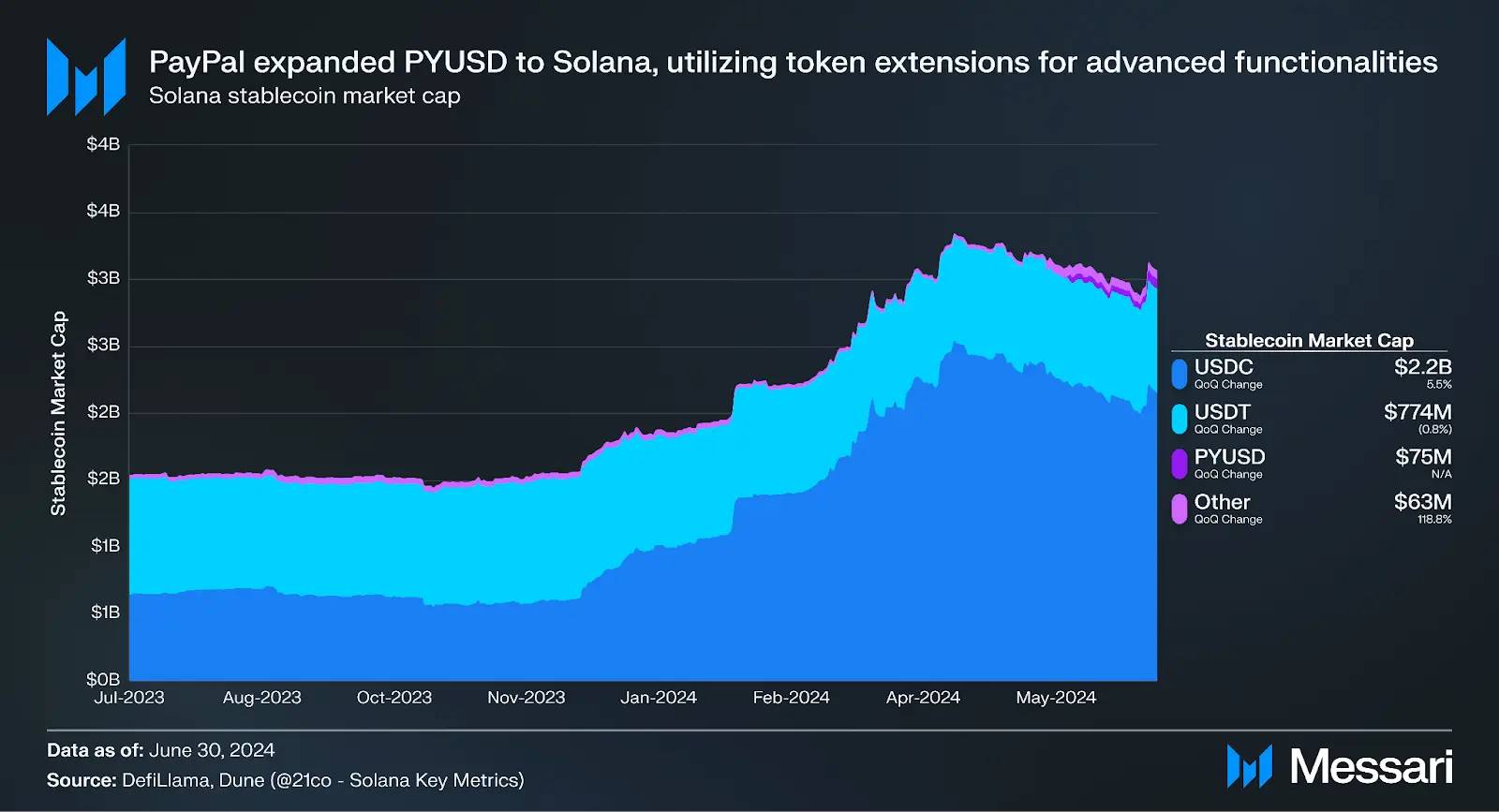
Solana’s stablecoin market cap grew 8% qoq in Q2 to $3.1 billion, ranking sixth among all blockchain networks.
At the end of May, PayPal expanded its stablecoin PayPal USD (PYUSD) to Solana, making it the second supported network after Ethereum. Issued by Paxos and approved by the New York State Department of Financial Services, PayPal highlighted token extension capabilities as a key reason for deploying on Solana, alongside low transaction costs and high throughput.
PYUSD includes multiple extension features, especially confidential transfers, which keep transaction amounts hidden from everyone except the sender, recipient, and optional third-party auditor. Confidential transfers are not yet enabled on Solana due to pending system call activation. PayPal also emphasized memo fields and transfer hooks, allowing developers to add programmable logic to transfers.
At quarter-end, PYUSD had a circulating market cap of $75 million on Solana, though distribution remained relatively concentrated. While officially launched, the token awaits broader integrations to drive wider adoption. Centralized exchanges are already working to integrate token extensions to support PYUSD. Shortly after quarter-end, several Solana dApps—including Jupiter and Kamino—and an incentivized campaign began supporting PYUSD.
Despite these developments, USDC remains the dominant stablecoin on Solana, with its Solana market cap increasing 5.5% qoq to $2.2 billion. Circle expanded its Web3 services to Solana in June, introducing its Programmable Wallets and Gas Station features. These APIs enable developers to embed secure multi-chain wallets into their apps and pay transaction fees on behalf of users. Rollout will occur in phases, with future releases supporting NFT transfers and program interactions.
Other notable DeFi-related events include:
-
RWA: Parcl’s token launch, BAXUS’s $5 million raise, AgriDex’s $5 million raise, etherfuse’s MXNe launch, MetaWealth’s migration to Solana announcement, elmnt’s tokenized commodities introduction, Drift and Ondo’s partnership, Bridgesplit’s closed beta release, VNX and Sygnum Bank’s partnership, and Velo and Solana Foundation’s partnership.
-
Bitcoin-related: Zeus Network’s $8 million raise and token launch, Wormhole’s WBTC launch, 21BTC’s launch, and Zeus Network’s APOLLO alpha testnet launch.
-
Restaking: Picasso’s restaking launch, Composable’s Mantis introduction, and Solayer’s restaking introduction.
-
Others: Ellipsis Labs’ $20 million raise, DFlow’s testnet launch, C3’s launch, Adrena’s perpetuals introduction, Ranger Finance’s perpetual aggregator introduction, Photon’s limit order launch and incentives, Lifinity Sandglass launch, Bullpen’s Telegram bot launch, RugCheck Token Verification launch, Prism V4 launch, and Coinhall’s Solana integration.
Liquid Staking
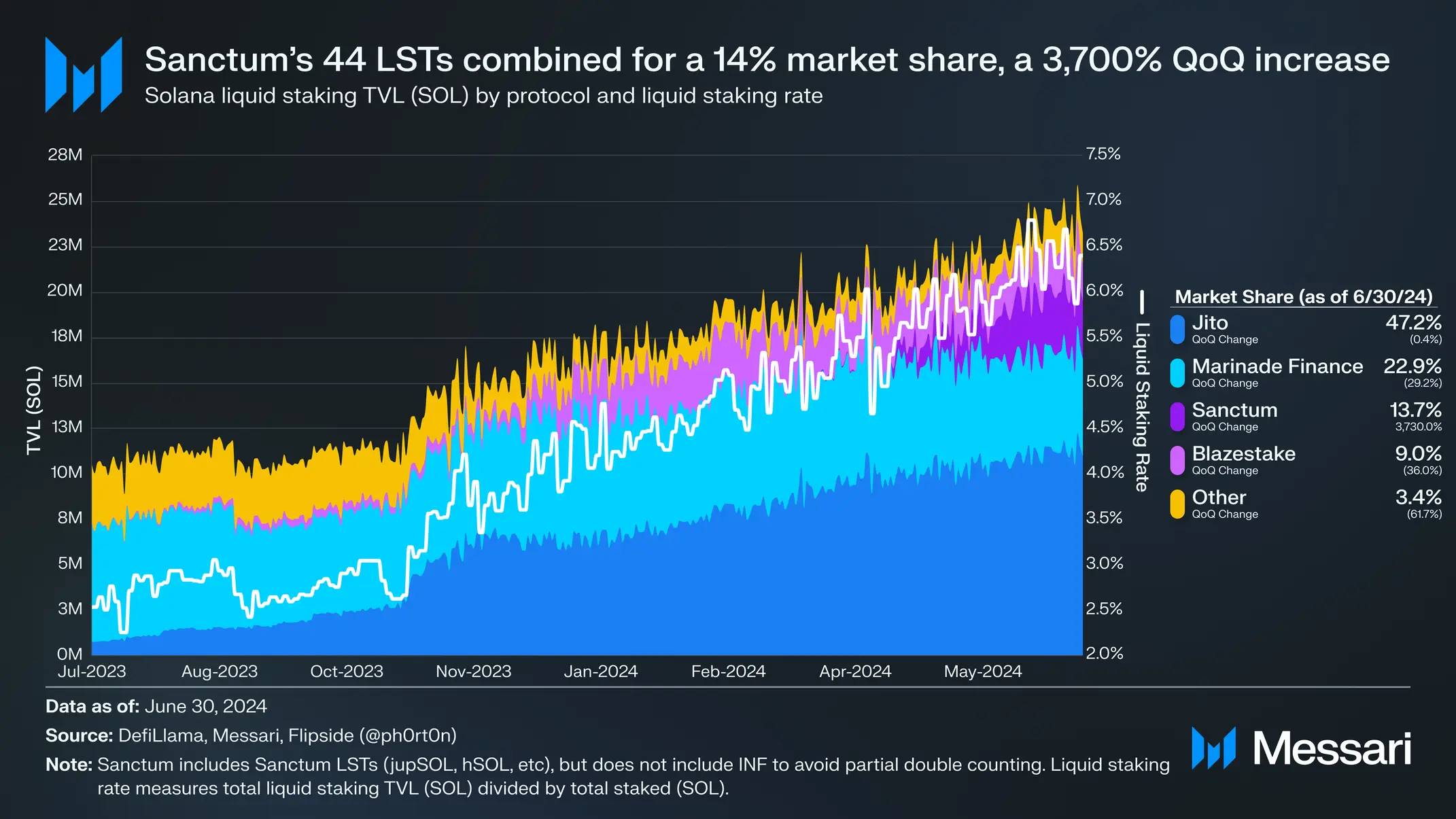
Solana’s liquid staking ratio—the percentage of staked SOL relative to total staked supply—increased 22% qoq in Q2 to 6.4%. With 65% of eligible SOL supply staked, the liquid staking ratio must continue growing to support a yield-based SOL ecosystem.
Since its launch last quarter, Sanctum rapidly gained market adoption, with its Sanctum LSTs capturing nearly 14% of Solana’s LST market share—a 3700% qoq increase. Adoption accelerated due to several market structure changes, particularly stake-weighted quality of service (SWQoS). To alleviate network congestion in April, Solana network upgrades further leveraged SWQoS. SWQoS incentivizes applications and infrastructure providers to run validators and accumulate stakes to provide better user experiences.
As a result, several projects launched their own validators, including Jupiter, Drift, DRiP, and Helius. Like other projects, these four also launched single-validator LSTs to improve distribution and offer unique benefits. For example, DRiP distributes free Droplets to hausSOL holders, and dSOL can be used as collateral on Drift.
Solana currently does not support validators returning block rewards (base and priority fees) to delegators natively. This native functionality only applies to inflation rewards. Historically, this wasn’t significant since fees typically accounted for only about 1% of total validator rewards (excluding MEV). But since late March, this proportion has risen to 5–10%, prompting validators to redistribute fees to compete on annual percentage yield (APY). Many validators choose single-validator LSTs for simpler fee redistribution mechanisms.
LSTs are also experimenting with different approaches to distribute staking rewards. For instance, Cubik’s iceSOL allocates all staking rewards to public goods funding, while wifSOL DCA’s all staking rewards into WIF and redistributes WIF back to delegators.
Overall, Sanctum hosts 44 LSTs, adding over 20 LSTs in Q2. The richness of LSTs is enabled by Sanctum Infinity, a multi-LST liquidity pool allowing supported LSTs to leverage each other’s liquidity. Top Sanctum LSTs by staked amount include Jupiter’s jupSOL (2.3 million SOL), Helius’s hSOL (403,000 SOL), and Solana Compass’s compassSOL (340,000 SOL).
In early April, Sanctum announced a $6.1 million raise led by Dragonfly. It subsequently launched Sanctum Wonderland, a points program where participants collect pet-like representations of LSTs and level them up through community tasks. In early June, it launched CLOUD, announcing a future airdrop and token sale via Jupiter’s LFG and Meteora Alpha Vault.
Jito’s jitoSOL remains the leader in Solana LSTs. Its supply increased 22% qoq to nearly 1.1 million SOL, capturing 47% market share. The community is currently discussing a governance proposal to begin transitioning management of the Jito staking pool to StakeNet. StakeNet is an open-source protocol for decentralizing Solana staking pool operations. The proposed transition would bring greater transparency, enhanced security, higher efficiency, and community governance to Jito.
Marinade’s mSOL supply declined 13% qoq to 5.3 million SOL, capturing 23% market share. Its native staking product, Marinade Native, holds an additional 2.7 million SOL. In mid-June, Marinade launched its Stake Auction Marketplace, where validators bid for staked SOL. The feature will roll out in phases, expected to go live in Q3 2024.
Consumer
NFTs
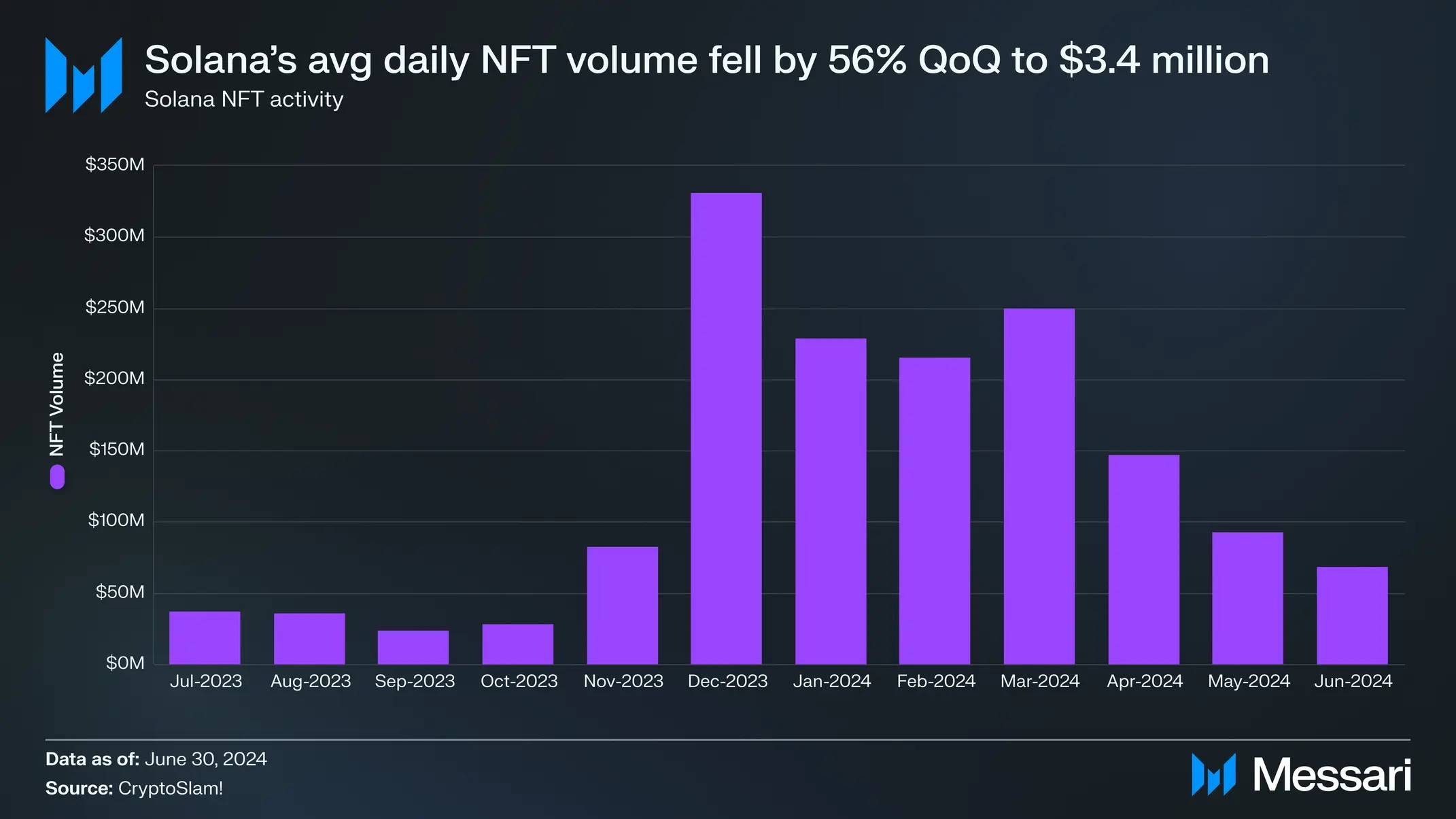
After a period of high activity at the end of 2023 and start of 2024, NFT trading volume declined in Q2. Average daily trading volume decreased 56% qoq to $3.4 million. During the quarter, the NFT marketplace landscape shifted, with Magic Eden regaining most organic trading volume share, rising from 25% to 59%. Conversely, Tensor’s market share fell from 71% to 35%.
In early April, the Tensor Foundation launched the TNSR token, airdropping 14.8% of total supply. Since the token launch, its market share has been 31%. At quarter-end, TNSR had a market cap of $73 million, with approximately 13% of total supply circulating. Magic Eden continues running its rewards program, expected to launch its own token.
Mads Lads was the highest-volume collection, totaling 230,000 SOL in trading volume. Just before quarter-end, an address purchased 59 Mad Lads for approximately 5,600 SOL (~$800,000). Other top collections by Q2 trading volume include Solana Monkey Business (104,000 SOL), Tensorians (91,000 SOL), Froganas (74,000 SOL), and Famous Fox Federation (51,000 SOL).
Most Solana NFTs are minted using Metaplex’s NFT standard. In early April, Metaplex launched a new NFT standard called Core. Core uses a single-account design optimized for cost and performance, featuring a flexible plugin system for further customization. The first external plugin was the Oracle plugin, enabling digital assets to react to real-world data.
At the end of May, Metaplex launched MPL-404, a hybrid token standard protocol developed with Mutant Labs, which pioneered the SPL-404 standard. Dubbed “hybrid DeFi,” this token standard aims to bring more liquidity to NFTs while preserving their unique characteristics.
Other NFT-related events include SharkyFi’s SHARK launch, Exchange Art’s token announcement, Artrade’s introduction and sale of Picasso, Garden Labs launching its owner-editable metadata program, 3.land open-sourcing its cNFT minter, and Claynosaurz being selected as a finalist for Collision Choice Awards.
Social and Creator Platforms
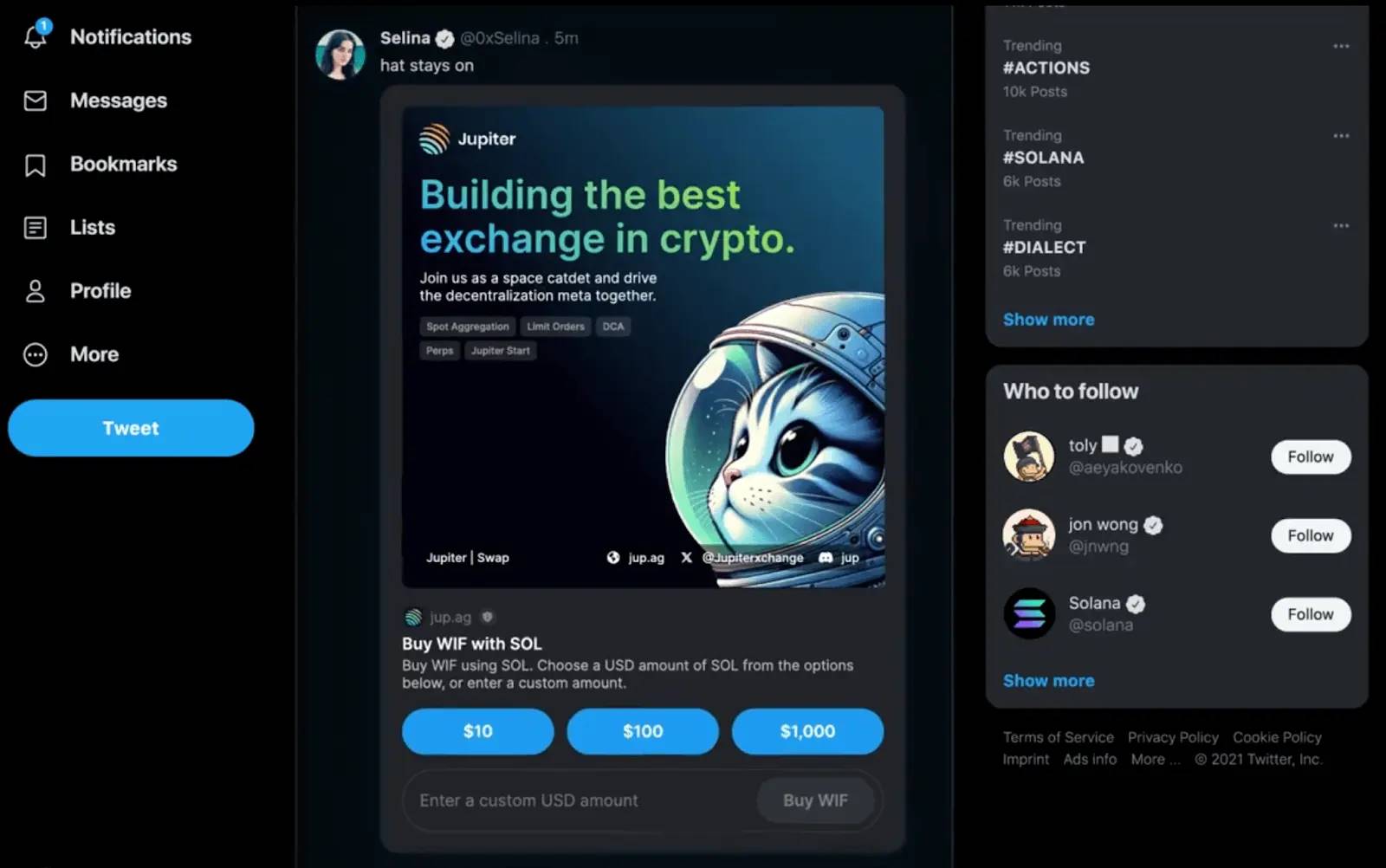
Blinks are shareable links that transform Solana Actions into URLs enriched with metadata. These links allow supported clients (like browser extension wallets or bots) to display enhanced functions, making transaction previews or extended interaction buttons immediately visible within wallets. Currently, only blinks from registered partners expand directly on Twitter. Users also need to enable blinks in their browser extension wallet settings for expansion.
Many top Solana projects have created blinks, including Jupiter, Tensor, Sphere, and TipLink. Blinks builders can apply for micro-grants (up to $1,000 per grant) through the Superteam Earn track, or apply directly to the Solana Foundation for larger grants (totaling up to $400,000 distributed).
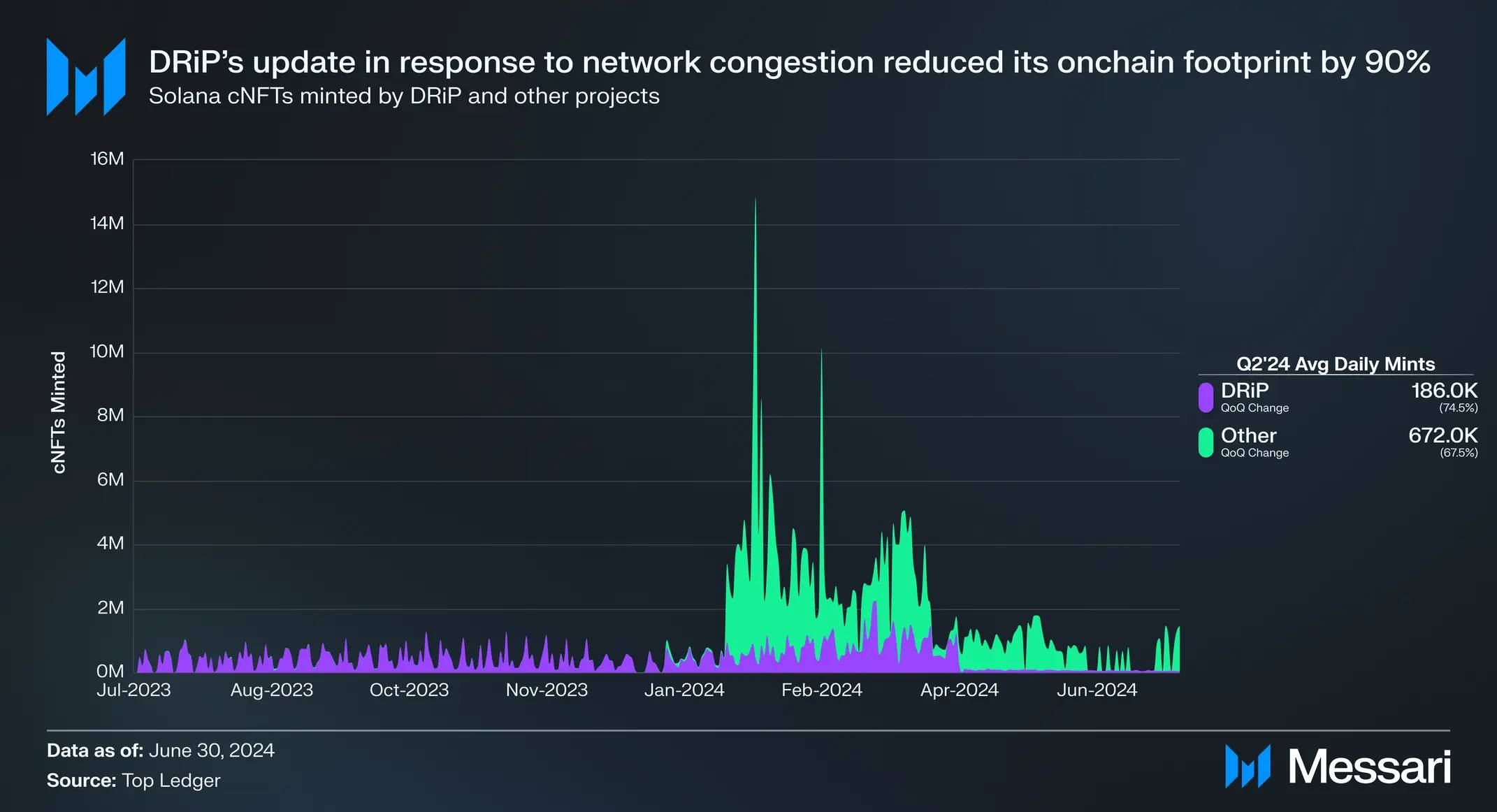
Like other applications, DRiP’s user experience suffered during network congestion in early April. Mid-April, it released an update to address this. Now, DRiP only mints collections on-chain when users claim them, reducing its average daily cNFT mints by 90%.
Mid-April, DRiP introduced comic artist Todd McFarlane, creator of Amazing Spider-Man and Spawn. An auction on DRiP sold a 1:1 digital scan of the original art piece Spawn #1 for over 110 SOL ($16,000). Other creators joining DRiP in Q2 include Rockstar Games artist Stephen Bliss, wallstreetbets, and singer Jason Derulo.
Other consumer-related events include:
-
Solana Labs’ Bond: In mid-June, Solana Labs launched Bond, a customer loyalty platform and API. Designed to open new revenue streams, offer product provenance and authenticity, enhance customer insights, and protect data privacy by enabling brands to easily launch NFTs and integrate blockchain-based payment rails.
-
Audius Updates: Audius, a music streaming platform aiming to shift power back to artists. At the end of June, it launched paid live streaming, enabling artists to receive instant payments for tracks and albums into Coinbase or other Solana wallets. Subsequently, it announced licensing agreements with all major U.S. Performing Rights Organizations (PROs).
-
Others: Cupcake’s testnet launch, Only1’s $1.3 million raise led by Newman Group, Solarplex acquired by Arweave ecosystem’s Forward Research announcement, dReader’s Cubik grant round distributing $40,000 to comic creators announcement, Access Protocol’s transferable subscription feature launch, Crowny’s app launch, GigHub’s launch, Nina’s iOS app launch, and Popset’s introduction.
Gaming
While some on-chain games are fully built on Solana’s mainnet, others have chosen scaling solutions for customizability and higher performance. In Q2, several projects announced Solana-based scaling frameworks tailored for gaming:
-
MagicBlock: In mid-June, MagicBlock launched MagicBlock Engine, a framework enhancing performance and VM customizability without sacrificing composability. The engine deploys “ephemeral rollups”—temporary runtimes that settle state back to Solana upon closure. All programs and accounts still exist on Solana mainnet but are mirrored onto ephemeral rollups. Temporary runtimes can leverage custom SVM validators optimized for speed and other configurable options like gasless transactions. The entire lifecycle of ephemeral rollups is abstracted from users, who still transact and hold assets on Solana mainnet. While MagicBlock Engine is built for fully on-chain games, the team noted it has drawn interest from non-gaming projects.
-
Sonic: In mid-June, Sonic announced a $12 million raise led by Bitkraft and launched its testnet. Sonic is a Layer-2 stack supporting game-specific rollups with shared sequencer network and settlement on Solana. Sonic leverages SVM while supporting EVM code through its HyperGrid interpreter.
In early May, Solana Labs partnered with Google Cloud to bring its Web3 game development API GameShift to Google Cloud’s game developers. After exiting testnet last quarter, GameShift added several new features this quarter, including asset creation, in-game token support, and developer wallets.
Other gaming developments in Q2 include Star Atlas’ Surge launch, STEPN’s collaboration with Adidas, Blockasset’s collaboration with UFC, Aurory’s Seekers of Tokane early access release, Nyan Heroes’ token launch and esports partnership, Solana Speedrun 3 game jam, Photo Finish LIVE’s Virtual Kentucky Derby and Pace Advantage collaboration, Blessed Burgers’ burger game, Chomp’s public testnet launch, BetDEX’s update, Portals’ airdrop, Bladerite developer Seeds Labs’ $12 million raise, MON Protocol’s Solana integration, The Backwoods’ launch, SolForge Fusion’s launch, Solana Games Ambassador Program creators, Lowlife Forms’ teaser, Valannia’s gameplay preview, and Love Monster’s Solana expansion plans.
DePIN
Solana is becoming a hub for DePIN applications, hosting projects such as Helium, Hivemapper, Render, and Teleport.
Notable events in Q2 include:
-
Helium Licensing Program: In mid-June, Helium Mobile announced a licensing program for its tech stack, allowing third-party manufacturers to produce and sell hotspot devices. The program aims to generate licensing revenue and expand the Helium Mobile hotspot network, reducing reliance on T-Mobile. After quarter-end, the Helium Foundation announced expanding the Helium network beyond wireless.
-
Shaga Raise: Shaga, a P2P network for gaming computers, announced a $1 million raise led by Arca near the end of June. Previously a winner at Solana Foundation’s Q3’23 Hyperdrive hackathon, Shaga is currently in closed beta.
-
Io.net Token Launch and Criticism: In mid-June, decentralized GPU aggregator io.net launched its IO token, accompanied by a Binance Launchpool and community airdrop. IO had a market cap of $325 million at quarter-end, with slightly over 10% of total supply circulating. Earlier in the quarter, the project faced criticism for inflated GPU counts displayed on its UI. Two days before the token launch, its CEO stepped down, succeeded by the former COO.
-
Ambient Raise: In May, Ambient announced a $2 million seed round led by Borderless Capital. Ambient also announced the acquisition of decentralized environmental monitoring network PlanetWatch. In Q3, Ambient plans to migrate the PlanetWatch token and network from Algorand to Solana and launch a new mobile app and upgraded backend.
-
Teleport in Austin: After launching in its first city (College Station, Texas) last quarter, decentralized ride-sharing protocol Teleport went live in Austin, Texas at the end of May announcement.
-
Roam Migration: In early April, decentralized WiFi network Roam announced migrating to Solana. The Roam app later launched on the Solana Mobile dApp store announcement.
Payments
With low transaction costs, sub-second finality, and thousands of nodes, Solana promises to help drive mainstream payments—Visa stated it would expand its USDC settlement pilot to Solana in Q3 2023.
Notable events this quarter from Solana-native payment infrastructure companies and apps include:
-
Stripe Crypto Payments: During its 2024 keynote, Stripe announced it would resume supporting crypto payments in summer. It will initially support USDC payments on Solana, Ethereum, and Polygon.
-
TipLink Updates: During its 2024 keynote, TipLink launched two new products. TipLink Wallet Adapter creates an in-browser wallet linked to a user’s Google account, eliminating the need for traditional wallet browser extensions and seed phrases. Wallet Adapter has already integrated with multiple Solana apps, including Jupiter, DRiP, Tensor, Drift, Sphere, and Helio. TipLink also launched TipLink Pro, a suite of tools allowing developers to distribute tokens via campaigns.
-
Sphere Updates: In May, Sphere launched Offload Wallet, allowing users to make off-ramp payments instantly by sending USDC to a wallet address tied to a connected bank account. It also launched SphereBot, enabling direct payments via Telegram. Finally, its on/offramp product exited private beta, opening to all users in June.
-
Helio Shopify Pay Plugin Update: In April, Solana Labs shut down Solana Mobile Chapter 2 credit card payments, now accepting payments only via the Solana Pay Shopify plugin. Since Chapter 2 bookings opened in January, the plugin helped Solana Labs save over $1 million in fees compared to traditional payments. Payment platform Helio launched a new set of features for the plugin, which it has managed since December announcement. New features include:
-
Multi-token payments, allowing buyers to use hundreds of tokens automatically swapped into merchants’ preferred currency via Jupiter
-
Support for stablecoins beyond USDC, including PYUSD, EURC, and USDY
-
Improved UI with faster transaction confirmations and automatic off-ramp payments
-
Loyalty programs with cNFT
-
Join TechFlow official community to stay tuned
Telegram:https://t.me/TechFlowDaily
X (Twitter):https://x.com/TechFlowPost
X (Twitter) EN:https://x.com/BlockFlow_News
 Messari