Growth from Demand: Dissecting OKX Web3's User Growth Drivers
TechFlow Selected TechFlow Selected
Growth from Demand: Dissecting OKX Web3's User Growth Drivers
Regardless of market cycles, users remain the core, and innovations centered on user experience will be key to a project's long-term and stable development.
 Navigating Web3 tides with focused insights
Not participating in memes means you haven't truly joined this bull run.
From hot ecosystems like Solana, Base, and TON, meme coins have ignited a craze that has become the dominant narrative in the crypto market during the first half of 2024. They've drawn the highest retail participation and delivered the best returns. According to CoinGecko data, meme coins ranked first among all crypto sectors in terms of return on investment in the first half of 2024, achieving an astonishing 1834.22%.
Amid such high-risk, high-reward dynamics, gaining early insights into market movements and investment behavior has become a widespread demand. Practical tools for on-chain trend analysis, smart money tracking, and search popularity rankings are rapidly spreading through communities via word-of-mouth. Among them, OKX Web3 Wallet’s upcoming Meme Mode launching in July—even while still in internal testing—has already sparked discussions within KOL and community circles due to its consistently smooth user experience. As one of the testers, we found during our product trial that the seamless performance of Meme Mode is inseparable from the underlying support of OKX Web3 Wallet's built-in transaction aggregation feature.
Trading remains the primary need for crypto users, and the industry’s debate over the future form of trading products continues. Examining OKX Web3 Wallet’s evolution in trading functionality not only reveals how a leading player thinks about “what kind of trading product users really want,” but also helps predict future trends in trading products by analyzing the growth drivers behind its impressive metrics.
According to OKX data, OKX Web3 Wallet achieved over 4.6 million weekly active users (WAU) last week (including both extension and mobile versions), ranking just behind MetaMask, the leading wallet project. Its weekly trading volume exceeded $381 million (including swaps, cross-chain transactions, and API usage), placing it at the forefront among Web3 wallets.
This article aims to deeply explore the upcoming Meme Mode features of OKX Web3 Wallet. On one hand, we’ll examine how this mode leverages the integrated decentralized exchange aggregator OKX DEX to deliver a frictionless and efficiently aggregated trading experience. On the other, we’ll analyze the user growth drivers behind this experience to gain insight into the future trends and opportunities in Web3 trading.
First Look at Meme Mode: Fast and Free
If Ethereum defined the last golden era of memes, then Solana has been the key driver of this cycle’s meme mania. In both quantity and quality, Solana has clearly emerged as the most active public chain for memes:
According to Dexscreener data, Solana saw a staggering 9,943 new token launches in a single day on March 15, 2024. From Silly at the end of 2023, to WIF—the hat-wearing Shiba Inu that went viral—to BOME, which pioneered a new presale model and surged 50x on its launch day, Solana continues to produce one legendary meme coin after another.
Renowned for its performance, Solana can handle up to 65,000 transactions per second with block times of just 400 milliseconds. While this lays the foundation for meme proliferation, it also gives Solana memes distinct characteristics: numerous projects, rapid pace, and high risk. Unlike traditional projects, memecoins offer almost no fundamentals to analyze. Understanding token distribution, tracking smart money flows, and detecting insider dumps become critical indicators when evaluating a meme project. Thus, trading tools that quickly filter on-chain information to enable faster decision-making and execution have become essential for meme hunters.
As early as March this year, OKX Web3 Wallet launched its Solana Meme Hunter feature, which identifies top-performing "smart money" addresses by measuring key metrics such as ROI (return on investment) and win rate, then uses intelligent algorithms to track their investment flows and push promising new projects to users—helping them cut through noise and make more rational investment decisions.
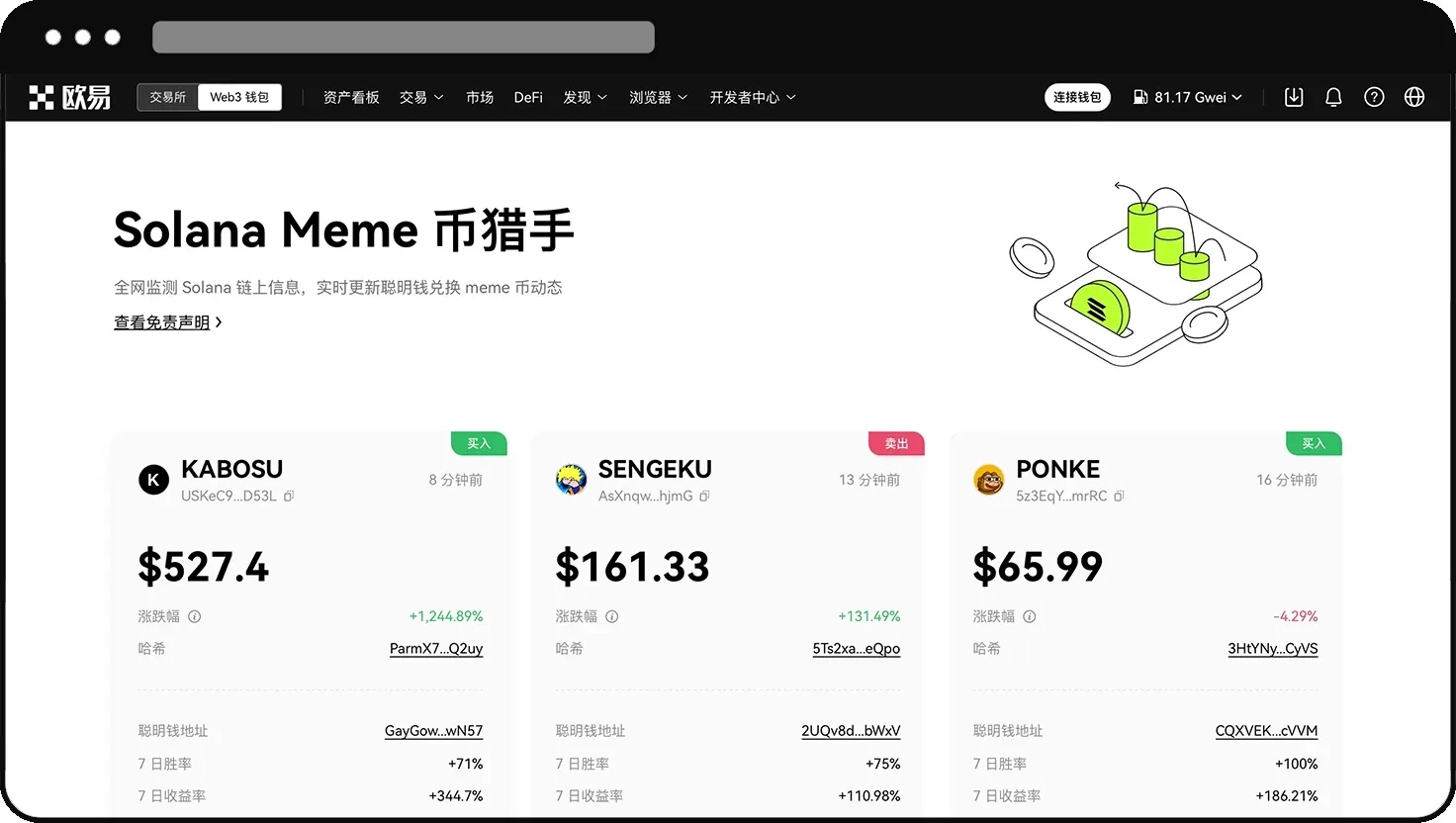
With the continued popularity of memes in the Solana ecosystem, OKX Web3 Wallet has doubled down on user demand by introducing Meme Mode and opening large-scale internal testing. As an invited tester, we now take a closer look at the specific features and advantages of OKX Web3 Wallet’s Meme Mode.
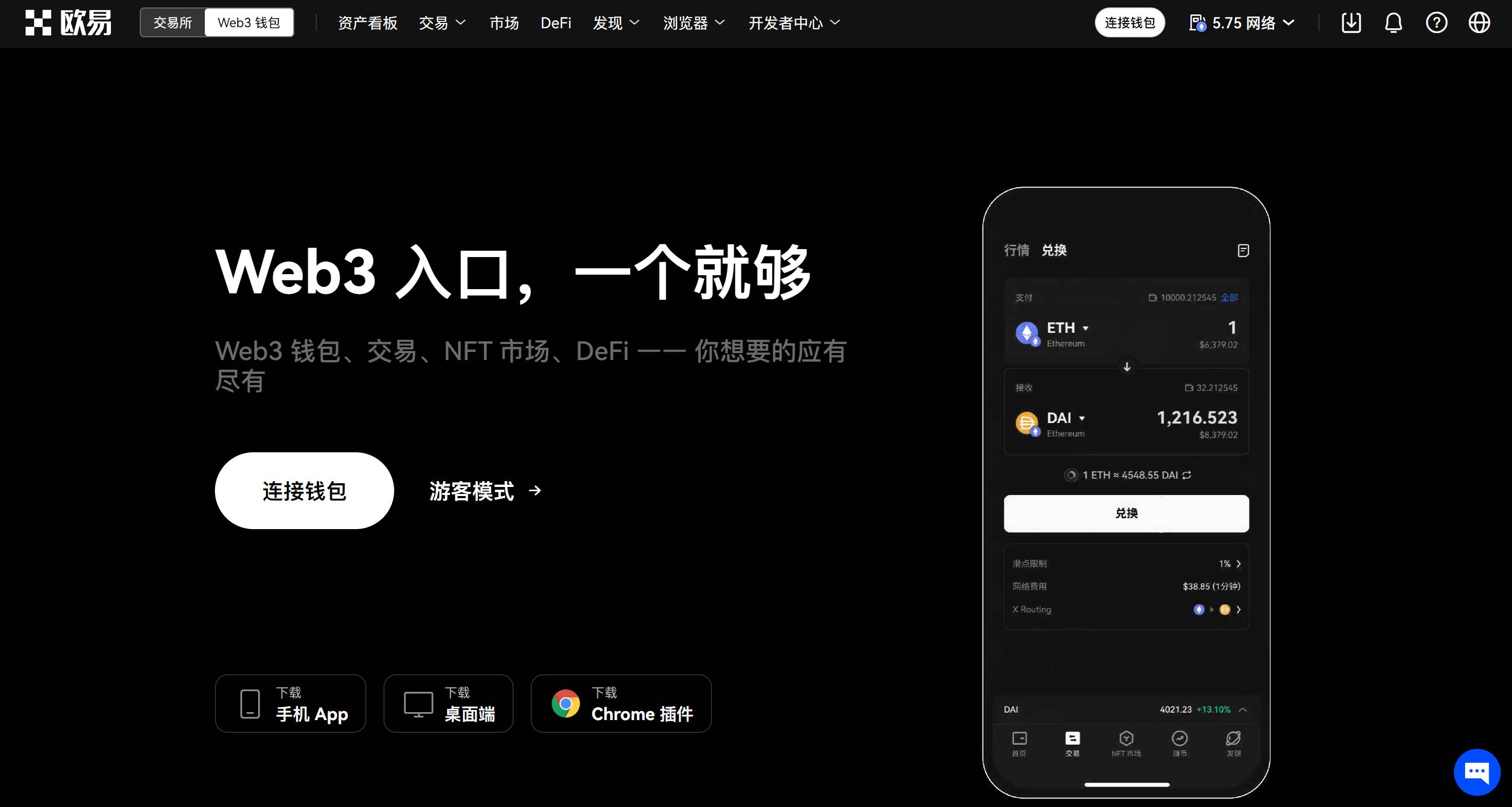
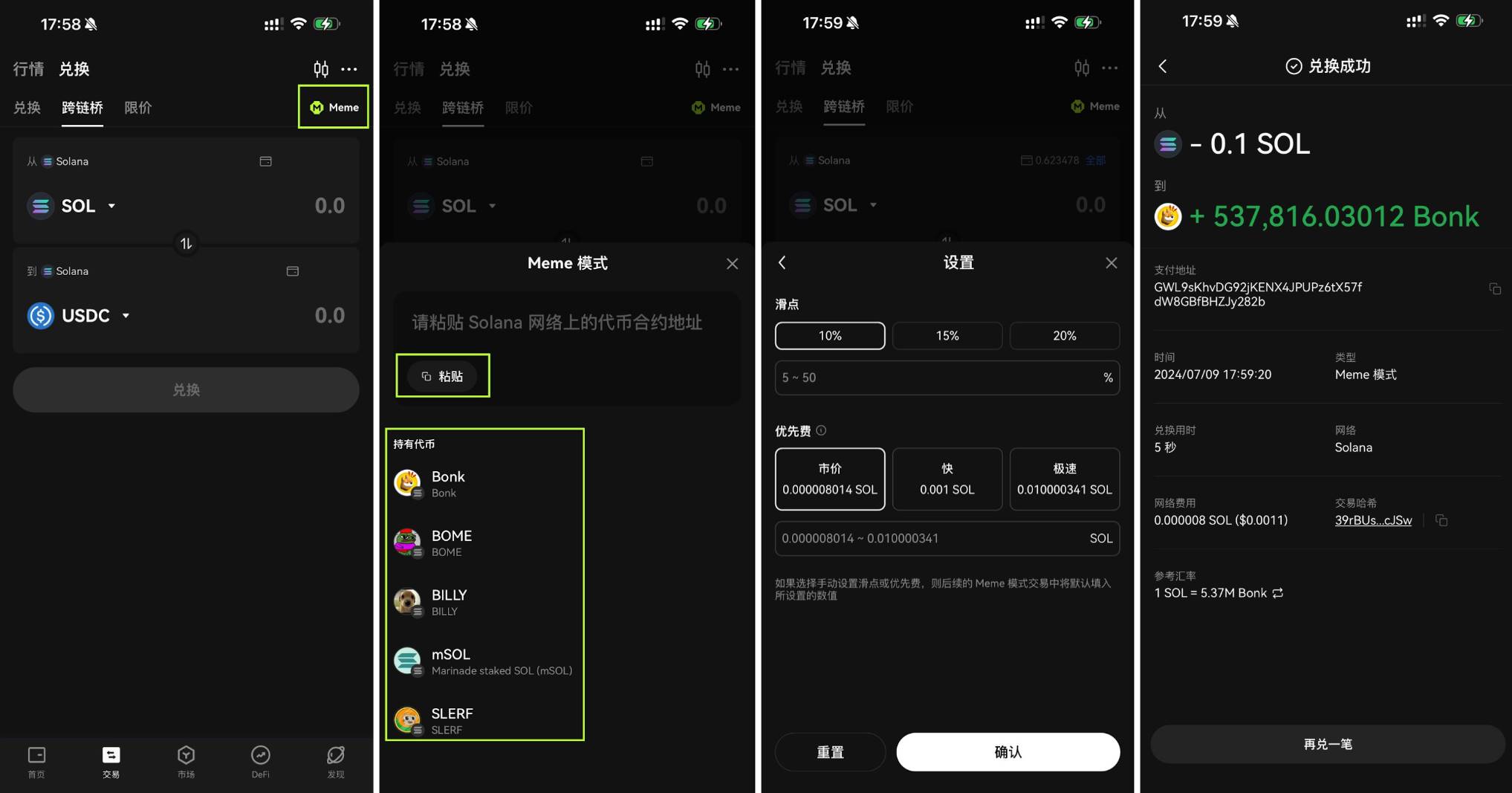
There are two ways for users to access OKX Web3 Wallet’s Meme Mode:
One way is directly through the top-right corner of the OKX Web3 trading page: if the user holds balances in any Solana-based tokens, they can immediately select and trade those assets; for new tokens, users can copy the contract address and paste it into the search bar to add and trade quickly. Alternatively, users can go to the market page, search or select a Solana-based token, enter the trading interface, and tap “Meme Mode” in the bottom-right corner to switch modes.
During trading, OKX Web3 Wallet’s Meme Mode defaults to higher slippage settings to improve transaction success rates. Users can customize parameters such as slippage tolerance and priority fee levels, or manually input values. Once set, these preferences will be automatically applied in future Meme Mode trades, ensuring a smooth and intuitive interaction flow.
Since the explosion of the Solana meme ecosystem, various practical tools have emerged, broadly falling into two categories: project discovery and trading.
For discovery, established platforms like Dextools and Dexscreener now support Solana, while GMGN offers dashboards, Pump.fun chart services, portfolio management, and SmartMoney/KOL wallet exploration. On the trading side, users can choose between wallets and DEX platforms. Additionally, many Telegram bots focused on tracking on-chain addresses or notifying users of trending tokens are available.
In comparison, OKX Web3 Wallet’s Meme Mode stands out with faster execution, lower costs, and a unified experience—from value discovery to seamless trading—all within one integrated interface.
We know that meme trading is time-sensitive—a meme token’s lifecycle may last only minutes. On Solana, transaction ordering depends on who reaches validators first. Given Solana’s low fees, bots flood the network with spam transactions to secure priority placement. Only the first executed transaction succeeds; others fail, forcing validators to waste computational resources processing failed attempts.
Previously, OKX Web3 Wallet optimized solutions for transaction failures, and now Meme Mode leverages Jito for even faster execution: As the first protocol in the Solana ecosystem combining MEV and liquid staking, Jito introduces a mempool and block space auctions, redistributing MEV revenue as staking rewards. This increases staker income, reduces wasted computation on spam, and significantly lowers the risk of MEV exploitation.
Notably, unlike most bot tools that charge around 1% in trading fees (for example, BonkBot, the most popular trading bot, reportedly earned $1.3 million per day in March), OKX Web3 Wallet’s Meme Mode charges no additional fees beyond standard slippage and priority fees. By passing these savings directly to users, OKX Web3 Wallet delivers a meme trading experience that excels in both efficiency and cost-effectiveness.
Additionally, OKX Web3 Wallet’s Meme Mode is built on top of OKX Web3’s non-custodial wallet infrastructure, further enhancing user security and control over assets.
After internal testing concludes, OKX Web3 Wallet’s Meme Mode will soon be available to all users. As a powerful assistant for meme hunters, Meme Mode aims to help more users capture opportunities and achieve higher returns in fast-paced, high-risk markets by improving value discovery, reducing costs, and enhancing usability. Interested readers will be able to try it firsthand upon release. That said, given the extreme volatility and risks associated with meme trading, caution is always advised—even though Meme Mode helps users identify opportunities efficiently.
User Growth Through Trading Needs: Low Barrier and High Aggregation Are Trends
As mentioned earlier, the acclaim for Meme Mode owes much to the foundational support of OKX Web3 Wallet’s built-in transaction aggregation. The broad positive feedback suggests that OKX Web3 has identified the core of user needs when answering the question: What do users really want in a trading product?
To uncover clues to this answer, let’s examine the evolution and trends in trading products. Back in the vibrant summer of 2020, projects like Compound, Uniswap, Sushiswap, and Curve kicked off the DeFi Summer, triggering explosive growth in on-chain trading volumes and user counts. According to DefiLlama, DEX trading volume grew nearly 200-fold from early to late 2020 compared to the beginning of the year. Subsequently, Ethereum congestion and high gas fees fueled the rise of new L1s and Layer 2s, each hosting successful trading applications. Through this explosive growth, we observed several emerging trends in user demands for trading products:
1. Aggregated Trading Products Gain Prominence
The growing number of trading products across different chains means liquidity is increasingly fragmented—and swap prices and costs vary significantly between pools. For users, finding the optimal swap path is both a challenge and an opportunity. Hence, aggregated trading platforms began gaining traction: standalone DEXs increasingly serve as building blocks for aggregators, which compare rates across multiple protocols to recommend the best swap routes, saving users the effort of manual comparisons.
Driven by this advantage, we’ve seen rapid growth in aggregation platforms: In June 2024, Jupiter, Solana’s leading DEX aggregator, surpassed $200 billion in total trading volume, accounting for over 80% of all DEX volume on Solana.
This aligns closely with OKX Web3’s “All-in-One” design philosophy—perfectly in sync with the broader trend toward aggregation.
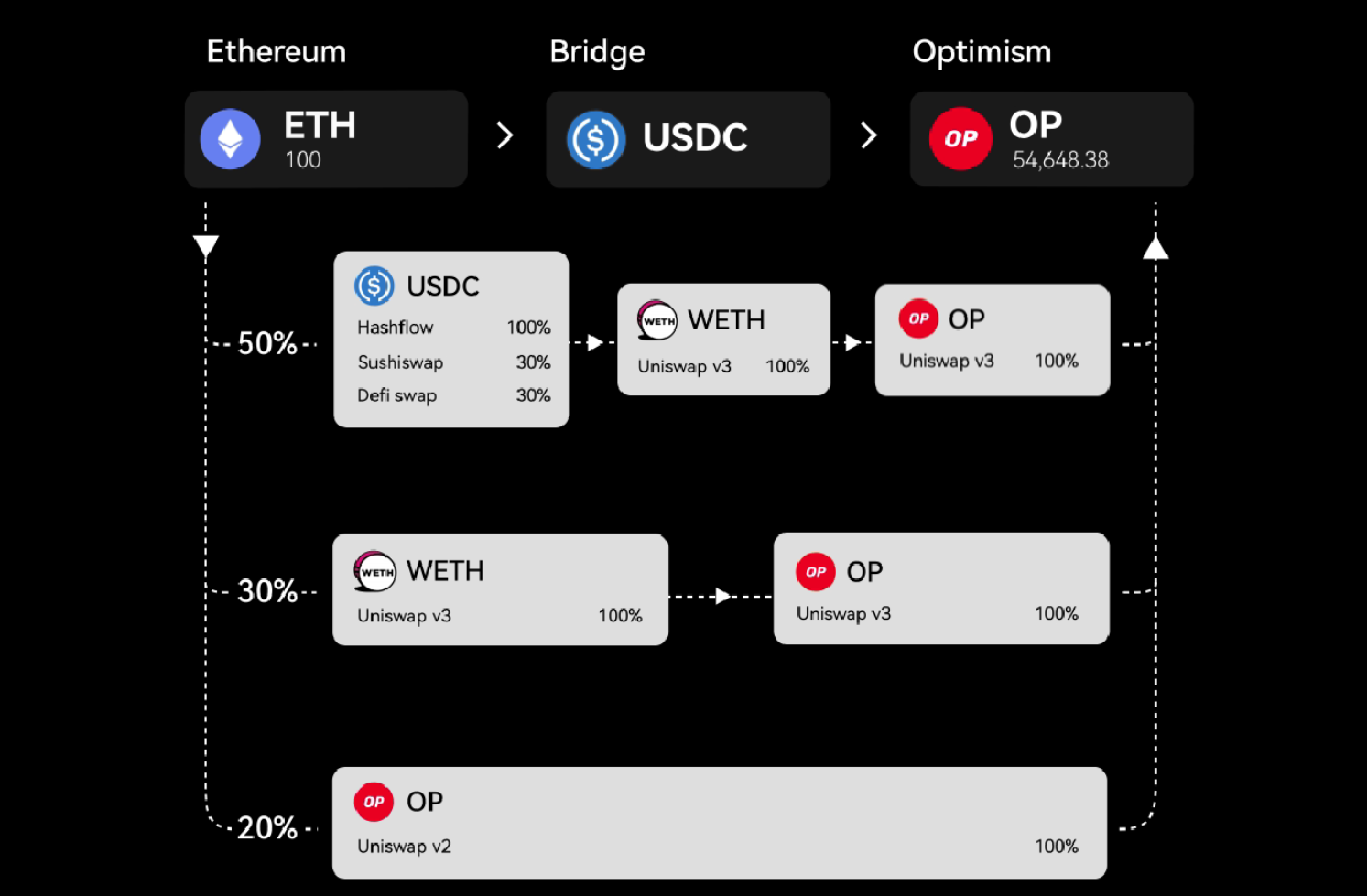
OKX Web3 Wallet’s built-in transaction aggregation (OKX DEX) uses smart routing algorithms to automatically calculate optimal trading paths across multiple chains and cross-chain scenarios, offering users quotes with lower slippage and reduced network fees. Compared to typical aggregators, OKX Web3 stands out for being “more comprehensive and efficient.”
Currently the only DEX in the market that integrates both swap aggregation and cross-chain bridging, OKX DEX aggregates over 400 major DEXs and 25+ cross-chain bridges, supporting more than 30 mainstream, popular, and emerging blockchains including Bitcoin, Ethereum, Solana, and Base.
On speed, OKX DEX uses its proprietary X-Rooting algorithm to deliver millisecond-level quotes. While most DEXs boast second-level response times, OKX DEX’s API responds in under 100 milliseconds—meaning it completes at least four responses in the blink of an eye. Faster pricing enables real-time access to the best rates, allowing traders to react swiftly to price changes and execute quickly. It also supports complex strategies like arbitrage and algorithmic trading, empowering professional traders and boosting platform liquidity and market depth—delivering a CEX-like seamless experience in DEX trading.
2. User Experience Becomes Key to Growth
User experience has long been a persistent issue—one that hasn’t been adequately solved.
While the 2020 DeFi boom expanded the crypto user base significantly, the trading experience was far from ideal—users were simply driven by high yields to endure the complexity of learning crypto’s intricate mechanics. As Ethereum faced congestion and high gas fees, users migrated to newer chains and L2s with better performance and lower costs. According to DefiLlama, on December 15, 2023, Solana’s DEX trading volume surpassed Ethereum’s for the first time, ending Ethereum’s long-standing dominance.
Years later, with existing user demand plateauing and the industry seeking new growth, lowering barriers and improving experiences have become consensus goals for Web3 mass adoption. Solutions like account abstraction have emerged, and many Web3 wallets continue exploring accessibility improvements. For instance, in February 2024, Coinbase unveiled its vision for a smart wallet at ETHDenver, releasing a developer test version allowing users to create wallets using Passkeys (Face ID, Google Chrome profiles, etc.).
In lowering entry barriers, OKX Web3 Wallet offers seed phrase backup via iCloud/Google Drive, MPC keyless wallets, and AA smart contract wallets—greatly reducing recovery costs and user friction. Among major exchange-backed Web3 wallets, OKX Web3 has been the earliest and most committed to exploring AA smart wallets. Currently, OKX supports AA wallet creation on eight popular chains including Ethereum, OKTC, and Arbitrum.
Beyond lowering barriers, good UX also involves minimizing friction—making trading more flexible and fluid. Optimizations here include chain abstraction for improved interoperability and initiatives like UniswapX’s gasless trading. OKX Web3 Wallet also features a Gas Swap function designed for beginners: users can instantly convert USDT, USDC, DAI, or WETH into native gas tokens. Even without sufficient gas, users can complete transactions seamlessly without leaving the trading interface—significantly simplifying cross-chain interactions.
Moreover, the built-in transaction aggregator supports limit orders and custom slippage settings, allowing users to preset desired buy/sell prices—orders execute automatically when market prices reach thresholds—and fine-tune price ranges to better manage risk and strategy execution, offering greater flexibility.
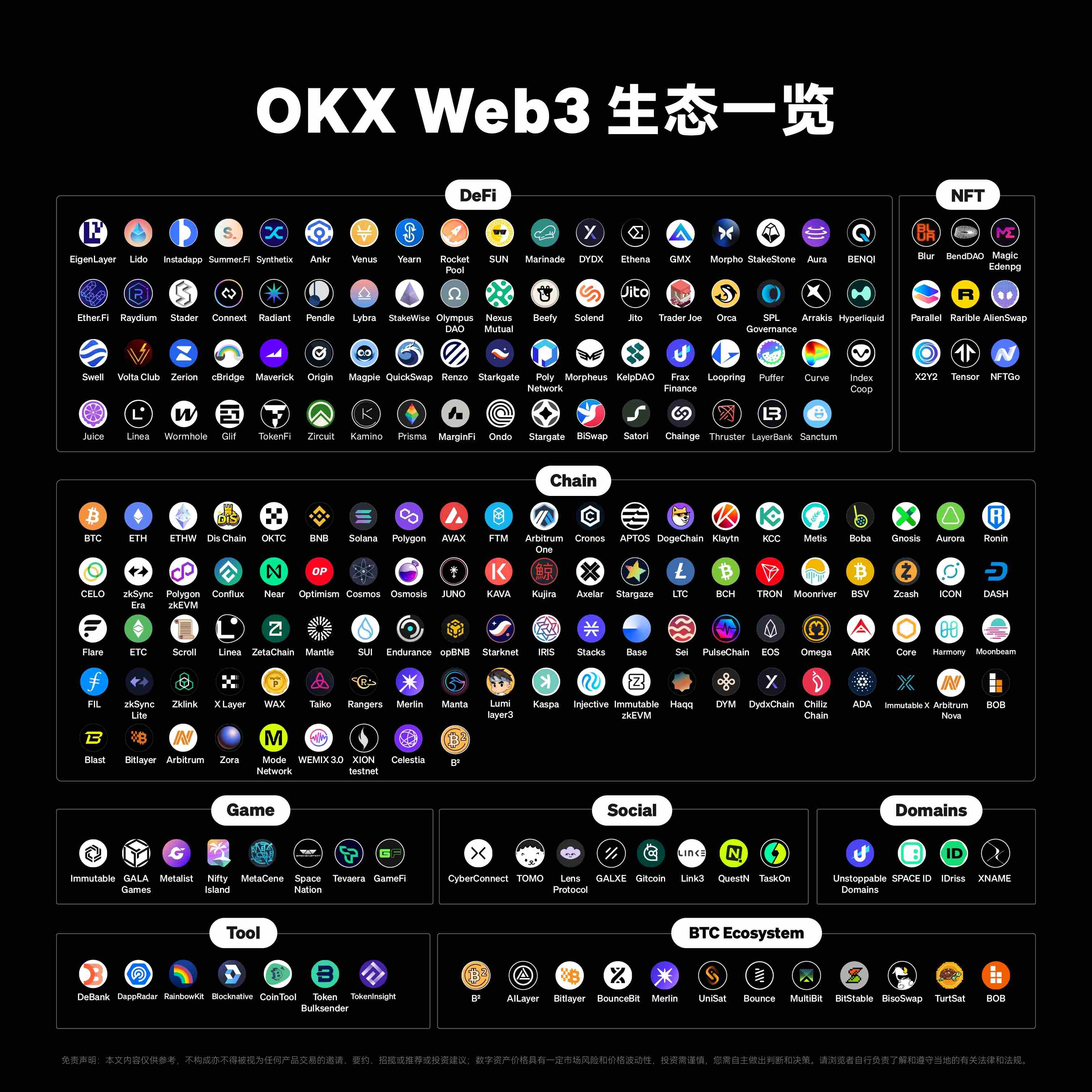
To further realize the vision of “one gateway to the entire Web3 ecosystem,” OKX Web3 aims to use the wallet as a starting point and trading as a lever, covering diverse use cases from DeFi and NFTs to gaming and RWA. This delivers a seamless, rich, efficient, and low-cost interaction experience. Currently, OKX Web3 Wallet supports over 95 blockchains and 1,000+ dApps. Users can easily participate in yield-generating activities across 200+ DeFi protocols via the DeFi module, trade NFTs across 20+ networks in the NFT marketplace, discover early-stage quality projects through the DApp explorer, earn potential rewards, and stay updated on offline Web3 events—all enabled by smooth cross-chain swap functionality that eliminates cumbersome steps.
3. Trading Features Must Keep Pace with Market Trends
This is straightforward: market trends naturally attract massive user attention. Staying aligned with these trends and meeting user demands often converts interested users into loyal users. But keeping pace requires not only sharp market insights from community engagement but also rapid technical responsiveness.
Ordinals were considered the DeFi Summer of 2023. During the Ordinals wave, several projects achieved rapid growth by capitalizing on the trend. For example, Unisat, the first open-source browser extension wallet for Bitcoin Ordinals, became the sole on-chain gateway for BRC-20 tokens amid severe infrastructure shortages on Bitcoin, leading to explosive user growth: according to Google Chrome Store data from May 2023, UniSat Wallet’s weekly active users exceeded 300,000—up from just 272 three months prior, representing over a hundredfold increase.
If Unisat revealed the potential of ordinals, then OKX Web3 Wallet’s entry into the space helped catalyze a “nationwide inscription” phenomenon. In late May 2023, OKX Web3 Wallet fully launched its Ordinals marketplace. With its smooth UX, comprehensive features, superior liquidity, and zero fees, it quickly gained a stellar reputation as a “must-have wallet” in the inscriptions ecosystem. Building momentum, OKX Web3 soon added batch minting and EVM inscription support, propelling its market share to the top within months. By December 18, 2023, its trading share peaked near 90%.
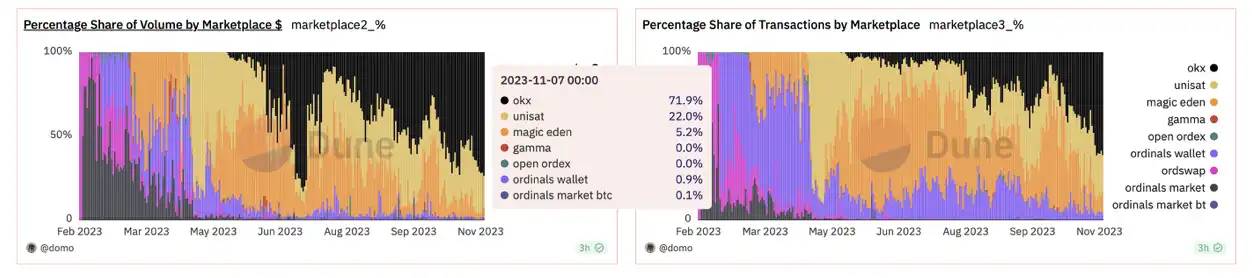
According to Dune analytics, OKX Web3 Wallet experienced rapid growth in May 2023 among Web3 wallets. And notably, this trend-driven growth proved sustainable: as shown below, while MetaMask’s market share declined, OKX Web3 Wallet continued rising even after the peak of the inscription hype. This sustained growth stems partly from its multi-chain advantage—inscription users were onboarded and developed habits using OKX Web3 Wallet for managing multi-chain assets—and largely from its genuinely smooth, user-centric experience that successfully retained users.
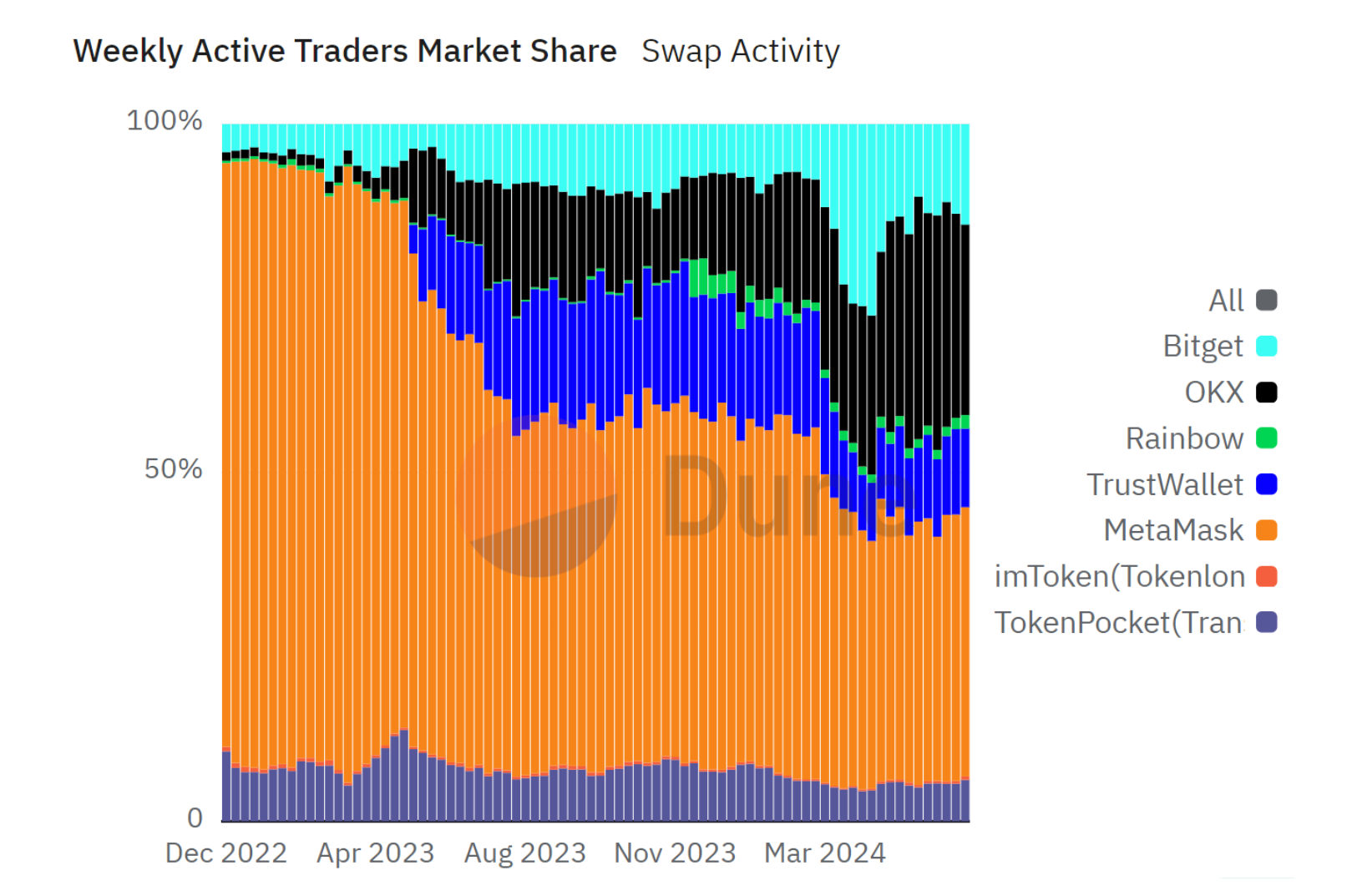
Entering 2024, as the meme wave grows stronger, the upcoming launch of Meme Mode is expected to bring another surge in user growth for the OKX Web3 ecosystem.
Toward a Billion Users: Multi-Dimensional Exploration of Web3 Trading Infrastructure
Although trading products have undergone multiple iterations since DeFi Summer—lowering barriers, reducing friction, and increasing efficiency—user experience has improved dramatically. Yet, it must be acknowledged that there’s still much work to be done on the road to a billion on-chain users.
First, regarding on-chain user scale: according to Crypto.com’s market size report, global cryptocurrency users grew 34% in 2023—from 432 million to 580 million—an encouraging figure. However, another noteworthy statistic: the top 20 L1s combined have only about 75 million active users, and the largest L2 monthly active count is slightly under 20 million. Overall, among 580 million crypto users, actual on-chain participants still represent vast untapped potential.
So how do we bridge this gap? Let’s return to the original question: what kind of trading product do users really want?
Since users are central to the question, perhaps they should also provide the answer. Consider this community user’s description of OKX Web3 Wallet and its transaction aggregation:
“Smooth interactions at low barriers, capturing opportunities through efficient aggregation.”
OKX Web3 Wallet’s evolution will continue focusing on low barriers and high aggregation: on one hand, exploring OMNI Gas to further simplify transactions and eliminate extra costs; on the other, intent-based trading to streamline operations and enhance UX. OKX DEX has already integrated UniswapX to launch intent-based trading, with plans to explore further innovations. Additionally, the built-in transaction aggregator will keep optimizing algorithms and integrating more DEXs and bridges, aiming to deliver broader coverage and faster quotes.
Notably, facing the grand vision of reaching a billion users, OKX Web3 embraces Web3’s open-source ethos: In the future, it will offer system-building services (WaaS), packaging wallet, DEX, and other infrastructure along with frontend interfaces into easy-to-use and programmable SDKs and APIs, providing one-stop integration solutions to empower more developers to build Web3.
Additionally, for driving new user adoption—the key to Web3 mass adoption—as leading exchanges roll out Web3 wallet features, on-chain user growth could accelerate: First, exchanges are usually the first touchpoint for most newcomers. Among 580 million crypto users, centralized exchanges—especially top-tier ones—hold the majority. By embedding Web3 wallets directly into exchange apps, the transition from CeFi to Web3 becomes smoother. Second, leading exchanges possess elite product, engineering, and operations teams along with extensive ecosystem connections, enabling easier resource integration and allowing them to shape Web3 product experiences with greater professionalism and precision.
As a top-tier exchange, OKX announced its shift toward Web3 as early as 2021—a forward-looking strategic move that gave it a head start over many competitors. This advantage allowed OKX Web3 to begin researching user trading needs and exploring product designs years ago, resulting in market-leading performance across trading volume, user numbers, and user experience. In doing so, OKX Web3 Wallet has set benchmarks and provided valuable lessons for future product development in the space.
Conclusion
Trading, as the core need of Web3 users, is becoming an increasingly competitive battleground for Web3 infrastructure.
It’s undeniable that from wallets to DEXs, the OKX Web3 team seems perpetually ahead in shaping standards for Web3 product design: when Web3 user experience was still an afterthought, OKX Web3 was pioneering smooth, efficient interfaces; and when others finally catch up in calling products “user-friendly,” OKX Web3 remains focused solely on what innovative improvements can be made based on evolving user needs.
Regardless of market cycles, users remain central. Continuous innovation centered on user experience will be key to long-term, stable project growth. We look forward to seeing more groundbreaking innovations from frontline builders like OKX Web3—and from the industry as a whole.
Join TechFlow official community to stay tuned
Telegram:https://t.me/TechFlowDaily
X (Twitter):https://x.com/TechFlowPost
X (Twitter) EN:https://x.com/BlockFlow_News
 深潮TechFlow