Blockchain's GPU: A Comprehensive Analysis of ZK Coprocessors
TechFlow Selected TechFlow Selected
Blockchain's GPU: A Comprehensive Analysis of ZK Coprocessors
ZK coprocessors enhance blockchain's ability to handle complex computational tasks through off-chain computation and zero-knowledge proofs, reduce gas fees, and extend the functionality of smart contracts.
 Navigating Web3 tides with focused insights
Author: YBB Capital Researcher Zeke
TL;DR
-
ZK coprocessors can be viewed as off-chain computing plugins derived from the modular concept, functioning similarly to GPUs in traditional computers that handle graphics computations for CPUs—essentially processors designed to offload specific computational tasks;
-
They can process complex computations and heavy data, reduce gas fees, and expand smart contract capabilities;
-
Difference from Rollups: ZK coprocessors are stateless and cross-chain compatible, suitable for complex computation scenarios;
-
ZK coprocessor development is highly challenging, with significant performance overhead and insufficient standardization. Hardware also requires substantial investment. Although the sector has matured significantly compared to a year ago, it remains relatively early-stage;
-
As infrastructure enters a modular era of fractal scaling, blockchains face liquidity shortages, fragmented users, lack of innovation, and poor cross-chain interoperability—creating a paradox with vertically scaled L1s. ZK coprocessors may eventually serve as a strong complement to both, helping them overcome these challenges, providing performance support for existing and emerging heavy applications, and enabling new narratives.
1. Another Branch of Modular Infrastructure: ZK Coprocessors
1.1 Overview of ZK Coprocessors
A ZK coprocessor can be seen as an off-chain computing plugin evolved from the modular paradigm, analogous to how a GPU assists a CPU in handling graphics-intensive tasks in conventional computing—i.e., a specialized processor designed to offload certain types of computational workloads. Under this framework, computationally intensive "heavy data" and complex logic operations—which public blockchains struggle with—can be processed by the ZK coprocessor, while the blockchain only needs to receive the final result, whose correctness is guaranteed via ZK proofs. This enables trustworthy off-chain computation for complex tasks.

Today’s trending applications such as AI, SocialFi, DEXs, and GameFi have urgent demands for high performance and cost efficiency. In traditional approaches, such high-performance “heavy apps” often adopt either on-chain assets with off-chain application layers or build dedicated app-specific chains. However, both models suffer from inherent issues: the former introduces black-box risks, while the latter faces high development costs, disconnection from native ecosystems, and fragmented liquidity. Moreover, limitations imposed by mainchain virtual machines (e.g., lack of application-layer standards, complex programming languages) further constrain development and operation of such applications.
The emergence of ZK coprocessors aims to solve these problems. To illustrate more clearly, imagine a blockchain as an offline terminal (like a phone or computer). On such a device, you can run simple applications like Uniswap entirely on-chain. But when it comes to more complex applications—such as running something like ChatGPT—the blockchain's compute power and storage become immediately insufficient, leading to exorbitant gas costs. In Web2, we use our devices similarly: a local terminal cannot run large language models like GPT-4o directly. Instead, queries are sent over the network to OpenAI servers, which perform inference and return results. A ZK coprocessor functions much like a remote server for blockchains. While different projects may vary slightly in design depending on their target use cases, the underlying principle remains consistent: off-chain computation verified through ZK proofs or storage proofs. Take Rise Zero’s Bonsai deployment as an example—the architecture is remarkably clean. Bonsai integrates seamlessly into Rise Zero’s zkVM. Developers need only two simple steps to leverage Bonsai as a coprocessor:
-
Write a zkVM application to handle the business logic;
-
Write a Solidity contract requesting Bonsai to execute your zkVM application and process the output.
1.2 How Is It Different From Rollups?
From the above definition, one might observe that Rollups seem to overlap significantly with ZK coprocessors in terms of implementation logic and goals. However, Rollups are more akin to multi-core extensions of the main chain. The key distinctions are as follows:
1. Primary Purpose:
-
Rollup: Increase transaction throughput and lower transaction fees.
-
ZK Coprocessor: Expand smart contracts’ computational capacity to handle more complex logic and larger datasets.
2. Working Principle:
-
Rollup: Aggregate transactions off-chain and submit them to the main chain, using fraud proofs or ZK proofs for validation.
-
ZK Coprocessor: Similar to ZK Rollups in verification mechanism, but applied to different use cases. ZK Rollups, constrained by chain structure and rules, are not well-suited for general-purpose coprocessing tasks.
3. State Management:
-
Rollup: Maintains its own persistent state and periodically synchronizes with the main chain.
-
ZK Coprocessor: Stateless—each computation is independent and does not maintain long-term state.
4. Application Scenarios:
-
Rollup: Primarily consumer-facing (C-end), suited for high-frequency trading.
-
ZK Coprocessor: Primarily business-facing (B-end), ideal for complex computation scenarios such as advanced financial modeling and big data analytics.
5. Relationship with Main Chain:
-
Rollup: Acts as an extension of a specific main chain, usually tied to a single blockchain network.
-
ZK Coprocessor: Can serve multiple blockchains and is not limited to any particular main chain—even capable of serving Rollups themselves.
Therefore, the two are not mutually exclusive but rather complementary. Even if a Rollup exists as an app-specific chain, a ZK coprocessor can still provide valuable services.
1.3 Use Cases
In theory, the application scope of ZK coprocessors is extremely broad, potentially covering projects across all blockchain sectors. By leveraging ZK coprocessors, dApps can achieve functionality closer to that of centralized Web2 applications. Below are some illustrative use cases collected from various sources:
Data-Driven DApp Development
ZK coprocessors enable developers to create data-driven DApps that leverage full-chain historical data and perform complex computations without introducing additional trust assumptions. This opens unprecedented possibilities for DApp development, including:
-
Advanced Data Analytics: On-chain analytics similar to Dune Analytics.
-
Complex Business Logic: Implementation of sophisticated algorithms and business rules found in traditional centralized applications.
-
Cross-Chain Applications: Building DApps based on multi-chain data.
VIP Trader Program for DEXs
A typical scenario involves implementing volume-based fee discount programs—“VIP trader loyalty programs”—on decentralized exchanges (DEXs). Such programs are common on centralized exchanges (CEXs) but rare on DEXs.
With ZK coprocessors, DEXs can:
-
Track users’ historical trading volumes
-
Calculate users’ VIP tiers
-
Dynamically adjust trading fees based on tier
Such features could help DEXs improve user retention, increase liquidity, and ultimately boost revenue.
Smart Contract Data Enhancement
ZK coprocessors can act as powerful middleware, providing data fetching, computation, and verification services for smart contracts—reducing costs and improving efficiency. This allows smart contracts to:
-
Access and process large volumes of historical data
-
Perform complex off-chain computations
-
Implement more sophisticated business logic
Cross-Chain Bridge Technology
Some ZK-based cross-chain bridge technologies, such as Herodotus and Lagrange, can also be considered applications of ZK coprocessors. These focus primarily on data extraction and validation, providing a trusted foundation for cross-chain communication.
1.4 ZK Coprocessors Are Not Perfect
Despite the many advantages listed, current ZK coprocessors remain imperfect and face several challenges. Here are my personal observations:
1. Development: ZK concepts are difficult for many developers to grasp, requiring knowledge of cryptography and proficiency in specialized tools and domain-specific languages;
2. High Hardware Costs: The hardware used for off-chain ZK computations must be fully borne by project teams. ZK hardware is expensive and rapidly evolving, risking obsolescence. Whether this forms a viable business model remains questionable;
3. Crowded Space: Technical implementations tend to converge, likely resulting in a landscape similar to today’s Layer 2 ecosystem—with a few standout projects and many others going unnoticed;
4. zk Circuits: Executing off-chain computations in a ZK coprocessor requires converting traditional software into zk circuits. Writing custom circuits per application is tedious, while using zkVMs incurs high overhead due to differences in computational models.
2. A Key Puzzle Toward Mass Adoption
(This section is highly subjective and reflects the author’s personal views.)
The current cycle is dominated by modular infrastructure. If modularity is indeed the right path forward, this phase may represent the final step toward mass adoption. Yet at present, there’s a shared sentiment: Why do we only see repackaged old ideas? Why are there far more chains than applications? Why are innovations like inscriptions hailed as the biggest breakthroughs of this cycle?
The root cause of this narrative drought lies in today’s modular infrastructure being insufficient to support super-apps, particularly due to missing prerequisites like full-chain interoperability and low user barriers. This has inadvertently led to the greatest fragmentation in blockchain history. Rollups, as the core of the modular era, have improved speed but introduced numerous side effects—liquidity fragmentation, user dispersion, and continued constraints on application innovation imposed by chains or VMs themselves. Meanwhile, Celestia, another “key player” in modularity, pioneered the idea of decoupling data availability (DA) from Ethereum, further exacerbating fragmentation. Whether driven by ideology or DA cost considerations, the outcome is clear: Bitcoin is forced to take on DA roles, other public chains race to offer cheaper alternatives, resulting in every major chain hosting anywhere from one to dozens of Layer 2 projects. Compounding this, all infrastructure and ecosystem participants have deeply adopted Blur’s (TieShun) points farming model (originally targeting OpenSea), requiring users to stake tokens within protocols. This triple-win model for whales (yield, ETH/BTC appreciation, free token drops) further drains on-chain liquidity.
In previous bull markets, capital circulated among just a handful to a dozen chains—sometimes concentrated almost entirely on Ethereum. Today, funds are scattered across hundreds of chains, locked in thousands of nearly identical projects. On-chain vibrancy has faded; even Ethereum lacks meaningful activity. As a result, Eastern users resort to PvP in the BTC ecosystem, while Western users do the same on Solana—both out of necessity. Thus, what I currently care most about is how to promote full-chain liquidity aggregation and foster new gameplay mechanics and super-apps. In the cross-chain interoperability space, traditional top players have consistently underperformed—they still resemble conventional bridges. New interoperability solutions, as discussed in prior reports, mainly aggregate multiple chains into a unified layer. Projects pursuing this include AggLayer, Superchain, Elastic Chain, JAM, among others—not elaborated here.
In short, achieving full-chain aggregation is a necessary hurdle in the modular architecture—but one that will take considerable time to overcome. In contrast, ZK coprocessors represent a more immediate puzzle piece. Beyond strengthening Layer 2s, they can also enhance Layer 1s. Could we temporarily sidestep the full-chain and trilemma debates and instead pioneer relevant applications on select Layer 1s or Layer 2s with broad liquidity? After all, the current blockchain narrative is severely lacking. Alternatively, diversifying gameplay, controlling gas costs, enabling large-scale applications, even improving cross-chain usability and lowering user thresholds—integrating coprocessor solutions offers a more ideal path than resorting to centralization.
3. Project Overview
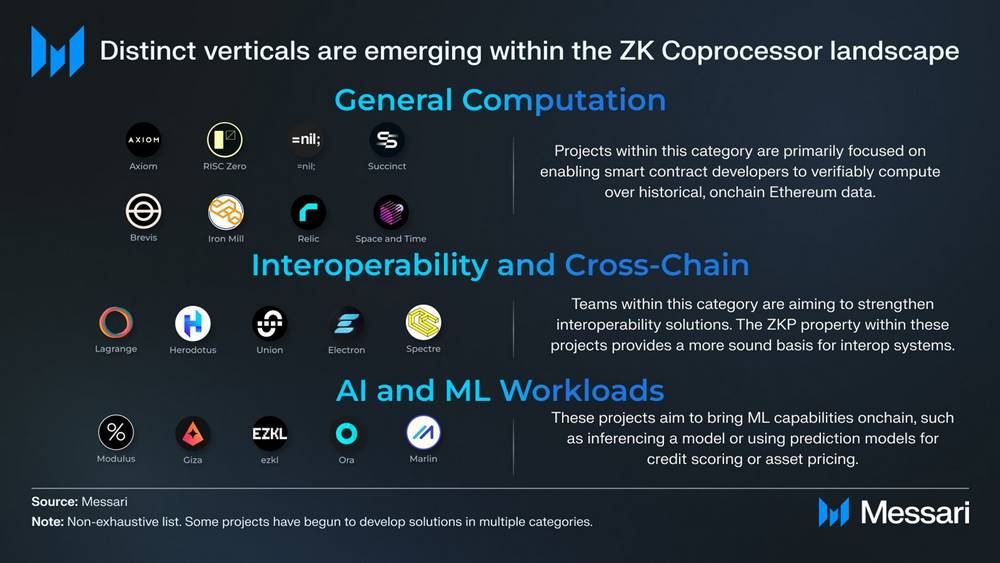
The ZK coprocessor sector emerged around 2023 and has reached a relatively mature stage today. According to Messari’s classification, existing projects fall into three vertical categories (general-purpose computing, interoperability & cross-chain, AI & machine learning), totaling 18 projects. Most are backed by top-tier VCs. Below, we highlight selected projects across different verticals.
3.1 Giza

Giza is a zkML (zero-knowledge machine learning) protocol deployed on Starknet and officially supported by StarkWare. It focuses on enabling AI models to be verifiably used within blockchain smart contracts. Developers can deploy AI models onto the Giza network, where Giza verifies the correctness of model inferences via zero-knowledge proofs and delivers results to smart contracts in a trustless manner. This empowers developers to build on-chain applications enhanced by AI, while preserving decentralization and verifiability.
Giza operates through three key steps:
-
Model Conversion: Giza converts commonly used ONNX-format AI models into formats executable within zero-knowledge proof systems, allowing developers to train models with familiar tools before deploying them on Giza.
-
Off-Chain Inference: When a smart contract requests inference, Giza performs the actual computation off-chain, avoiding the prohibitive cost of running complex AI models directly on-chain.
-
Zero-Knowledge Verification: Giza generates ZK proofs for each inference, proving correct execution. These proofs are verified on-chain, ensuring result integrity without re-executing the full computation.
Giza enables AI models to serve as trusted input sources for smart contracts—without relying on centralized oracles or trusted execution environments. This unlocks new possibilities such as AI-driven asset management, fraud detection, and dynamic pricing. It stands as one of the few logically sound Web3 x AI projects and represents an elegant application of coprocessing in the AI domain.
3.2 Risc Zero
Risc Zero is a leading ZK coprocessor project backed by multiple top-tier VCs. It enables arbitrary computations to be executed and verified within blockchain smart contracts. Developers write programs in Rust and deploy them to the RISC Zero network, which then uses zero-knowledge proofs to verify execution correctness and deliver results to smart contracts in a trustless way—enabling complex on-chain applications while maintaining decentralization and verifiability.
We briefly described the deployment workflow earlier. Let’s now dive deeper into its two core components:
Bonsai: RISC Zero’s Bonsai serves as the coprocessor module, seamlessly integrated with the RISC-V instruction set architecture’s zkVM. It allows developers to rapidly integrate high-performance zero-knowledge proofs into Ethereum, L1 blockchains, Cosmos app-chains, L2 rollups, and dApps within days. Bonsai enables direct smart contract calls, verifiable off-chain computation, cross-chain interoperability, and generic rollup functionality. Designed with a decentralized-first distributed architecture, it leverages recursive proofs, custom circuit compilers, state continuation, and continuously improved proof algorithms, enabling anyone to generate high-performance ZK proofs for diverse applications.
zkVM: The zkVM is a verifiable computer operating similarly to real embedded RISC-V microprocessors. Based on the RISC-V ISA, it supports multiple high-level programming languages—including Rust, C++, Solidity, and Go—for writing programs that generate zero-knowledge proofs. It supports over 70% of popular Rust crates, seamlessly combining general-purpose computing with ZK proofs. Capable of generating efficient ZK proofs for arbitrarily complex computations, it ensures privacy during computation and verifiability of outcomes. The zkVM employs ZK technologies like STARKs and SNARKs, utilizing components such as Recursion Prover and STARK-to-SNARK Prover for efficient proof generation and verification, supporting off-chain execution with on-chain validation.
Risc Zero has already integrated with several Ethereum-based Layer 2s and demonstrated multiple Bonsai use cases. One notable example is Bonsai Pay—a demo allowing users to send or withdraw ETH and tokens on Ethereum using their Google accounts, powered by RISC Zero’s zkVM and Bonsai proving service. This showcases how RISC Zero can seamlessly integrate on-chain applications with OAuth2.0 (the standard used by major identity providers like Google), effectively lowering the barrier to entry for Web3 users through familiar Web2 interfaces. Other demos include DAO-related applications.
3.3 =nil;
=nil; is funded by prominent entities including Mina, Polychain, Starkware, and Blockchain Capital. Notably, participation from cutting-edge ZK projects like Mina and Starkware indicates strong technical validation. =nil; was previously featured in our “Compute Market” research report, primarily focusing on its Proof Market—a decentralized market for proof generation. However, the project also includes a sub-product called zkLLVM.
zkLLVM is an innovative circuit compiler developed by the =nil; Foundation. It automatically converts application code written in mainstream languages like C++ and Rust into efficient provable circuits on Ethereum—eliminating the need for specialized zero-knowledge DSLs. This dramatically simplifies development and lowers barriers. By avoiding zkVMs, it achieves better performance and supports hardware acceleration to speed up proof generation. It applies to various ZK use cases including Rollups, bridges, oracles, machine learning, and gaming—and tightly integrates with =nil; Foundation’s Proof Market to offer end-to-end support from circuit creation to proof generation.
3.4 Brevis
Brevis is a sub-project of Celer Network—an intelligent zero-knowledge (ZK) coprocessor for blockchains that enables dApps to access, compute, and utilize arbitrary data across multiple blockchains in a fully trustless manner. Like other coprocessors, Brevis supports a wide range of use cases, including data-driven DeFi, zkBridges, on-chain user acquisition, zkDID, and social account abstraction.
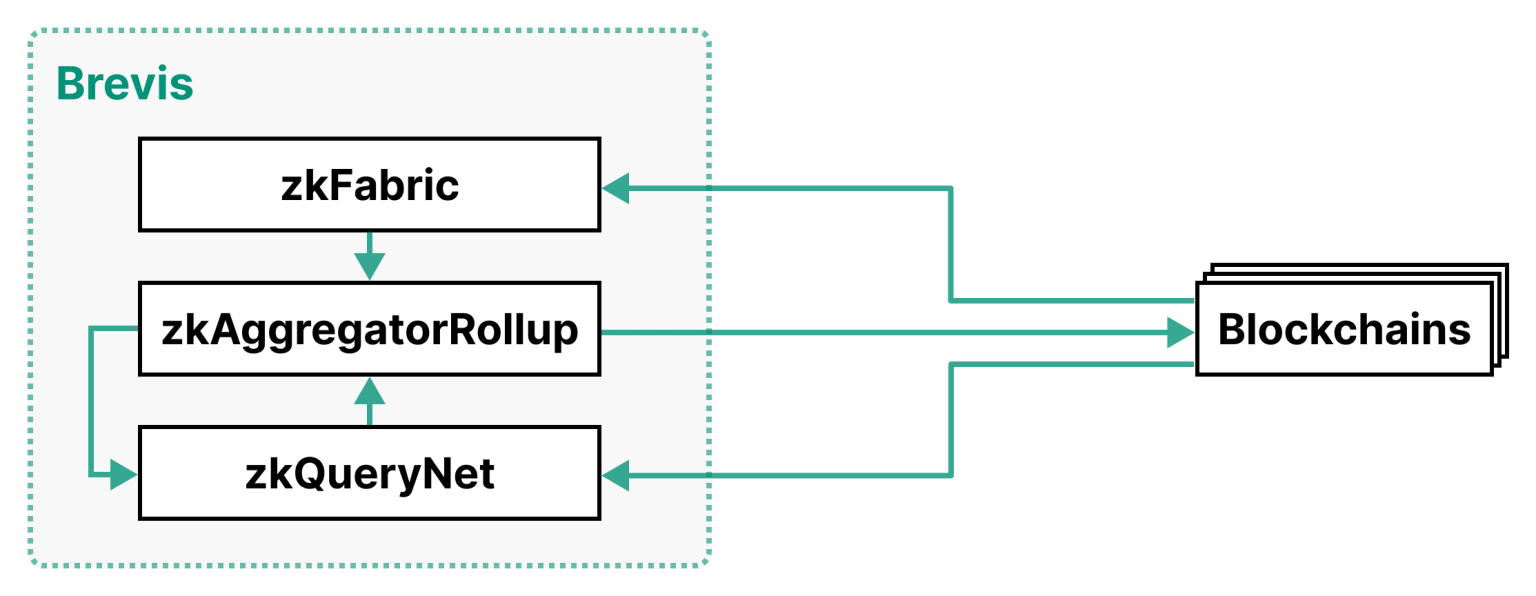
Brevis’ architecture consists of three core components:
-
zkFabric: Acts as Brevis’ relay layer. Its primary role is to collect and synchronize block header information from all connected blockchains, then generate consensus proofs via ZK light client circuits for each collected block header.
-
zkQueryNet: An open marketplace of ZK query engines. It accepts data queries directly from on-chain smart contracts and generates query results along with corresponding ZK query proofs via dedicated ZK query engine circuits. Engines range from highly specialized (e.g., calculating DEX trading volume over a period) to highly generalized abstractions with advanced query languages, catering to diverse application needs.
-
zkAggregatorRollup: Serves as the aggregation and storage layer for zkFabric and zkQueryNet. It verifies proofs from both components, stores proven data, and submits the ZK-proven state root to all connected blockchains—enabling dApps to directly access verified query results within their on-chain smart contract logic.
Through this modular architecture, Brevis provides trustless, efficient, and flexible access to data for on-chain smart contracts across all supported public chains. UNI’s V4 version has adopted Brevis, integrating it with Hooks—a system allowing customized logic integration for various users—to facilitate reading historical blockchain data, reduce gas fees, and preserve decentralization. This exemplifies how ZK coprocessors can empower DEX evolution.
3.5 Lagrange
Lagrange is an interoperability-focused ZK coprocessor protocol co-led by 1kx and Founders Fund. Its primary goal is to support trustless cross-chain interoperability and innovation in applications requiring complex big-data computations. Unlike traditional node bridges, Lagrange achieves cross-chain interoperability through its innovative ZK Big Data and State Committee mechanisms.
ZK Big Data: The core product of Lagrange, responsible for processing and verifying cross-chain data and generating associated ZK proofs. This component includes a highly parallelized ZK coprocessor for executing complex off-chain computations and generating zero-knowledge proofs, a specially designed verifiable database supporting infinite storage slots and direct SQL queries from smart contracts, a dynamic update mechanism that only updates changed data points to reduce proof time, and integrated functionality allowing developers to access historical data via SQL queries from smart contracts without writing complex circuits—collectively forming a large-scale blockchain data processing and verification system.
State Committee: A decentralized validation network composed of multiple independent nodes, each staking ETH as collateral. These nodes function as ZK light clients, specifically validating the states of optimized rollups. Integrated with EigenLayer’s AVS, the State Committee leverages restaking to enhance security, supports unlimited node participation, and achieves super-linear security growth. It also offers a “fast mode,” allowing users to perform cross-chain operations without waiting for challenge windows—greatly improving user experience. The combination of these two technologies enables Lagrange to efficiently handle massive datasets, execute complex computations, and securely transmit and verify results across different blockchains, providing foundational support for developing sophisticated cross-chain applications.
Lagrange has already integrated with EigenLayer, Mantle, Base, Frax, Polymer, LayerZero, Omni, AltLayer, and will serve as the first ZK AVS linked within the Ethereum ecosystem.
Join TechFlow official community to stay tuned
Telegram:https://t.me/TechFlowDaily
X (Twitter):https://x.com/TechFlowPost
X (Twitter) EN:https://x.com/BlockFlow_News
 @YBBCapital