









Web3 Lawyer: How Do Cryptocurrency Exchanges Exploit Token-Issuing Projects?
TechFlow Selected TechFlow Selected
Web3 Lawyer: How Do Cryptocurrency Exchanges Exploit Token-Issuing Projects?
As a Web3 entrepreneur issuing tokens, you need not only guard against regulators deeming it illegal securities issuance, but also beware of being exploited in reverse by exchanges listing your token.
 Navigating Web3 tides with focused insights
By ManQin Blockchain Legal Services
Web3 founders face not only the everyday challenges common to traditional internet entrepreneurs but also a new Hard Mode challenge: token issuance.
To the uninformed public, a Web3 project’s highlight moment is getting listed on a major exchange—after all, it's like becoming a “publicly traded company.” But only those directly involved truly understand the bittersweet reality behind it.
As a Web3 founder issuing tokens, you must not only guard against regulatory risks such as being classified as conducting an illegal securities offering and ensure compliance through offshore structures and foundation setups, but also beware of a massive pitfall: being exploited in reverse by the very exchange listing your token.
"Shitcoins go to DEXs; serious projects go to CEXs"—this has become an unwritten industry rule. Cryptocurrency exchanges have become the preferred route for many founders launching tokens, giving them a sense of prestige. However, few realize that most cryptocurrency exchanges are merely makeshift operations riddled with the bugs and human risks typical of early-stage startups. A common danger is internal exchange employees manipulating token prices via fake trading volume to exploit both project teams and retail investors—an ever-present threat that’s hard to detect.
Liu Honglin, lawyer at ManQin Law Firm, will share some insights into the "dark forest rules" of the crypto exchange world based on his firsthand observations, offering psychological preparation and practical preventive advice for Web3 founders planning to list on exchanges.
Common Exchange Exploitation Tactics
Unlike mainland Chinese users who assume listing on A-shares is extremely difficult, for Web3 project teams, getting listed on a crypto exchange isn’t particularly challenging overall. As long as you have sufficient funds to pay the listing fees, you can generally get listed even on top-tier exchanges.
In terms of process, first, Web3 project teams must contact the exchange’s listing team, fill out and submit a listing application form, and provide a project whitepaper outlining the project’s goals, technical approach, team background, market analysis, and tokenomics model. Second, they need to provide test results and security audit reports, along with a legal opinion letter from qualified attorneys confirming the legality and compliance of the token.
Regarding costs, Web3 projects typically have to pay listing fees, which vary by exchange and range from tens of thousands to hundreds of thousands of U.S. dollars. Additionally, there are expenses for legal opinions and technical audits, costing anywhere from several thousand to tens of thousands of dollars depending on complexity and service provider rates. Beyond basic listing fees, exchanges often invent various pretexts to extract more value from Web3 projects—for example, demanding a certain amount of tokens as market-making collateral to ensure liquidity and incentivize favorable trading conditions; or requiring token airdrops and marketing campaigns to reward holders of the exchange’s native token.
Do you think these overt charges represent all the revenue exchanges collect? No—there’s also the hidden robbery.
The main reason is that centralized exchanges (CEXs) handling decentralized cryptocurrencies are, in fact, purely centralized companies. Those familiar with large centralized organizations know they inherently suffer from issues such as data opacity, insider manipulation, and conflicts of interest. As centralized platforms, exchanges control vast amounts of trading data and user information, granting them immense power to manipulate markets. Below are some common market manipulation tactics—one of which is almost guaranteed to affect you.
1. Fabricating Trading Volume: A “skilled” exchange doesn’t just exploit project teams—it often targets retail investors simultaneously. The most common method involves exchange staff or affiliated parties generating artificial trading volume through massive buy/sell orders to lure in more retail investors and manipulate token prices. This practice is commonly known as “wash trading” or “volume pumping.” A report previously released by the Blockchain Transparency Institute (BTI) found that over 80% of trading volume among the world’s top 25 exchanges was fabricated. The report noted that for some exchanges, actual trading volume accounted for less than 1% of reported figures. Shortly after publication, a senior executive from a leading exchange shared the report, commenting: “This is the most accurate and insightful ranking of crypto exchanges I’ve ever seen.”
2. Data Manipulation: As the saying goes, “On my turf, I call the shots.” Exchanges can use backend privileges to directly alter specific project trading data, affecting token market performance. For instance, manipulating key indicators like candlestick charts and trading volume to mislead investor decisions. Such manipulations often occur during periods of high market volatility to create false market signals and induce followership. Recently, Lawyer Honglin observed a newly listed project whose price was manipulated by a cryptocurrency exchange, showing abnormal data patterns over several consecutive days—many investors suspecting internal trading and data tampering by the exchange.
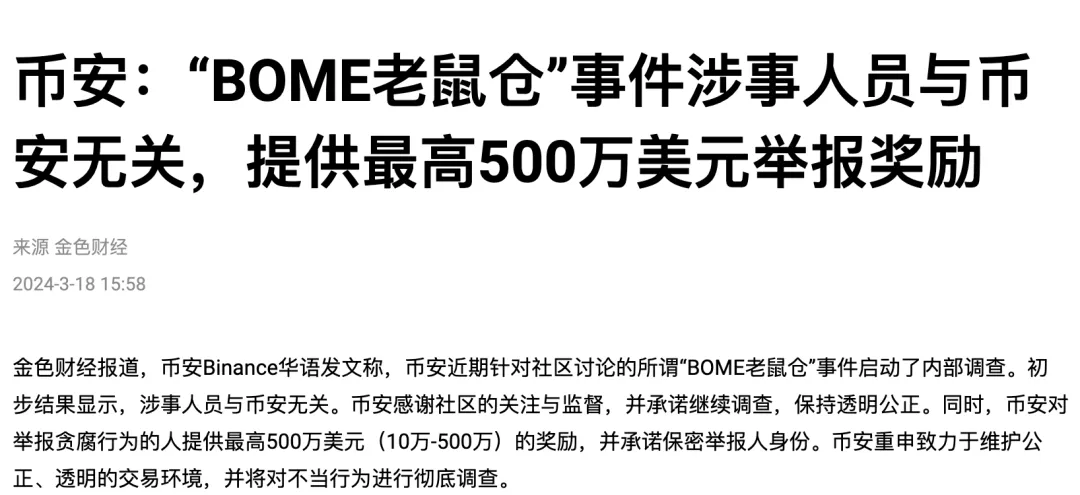
3. Insider Trading: Using non-public market information for personal gain. Exchange employees or associates may conduct trades ahead of major market moves to reap huge profits. For example, buying or selling relevant tokens before a new token launch or significant announcement. Earlier this year, in the case of BOME (Book of Meme), which achieved the fastest listing on a certain An exchange, media outlets suspected insider trading by exchange staff. Prior to the official announcement, one account withdrew approximately $2.3 million worth of SOL from the exchange platform and purchased 314 million BOME tokens at $0.0074 each. After BOME was listed, its price surged over 1,500% on the exchange. The exchange subsequently launched an internal investigation, claiming no involvement by its employees.
4. High-Frequency Trading and Arbitrage: Many exchanges operate their own trading desks or partner with market makers who employ high-frequency trading (HFT) techniques to execute millisecond-level trades, capturing tiny price differences that accumulate into substantial arbitrage profits. HFT typically relies on complex algorithms and high-performance computing systems capable of executing vast numbers of trades in seconds. In 2017, a flash crash of Ethereum (ETH) on a major exchange drew widespread attention when ETH’s price plummeted from $319 to $0.10 within seconds before quickly recovering. Post-event investigations revealed that HFT algorithms triggered massive cascading sell and buy orders during extreme market fluctuations, causing wild price swings.
How Should Founders Respond?
Blaming oneself first when problems arise is a survival tactic for adults. Since external factors are beyond our control, we founders must stay vigilant. Here is Lawyer Honglin’s advice regarding the above risks:
1. Choose Reputable Exchanges: When selecting an exchange, prioritize those with strong reputations and transparent operations, avoiding new or unknown platforms. It is recommended to evaluate exchange credibility by reviewing publicly available audit reports, user reviews, and third-party rating agencies. Additionally, communicate with other project teams to learn about their real-world experiences across different exchanges. Also, avoid listing your token exclusively on a single exchange, as this makes it easier for that exchange to engage in behind-the-scenes manipulation and price control.
2. Sign Detailed Listing Agreements: When entering into a listing agreement with an exchange, clearly define both parties’ rights and obligations, especially clauses related to data transparency and operational compliance, to protect your interests. The agreement should include prohibitions against wash trading and data manipulation, along with corresponding penalties for violations. Additionally, require the exchange to provide regular trading data reports so your team can conduct independent audits.
3. Monitor Market Activity in Real Time: Use professional market analytics tools to continuously track your token’s market behavior, promptly identify suspicious trading activities, and take timely countermeasures. It is advisable to cross-verify data using multiple independent sources instead of relying on a single platform. Consider engaging third-party monitoring services that offer 24/7 surveillance and risk alerts.
4. Involve Legal Counsel: The importance of competent legal compliance advisors is no less than that of market makers—a point many token-issuing projects overlook. A practical recommendation is to hire experienced blockchain and cryptocurrency lawyers as soon as you consider launching a token. Skilled legal advisors in the crypto space can assist with all exchange-related legal matters, ensuring operations comply with applicable laws. They can participate in drafting and reviewing listing agreements upfront, help identify potential legal risks, and swiftly initiate legal action if issues arise. More importantly, they can provide strategic guidance post-listing during unexpected incidents, minimizing unnecessary PR crises.
5. Community Building and User Education: “He who wins the community, wins the game.” Every successful Web3 project stands on solid community support. Hosting online and offline events, publishing educational content, and fostering interactive engagement are standard practices to strengthen community cohesion and shape investment sentiment. During bull markets, community members happily follow leaders’ leads—but once the market turns, frustration erupts, with insults, personal attacks, and threats of police reports becoming commonplace. Therefore, Lawyer Honglin frequently reminds fellow Web3 founders: don’t make absolute promises in your community chats, as every exaggeration becomes a trap waiting to backfire. In emergencies involving exchanges or market makers, promptly disclose updates via official social media channels to prevent panic.
Conclusion
Overall, there are plenty of seasoned scammers eager to profit off Web3 founders. Beyond navigating diverse legal and regulatory landscapes across jurisdictions, entrepreneurs must remain alert to pitfalls set by crypto exchanges, market makers, and other business partners. We hope this article helps you better understand the obstacles centralized crypto exchanges may place in your path during the entrepreneurial journey, raising awareness of these risks. With greater caution and preparation during token issuance and trading, we wish every founder smoother sailing, fewer traps, and more opportunities for growth ahead.
Join TechFlow official community to stay tuned
Telegram:https://t.me/TechFlowDaily
X (Twitter):https://x.com/TechFlowPost
X (Twitter) EN:https://x.com/BlockFlow_News










