









Canaan Inc. Financial Report Analysis: How Do Miners Navigate Bull and Bear Cycles?
TechFlow Selected TechFlow Selected
Canaan Inc. Financial Report Analysis: How Do Miners Navigate Bull and Bear Cycles?
This article will conduct an in-depth analysis of Canaan's financial performance over the past few years, exploring its growth and development amid industry fluctuations.
 Navigating Web3 tides with focused insights
Author: Nandin WU
Over the past few years, Canaan Inc. has undergone transformative changes, navigating through both bull and bear markets. Meanwhile, the company's operational capacity, profitability, and financial structure have experienced significant fluctuations. Behind certain financial figures lies Canaan’s resilience and adaptability across varying market conditions, as well as its flexible strategies in responding to challenges. This article provides an in-depth analysis of Canaan's financial performance over recent years, exploring its growth and development amid industry volatility.
1. Per-Share Metrics

Regarding basic earnings per share (EPS), Canaan reported a loss in 2019 with negative EPS. The reasons include intense market competition that year, resulting in lower-than-expected sales, declining gross margins, and ultimately losses. Additionally, the company made substantial investments in research and development or capital expenditures that had not yet yielded profits. In 2020, the loss narrowed due to cost-control measures, improved production efficiency, and enhanced operational effectiveness, which reduced losses. Sales revenue also rebounded slightly, gross margins improved, and some non-recurring gains helped mitigate the deficit.
In 2021, Canaan’s profitability increased significantly, primarily driven by the rising Bitcoin market, which boosted mining machine sales volume and prices, thereby increasing revenue and profit. Moreover, the company launched new products or services that gained market acceptance, adding new sources of income. Profitability further increased in 2022, supported by sustained market demand and the payoff from prior R&D investments—new products and technological innovations achieved success, driving continued profit growth. However, Canaan returned to a loss in 2023, with EPS turning negative again, due to Bitcoin market volatility that led to weaker sales performance, reduced revenue, and lower gross margins. Additionally, the company incurred non-recurring expenses or risks such as inventory adjustments and impairment provisions, negatively impacting profitability.
As for book value per share, let us analyze the changes at Canaan from 2019 to 2023:
In 2019, book value per share was CNY 1.49. The relatively low level reflected the company's early-stage development, limited asset scale, and constrained profitability. At this stage, Canaan faced typical startup challenges and required time to grow and expand.
In 2020, book value per share surged to CNY 25.46, indicating strong profitability and rapid asset expansion during the year. This suggests effective profit-growth strategies, or possibly major asset acquisitions or mergers that elevated net asset levels. By 2021, it declined to CNY 20.13—lower than the previous year but still at a high level, reflecting relatively stable profitability. In 2022, book value per share dropped sharply to CNY 2.79. This significant decline may have been caused by Bitcoin market volatility affecting profits, stagnant or shrinking asset size, and non-recurring charges such as inventory write-downs or impairment provisions, all of which impacted net asset levels.
In 2023, book value per share recovered slightly to CNY 4.42—showing improvement but still below the levels seen in 2019 and 2020—indicating that the company is actively working to address challenges posed by Bitcoin market fluctuations.
Overall, Canaan has experienced notable fluctuations in profitability and asset scale over these years, heavily influenced by Bitcoin market cycles. The company likely adjusted its business strategies to adapt to changing market environments and challenges.
2. Operating Efficiency Analysis
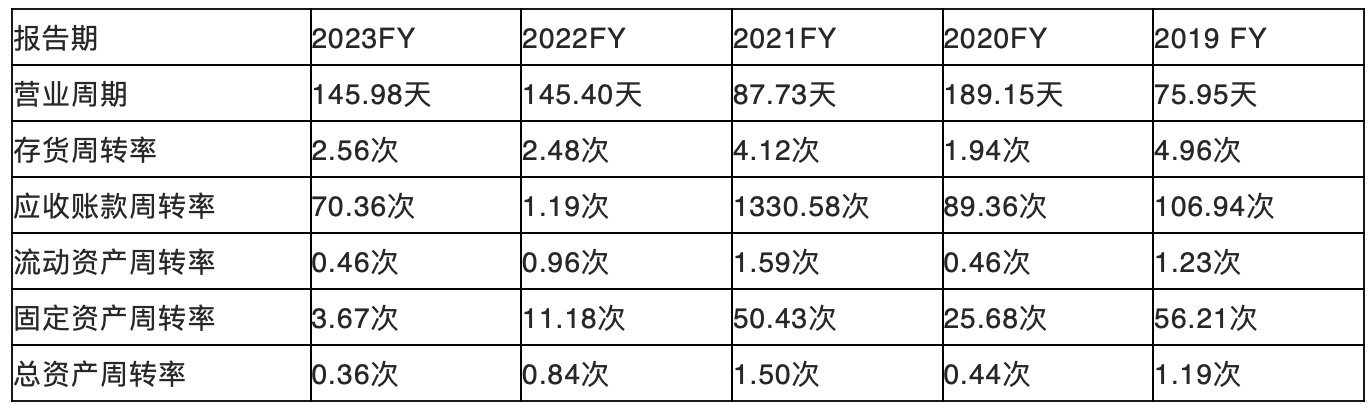
Canaan’s operating efficiency was relatively weak in 2020, 2022, and 2023, mainly due to the Bitcoin bear market, which suppressed miner demand and slowed inventory turnover.
However, compared to 2020, there were significant improvements in operations in 2022 and 2023, driven by several key factors: (1) Technological advancement in mining—through innovation and service optimization, the company adapted to regulatory changes and pursued long-term industry success; (2) Fundraising and cash flow management—successfully raising capital in financial markets and optimizing cash flow strengthened financial flexibility and responsiveness; (3) Growth in mining assets—through diversified mining operations and higher uptime, the company achieved significant growth in cryptocurrency holdings, generating additional revenue and asset appreciation potential.
3. Profitability Analysis
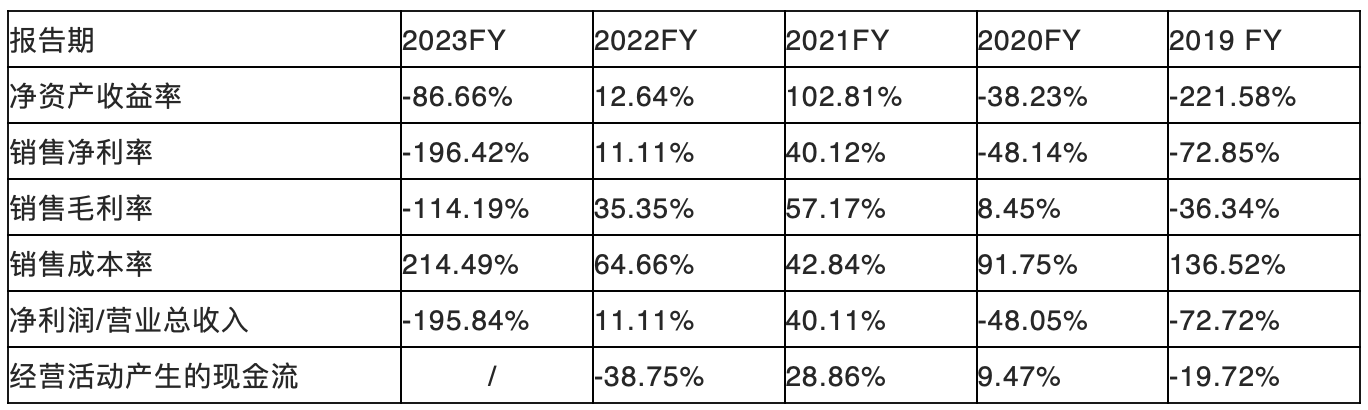
Regarding return on equity (ROE): In 2019, Canaan’s ROE was -221.58%, indicating a large net loss relative to shareholders’ equity. In 2020, ROE improved to -38.23%—still negative, but showing progress, though profitability challenges remained. In 2021, ROE jumped to 102.81%, reaching a high level, reflecting strong profitability and efficient use of assets. From 2022 to 2023, ROE gradually declined and turned negative again, signaling weakening profitability.
Net profit margin followed a similar trend. As of 2023, the company’s revenue was insufficient to cover costs and expenses, indicating room for improvement in sales performance.
For gross profit margin, Canaan’s margin rose from negative in 2019 to 57.17% in 2021, then gradually declined back into negative territory. This reflects initially high costs, followed by improved operations, and later deterioration due to changes in sales costs and pricing.
In summary, Canaan’s profitability has fluctuated significantly over the past few years, with all metrics affected by market conditions and strategic decisions. The company needs to further optimize management and improve profitability and capital efficiency. Performance was particularly weak in 2020 and 2023, coinciding with Bitcoin bear markets that challenged operations.
4. Financial Ratio Analysis
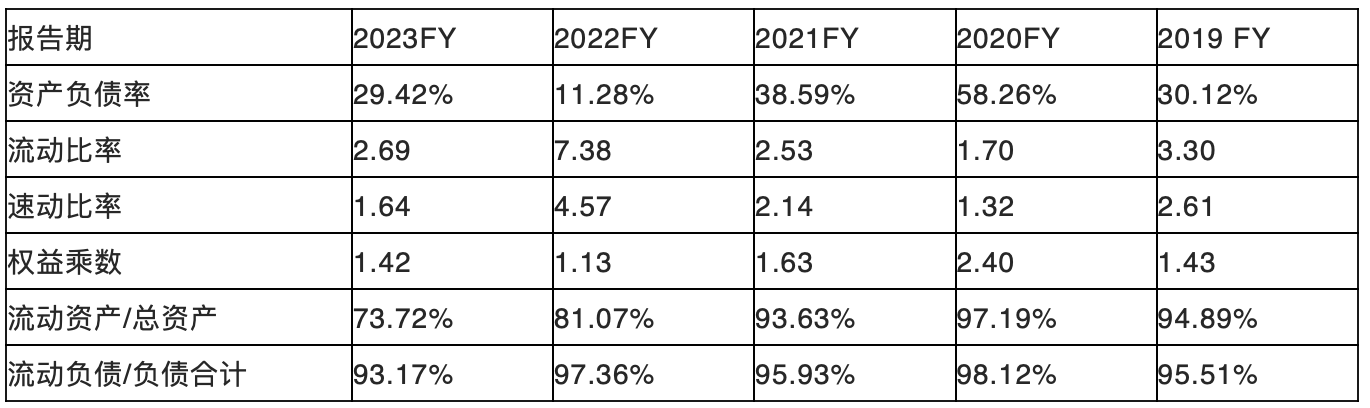
Canaan’s capital structure and liquidity indicators have shown notable changes over the past few years:
In terms of debt-to-asset ratio, the company’s leverage has fluctuated over the past five years, showing an overall upward trend. The ratios were relatively high in 2020 (58.26%) and 2023 (38.59%).
The current ratio has also fluctuated, trending downward overall. In 2023, it reached its lowest point at 1.70, suggesting weakened short-term solvency.
Similarly, the quick ratio has declined, reaching 1.32 in 2023. This ratio measures liquidity after excluding inventory, and a lower value indicates difficulty in meeting short-term obligations.
The equity multiplier has also fluctuated, peaking at 2.40 in 2020 before declining. A higher equity multiplier indicates greater reliance on debt financing.
The proportion of current assets to total assets has fluctuated over the past five years, trending downward overall. In 2023, it stood at 73.72%. A declining share suggests more funds are being allocated to illiquid or long-term investment assets.
Meanwhile, the share of current liabilities in total liabilities has also fluctuated, reaching 93.17% in 2023. An increasing proportion indicates higher short-term debt burden or insufficient liquid assets to cover near-term obligations.
Based on the trends in debt-to-asset ratio, current ratio, quick ratio, and other indicators, Canaan’s overall solvency has weakened in recent years. Key reasons include: (1) Rising debt-to-asset ratio—the upward trend, especially peaks in 2020 and 2023, indicates growing debt pressure and higher leverage relative to assets; (2) Declining current ratio—a lower ratio in 2023 (1.70) signals weaker short-term solvency; (3) Falling quick ratio—the 2023 level of 1.32 reflects deteriorating liquidity after excluding inventory, making it harder to meet immediate liabilities; (4) Decreasing share of current assets—more capital tied up in non-current assets reduces liquidity and undermines repayment capacity.
In conclusion, Canaan’s solvency has generally declined over the past few years due to rising leverage, falling liquidity ratios, and decreasing current asset allocation. The company must optimize its capital structure and enhance liquidity to ensure sustainable repayment capability.
Overall, in terms of revenue and profit, the company saw growth in 2020 followed by a decline in 2021, with a sharp rise in net profit in 2021 largely attributable to the peak of the cryptocurrency market. However, market challenges in 2022 and 2023 led to significant drops in revenue and profit, especially a substantial net loss in 2023, highlighting the negative impact of industry volatility on profitability. On the sales front, total computing power sold declined due to crypto market swings, with a sharp drop toward the end of 2022 and a severe decline in Q4. The company continued to increase R&D spending, particularly in 2022, to maintain competitiveness in new products and technologies and respond to market shifts.
5. Overall Conclusion
In summary, Canaan has navigated market ups and downs over the past five years, particularly facing steep declines in revenue and profit in 2022 and 2023. In response to industry volatility, the company has leveraged technological innovation, R&D investment, and market expansion to overcome challenges. Overall, the improvement in Canaan’s financial performance in 2023 can be attributed to the following initiatives:
1. Canaan possesses strong capabilities in ASIC chip design, successfully developing and manufacturing high-performance Bitcoin mining machines. Furthermore, leveraging its ASIC expertise, the company is actively expanding into AI, offering comprehensive AI solutions including AI chips, algorithm development and optimization, hardware modules, end-user products, and software services;
2. Through strategic partnerships with specific cryptocurrency mining farms, Canaan has entered the Bitcoin mining business as a second growth engine. This initiative aims to leverage the Bitcoin ecosystem and create synergies with mining machine sales. By continuously increasing computing power and hash rate, Canaan strengthens its mining operations, reduces inventory risk, and enhances financial and operational performance;
3. By integrating internal and external production resources, Canaan has enhanced assembly capabilities for Bitcoin miners and AI chips, achieving high-quality, high-yield, and stable production. The company has established long-term partnerships with leading global suppliers, ensuring efficient and reliable manufacturing;
4. Effective January 1, 2023, the company changed its reporting currency from Chinese yuan to U.S. dollars to better reflect its global business development and future strategy. This change improves consistency in financial reporting and supports strategic advancement in global markets;
5. Canaan has achieved breakthroughs in multiple technical areas critical to blockchain and AI ASICs, such as low-voltage operation, high power efficiency, and high computing density. Additionally, the company owns most of the intellectual property used and has accumulated valuable know-how and multi-generation proprietary silicon data through years of ASIC design experience;
6. Canaan plans to continue expanding its customer base, launching more products and solutions to diversify revenue streams, despite currently relying on a small number of customers for a significant portion of income.
Through these initiatives, Canaan has made significant progress in enhancing technological capabilities, expanding markets, optimizing operations, and managing costs, leading to a more stable and robust financial performance in 2023. We believe that going forward, Canaan will continue to monitor market dynamics, maintain competitiveness, and pursue proactive growth strategies to achieve sustainable long-term development.
Join TechFlow official community to stay tuned
Telegram:https://t.me/TechFlowDaily
X (Twitter):https://x.com/TechFlowPost
X (Twitter) EN:https://x.com/BlockFlow_News
 TaxDAO









