Understanding Pi Squared: A ZK General-Purpose Settlement Layer Led by Academic Elites from Top Universities, with $12 Million in Funding
TechFlow Selected TechFlow Selected
Understanding Pi Squared: A ZK General-Purpose Settlement Layer Led by Academic Elites from Top Universities, with $12 Million in Funding
The square of this faction—what on earth is its origin?
 Navigating Web3 tides with focused insights
By TechFlow
The market doesn't feel like a bull run, yet fundraising doesn't resemble a bear market either.
While BTC has been declining steadily in recent days, the primary market continues to see major funding announcements pouring in.
Aside from Sentiment, the AI behemoth that raised $85 million (see: Valued at $85M? A Closer Look at Sentient, the AI Project with Polygon Co-Founder Leading Massive Funding), another notable funding this week is Pi Squared, a project related to ZK.
On July 2, Pi Squared announced it secured a $12 million seed round led by Polychain Capital, with participation from ABCDE, Bloccelerate, Generative Ventures, Robot Ventures, and Samsung Next.
Angel investors include Justin Drake from the Ethereum Foundation and Sreeram Kannan, founder of EigenLayer.

From publicly available information, the name "Pi Squared" carries strong mathematical overtones—pi, an infinite repeating constant, squared, evoking a sense of hardcore, mysterious technical depth.
The project itself focuses on building “universal ZK circuits” and a “universal settlement layer”—another one of those projects where you recognize every word in the description but still can’t quite grasp what it does.
Still high-end infrastructure, still ZK—which always comes with lofty valuations—and backed by top-tier VCs and well-known angel investors...
While rejecting flashy, overhyped projects won’t necessarily protect you from losses, completely ignoring well-funded new ventures isn’t wise either.
So, what exactly is this Pi Squared all about?
Pi Squared: Led by Academic Heavyweights from Top Universities
If you draw Pi Squared on a blackboard, people might be confused. But when an academic heavyweight draws it, the effect is entirely different.
Pi Squared is actually founded and led by Grigore Rosu, a computer science professor at the University of Illinois Urbana-Champaign, who also serves as CEO of the project.
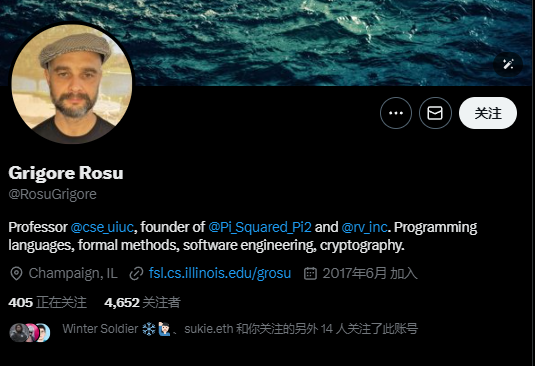
Rosu became a full professor at UIUC in 2014, specializing in formal verification and runtime verification. In simpler terms, formal verification uses mathematical methods to prove the correctness of software and hardware systems, ensuring they function properly under all conditions; runtime verification involves real-time monitoring of system behavior to enhance stability and security.
According to Wikipedia, several of Professor Rosu’s papers have received top paper awards from the Association for Computing Machinery (ACM) and the International Conference on Automated Software Engineering (ASE).
But what does this have to do with a crypto project?
Looking at Pi Squared’s core mission, it aims to use zero-knowledge proof (ZK) technology to verify the correct execution of any program—regardless of programming language (PL) or virtual machine (VM)—providing a universal and efficient validation method designed to enable seamless interoperability across blockchains, languages, and applications.
This aligns perfectly with Professor Rosu’s research expertise in verification—a domain where academic excellence translates directly into technological advantage.
When a project is led by academic experts with deep technical backgrounds, its credibility naturally increases.
Additionally, Pi Squared’s CTO, Dr. Xiaohong Chen, earned her bachelor's degree from Peking University before pursuing her PhD at the University of Illinois Urbana-Champaign. She shares a similar academic background and research focus with Professor Rosu, suggesting a possible mentor-student or colleague relationship.

Another co-founder and COO, Patrick MacKay, also graduated from UIUC and previously served as COO at Runtime Verification—the earlier startup founded by Grigore Rosu—indicating a smooth transition of long-time colleagues into familiar roles. Notably, Runtime Verification’s work includes security audits of VMs and smart contracts on public blockchains.
With academic leaders at the helm and seasoned colleagues and alumni forming the core team, it’s no surprise that Pi Squared has attracted strong interest from venture capitalists.
USL: Enabling System Transaction Settlement
Now let’s take a closer look at what Pi Squared means by a “universal settlement layer.”
First, it’s important to clarify that Pi Squared does not target end users directly, but rather provides tools and infrastructure for developers and crypto platforms.
Pi Squared aims to create a Universal Settlement Layer (USL) to simplify interoperability among blockchains, programming languages, and applications, completely eliminating the need for traditional, error-prone language implementations such as compilers, transpilers, or interpreters.
To put it simply, think of it as a super translator that enables seamless interaction between different blockchains, programming languages, and applications. Developers can build cross-chain and cross-language applications much more easily.
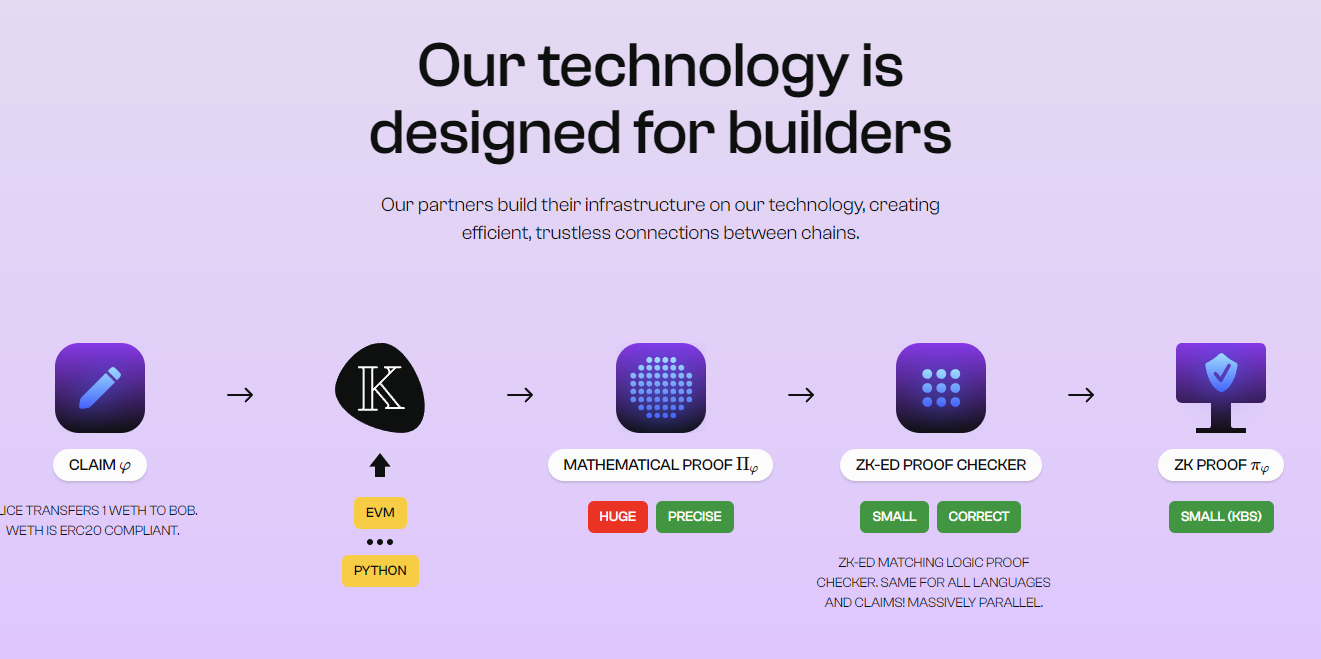
The diagram on Pi Squared’s official website clearly illustrates how this super translator works:
-
Transaction Initiation: A user (e.g., Alice) initiates a transaction request, such as transferring 1 WETH to Bob. WETH is an ERC20-compliant token.
-
Universal Settlement: The transaction request is submitted to an environment supporting arbitrary virtual machines and programming languages—such as EVM or Python. This is the so-called Universal Settlement Layer (USL). As long as there exists a formal specification for the given language or VM, computation can be expressed in any language or VM. In short: no restrictions on VMs or programming languages.
-
Proof Generation: A mathematical proof is generated to verify the correctness of Step 2. This proof is highly precise but may be very large.
-
Proof Verification: A ZK-ED (Zero-Knowledge - Matching Logic) proof checker verifies this “large proof.” This checker is compact and capable of massive parallel processing.
-
ZK Compression: Finally, a compact zero-knowledge proof is generated to confirm the correctness of the original transaction. This ZK proof is small, efficient to transmit, and fast to verify.
Thus, the above process demonstrates how a simple transaction request evolves through mathematical proof generation and verification, ultimately producing a smaller zero-knowledge proof that ensures both correctness and privacy.
The entire workflow supports multiple programming languages and execution environments, offering efficiency and trustlessness, ideal for cross-chain connectivity and other applications requiring high security and privacy.
In terms of ecosystem positioning, Pi Squared sits in the middle of the tech stack—above lies the computation and sequencing layer, below the consensus and data availability layers.
You can view Pi Squared’s USL as a kind of optimistic rollup, interpreting and verifying computational transactions, bridging upper-layer computation with lower-layer consensus.
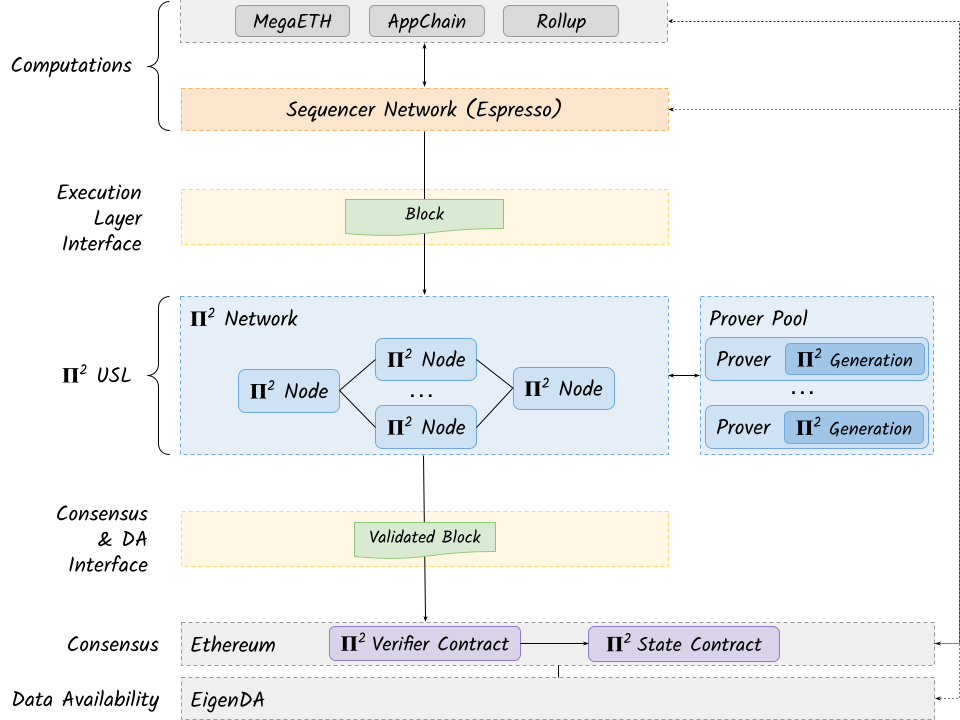
Moreover, Pi Squared mentions having its own network with nodes running a consensus protocol. It is likely to feature a staking-based economic model, which would directly tie into a native token.
However, no details about a token have been disclosed in current documentation. While the network design leaves room for a token, how it will be implemented remains to be seen as more information emerges.
Pi Squared is currently in the proof-of-concept phase. Professor Rosu stated the project plans to launch a testnet by the end of 2024. For now, it remains in the early awareness and promotion stage, with no activities or tasks open for public participation.
We will continue to monitor the project closely. Despite claims of “no mutual dumping,” opportunities worth participating in inevitably arise.

Join TechFlow official community to stay tuned
Telegram:https://t.me/TechFlowDaily
X (Twitter):https://x.com/TechFlowPost
X (Twitter) EN:https://x.com/BlockFlow_News
 深潮TechFlow