Interpreting the MegaETH Whitepaper: Infrastructure Never Sleeps — What Makes This Heavily Funded L2, Backed by Vitalik, So Exceptional?
TechFlow Selected TechFlow Selected
Interpreting the MegaETH Whitepaper: Infrastructure Never Sleeps — What Makes This Heavily Funded L2, Backed by Vitalik, So Exceptional?
Now that all market participants are fatigued by the performance narratives of public blockchains, what enables MegaETH to break through?
 Navigating Web3 tides with focused insights
By: TechFlow
Infrastructure never sleeps; there are more chains than applications.
While the market groans under relentless PUA from airdrops of various "god-tier" projects, the primary market continues its frantic race to "create gods."
Last night, another L2 with an explosive lineup emerged — MegaETH, raising $20 million in seed funding led by Dragonfly, with participation from Figment Capital, Robot Ventures, Big Brain Holdings, and angel investors including Vitalik, Cobie, Joseph Lubin, Sreeram Kannan, and Kartik Talwar.
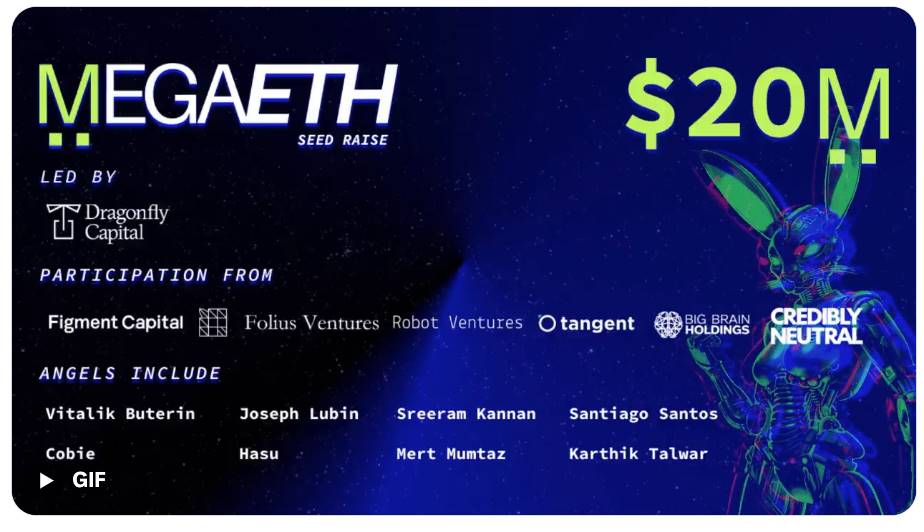
Top-tier VCs leading investment rounds, crypto legends like Vitalik serving as angel investors, and a project name directly incorporating ETH—within the attention-scarce crypto market, these labels all serve to establish "legitimacy."
From its official description, MegaETH can still be summarized using one familiar word—fast.
The first real-time blockchain, lightning-fast transaction transmission, sub-millisecond latency, and over 100,000 transactions per second...
In today’s market where participants are fatigued by narratives around blockchain performance, how does MegaETH break through?
We dug into MegaETH's whitepaper to find out.
Many chains exist, but none achieve "real-time"
Setting aside narratives and hype, why does the market need another blockchain called MegaETH?
MegaETH answers this itself: simply creating more chains won't solve blockchain scalability. Current L1s/L2s face common issues:
-
All EVM chains exhibit low transaction throughput;
-
Secondly, due to scarce computational resources, complex applications cannot go on-chain;
-
Finally, applications requiring high update rates or rapid feedback loops are impractical given long block times.

In other words, existing blockchains cannot actually achieve:
-
Real-time settlement: Transactions are processed immediately upon arrival, with results published almost instantaneously.
-
Real-time processing: The blockchain system can process and validate large volumes of transactions within extremely short timeframes.
What do these "real-time" capabilities mean for actual use cases?
For example, high-frequency trading requires placing and canceling orders within milliseconds. Or real-time combat games or physics simulations that require the blockchain to update states at extremely high frequencies. Clearly, current chains fall short.
Node Specialization Enables Real-Time Performance
So what is MegaETH's general approach to achieving such "real-time" capability? In short:
Node specialization: Reduce consensus overhead by separating transaction execution tasks from full node responsibilities.
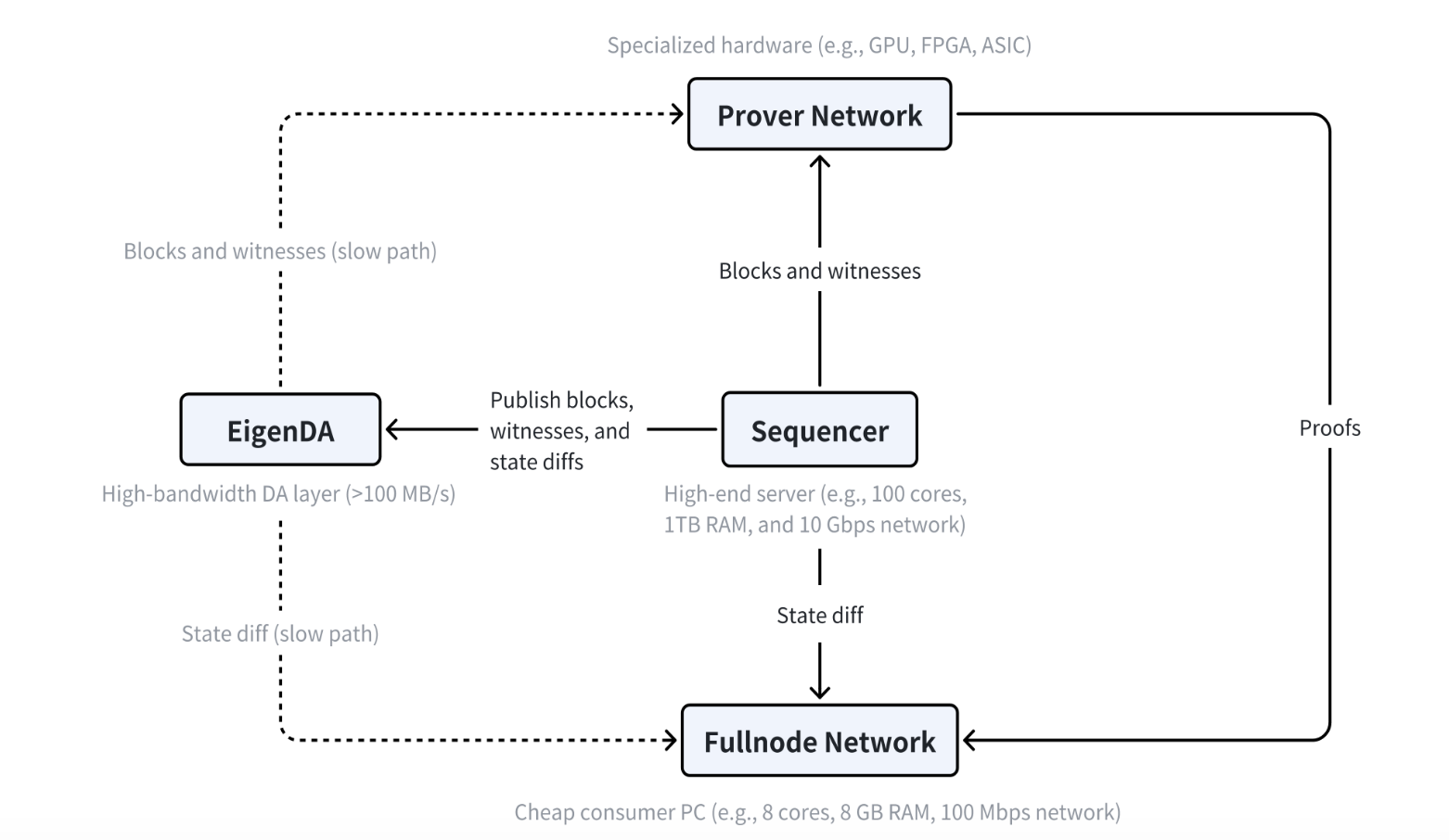
More specifically, MegaETH has three main roles: sequencer, prover, and full node.
Specifically, only one active sequencer executes transactions at any given time, while other nodes receive state diffs via the p2p network and update their local state without re-executing transactions.
The sequencer handles ordering and execution of user transactions. However, MegaETH maintains only one active sequencer at any time, eliminating consensus overhead during normal execution.
Provers use a stateless validation scheme to verify blocks asynchronously and out-of-order.
A simplified workflow of MegaETH looks like this:
1.Transaction Processing and Ordering: User-submitted transactions are first sent to the Sequencer, which processes them sequentially and generates new blocks and witness data.
2.Data Publication: The sequencer publishes generated blocks, witness data, and state diffs to EigenDA (the data availability layer), ensuring data availability across the network.
3.Block Verification: The Prover Network retrieves blocks and witness data from the sequencer, verifies them using specialized hardware, generates proofs, and returns them to the sequencer.
4.State Update: The Fullnode Network receives state diffs from the sequencer, updates its local state, and can also verify block validity through the Prover Network, ensuring consistency and security of the blockchain.
Measure First, Then Execute
Looking deeper into the whitepaper, MegaETH acknowledges that while the idea of "node specialization" sounds good, it doesn’t automatically translate into practical implementation.
When building the chain, MegaETH adopted a solid principle: measure first, then execute—conduct thorough performance measurements to identify the true bottlenecks in existing blockchain systems before applying the node specialization concept.
So what problems did MegaETH uncover?
The following section may be too technical for casual readers; feel free to skip ahead if needed.
-
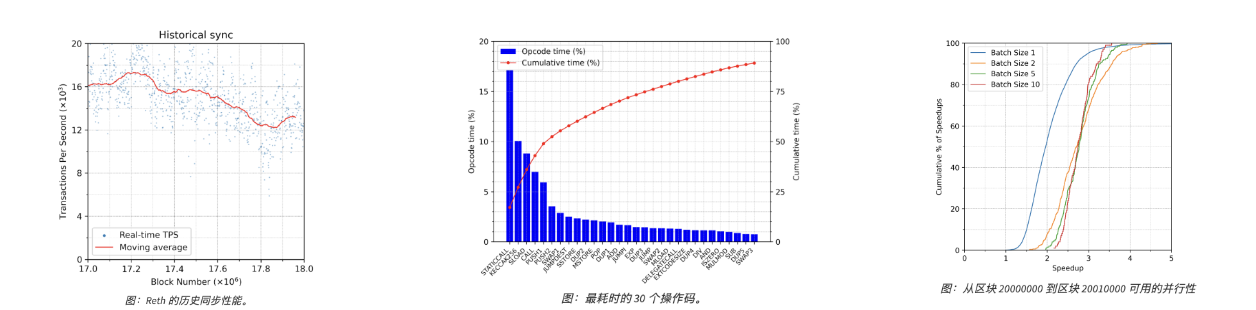
Transaction Execution: Their experiments show that even with powerful servers equipped with 512GB RAM, Ethereum execution clients like Reth can only reach about 1,000 TPS (transactions per second) in real-time sync mode, indicating significant performance bottlenecks in transaction execution and state updates.
-
Parallel Execution: Even the popular parallel EVM concept faces unresolved performance issues. The acceleration effect of parallel EVM in production is limited by workload parallelism. MegaETH’s measurements reveal that the median parallelism in recent Ethereum blocks is less than 2, increasing only to 2.75 even when combining multiple blocks.
(A parallelism value below 2 means that, in most cases, fewer than two transactions per block can be executed simultaneously. This indicates that transactions in current blockchain systems are largely interdependent and cannot support large-scale parallel processing.)
-
Interpreter Overhead: Even fast EVM interpreters like revm are still 1–2 orders of magnitude slower than native execution.
-
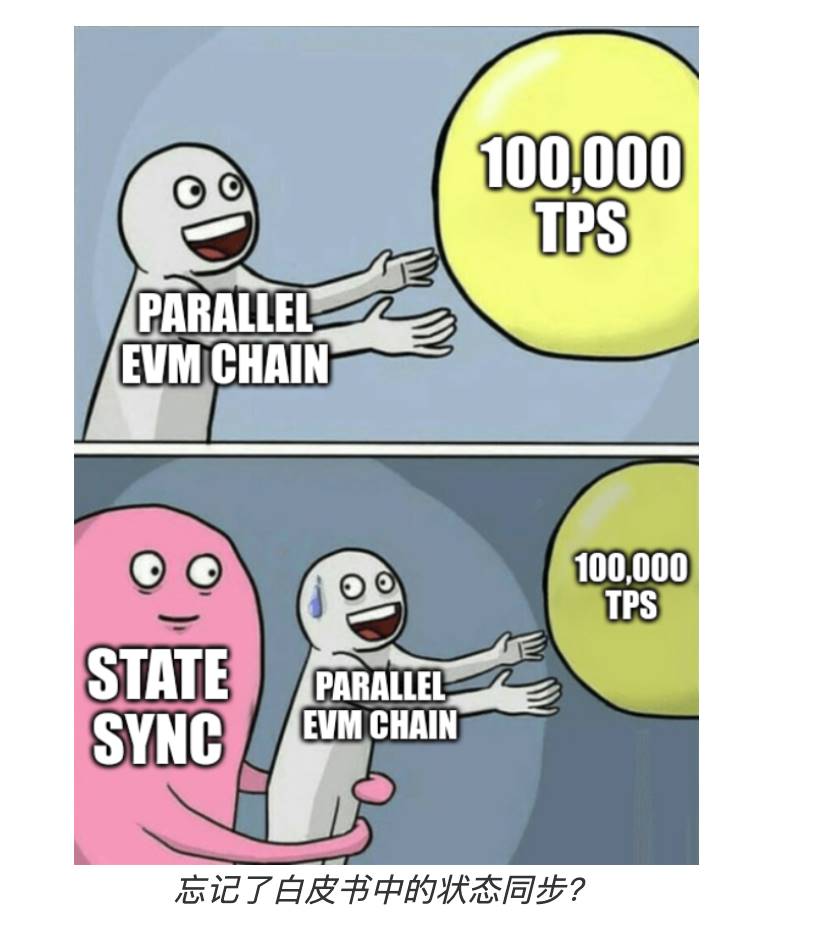
State Synchronization: Syncing 100,000 ERC-20 transfers per second consumes 152.6 Mbps of bandwidth, with more complex transactions requiring even higher bandwidth. Updating the state root in Reth takes 10x more computational resources than executing transactions. In plain terms: current blockchains consume excessive resources.
After identifying these issues, MegaETH began implementing targeted solutions, making the earlier proposed logic much clearer:
-
High-Performance Sequencer:
Node Specialization: MegaETH improves efficiency by assigning tasks to specialized nodes. Sequencer nodes handle transaction ordering and execution, full nodes manage state updates and verification, and prover nodes use dedicated hardware to validate blocks.
High-End Hardware: The sequencer uses high-performance servers (e.g., 100 cores, 1TB RAM, 10Gbps network) to handle massive transaction loads and rapidly generate blocks.
-
State Access Optimization:
In-Memory Storage: Sequencer nodes are equipped with large amounts of RAM, enabling the entire blockchain state to be stored in memory, eliminating SSD read latency and accelerating state access.
Parallel Execution: Although parallel EVM provides limited speedup under current workloads, MegaETH optimizes its parallel execution engine and supports transaction priority management to ensure critical transactions are processed promptly during peak times.
-
Interpreter Optimization:
AOT/JIT Compilation: MegaETH introduces AOT/JIT compilation techniques to accelerate execution of compute-intensive contracts. While performance gains may be limited for most contracts in production environments, these technologies significantly boost performance in specific high-compute scenarios.
-
State Synchronization Optimization:
Efficient Data Transfer: MegaETH designs an efficient encoding and transmission method for state diffs, enabling synchronization of large state updates even under limited bandwidth.
Compression Techniques: By employing advanced compression, MegaETH can synchronize state updates for complex transactions (like Uniswap swaps) within bandwidth constraints.
-
State Root Update Optimization:
Optimized MPT Design: MegaETH adopts optimized Merkle Patricia Trie structures (such as NOMT) to reduce read/write operations and improve state root update efficiency.
Batching Techniques: By batching state updates, MegaETH reduces random disk I/O operations and enhances overall performance.
These details are highly technical, but beyond the specifics, you can clearly see that MegaETH possesses genuine technical expertise—and a clear motivation:
By publicly sharing detailed technical data and test results, it aims to enhance transparency and credibility, helping the technical community and potential users gain deeper understanding and trust in its system performance.
Elite Academic Team, Repeatedly Favored?
Throughout the whitepaper analysis, it becomes evident that although MegaETH's name sounds flashy, the documentation reflects a meticulous, nerdy technical rigor.
Public information shows that MegaETH’s team appears to have Chinese roots. CEO Li Yilong is a computer science PhD from Stanford; CTO Yang Lei holds a PhD from MIT; CBO Kong Shuyao earned her MBA from Harvard Business School and has worked at several well-known crypto firms (e.g., ConsenSys); the growth lead shares overlapping experience with the CBO and is also a graduate of New York University.


A four-member team, all from top U.S. universities—their influence in terms of connections and resources speaks for itself.
Previously, in our article "Fresh Graduate as CEO: Who Is Nexus, Pantera-Led $25 Million Startup?", we noted that Nexus’s CEO, though a recent graduate, also hails from Stanford with solid technical background.
Top-tier VCs clearly favor elite technical talent from top schools. Combined with Vitalik’s investment and the ETH name drop, both technical narrative and marketing impact could be maximized.
At a time when old "gods" are turning into "fallen," projects are struggling to emerge, and markets remain stagnant, MegaETH will undoubtedly trigger another wave of FOMO.
We’ll continue monitoring updates regarding the project’s testnet launch and interaction opportunities.
Join the official TechFlow community
Telegram subscription group:
Official Twitter account:
English Twitter account:
Join TechFlow official community to stay tuned
Telegram:https://t.me/TechFlowDaily
X (Twitter):https://x.com/TechFlowPost
X (Twitter) EN:https://x.com/BlockFlow_News
 深潮TechFlow