NFT Sector Mid-Year Report: Volatile and Unpredictable – Who Are the Hidden "Big Winners"?
TechFlow Selected TechFlow Selected
NFT Sector Mid-Year Report: Volatile and Unpredictable – Who Are the Hidden "Big Winners"?
Trading volume plummeted to $795 million in May, a 42% drop from April.
 Navigating Web3 tides with focused insights
Author: HAMSTER
In the first half of 2024, the NFT market experienced significant volatility.
TL,DR:
-
Total trading volume: Although January 2024 saw a transaction volume of $1.28 billion—35.3% higher than January 2023—the market fluctuated significantly afterward. In May, trading volume plummeted to $795 million, marking a 42% drop from April.
-
Multi-chain trading volume: Ethereum continues to dominate the NFT market, though its market share has fluctuated throughout the first half of the year, declining from 66.67% in January to 45% in April before recovering to 58.22% and 62.2% in May and June respectively. Driven by the Ordinals protocol, Bitcoin's share in the NFT market surged from 9.4% in January to 33.47% in April, then fell back to 12.37% and 11.76% in May and June. Solana’s market share remained relatively stable, while Polygon experienced notable fluctuations.
-
Major NFT marketplaces: Blur maintains its leading position with 46.38% market share. Magic Eden expanded its reach through multi-chain support and airdrop initiatives, increasing its share to 11.74%, while OpenSea's share dropped to 15.96%. Additionally, emerging platforms like OKX NFT and Tensor have maintained or grown their respective market shares through innovative incentive programs.
Total Trading Volume: Major Volatility in First Half of 2024, Sharp Drop in May
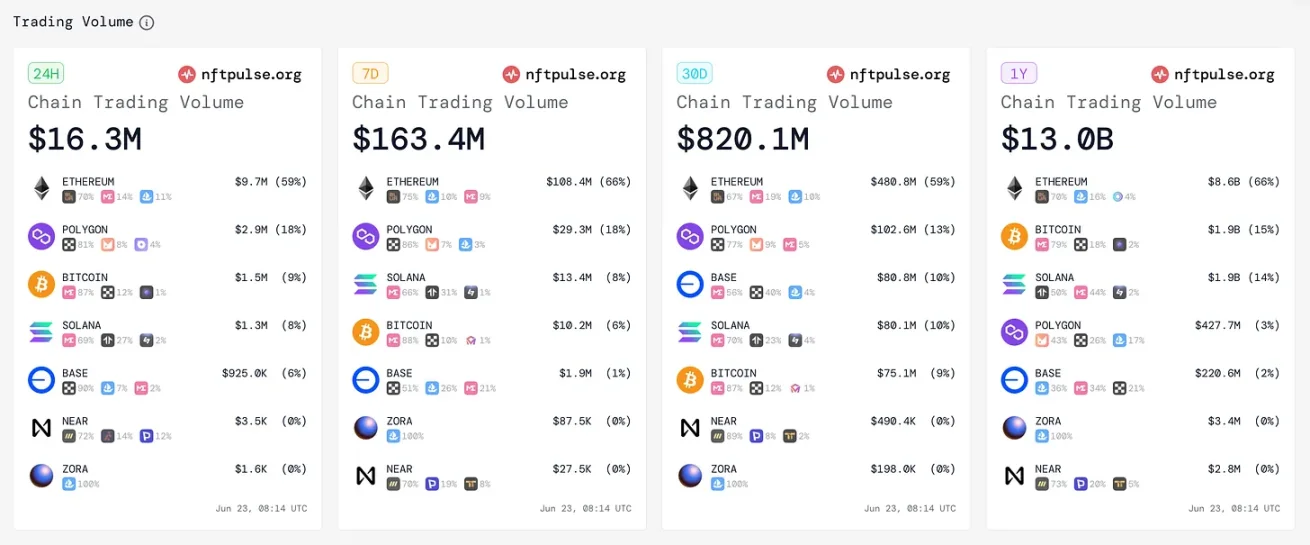
In December 2023, the total NFT market trading volume reached record levels. According to data from NFT Pulse, NFT sales on the Bitcoin network exceeded $881 million for the first time, setting a new monthly high. This figure significantly surpassed those of Ethereum ($365 million) and Solana ($325 million). Overall, the entire NFT market recorded approximately $1.7 billion in trading volume during December 2023.
However, in January 2024, NFT market trading volume declined to $1.28 billion, a 24.7% decrease from December 2023. Despite this, the overall trading volume trended upward in early 2024, peaking at $2.157 billion in March. In May, however, total NFT trading volume sharply dropped from $1.38 billion in April to $795 million—a 42% decline. NFT trading volumes on Bitcoin, Ethereum, and Solana decreased by 80.5%, 20%, and 50.1% respectively. The number of NFT traders also declined compared to previous months, especially on Bitcoin, where trader count fell from 393,000 in April to just 114,400 in May.
Year-on-Year Comparison: 2024 vs. 2023
January Comparison
-
January 2023: NFT market trading volume was nearly $946 million.
-
January 2024: Trading volume rose to $1.28 billion, an increase of 35.3% year-on-year, indicating continued market growth.
May Comparison
-
May 2023: NFT market trading volume was approximately $870 million.
-
May 2024: Trading volume dropped to $795 million, an 8.6% decline year-on-year, reflecting a significant market downturn.
Data source: NFT Pulse
Summary
Overall, despite strong performance at the beginning of 2024, the market experienced significant volatility and a subsequent downturn, particularly in May, when both trading volume and activity declined noticeably. This indicates that the NFT market faced challenges in the first half of 2024 and requires further observation regarding future trends and recovery potential.
Multi-Chain Trading Volume: BTC Market Share Expands Rapidly, Temporarily Surpassing Ethereum
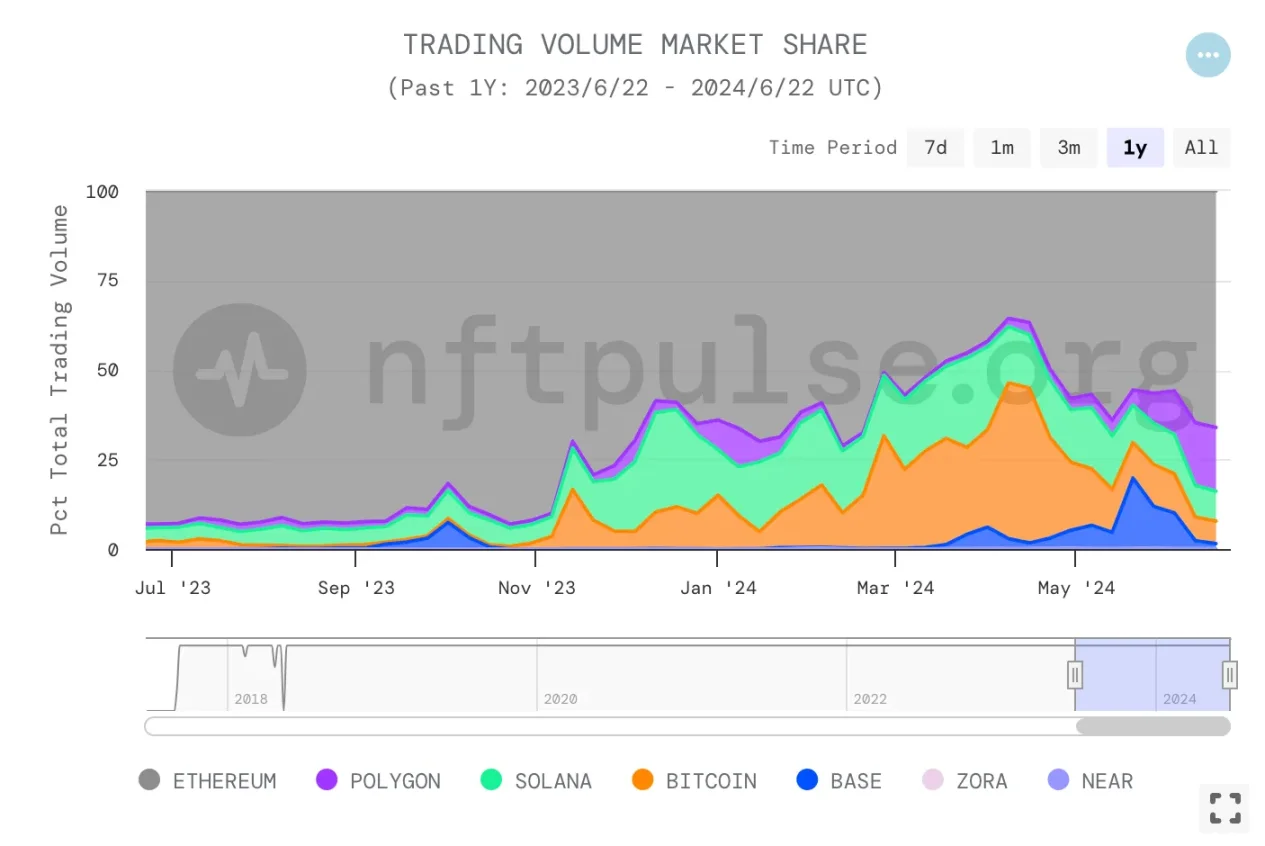
During the first half of 2024, there were significant shifts in NFT trading volume market share across different blockchains. Below is an overview of each major blockchain’s market share:
-
Ethereum: Held 72.3% market share in 2023; in early 2024, it declined temporarily before rebounding, briefly losing its top position.
-
Bitcoin: Market share was 12.9% in 2023. In the first half of 2024, Bitcoin’s trading volume fluctuated dramatically, rising to around 40% before falling back near 12%.
-
Solana: Market share was 7.4% in 2023, but grew significantly in early 2024 to about 20%, demonstrating the most stability among all chains during market fluctuations.
-
Base: Market share was negligible in 2023 (2.3%), but surged due to MEME and Degen launching L3, reaching a peak of 10.62%.
-
Polygon: Had 2.2% market share in 2023, but experienced dramatic drops and rebounds in trading volume during the first half of 2024.
Data source: NTF Pulse
Monthly Data Breakdown (Source: NFT Pulse)
-
January 2024: BTC held 9.4% NFT trading volume market share, Ethereum 66.67%, Solana 17.75%, Polygon 5.9%. Notably, Polygon’s trading volume dropped sharply week-over-week.
-
February 2024: BTC NFT trading volume increased significantly, driven by collections such as NodeMonkes on Ordinals, growing to 18.37% market share. Ethereum stood at 62.15%, Solana at 17.85%, and Polygon fell to 1.32%. Base began gaining traction due to the MEME sector, capturing 0.15% market share.
-
March 2024: BTC NFT trading volume continued rising, reaching 26.02% market share, while Ethereum dropped to 48.76% and Solana rose to 21.44%. Ethereum’s weekly NFT volume declined steadily, while Base emerged strongly, hitting 6% market share in the final week of March.
-
April 2024: BTC NFT market share surged to 33.47%, showing strong momentum. In early April, BTC even surpassed ETH, reaching 43.5% share. In contrast, Ethereum dropped to 45%, Solana slightly declined but held around 16.37%, and Base accounted for 3%.
-
May 2024: BTC NFT volume crashed to 12.37% market share, while Ethereum recovered to 58.22%. Solana stood at 13.5%, and Base spiked to 10.62%.
-
June 2024: As of the writing of this article (June 24), BTC NFT market share continued to fall to 11.76%, while Ethereum rebounded further to 62.2%. Solana dropped to 9.4%, Base fell to 4.56%, and Polygon recovered to 15.83%.
Summary
In summary, the first half of 2024 witnessed significant shifts in NFT trading volume market share across various blockchains. The surge in BTC NFT trading volume was primarily driven by the Ordinals protocol. Starting at 9.4% in January, BTC’s share jumped to 33.47% by April and briefly surpassed Ethereum. Although BTC’s market share retreated to 12.37% and 11.76% in May and June, its overall performance still reflects strong growth momentum.
In comparison, Ethereum’s market share fluctuated but remained dominant overall, dropping from 66.67% in January to 45% in April, then recovering to 58.22% and 62.2% in May and June. Solana demonstrated relative stability, while Polygon experienced significant volatility, notably rebounding to 15.83% in June.
These market share changes not only reflect the dynamic nature of the NFT market but also highlight the competitive landscape and development potential of different blockchains within the NFT ecosystem. With the continuous emergence of new protocols and projects, NFT market shares are likely to keep evolving in the coming months and years, presenting both opportunities and challenges for market participants.
Marketplace Market Share: Blur Maintains Lead, Magic Eden Briefly Takes Top Spot Late May to Early June
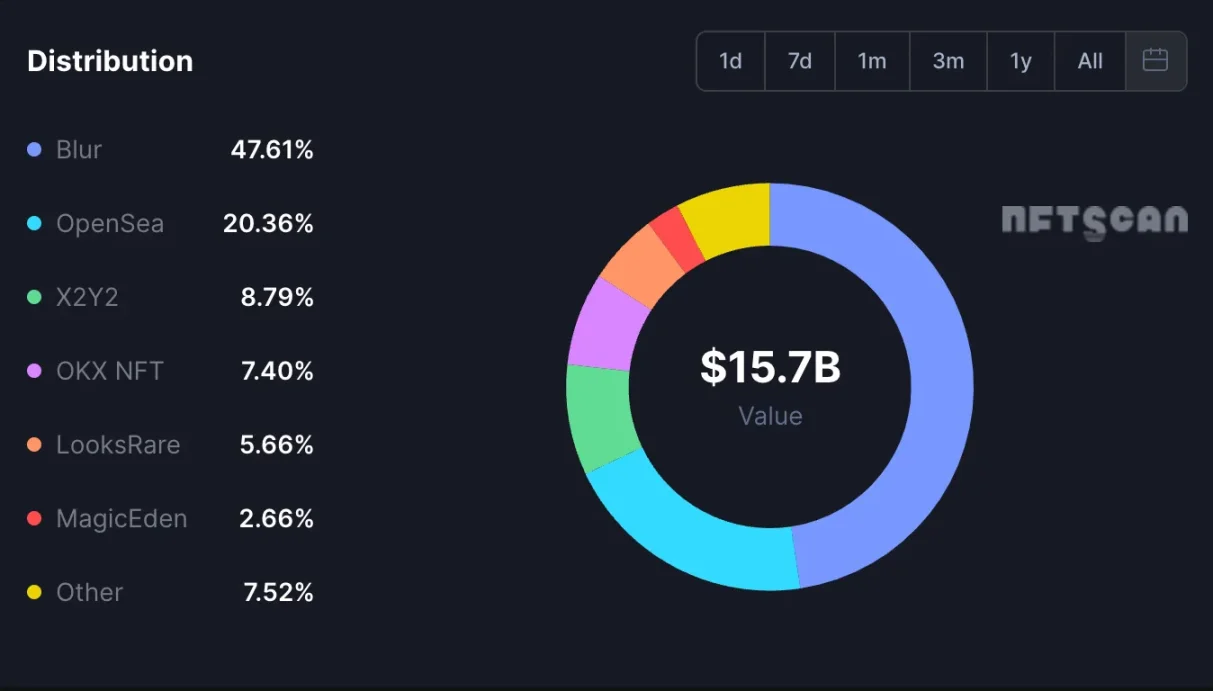
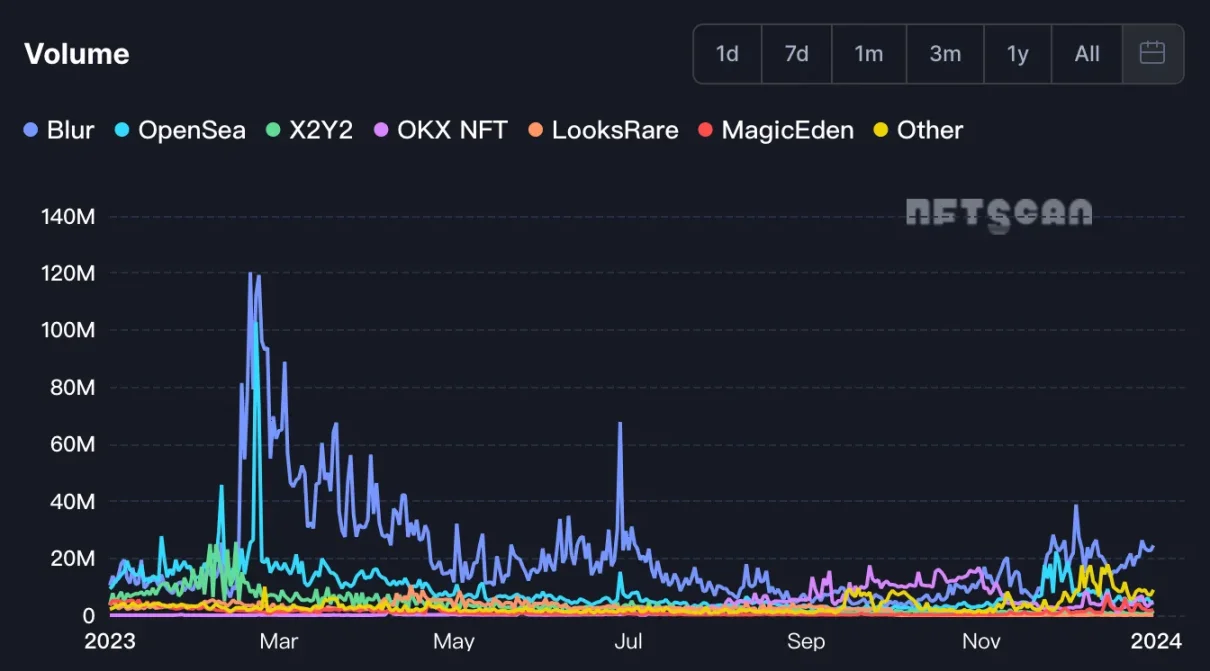
2023 NFT Marketplace Market Share Overview
Blur: Thanks to its airdrop incentives, zero transaction fees, and non-enforcement of creator royalties, Blur overtook OpenSea to become the leading NFT marketplace with 47.61% market share. This strategy attracted many users, especially those aiming to maximize trading profits.
OpenSea: Despite intense competition, OpenSea retained its status as a top NFT marketplace with 20.36% market share. As a long-standing platform, it remains a preferred choice for many users, particularly within the Ethereum ecosystem.
X2Y2: Averaged 8.79% market share in 2023, starting strong but ending the year nearly irrelevant. Initially attracting users with low fees and no royalties, X2Y2 gradually lost ground as competition intensified.
OKX NFT: Emerged rapidly in 2023 with an average market share of 7.4%, becoming one of the main platforms for Ordinals NFTs on BTC. Its multi-chain support and zero-fee model quickly drew users, especially in the Bitcoin ecosystem.
Magic Eden: Captured 2.66% market share, primarily focused on Solana NFTs. Its share grew notably toward the end of 2023, thanks to expansion into multiple blockchains including BTC.
Data source: NFT Scan
Overall, the NFT marketplace landscape in 2023 saw significant shifts. Platforms continuously innovated in technology and user experience, expanding multi-chain support and introducing reward mechanisms to attract and retain users. This diversified competitive environment not only fueled platform growth but also drove broader prosperity and advancement in the NFT market.
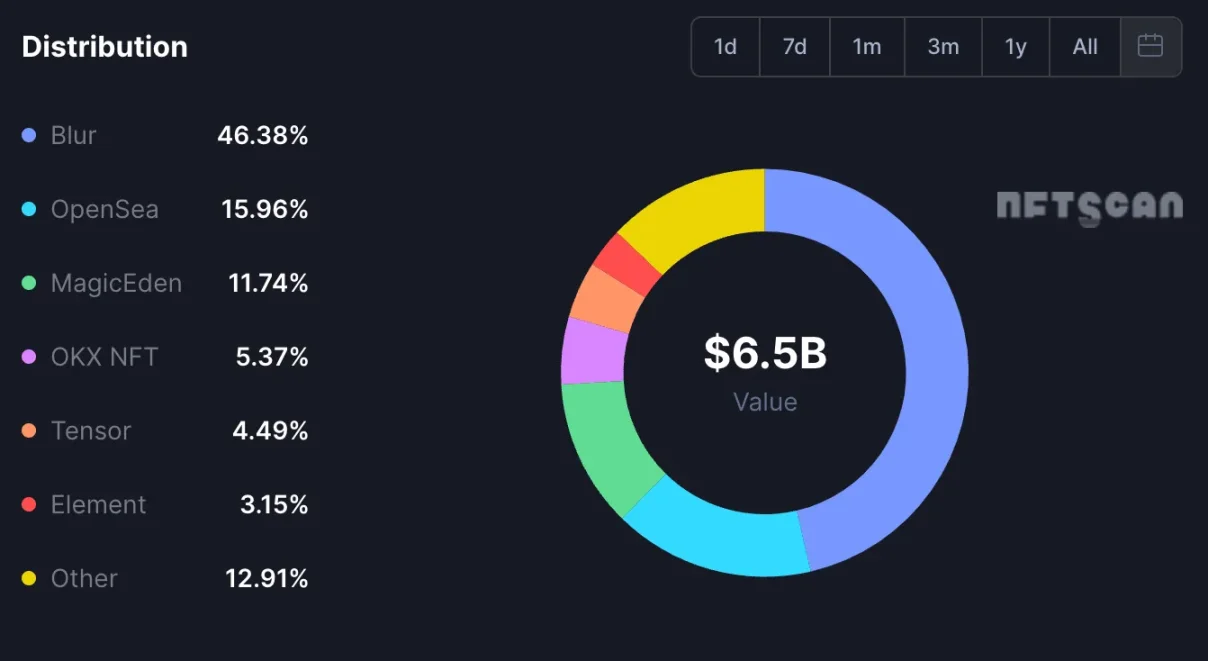
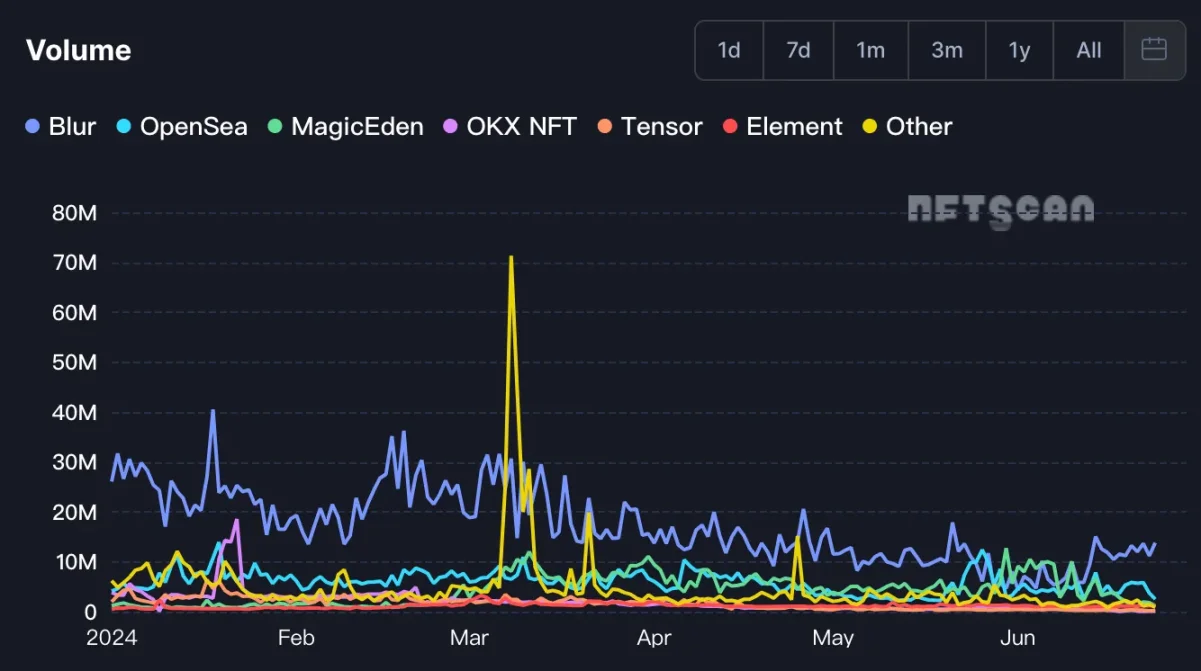
2024 NFT Marketplace Market Share: As of June 24
-
Blur: Maintained its leadership with 46.38% market share. Most of its trading volume still comes from Ethereum, with Blast chain accounting for only 0.56%.
-
OpenSea: Faced fierce competition without launching major innovations, causing its market share to drop to 15.96%. Despite losing its top spot, OpenSea remains one of the most important NFT marketplaces, especially with a broad user base in the Ethereum ecosystem.
-
X2Y2: Market share is now negligible, effectively disappearing from the NFT marketplace race.
-
OKX NFT: Remained stable with around 5.37% market share. As a multi-chain platform supporting Ethereum, Solana, BSC, and others, OKX NFT attracts users with its user-friendly interface and low fees.
-
Magic Eden: Expanded its market share to 11.74%, becoming a primary marketplace for Solana and BTC NFTs. Its cross-chain expansion strategy and potential airdrop plans led to rapid increases in user numbers and trading volume.
-
Tensor: Benefiting from an airdrop incentive program, Tensor—one of the main Solana NFT marketplaces—saw its market share rise to 4.49% in the first half of 2024. Its incentive model significantly boosted user engagement and trading activity.
Data source: NFT Scan
Summary
From the above, it is clear that Blur and Magic Eden stood out in 2024, while OpenSea, despite losing some share, remains significant. Emerging platforms like OKX and Tensor are gradually expanding their influence through innovative incentive strategies.
Conclusion
In the first half of 2024, the NFT market experienced significant volatility and overall instability. While the launch of Bitcoin ETFs brought new capital inflows, it did not clearly drive a broad market rally. On the contrary, recent sharp declines triggered market panic, leading to a substantial drop in trading volume and weak investor sentiment. This volatility highlights high risk and uncertainty. Whether the NFT market can enter a bull run remains an open question.
Join TechFlow official community to stay tuned
Telegram:https://t.me/TechFlowDaily
X (Twitter):https://x.com/TechFlowPost
X (Twitter) EN:https://x.com/BlockFlow_News
 @ChainFeedsxyz