








Artela Whitepaper Explained: Unique Parallel Execution Stack + Elastic Block Space
TechFlow Selected TechFlow Selected
Artela Whitepaper Explained: Unique Parallel Execution Stack + Elastic Block Space
EVM++ reduces parallel execution conflicts by using AI models to accurately predict transaction dependencies, and maintains dApp performance stability through elastic block space.
 Navigating Web3 tides with focused insights
By 0XNATALIE
In March this year, the scalable L1 blockchain network Artela launched EVM++, an upgrade to the next-generation EVM execution layer technology. The first "+" in EVM++ stands for "Extensibility," achieved through Aspect technology that enables developers to create on-chain custom programs within a WebAssembly (WASM) environment. These programs can work alongside the EVM to deliver high-performance, application-specific extensions for dApps. The second "+" represents "Scalability," significantly enhancing network processing capacity and efficiency through parallel execution techniques and elastic blockspace design.
WebAssembly (WASM) is an efficient binary code format capable of near-native execution speed in web browsers, making it especially suitable for compute-intensive tasks such as AI and big data processing.
Yesterday, Artela released its whitepaper detailing how it enhances blockchain scalability by developing a parallel execution stack and introducing elastic blockspace based on elastic computing.
The Importance of Parallel Processing
In traditional Ethereum Virtual Machines (EVM), all smart contract operations and state transitions must remain consistent across the entire network. This requires all nodes to execute transactions in the exact same order. As a result, even transactions with no actual dependencies must be processed one after another—serially—according to their position in the block. This approach leads to unnecessary delays and low efficiency.
Parallel processing allows multiple processors or computing cores to simultaneously execute multiple computational tasks or process data, significantly improving processing efficiency and reducing runtime—especially for complex or large-scale computations that can be broken down into independent subtasks. A parallel EVM extends or improves upon the traditional Ethereum Virtual Machine by enabling simultaneous execution of multiple smart contracts or function calls, greatly increasing the network’s overall throughput and efficiency. It also optimizes performance during single-threaded execution. The most direct advantage of a parallel EVM is enabling existing decentralized applications to achieve internet-scale performance.
The Artela Network and EVM++
Artela is an L1 blockchain that enhances EVM extensibility and performance through EVM++. EVM++ upgrades the EVM execution layer by integrating the flexibility of EVM with the high performance of WASM. This enhanced virtual machine supports parallel processing and efficient storage, enabling more complex and performance-demanding applications to run on Artela. Beyond supporting traditional smart contracts, EVM++ allows high-performance modules like AI agents to be dynamically added and executed on-chain. These agents can operate as on-chain coprocessors independently or participate directly in on-chain games, creating truly programmable NPCs.
Artela employs a parallel execution design to ensure that network node computing power can scale flexibly according to demand. Additionally, validator nodes support horizontal scaling, allowing the network to automatically adjust the number of computing nodes based on current load or demand. This scaling process is coordinated by an elasticity protocol to ensure sufficient computing resources within the consensus network. Through elastic computing, Artela guarantees scalable node computing power, ultimately achieving elastic blockspace. This allows large dApps to request dedicated blockspace based on specific needs, satisfying both public blockspace expansion requirements and ensuring the performance and stability of large-scale applications.
Deep Dive: Artela's Parallel Execution Architecture
1. Predictive Optimistic Execution
Predictive optimistic execution is one of Artela’s core technologies and a key differentiator from other parallel EVMs such as Sei and Monad. Optimistic execution refers to a parallel execution strategy that initially assumes no conflicts between transactions. Under this mechanism, each transaction maintains a private version of the state, recording modifications without immediate finalization. After execution, a validation phase checks for conflicts with global state changes caused by other concurrently executed transactions. If conflicts are detected, the transaction is re-executed. The “predictive” aspect involves using specific AI models to analyze historical transaction data and predict dependencies among upcoming transactions—specifically which transactions might access the same data—and then grouping and scheduling them accordingly to minimize execution conflicts and redundant reprocessing. In contrast, Sei relies on dependency files pre-defined by developers, while Monad uses compiler-level static analysis to generate such dependency files. Neither approach achieves EVM equivalence, nor do they possess the adaptive capabilities of Artela’s AI-driven dynamic prediction model.
2. Async Preloading
Async preloading aims to address I/O bottlenecks caused by state access, with the goal of accelerating data retrieval and reducing wait times during transaction execution. Before executing transactions, Artela uses its prediction model to proactively load required state data from slow storage (e.g., hard drives) into fast storage (e.g., memory). By preloading necessary data, I/O wait times during execution are minimized. When data is preloaded and cached, multiple processors or execution threads can access it simultaneously, further increasing parallelism.
3. Parallel Storage
With the introduction of parallel execution, although transaction processing can be parallelized, if data read/write and update speeds cannot keep pace, storage becomes the critical bottleneck limiting overall system performance. Solutions like MonadDB and SeiDB have already begun focusing on storage-layer optimization. Artela has developed its own parallel storage system by drawing from and integrating various mature traditional data processing techniques, further boosting the efficiency of parallel processing.
The parallel storage system is primarily designed to solve two major issues: enabling parallelized storage operations and improving the efficiency of writing state data to the database. Common challenges in data storage include write amplification and increased database processing pressure. To effectively address these, Artela adopts a separation strategy between State Commitment (SC) and State Storage (SS). This divides storage responsibilities: one part handles rapid operations without preserving complex data structures, saving space and reducing redundancy; the other part records all detailed data information. Furthermore, to maintain performance under heavy data loads, Artela combines small data chunks into larger ones, reducing complexity during data persistence.
4. Elastic Blockspace (EBS)
Artela’s Elastic Blockspace (EBS) is built upon the concept of elastic computing, enabling automatic adjustment of the number of transactions per block based on network congestion levels.
Elastic computing is a cloud computing service model that allows systems to automatically adjust computing resource configurations in response to changing workload demands, primarily aiming to optimize resource utilization and rapidly provision additional computing power when demand increases.
EBS dynamically adjusts blockspace resources based on individual dApp requirements, providing high-demand dApps with dedicated, expandable blockspace to address the significant differences in blockchain performance needs across applications. The core advantage of EBS lies in “predictable performance,” delivering consistent, predictable TPS for dApps. Thus, regardless of congestion in public blockspace, dApps with dedicated blockspace enjoy stable TPS. Moreover, if a dApp’s contracts are written to support parallel execution, they can achieve even higher TPS. In essence, EBS offers a more stable environment compared to traditional blockchain platforms like Ethereum or Solana. During periods of network congestion—such as NFT mints or DeFi activity peaks—these traditional platforms often suffer degraded dApp performance. Artela effectively solves such issues through customized and optimized resource management.
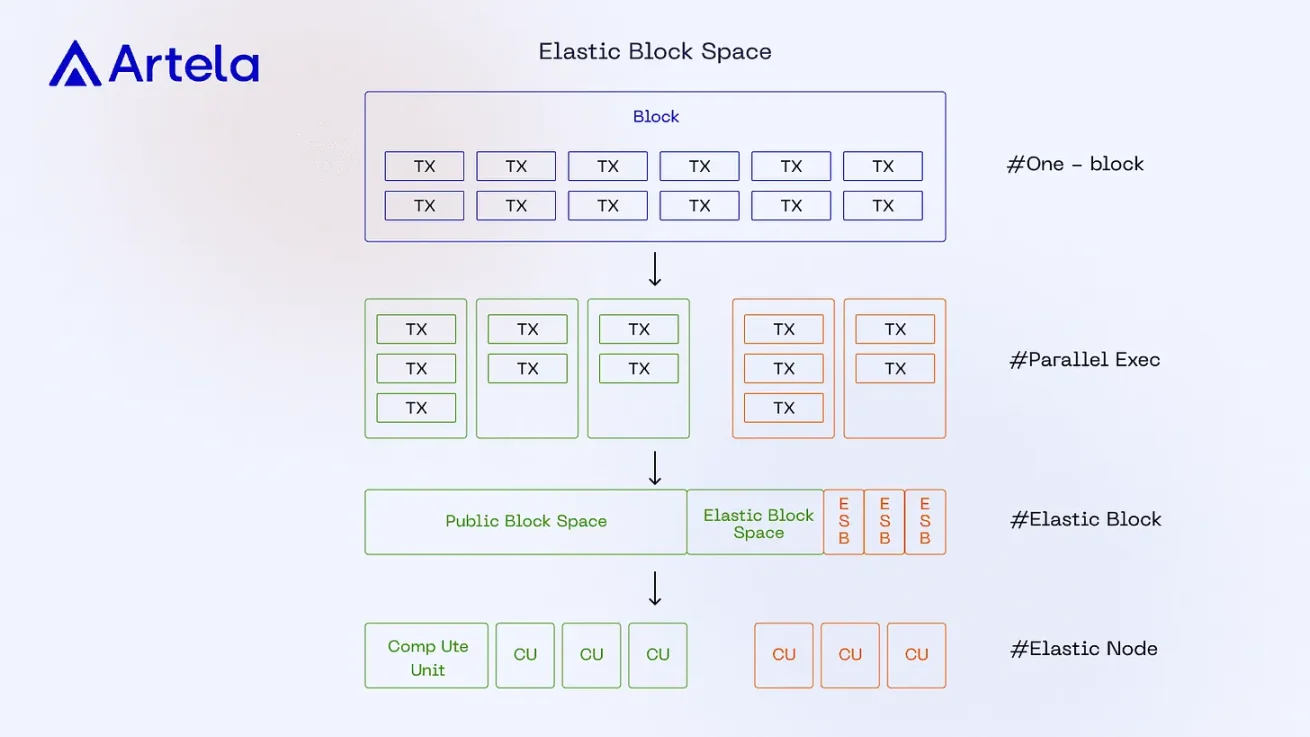
In summary, Artela achieves high scalability and predictable network performance through its parallel execution stack and elastic blockspace. This architecture leverages AI models to accurately predict transaction dependencies, minimizing conflicts and redundant executions. Large applications can obtain dedicated processing power and resources on demand, ensuring stable performance even under high network load. This enables the Artela network to support more complex use cases, such as real-time big data processing and sophisticated financial transactions.
Join TechFlow official community to stay tuned
Telegram:https://t.me/TechFlowDaily
X (Twitter):https://x.com/TechFlowPost
X (Twitter) EN:https://x.com/BlockFlow_News
 @ChainFeedsxyz


