








Investing in L2 vs. Investing in ETH: Which Has a Brighter Future?
TechFlow Selected TechFlow Selected
Investing in L2 vs. Investing in ETH: Which Has a Brighter Future?
As more L2 projects launch, the FDV of L2 tokens may continue to face pressure and dilution.
 Navigating Web3 tides with focused insights
Author: James Ho
Compiled by: TechFlow
Investing in L2 vs ETH
Over the past few years, Layer 2 (L2) solutions on Ethereum have made significant progress. Currently, the total value locked (TVL) in Ethereum L2s exceeds $40 billion, up from just $10 billion a year ago. On @l2beat, you'll find over 50 L2 projects, but the top 5–10 account for over 90% of the TVL.
Following the implementation of EIP-4844, transaction fees have dropped dramatically—on platforms like Base and Arbitrum, fees are often below $0.01.
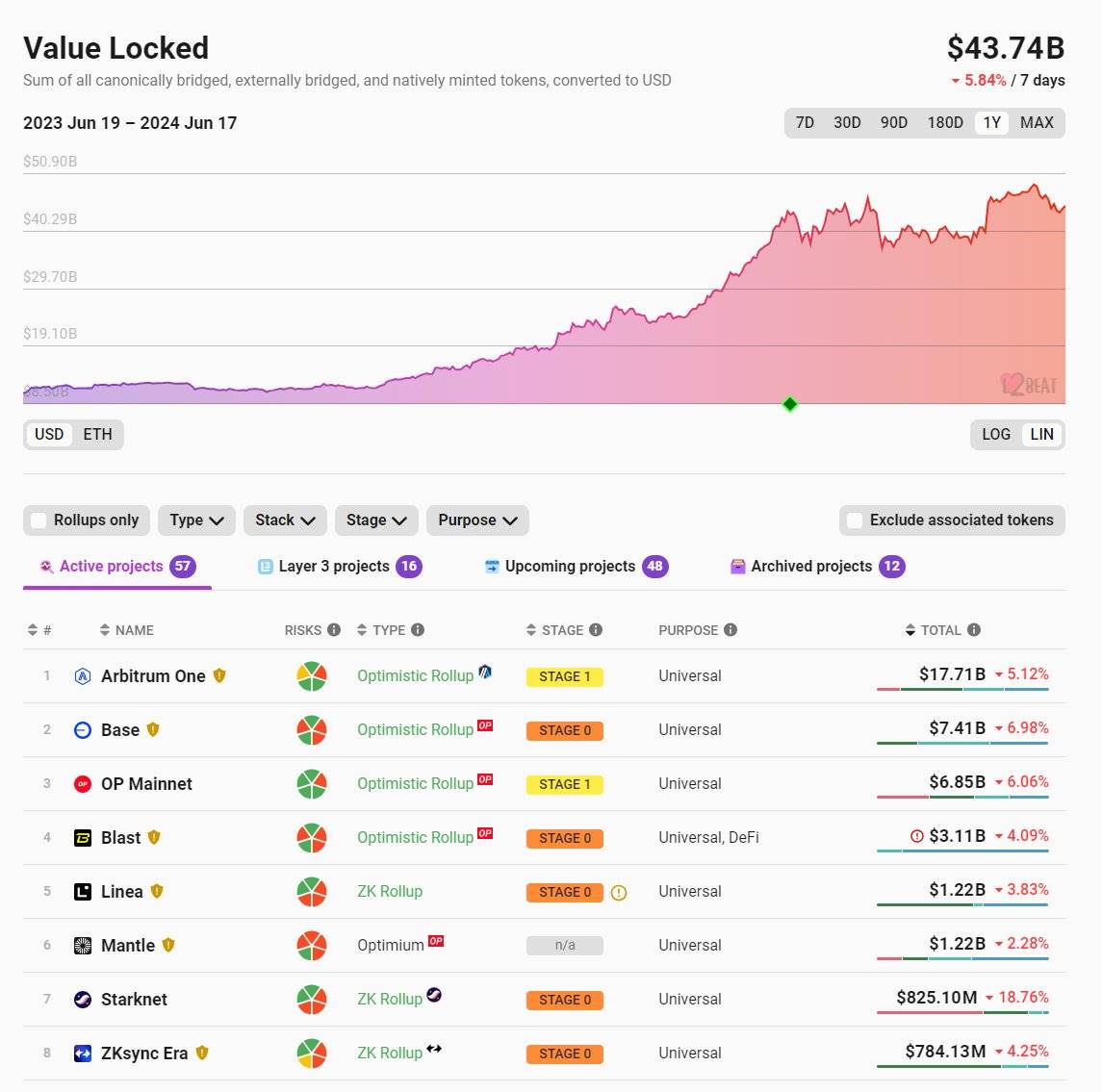
Despite major technological and usage advances, L2 tokens have generally performed poorly as liquidity investments (though they've done well as venture investments). You can easily find many jokes and memes about how L2 tokens underperform relative to ETH.
We reviewed the valuations of major L2s relative to ETH. A striking observation is: despite an increasing number of listed L2s, their combined fully diluted valuation (FDV) as a percentage of ETH’s market cap has remained nearly unchanged.
Two years ago, the only listed L2s were Optimism and Polygon, with a combined FDV of 8% of ETH’s market cap. Today, with Arbitrum, Starkware, zkSync, and others, that figure stands at 9%.
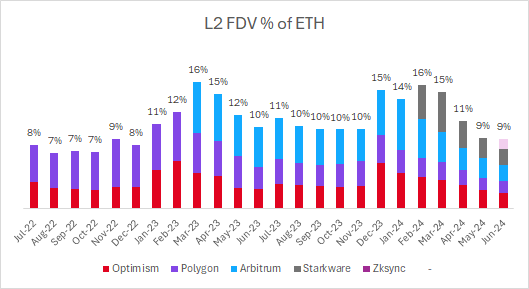
Each new L2 token launch effectively dilutes the valuation of previously launched L2 tokens.
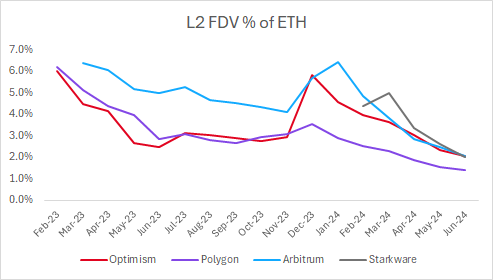
The result of investing in L2 tokens has been significant underperformance relative to ETH. The past 12-month returns are:
-
ETH: +105%
-
OP: +77%
-
MATIC: -3%
-
ARB: -12%
For a long time, major L2 tokens have had FDVs hovering around $1 billion. In a way, this seems arbitrary—market participants don’t have strong justification for why it should be $1 billion rather than $2 billion or $300 million. Ultimately, due to demand-side liquidity and/or large unlocks, there is significant supply pressure.
The aforementioned L2s generate $20–30 million in fees per month. Since EIP-4844, fees have declined to $3–4 million per month, annualizing to roughly $40–50 million in fees.
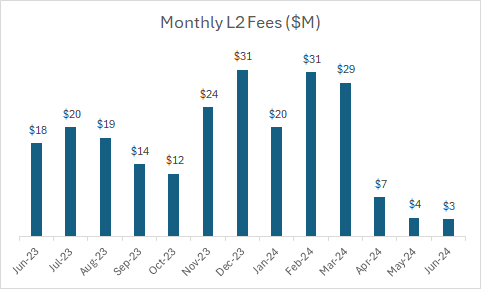
Includes: Optimism, Arbitrum, Polygon, Starkware, zkSync
Currently, major L2 tokens have a combined FDV of ~$40 billion and annualized fees of ~$40 million, resulting in a valuation multiple of approximately 1,000x.
This contrasts sharply with major DeFi protocols, which typically trade at multiples of 15–60x (based on last month's annualized fees):
-
DYDX: 60x
-
SNX: 50x
-
PENDLE: 50x
-
LDO: 40x
-
AAVE: 20x
-
MKR: 15x
-
GMX: 15x
As more L2 projects launch, the FDVs of L2 tokens may continue to face pressure and dilution. There is simply too much supply; liquid markets struggle to absorb it easily.
Conclusion
-
In the long run, L2s may generate substantial fee revenue. L2s collectively generate $150 million annually in fees (including Base, Blast, Scroll), and this number could grow significantly as L2 activity increases.
-
The above analysis is not targeted at any specific L2 project but represents a broad observation across the category. Buying a basket of L2 tokens at ~$40B FDV and ~$40M in fees (1,000x multiple) and expecting them to outperform ETH over the long term appears difficult.
-
Clearly, blockspace is not scarce between L2s and high-throughput chains (e.g., Solana, Sui, Aptos). The limiting factor is applications using this blockspace. I hope to see more focus shift toward the application layer, and expect liquid markets to reward the application layer over infrastructure in the coming years.
-
In the previous cycle, it was more common for projects to launch far earlier. MATIC launched in the open market at an FDV under $50 million and now exceeds $5 billion—a 100x increase. However, this is no longer the case for recent launches such as $OP, $ARB, $STRK, $ZK, and most other L2 tokens likely to launch in the future.
Join TechFlow official community to stay tuned
Telegram:https://t.me/TechFlowDaily
X (Twitter):https://x.com/TechFlowPost
X (Twitter) EN:https://x.com/BlockFlow_News
 @Modular_Capital


