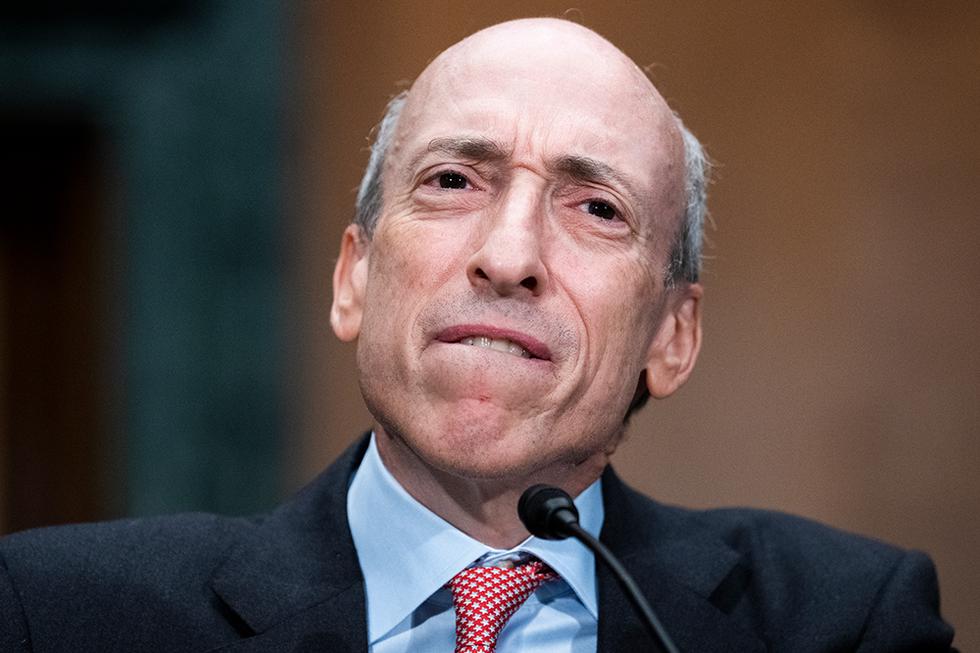
A Fresh Perspective on the Misunderstood SEC Chairman Gary Gensler
TechFlow Selected TechFlow Selected
A Fresh Perspective on the Misunderstood SEC Chairman Gary Gensler
Gensler may have affiliations, personal biases, external pressures, or even vested interests, but the process of crypto integrating into the mainstream is indeed accelerating.
 Navigating Web3 tides with focused insights
Author: Fu Ruheshi, Odaily Planet Daily
When it comes to the "public enemy" of the crypto world, many people immediately think of the U.S. Securities and Exchange Commission (SEC). Whenever a project or prominent figure is targeted by the SEC, market prices often drop. SEC Chair Gary Gensler has become particularly notorious.
Since taking office as SEC Chair in April 2021, Gensler has now served more than half of his term. Throughout this period, he has frequently taken strong stances against the crypto industry, making statements such as “the vast majority of tokens in the crypto market qualify as securities, so their issuance and sale are subject to securities regulations.” He has also led enforcement actions against major crypto firms including Binance, Coinbase, Kraken, and FTX.
All signs suggest that Gary Gensler may be biased against the crypto industry—but is reality truly what people perceive? Odaily Planet Daily takes a fresh look at SEC Chair Gary Gensler from an entirely new perspective.
From Goldman Sachs to MIT Professor: The Making of Crypto’s “Iron-Fisted Instructor”
Gary Gensler’s Career Path: A Hardline Approach Defines His Leadership Style
Gensler was born into a Jewish family and developed an early interest in finance. After graduation, he joined Wall Street giant Goldman Sachs, where he became one of the firm’s youngest partners at age 30. He spent 18 years building his career there.
In 1995, when Goldman Sachs CEO Robert Rubin was appointed U.S. Treasury Secretary, Gensler followed Rubin into public service as Assistant Secretary for Financial Markets at the U.S. Department of the Treasury, officially launching his government career.
A committed Democrat, Gensler advised Barack Obama during his 2008 presidential campaign and later served as Chairman of the Commodity Futures Trading Commission (CFTC) during Obama’s presidency. This was shortly after the global financial crisis, with the derivatives market in disarray. Gensler took a firm regulatory approach, introducing new rules to help rebuild order in the U.S. derivatives market. As a result, he earned recognition as “one of the key reformers after the financial crisis.”
After Obama’s term ended, Gensler served as chief financial officer for Hillary Clinton’s 2016 presidential campaign. Following Donald Trump’s victory, seeing limited prospects in politics, Gensler moved to the Massachusetts Institute of Technology (MIT), where he taught a course titled “Blockchain and Money.”
During his time at MIT, Gensler encouraged students to engage with the blockchain industry and praised Algorand as an example of blockchain’s transformative potential: “Maybe in five years, you could build Uber or Lyft on blockchain… Blockchain will have sufficient performance capabilities by then—like Silvio Micali’s Algorand. Silvio is a Turing Award winner at MIT; I’ve worked with him. He possesses great technology and performance. You could develop something like Uber on top of Algorand.”
In 2020, following Joe Biden’s election victory, Gensler was nominated by Biden to serve as SEC Chair—a role that marked the beginning of his complex relationship with the crypto industry.
From Gensler’s career history, it's clear that his current tough regulatory stance stems largely from his tenure as CFTC Chair. Perhaps in his view, today’s crypto industry resembles the post-crisis derivatives market. However, the author believes that Gensler’s enthusiasm for crypto during his time at MIT was genuine. These seemingly contradictory experiences likely contribute to public misunderstanding about him.
Reviewing Gensler’s Enforcement Actions Against the Crypto Industry
From 2021 to 2024, the SEC under Gensler launched numerous significant enforcement actions against the cryptocurrency industry. Below are some key cases:
Ripple Labs:
-
Case Summary: In December 2020, the SEC sued Ripple Labs, alleging unregistered securities offerings through the sale of XRP tokens. The case continued into 2021, with Ripple arguing that XRP is not a security.
-
Outcome: In a July 2023 court ruling, Ripple achieved partial victory—some activities were deemed non-securities, but violations were still found. Later, the SEC demanded Ripple pay nearly $2 billion in penalties; the final judgment remains pending.
Coinbase:
-
Case Summary: In September 2021, the SEC warned Coinbase that its planned lending product might constitute an unregistered securities offering and threatened legal action.
-
Outcome: Coinbase canceled the product launch and continued working with the SEC to ensure compliance across other services.
BitConnect:
-
Case Summary: The SEC filed suit against BitConnect and its founders, accusing them of running a Ponzi scheme worth over $2 billion.
-
Outcome: Multiple senior figures from BitConnect were charged; the case remains ongoing.
BlockFi:
-
Case Summary: The SEC alleged that BlockFi offered unregistered crypto lending products that constituted securities.
-
Outcome: BlockFi agreed to pay $100 million in settlements—$50 million to the SEC and $50 million to state regulators.
Kraken:
-
Case Summary: The SEC claimed Kraken’s staking program amounted to an unregistered securities offering.
-
Outcome: Kraken agreed to pay $30 million in penalties to settle the case.
FTX and SBF (Sam Bankman-Fried):
-
Case Summary: In November 2022, FTX collapsed due to liquidity issues, exposing severe flaws in financial management and risk controls. In 2023, SBF was charged with fraud and misappropriation of funds.
-
Outcome: SBF faces multiple legal proceedings, which remain ongoing.
Binance and CZ (Changpeng Zhao):
-
Case Summary: The SEC investigated Binance and its founder CZ, accusing them of investor fraud and operating an unregistered exchange.
-
Outcome: Binance agreed to forfeit $2.5 billion and pay $1.8 billion in criminal fines, totaling $4.3 billion. CZ was sentenced to four months in prison.
Genesis and Gemini:
-
Case Summary: The SEC sued crypto lending platform Genesis and exchange Gemini, alleging they attracted investors through unregistered crypto lending products, violating securities laws.
-
Outcome: The case is still ongoing.
Terraform Labs and Do Kwon:
-
Case Summary: The SEC filed suit against Terraform Labs and its founder Do Kwon, accusing them of defrauding investors and misleading the public through the issuance and sale of unregistered securities.
-
Outcome: The case is still being adjudicated, with serious legal consequences looming for Do Kwon and Terraform Labs.
From these examples, it’s evident that under Gensler’s leadership, the SEC shows near-zero tolerance toward staking and lending products launched by crypto exchanges. Next come accountability efforts following black swan events, followed by anti-fraud and anti-money laundering cases. These three categories of enforcement actions are generally more acceptable to the crypto industry and can even support its long-term development. However, the SEC’s application of the “security” label to certain tokens has drawn widespread criticism.
Currently, the SEC relies on the Howey Test—a standard established by the U.S. Supreme Court in the 1946 case *SEC v. W.J. Howey Co.* According to the Howey Test, a transaction qualifies as a securities offering if all of the following conditions are met:
-
An investment of money or other fungible assets;
-
The investment is in a common enterprise;
-
The investor expects profits derived from the efforts of a third party (typically a company or entity);
-
The expected return depends primarily on the efforts of that third party.
All four criteria must typically be satisfied. However, tokens are complex—their use in different contexts may sometimes meet these conditions and sometimes not. This ambiguity leads to endless debates—“each side thinks they’re right”—putting Gensler at the center of ridicule within the crypto community.
Despite Public Criticism, Gensler Has Advanced Crypto’s Integration into Mainstream Finance
Public opinion about Gensler in the crypto space is largely negative, with frequent claims that he is destroying the industry. Most articles adopt this critical angle when discussing Gensler and the SEC.
Is this perspective accurate? In the author’s view, such opinions are biased. Looking back at the 15-year history of the crypto industry, no previous SEC chair has contributed more to its advancement than Gensler has in just three years.
Consider the major positive developments in the crypto industry since Gensler took office in April 2021:
-
October 2021: The first Bitcoin futures ETF launched.
-
January 2024: The first Bitcoin spot ETF launched.
-
May 2024: Approval of 19b-4 filings for Ethereum spot ETFs. (Multiple institutions indicate Ethereum spot ETF products will go live this month.)
These three milestones carry extraordinary significance for the crypto industry.
Drawing from personal experience, the author recalls that in the past, when asked about his job and mentioning crypto, digital currencies, or Bitcoin, people would warn him, “That industry is problematic—find a real job soon.” The author could only smile politely. Given the general sentiment and industry conditions at the time, it was hard to argue otherwise. But this year, when similar questions arise, people bring up the U.S. launch of Bitcoin spot ETFs and Hong Kong’s proactive stance on Web3, asking the author about industry trends and engaging openly about related projects without hesitation.
This shift illustrates how SEC approval of crypto ETFs has effectively endorsed the industry’s entry into the mainstream, giving it formal recognition on the global stage. For this achievement alone, Gensler deserves a notable place in crypto history.
Some may argue that even if someone else had been SEC Chair, crypto ETFs would have been approved eventually given broader market trends. But isn’t that hindsight bias? How did this trend emerge in the first place? And has the SEC’s role in approving crypto ETFs been underestimated? These are difficult to quantify. Yet the fact remains: institutional capital entering the crypto space does so with security as a top priority. Compared to abstract arguments about inevitability, the author believes such mainstream investors place greater trust in national-level regulatory endorsement.
It’s also true that many believe Gensler-led SEC actions have negatively impacted the industry—triggering market downturns and hindering project development. But examining the SEC’s enforcement record, much of it targets black swan events like FTX and BitConnect—incidents that would inevitably cause market volatility regardless. Other actions mainly revolve around whether certain tokens qualify as securities. From another perspective, this reflects mainstream finance attempting to establish a regulatory framework for the crypto industry. While the final shape of this framework remains uncertain, such efforts represent necessary steps that Gensler and the SEC are actively exploring.
Short-term market fluctuations caused by regulation will fade over time—they are merely small ripples in the broader trend. But the approval of crypto ETFs by the SEC in recent years will shine brightly in the annals of history.
In summary, Gensler may have allegiances, personal motives, external pressures, or interests. But the author prefers to believe that he is advancing the integration of the crypto world into the mainstream—as he sees fit.
Join TechFlow official community to stay tuned
Telegram:https://t.me/TechFlowDaily
X (Twitter):https://x.com/TechFlowPost
X (Twitter) EN:https://x.com/BlockFlow_News
 Odaily