From Newbie to Alpha Hunter: The Grassroots Upstart Who Slept Through the Storm
TechFlow Selected TechFlow Selected
From Newbie to Alpha Hunter: The Grassroots Upstart Who Slept Through the Storm
You must elevate your level of understanding, because ultimately, your assets will always revert to your cognitive curve.
 Navigating Web3 tides with focused insights
Author: Jack, BlockBeats
In the crypto space, being a KOL is becoming increasingly difficult. After the Chinese crypto community's migration to Twitter, the market and retail investors now demand that KOLs possess deep understanding, professional expertise, and the ability to spot alpha opportunities early. Under these increasingly stringent standards, crypto KOLs are undergoing a new round of natural selection—older-generation influencers are gradually fading from center stage, while making room for a new wave of capable, rising KOLs.
The skilled KOL we recently interviewed is Rain Sleeper (@0xSleepinRain). From a "crypto newbie" to a Weibo influencer, and later building his own paid community, his journey epitomizes the inspirational rise of an ordinary retail investor. Among a field of strong players, Rain Sleeper stands out like a top student in class—constantly organizing and sharing his study notes. In his words, his secret to success is "the early bird catches the worm."
From Media Professional to KOL
Rain Sleeper (hereafter referred to as Morty) majored in mechanical engineering, studying material forging, blueprint design, and other technical fields. As he puts it, "After graduation, I was most likely headed to a factory to tighten screws." Yet despite being an engineer by training, he has had a long-standing connection with writing and content creation—from treasure-hunting on content platforms during college, to his first job upon entering crypto, to his daily work today. Indeed, in today’s crypto industry, content leverage may well be the most effective form of leverage.
Entering Crypto
During university, Morty discovered opportunities on content platforms such as Baijiahao, Toutiao, and Huoshan Video, and began operating multiple自媒体 accounts with classmates, earning his first pot of gold. In hindsight, Douyin might have been a better choice at the time, but since he wasn't good at video production, Morty passed on the opportunity—a decision that ultimately solidified his preference for written content.
In 2018, after graduating, platform booms began to fade. Recognizing the limitations of those industries, Morty moved to Hangzhou in search of new opportunities. After submitting just three or four resumes, he joined the crypto media outlet Bibi News, marking the beginning of his journey in crypto. Once, he had the chance to interview Gavin Wood shortly after he started working on Polkadot and, impressed by him, bought some DOT. Later, at an industry event in Shanghai, Morty received an invitation from Cointelegraph China’s team—he immediately sold his entire position and relocated to Shanghai.
Before this, journalism was purely a job for Morty—he didn’t participate in trading. But by the end of 2021, watching the DOT he had sold surge from $5 to $60, Morty realized he could try trading himself: "I live by one principle: create memories. You can’t just go to work every day—you need to do something meaningful."
BlockBeats: Which project impacted you the most back then?
Rain Sleeper: The biggest influence was Burger Swap—it was the first DEX on BSC, and it rose from $0.5 to $27. At the time, I didn’t have much money, so I skipped meals to buy BURGER around $0.5—about 2,000 USDT worth, which was a lot for me then, though not substantial by broader standards. I sold half at around $7, held through its rise to $27, and only sold the rest when it dropped back to $7. Honestly, I didn’t fully understand things back then. If I could go back, I’d definitely perform much better.
BlockBeats: Any other impactful projects?
Rain Sleeper: Avalanche and Solana were also significant—Solana being the most impactful. I bought SOL around $35–$45, sold 25% at $80, another 25% at $100, and another 25% at $120, finally selling everything at $140. I never expected it to reach $200.
I had taken a position on Binance, but right after buying came the “May 19” crash, and SOL dropped to $26—I added more then. I remember clearly that in the second half of that year, SOL was among the first to rally, climbing to $70–$80 before the broader market went crazy. I also paid attention to Avalanche because their foundation launched the Avalanche Rush with generous incentives, which I believed would attract market attention. However, I completely missed Luna.
BlockBeats: The previous cycle was dominated by “Weibo pump-and-dump gurus.” Most newcomers who entered around 2021 or 2022 struggled to learn real investment logic from these “guru teachers.” How did you build your own understanding?
Rain Sleeper: I’ve had many mentors along the way—former colleagues at Cointelegraph China, friends I met toward the end of 2022, and KOLs I connected with on Weibo and Twitter. They taught me a lot, especially about information flow.
For example, project teams get information at Layer A; VCs receive it at Layer B. When a project plans something, VCs know first, retail investors last. This information lag often determines price movements—so by the time retail jumps in, they’re often just catching the bag. They also taught me that trading crypto can actually make money, which sparked my interest in reading and thinking deeply about the space.
Building a Community
In late 2021, Morty was still working at Cointelegraph China and hadn’t planned to become a KOL. But due to his habit of writing and organizing information, he felt it was wasteful to keep insights to himself—so he began sharing them on social media. A year later, he became a well-known crypto KOL on Weibo with over 10,000 followers.
In September 2022, a TA analyst approached Morty proposing a paid group collaboration. Morty felt unprepared, so he spent time preparing—organizing Notion databases and other materials. Though the partnership never materialized, the process gave Morty the idea to launch his own community.
By the end of 2023, Morty left Weibo entirely and partnered with Huang Mantou (“Steamed Bun”) to launch a paid community. They had worked together at TechFlow, with one focusing on sourcing information and the other on analysis. In the new venture, Huang continues hunting for alpha, while Morty analyzes market trends and narratives. Since late last year, their group has grown from 200 to 300, and now nearly 500 members. Running the community, Morty says, has made him more confident.
BlockBeats: What’s the target size for your community?
Rain Sleeper: In terms of member count, I’ll probably cap it at 500. If I were just here to cash grab, the group wouldn’t even have reached this size. I take the community seriously—I share important insights I come across and post my personal trades regularly.
BlockBeats: Does this generate positive feedback for you?
Rain Sleeper: Yes, and I’ve met many interesting people through the community who provide valuable feedback. Even though members pay to join, many bring fresh perspectives and ideas—I find that really cool. It strengthens my motivation and confidence to keep improving.
BlockBeats: Does running the community consume a lot of energy?
Rain Sleeper: I’m used to it—I integrate community management into my personal growth. Running the community is itself a learning process, which I find really cool. For instance, when I share readings and thoughts, members engage and exchange ideas. That feedback loop becomes another stream of information—including their sentiment, which I can sense. Observing the market, understanding it, and staying connected to it is essential. Trading in isolation is hard. This helps me stay tightly linked to market dynamics.
BlockBeats: Besides your community members, do you frequently interact with other industry professionals?
Rain Sleeper: Yes, with a few consistent contacts—some pure traders, some yield farmers, and some smart money. I enjoy these conversations because they help me see things from different angles. Going solo is tough—you fall into information silos. Even Twitter’s recommendation algorithm creates echo chambers. That’s why I use email subscriptions and curated Twitter Lists to broaden my information flow.
Knowledge Building and Investment Logic
Morty strongly believes in the wisdom of “early bird catches the worm.” Whether at Bibi News, Cointelegraph China, or later at TechFlow, he consistently sought to learn from others: "You must elevate your understanding—ultimately, your wealth will reflect your level of awareness." His experiences at Cointelegraph and TechFlow were particularly formative. The two key lessons he took away: understanding information flow, and building your own information pipeline.
BlockBeats: How do you build an effective information-gathering framework?
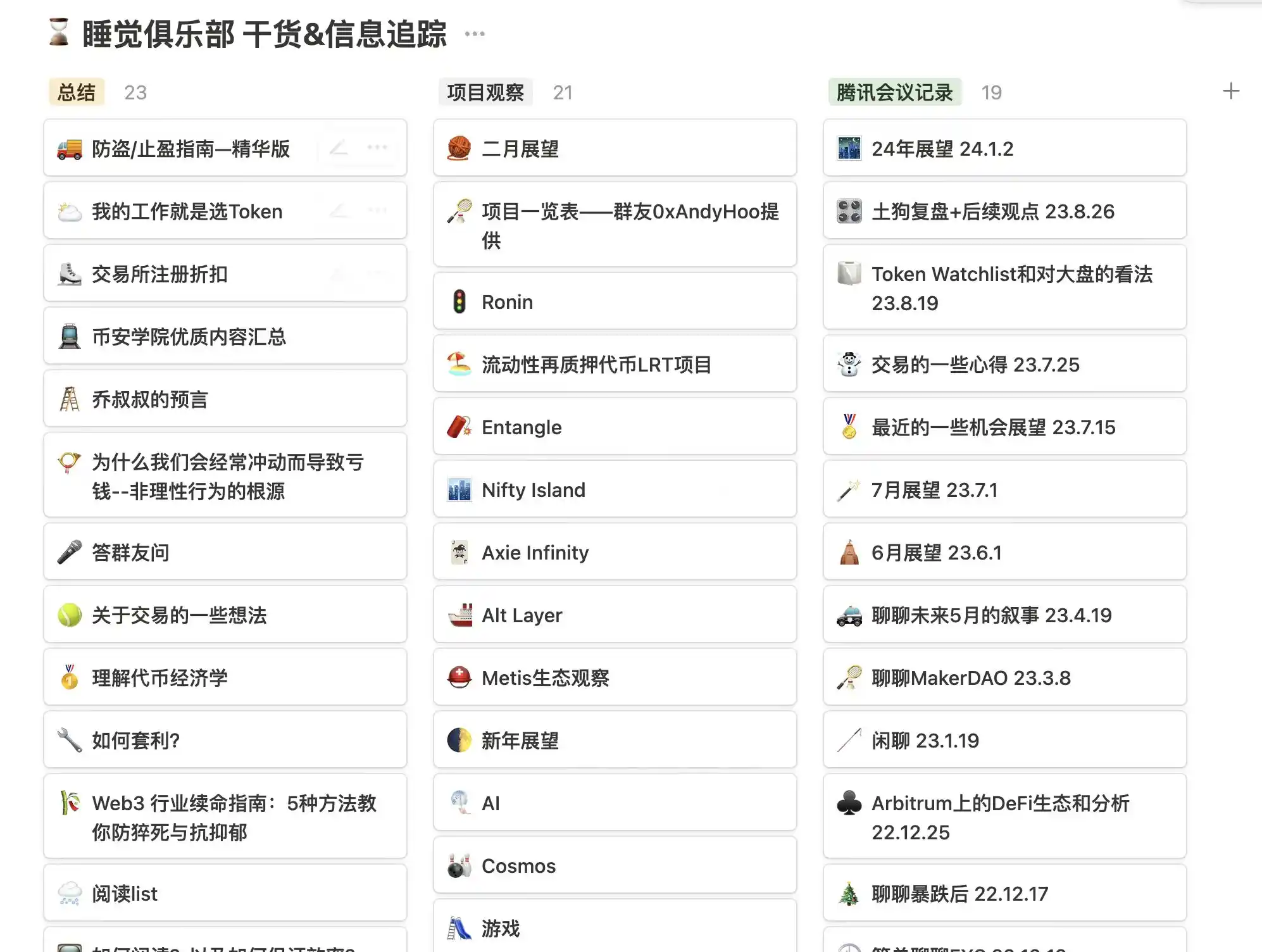
Rain Sleeper: I habitually subscribe to content I find valuable. I follow many Substack newsletters via email and maintain curated Lists on X. I read others’ perspectives, add my own analysis, and form judgments accordingly.
I also organize everything I regularly read into structured Lists—project databases, records of community calls, and collections of insightful articles. This method may not suit everyone, but it helps me generate thoughts and opinions. Although I share these publicly, few actually go through them. In reality, it’s mostly a personal reading log.
I also monitor market sentiment. For example, if several KOLs I follow say they’re stepping back from the market, or if community discussions dry up, I interpret that as potentially nearing a bottom. That said, I don’t focus much on pure trading metrics—I admit this is a weakness. I rarely analyze charts or technical indicators.
BlockBeats: Do you think technical analysis is important in today’s market environment?
Rain Sleeper: The core issue is chart validity—in this industry, charts are often drawn for you by others. Charts matter, but not that much. If someone claims you can consistently outperform Bitcoin using only TA, that’s unrealistic. In this highly PVP market, the real test is your ability to pick winning assets.
Since my partner focuses on TA, I identify promising assets and let him assess entry points based on charts. If the timing doesn’t look right, I either pass or wait. It’s a complementary approach. Recently, I haven’t made time to study TA—but that’s really just an excuse for my laziness.
BlockBeats: So reading is a crucial part of how you build knowledge?
Rain Sleeper: Yes, I’d say two things: reading and writing. Writing, for me, is about externalizing my thoughts. You don’t have to publish on social media, but keeping personal notes—say, in Notion—and reviewing them periodically is powerful. My initial understanding of the industry came from building a knowledge base: starting with Bitcoin, then moving to public chains, DeFi, NFTs, Gaming, etc., forming a mental framework and branching out from there.
I also carry a small notebook where I jot down personal insights or sharp quotes I encounter. This mindset matters. Everyone wants to make big money, but managing $100K versus $1M requires completely different approaches. Ultimately, you must make investment decisions based on your capital size and risk tolerance—figuring out how to survive longer than others in the market. These notes and reflections help guide that process.
BlockBeats: At the start of the year, you began rating “star-tier narratives,” updating them monthly. What’s your logic and criteria for assigning star ratings?
Rain Sleeper: Primarily market recognition—the narrative’s ability to capture market attention over time. If a narrative has previously drawn significant attention, like AI, I assign it a higher rating.
Bitcoin, for example, remains a five-star narrative. Inscriptions might be short-term hype; Runes are better—they enable more utility on Bitcoin. Even if Runes cooled off temporarily, someone will push it again. The market naturally stays attentive to Bitcoin’s ecosystem—once a narrative emerges, participation follows.
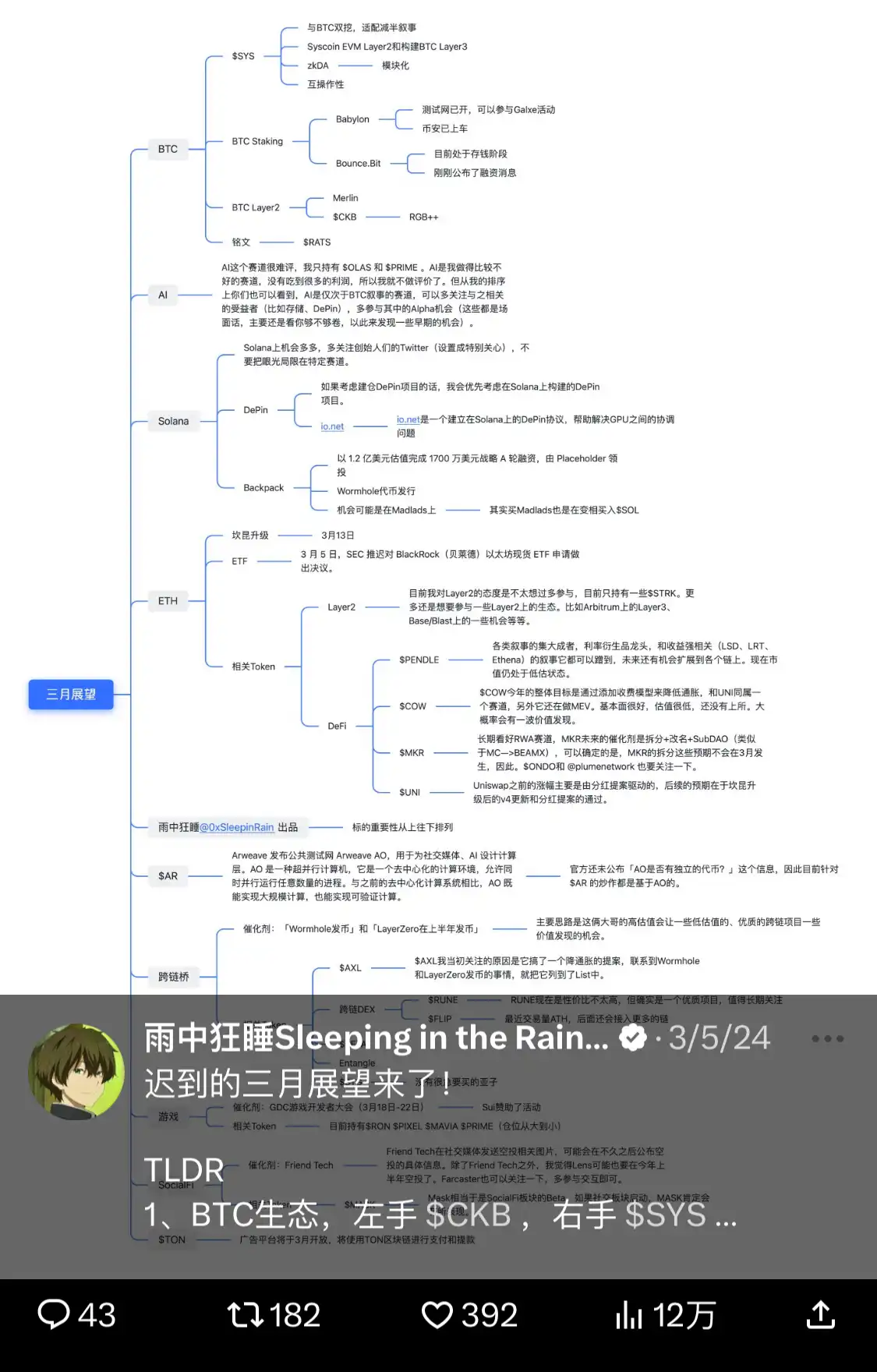
One narrative I misjudged at the start of the year was Solana—I rated it four stars, but given its strong performance across the board, it clearly deserves five.
BlockBeats: I noticed you later ranked it above Ethereum.
Rain Sleeper: Upon reflection, Ethereum is a massive asset, heavily promoted in Western markets. It may be complex, but its position is unshakable compared to Solana. I don’t know if Ethereum can be replicated, but it would take time. From that perspective, I haven’t participated much in Bitcoin L2s—why wouldn’t I play on Ethereum or Solana instead? Of course, I believe there are wealth opportunities wherever attention flows—it’s sustainable over the long term. Take Ethereum: BlackRock’s RWA is built on Ethereum. If BlackRock is doing it, I’ll follow with assets like ONDO.
BlockBeats: Whenever you share spot trading ideas in the group, you set stop-loss levels. Where did the concept of a “spot stop-loss” come from?
Rain Sleeper: Stop-losses are mainly set for the community. Everyone has different risk tolerance. On certain positions, I can afford higher risk, but others may not. One issue I have is being “too far left”—when I strongly believe in a coin, I overestimate its trajectory, causing me to hold through painful drawdowns. For example, I believed COW under the intent narrative had potential, so I held without urgency. Similarly, WEN on Solana—this recent pullback hurt precisely because I was too diamond-handed.
BlockBeats: What defines your “left-side strategy”?
Rain Sleeper: Anticipating narrative catalysts. For example, I thought intent-related narratives might rise around Cancun, so I bought UNI and COW. They eventually rose, though perhaps not for the reasons I expected—luck played a role. Sometimes luck isn’t on my side. I often wait a long time for my thesis to play out. If a token rises significantly before the catalyst hits, and I believe the catalyst hasn’t arrived yet, I usually won’t sell. In this PVP market, narrative rotations are fast—diamond hands often get punished.
BlockBeats: Many people couldn’t exit in time during April’s correction—few expected the bearish phase to last this long.
Rain Sleeper: The market had already signaled it—Bitcoin’s six consecutive monthly green candles indicated a correction was due. I had the chance to exit but failed to act clearly—that was my mistake.
BlockBeats: What exactly weren’t you clear about?
Rain Sleeper: Unclear about the necessity and magnitude of the pullback—and emotionally attached to altcoins.
Outlook on the Market
BlockBeats: What speculative expectations remain in this cycle?
Rain Sleeper: Beyond expectations of liquidity returning post-rate cuts, there’s also the macro factor of elections. In this context, stakeholders will prioritize stability and compete for crypto voters. But if no new catalysts emerge afterward, the market may fall into dormancy. Liquidity is currently weak. I’m not overly optimistic. Still, once liquidity returns, a new wave of opportunities will arise. This is a long-term process.
BlockBeats: Each cycle is different, right?
Rain Sleeper: Yes. I don’t think predictions matter much—what matters is assessing the current market state. For example, on April 29, I sensed the market was bottoming because community sentiment was extremely pessimistic, almost bear-market level. But consider: it’s an election year—major shocks are unlikely. Things should stay relatively stable.
With so many bears at the time, I saw an opportunity to accumulate. I went long on Ethereum and bought many related ecosystem tokens. I set stop-losses—if my call was wrong, I’d cut losses.
BlockBeats: There’s a lot of discussion now about high FDV and low circulating supply. What’s your take?
Rain Sleeper: I think this will spawn new narratives. The market will seek tokens with full circulation, zero unlocks, and already priced-in valuations. I read Cobie’s article—his main point is that buying pressure often occurs at the primary level, not secondary, which could lead to poor post-listing performance for new tokens.
There’s already been online discussion about “not bagholding each other.” I think the key takeaway is this: it’s a market issue, and the market will gradually recognize and correct it. I believe the market will mature into a smarter state over time. At its core, the problem is insufficient liquidity.
BlockBeats: Will the crypto market see the same kind of “massive rallies” in future bull runs as in past cycles?
Rain Sleeper: I believe so—crypto offers us a gambling opportunity. While we shouldn’t constantly frame crypto as a casino, as GCR pointed out, many people join crypto precisely because it feels like one. It’s more convenient than going to Macau, and the odds of making money might even be better. So crypto and altcoins won’t die—as long as there’s demand, they’ll persist, and people will continue building narratives around alts.
BlockBeats: What area will you focus on in the coming period?
Rain Sleeper: My main positions are on Ethereum—for example, Pendle is a long-term holding. I mentioned this in my May outlook, though at the time I placed ETH further down the list. I also put AI lower, partly because there are many near-term catalysts, and partly because the market is counterintuitive—when everyone likes AI, it tends to underperform. The market needs to shake off the overly optimistic crowd first.
I also hold some Solana, though I rarely initiate buys. My main goal with Solana is written right in the group name: accumulating SOL-denominated wealth. By actively participating in the Solana ecosystem, everything serves the growth of my SOL holdings.
BlockBeats: Final question: how long until altcoins return to their previous price levels?
Rain Sleeper: I remain optimistic about the medium to long term—especially Ethereum, which has a real shot at reaching new highs. Once expectations are exhausted, I’ll choose to step back and rest.
Join TechFlow official community to stay tuned
Telegram:https://t.me/TechFlowDaily
X (Twitter):https://x.com/TechFlowPost
X (Twitter) EN:https://x.com/BlockFlow_News
 BlockBeats