








Exclusive Interview with CARV Founder: Building a Flywheel Effect Requires Infrastructure and Applications to Advance Together
TechFlow Selected TechFlow Selected
Exclusive Interview with CARV Founder: Building a Flywheel Effect Requires Infrastructure and Applications to Advance Together
Over the past few decades of internet development history, there has been a pattern: infrastructure develops for a period, then enters a silent phase, after which it enables more applications. When applications rapidly grow, they in turn demand further advancements in infrastructure.
 Navigating Web3 tides with focused insights
Author: 1912212.eth, Foresight News
Data has become the new "oil resource" in the AI wave, playing an extremely critical role in the tech giants' AI arms race. However, privacy rights, usage rights, and revenue rights related to data have long been neglected by users. Over the past decades of internet development, users have been producers of data but not true beneficiaries. In fact, large technology companies have repeatedly been exposed for practices like big-data price discrimination.
In the decentralized Web3 movement, data sovereignty and revenue rights are gradually becoming attainable. Users can now earn rewards through tokens—a core mission that CARV is actively pursuing. CARV is a modular data layer specifically built for AI and Web3 gaming. In both AI and gaming sectors—areas characterized by massive and diverse data volumes—ordinary users’ data flows across application, ID, storage, computation/training, execution, and finally validation layers, ultimately generating high-value data essential to these industries.
In the previous market cycle, pioneers like Gala brought significant returns to early participants. Recently, Aethir’s node sales also showed strong performance. Given this context, Foresight News sat down with Victor, founder of CARV, to gain deeper insights into the team, product, nodes, and future roadmap.
1. The Birth of CARV: Coincidence or Inevitability?
CARV's founder Victor studied at Harvard Business School and has entrepreneurial and investment experience in the Web2 space. After diving into Web3 and exploring multiple directions, he eventually settled on building a modular data layer for gaming and AI.
CARV is a homophone of the English word “carve,” meaning “to sculpt.” Gamers continuously train and refine their data—essentially carving it—symbolizing CARV’s own craftsmanship in product development. At another level, it represents how achievements—like those of players—are carved and permanently recorded on-chain.
Foresight News: Many people may just be hearing about CARV for the first time. Could you introduce yourself and your background in crypto? Also, tell us about your team.
I started my entrepreneurial journey back in 2015 and within two years grew the company to a point where it was acquired by a Fortune 500 firm. My focus has always been in tech—I’ve worked at McKinsey, then moved into venture capital, analyzing various fields including AI, consumer tech, hard tech, and also conducted research in crypto, where I met our current CTO. Later, during my time at Harvard Business School, I connected with the rest of our founding team.
Our CTO completed graduate studies in the U.S. and immediately began working in crypto. In 2017, he developed a blockchain-based video livestreaming product and did development work on the Cosmos chain. He later sold his company to BitTorrent and joined Coinbase, leading efforts around private keys and Layer 2 solutions. Our Head of Growth and Operations previously worked at Tencent and other firms, serving as a game producer focused on publishing and operations.
Foresight News: CARV focuses on a modular data layer for gaming and AI. Was this direction clear from the beginning, or did you arrive here after multiple iterations?
We had a general direction initially, but only after extensive exploration did we settle on this specific path.
We observed many issues in Web2—for instance, personal data is always controlled by centralized entities, leaving individuals powerless over their own data sovereignty. Additionally, while vast profits are generated from data usage, individual users—the actual data providers—receive none of these benefits. This creates a fundamental problem.
This leads to further complications. Regulations such as Europe’s GDPR and California’s CCPA were designed to protect user privacy, but they make it harder for data consumers—like game companies trying to run targeted ads—to access accurate user data. So we identified a dual problem: individuals lack data sovereignty and privacy protection, and cannot share in the value created from their data. On the other side, brands, companies, and data users struggle to obtain precise, high-quality user data legally and efficiently.
We saw a major opportunity to bridge this gap—enabling data to create more value. On one hand, protecting user privacy and allowing them to capture value from their data use (i.e., enabling self-sovereign data control and monetization); on the other, helping data users obtain high-quality personal data via compliant channels to generate value.
We found that gaming and AI are two areas where data value is most evident. Gaming, in particular, generates massive amounts of data. For game studios, acquiring user data is crucial—for targeted advertising, market analysis, etc.—and requires a solid foundation of user data. That’s why we first targeted the gaming sector. Based on this, we launched our flagship product, CARV Play, which has been operational for two years and serves approximately 2.5 million registered users. Another area emerged in late last year and into this year: increasing demand for personal data in AI training. Thus, we’ve locked onto these two verticals—gaming and AI—with plans to explore more in the future.
2. Modular Data Layer for Gaming + AI: Not Just Hype, But Real Substance
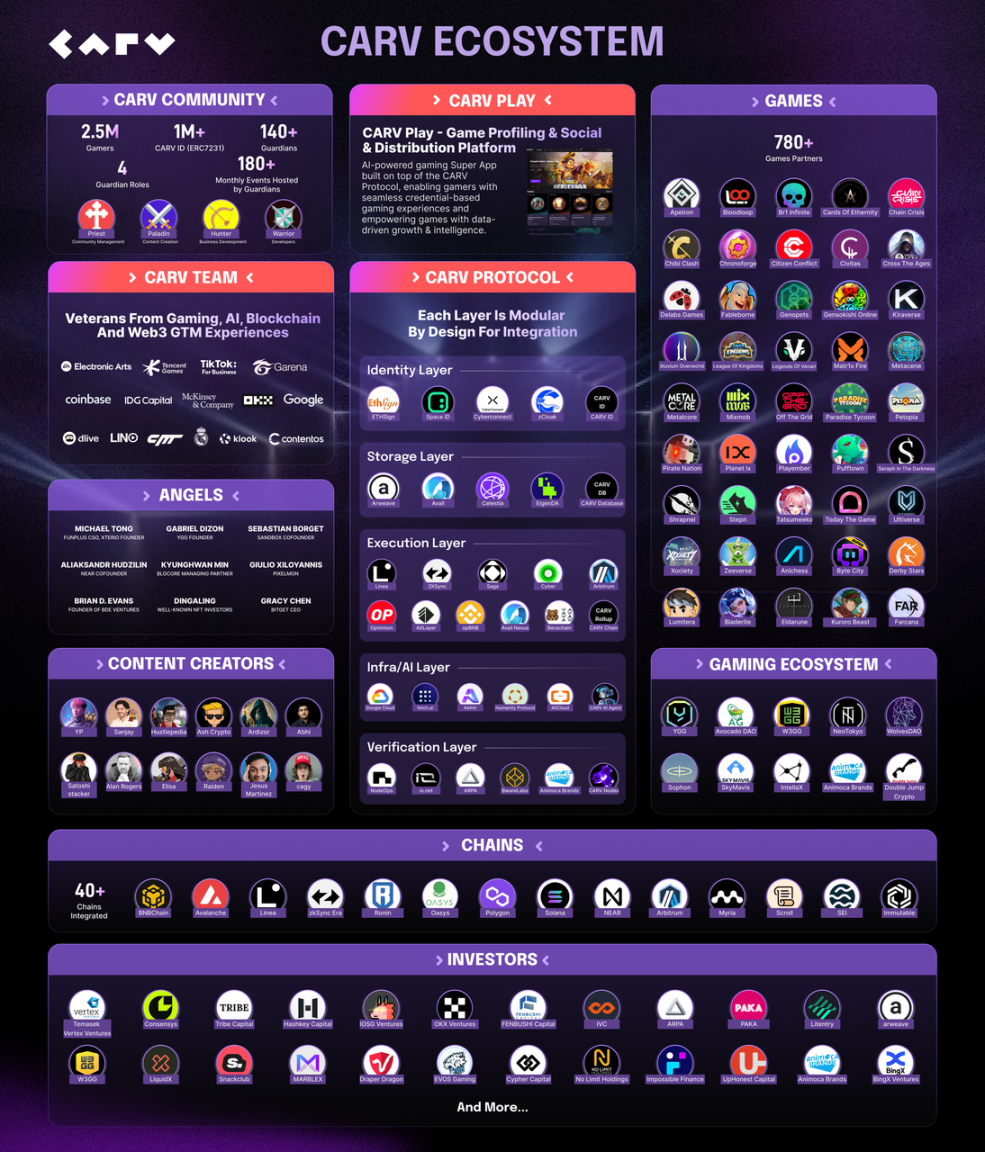
Wherever there’s hype, there are projects chasing it. CARV, however, targeted gaming and AI—two hot sectors—from day one based on genuine insight, focusing on building real products. Currently, CARV Play—an interoperable authentication system and the largest Web3 gaming distribution and social platform—has been live and operating for two years, validated by real-world usage and revenue generation. Other products, such as CARV AI Agent (CARA Bot) on the TON ecosystem, are under active development.
Foresight News: What’s your view on the development of gaming and AI in crypto?
Web3 gaming evolves in stages. Many games face skepticism because they lack strong gameplay fundamentals. A game must first be fun; only then can it layer on additional earning mechanisms. However, due to Web3’s inherent financialization, some projects put profit before playability, resulting in uneven quality.
That said, especially since the start of this bull market, we’re seeing upcoming games with quality levels that would stand out even in traditional Web2.
As for gaming and AI, I expect that within the next cycle—anywhere from several months to a few years—we’ll see truly compelling applications capable of bringing Web3 into mainstream Web2 adoption.
Looking at internet history over the past decades, infrastructure develops first, enters a quiet phase, then enables new applications. As apps grow rapidly, they drive renewed demand for better infrastructure. From the start, CARV adopted a dual-track strategy—building both application layer and foundational infrastructure in parallel—ensuring independence and accelerating the flywheel effect.
Foresight News: What’s the current status of CARV’s product development?
Currently, we’re focused on building a modular data infrastructure and exploring deeper integration with AI, including:
Modular Data Layer: We’ve established a full suite of protocols giving users complete data sovereignty. Through these protocols, users can authorize, store, verify, and confirm their identity, player profiles, and game data—and earn revenue from them. Right now, we’re selling CARV verification nodes, using both user-owned and proxy nodes to enrich and atomize our validation layer.
AI Integration: We’ve launched CARV AI Agent—CARA Bot—on the TON ecosystem. Powered by GPT large models, it acts as CARV’s encyclopedia and intelligent assistant, answering user questions. Next, we’ll leverage personalized user data for smart recommendations, D2E tasks, and ad targeting. We’re also seeking strategic partnerships with leading AI companies to unlock greater value via AI × Data synergies.
CARV Protocol is a modular cross-chain data layer comprising components for authentication, storage, processing, and monetization. Aligned with ERC-7231—a standard recently approved by the Ethereum community—CARV ID aggregates over 1 million users’ Web2 and Web3 identities, advancing data self-sovereignty. CARV Link oracle services handle on-chain data attestation, with data stored in CARV’s decentralized hybrid Ethereum storage system. Data is processed before being published across multiple blockchains, simplifying cross-chain management and ensuring secure, efficient monetization in Web3.
Meanwhile, CARV Play is the leading cross-platform authentication system and Web3 gaming distribution and social platform. In the past quarter alone, it averaged over 500,000 daily active wallets and ranked among the top three most active ecosystems on chains like Linea, opBNB, zkSync, and Ronin. It delivers enhanced gaming experiences—enabling data sharing, credential building, gameplay, and reward earning—for 2.5 million players. Around 30% of existing Web3 games are already listed on the platform, from MARBLEX and Shrapnel to Off the Grid, Pixelmon, and Pixels.
Foresight News: Who do you consider your most direct competitors? And what sets you apart?
In the Web2 space, as a foundational data infrastructure provider, we see companies like AppLovin (market cap $27B) and LiveRamp (market cap $2.3B) as comparable. However, CARV differs fundamentally by returning data ownership and monetization rights directly to users. Any revenue generated from user data is shared with the original data creators.
Additionally, we’ve created a unified user ID standard (ERC-7231) that bridges Web2 and Web3, enabling seamless data portability—unlike today’s fragmented, siloed solutions. This creates a powerful flywheel effect for both users and enterprise clients in industries like gaming and AI.
For our gaming application CARV Play, companies like Taptap (market cap $850M)—a community-driven mobile game discovery and distribution platform—are relevant comparables. Our key distinction lies in delivering true cross-platform achievement and identity portability—even across console, mobile, and PC games. Achievements are proven on-chain, unlocking credential-based matchmaking and incentivized community voting.
Within Web3, some projects touch on isolated aspects—like gaming platforms (Portal, Forge, GALA, Treasure) or decentralized data (Grass, Masa Network, Ocean Protocol). But CARV uniquely integrates comprehensive gaming application layers, AI agents within the TON ecosystem, and our underlying protocol infrastructure. We already have 2.5 million registered users and over 790 integrated game and AI partners.
Critically, our industry-specific approach enables us to cultivate highly refined, high-quality datasets tailored for post-IDFA game studios and AI models requiring premium first-party and zero-party data. This demand is validated by over $1 million in monthly revenue and more than 350 real business customers.
3. No Fake Points Games—Community and Node Allocation Take Priority
An increasing number of projects use points systems to lure whales, then retail users. The market is growing tired of endless points farming. Beyond points, are there other ways for a project to share value with users and accelerate decentralization? Beyond airdrops, CARV’s approach is selling nodes. For gamers, owning a node not only enhances gameplay but also boosts game discovery and profitability.
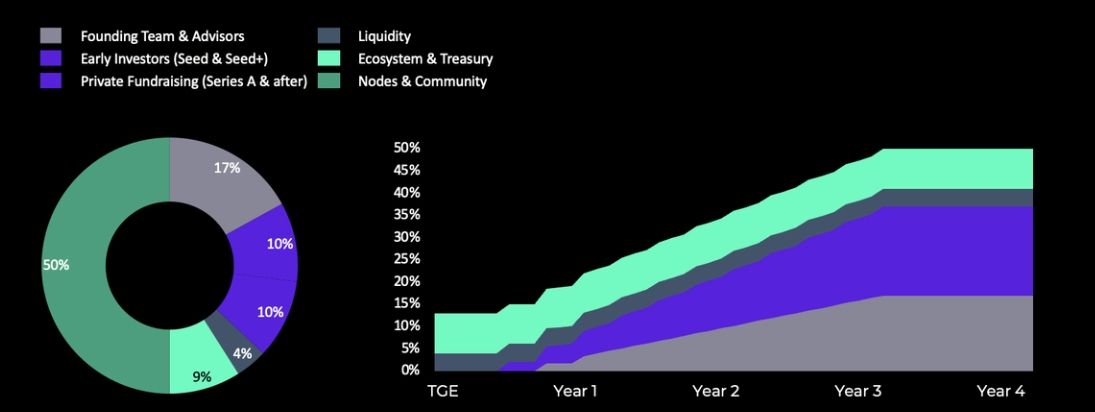
In CARV’s tokenomics, 50% of the total supply is equally split between the community and node operators—a rare model in a crypto landscape often dominated by VC allocations.
Foresight News: Many projects face controversy over airdrops—especially points farming. How does CARV view this issue? How was the community allocation determined?
This is a complex question. From a no-token perspective, points can help solve cold-start problems. But once a token exists, community expectations around rewards rise significantly. Before launching a token, projects often resort to so-called “innovations” like points systems.
In the CARV ecosystem, both the community and node operators are indispensable. We deeply value early contributors. Within CARV’s token economics, 25% is allocated to the community and 25% to node operators. This node sale will not affect the rights or airdrop eligibility of early community contributors.
Foresight News: Let’s talk about nodes. Most readers are used to buying tokens—what exactly is a CARV node? What does it do? Why sell nodes?
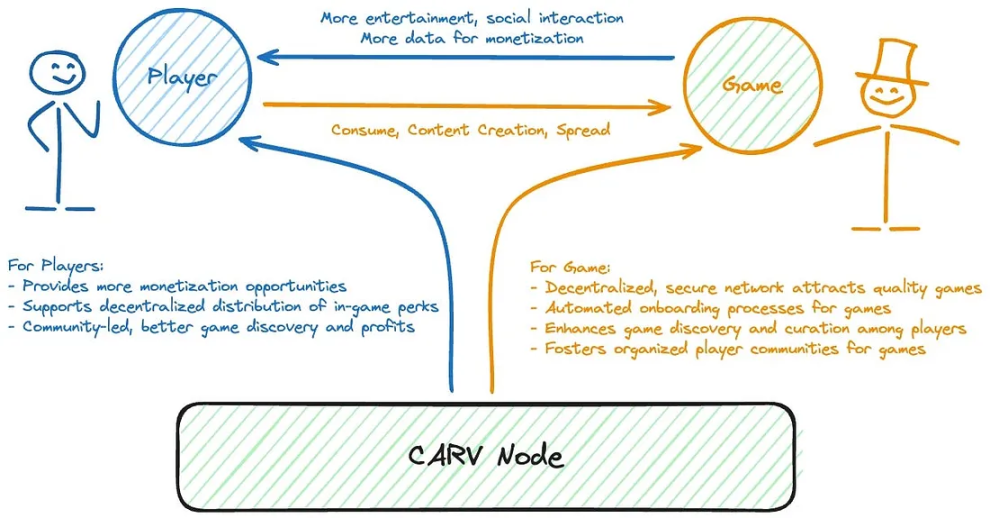
Validator nodes are lightweight, community-run nodes that play a vital role in maintaining protocol integrity, enhancing trust and security. Currently, these nodes primarily verify TEE proofs on-chain to ensure result reliability and user data privacy.
CARV nodes have always been part of our roadmap because we believe their integration is crucial to amplifying dynamics between players and games. Using verifiable mechanisms and consensus, CARV nodes enable secure data processing, pushing the protocol toward a permissionless, decentralized, and more secure ecosystem. This means more high-quality games can join, onboarding becomes easier, and player communities benefit from improved game discovery and engagement.
For players, a more decentralized and secure network opens up greater opportunities for monetization and participation. A community-led approach not only enhances gaming experiences but also drives game discovery and profitability. Looking ahead, this decentralized network will expand to offer additional services such as storage, oracles, and gaming L2 solutions. These initiatives aim not just to generate profit but to reinvest in the ecosystem, ultimately benefiting players.
Benefits of running a CARV node include three main aspects:
-
Reward Opportunities: Eligibility for a significant share of network rewards, with 25% of CARV tokens allocated to node validators
-
Decentralization: Contributing to a truly decentralized data economy that respects user autonomy and privacy
-
Influence: Having a voice in the CARV community, helping shape network development and governance
4. How Can Ordinary Users Seize Node Opportunities?
In the last bull cycle, early Gala node holders earned substantial returns. Will history repeat itself in this cycle? That’s the big question on many investors’ minds. Beyond speculation, what are CARV’s core advantages? The answers lie in technology, incentives, and ecosystem strength.
Foresight News: Projects like Gala, XAI, and Aethir have done similar node sales. What makes CARV different? What are your advantages?
There are several key differences: Technologically, CARV has achieved end-to-end data flow—covering authentication, storage, validation, and processing. Our modular design greatly facilitates collaboration with other projects.
Our node sale combines the strengths of DPoS (Delegated Proof-of-Stake) and PoA (Proof-of-Authority), enabling sufficient decentralization. This decentralized node network integrates seamlessly with CARV’s modular data layer. Currently, the node network primarily supports CARV’s data processing layer, ensuring compliance and privacy. Going forward, it will support the data storage layer, strengthening CARV’s on-chain DA (data availability) solution. Eventually, the node network will serve the identity layer, powering CARV’s decentralized oracle for gaming and AI.
On incentives, CARV uses a 6-month 25%-reduction emission model—more favorable than most. The first 6 months release 28%, and 50% within the first year. CARV also features a unique reserve buyback contract: if users don’t claim rewards during the period, they can apply for a 100% buyback after 6 months.
Essentially, if a user runs a node and is unsatisfied with its performance after six months, they can request a full buyback—effectively guaranteeing they won’t suffer major losses.
We’ll also offer testnet rewards at TGE to help some users break even, and multiple partner projects will airdrop to node operators. With nearly 400 partners already, we’ve announced several upcoming airdrops, with more to come.
Foresight News: For average retail users, what’s involved in participating in nodes? Any advice?
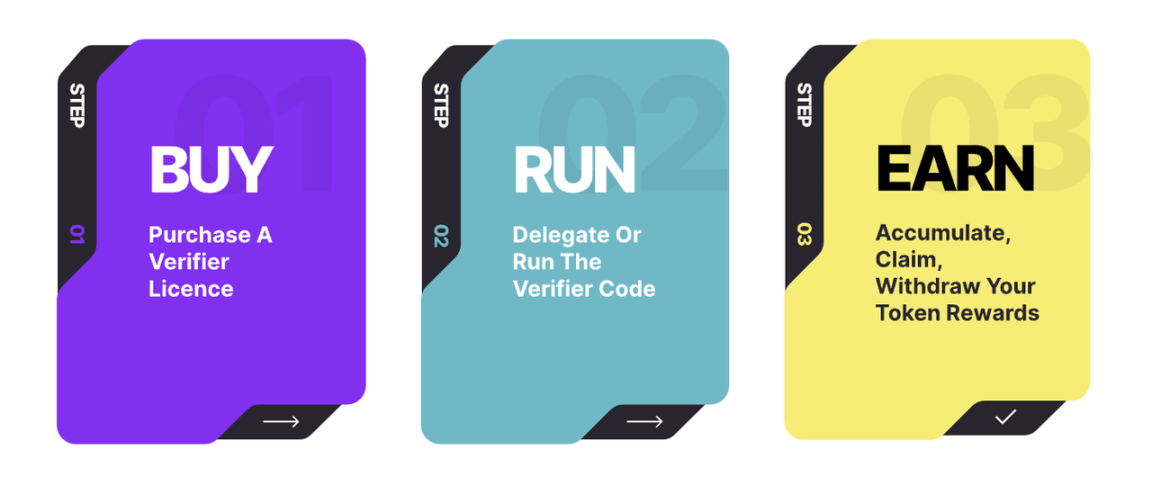
Technically, users can either run a node directly or delegate to a node operator. We’ve intentionally avoided complexity—it’s not like traditional nodes that produce blocks or validate every transaction.
Secondly, we aim to make participation as simple as possible—even without downloading software. Users can launch a node directly in-browser. The only requirement is keeping the browser open to help verify data on the corresponding chain.
We want this to be effortless. Users need only verify for 6 hours per day—just complete the required validation within that window to earn rewards.
For typical gamer users, they might simply leave their computer on overnight with the browser running—effortlessly meeting daily targets and creating mutual benefit.
We offer different node options tailored to various user needs. Our advice: choose the option best suited to you and start operating your node.
Foresight News: Can you share your current priorities and future roadmap?
Technically, our current focus is improving node support—making it easier for users to run nodes and enhancing the overall purchase and operation experience. Next, we’ll rapidly expand the application scope of the node network, including data layer validation, oracle implementation, and possibly even deploying our own dedicated network based on demand.
We’re currently discussing collaborations with major projects like Avail, which is interested in our data storage capabilities.
Next up is oracles—a current pain point. Both node operations and many games need specialized, gaming-optimized oracle mechanisms. Expanding the validation network’s use cases here is a priority.
Our broader vision includes building our own validation network, processing layer, and eventually our own data layer—including DA (data availability) and storage.
On the AI front, we’ve announced partnerships with Aethir and Google Cloud. Aethir provides a decentralized GPU network—critical for AI compute power. Google Cloud is a top-tier infrastructure provider offering CPUs, networking, resources, and CDN—all essential infrastructure. Currently, CARV functions as a middleware layer. By partnering with both Aethir and Google Cloud, we connect all底层 compute and GPU capabilities. Upstream, we integrate AI applications—including our own AI agent—and have already incorporated functionalities from fetch.ai.
We aggregate all AI infrastructure below and all AI applications above. As the middle layer, CARV provides the data. For AI, combining data with infrastructure—data plus GPUs—opens infinite possibilities.
Going forward, CARV may further integrate GPUs and data, backed by Google Cloud as a powerful infrastructure provider, along with our applications. Our next step is to build a full AI ecosystem centered on CARV as the middleware layer—this is our key focus.
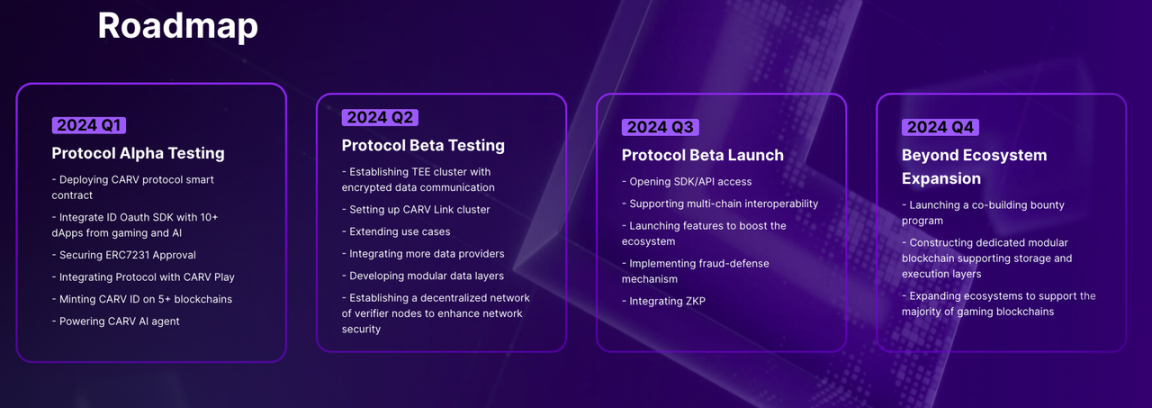
We’re consistently executing along our roadmap.
From the user and gaming perspective, first, we aim to deliver a more complete, seamless UI/UX. Once users have their ID, they gain lifetime passive income—simply living their normal lives, using mobile internet, playing their favorite games, and participating in the protocol to seamlessly accumulate richer data, creating greater value for other applications while capturing their fair share. Monetization remains a core experience we continue to improve.
Second, our team has deep DNA in gaming and data—or gaming and AI. We’re refining experiences for different types of players. Hardcore gamers, for example, will be able to express their gamer identity and experience in uniquely powerful ways on CARV’s application layer. We’ll continue enhancing the social and content dimensions.
This is an application-layer advancement. From a PMF (Product-Market Fit) and commercial standpoint, having already served over 700 game and AI companies—helping them with user acquisition, user understanding, and model training pain points—we’ll further refine our B2B offerings, evolve our monetization model toward something like Taptap’s, and push beyond current limits. We’ll also deepen SDK integrations to make the revenue model even smoother.
Join TechFlow official community to stay tuned
Telegram:https://t.me/TechFlowDaily
X (Twitter):https://x.com/TechFlowPost
X (Twitter) EN:https://x.com/BlockFlow_News
 Foresight News






