
Solana Vote to Reward Validators with 100% Priority Fees Highlights Ongoing Community Disputes Over Governance
TechFlow Selected TechFlow Selected
Solana Vote to Reward Validators with 100% Priority Fees Highlights Ongoing Community Disputes Over Governance
Where there is interest, there is conflict; where there is conflict, there is江湖.
 Navigating Web3 tides with focused insights
Author: Frank, PANews
Where there is interest, there is conflict; where there is conflict, there is江湖 (jianghu). Behind the seemingly calm approval of a proposal within Solana's validator community lies an intense struggle over interests.
On May 28, Solana’s validator community passed a vote approving Solana Improvement Document (SIMD)-0096. This proposal redirects all transaction priority fees to validators, changing the previous model that split fees 50% for burning and 50% for rewarding validators. The aim is to improve validator income and network security. Although the proposal passed with 77% support as expected, it sparked multiple rounds of fierce debate among validators over tokenomics, governance flaws, and allegations of insider manipulation. PANews provides an in-depth analysis of the key issues raised by the community and the potential implications following the proposal’s approval.
For Ecosystem Health or Validator Manipulation?
In fact, according to information on GitHub, this proposal was initially introduced as early as December 2023. At first, only a few core developers discussed it briefly via comments. In these initial discussions, Tao Zhu, who proposed the change, did not explain why altering the fee distribution ratio was necessary. The participating developers almost unanimously agreed, conducted relevant tests, and implemented the feature in a new version—allocating 100% of priority fees to validators.
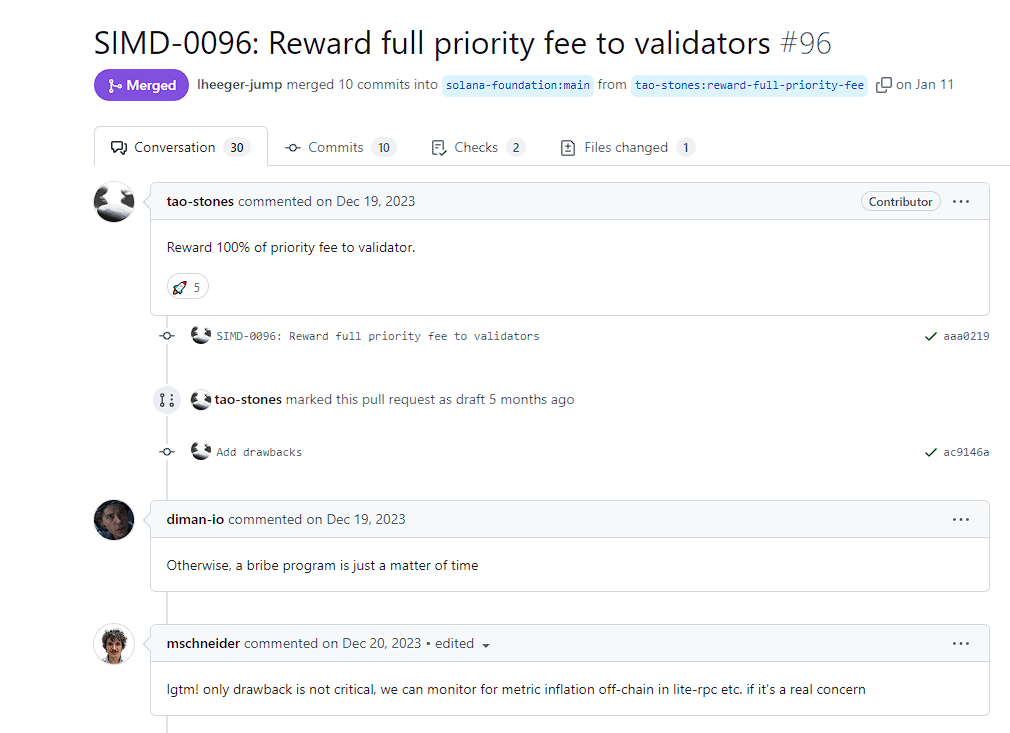
It wasn’t until March 12 that Max Sherwood, co-founder of H2O Nodes, commented on GitHub: “Does such a significant economic change not require community discussion? Validators’ economics will be greatly affected. It could be said that token holders will bear the cost, seeing increased supply issuance. This doesn’t seem like a purely technical change. Where did this come from? We need greater awareness of such changes and possibly some form of voting.”
Subsequently, some previously involved developers acknowledged that the document was a final draft open for community discussion. It wasn’t until May 9 that the proposal was formally introduced on the Solana validator forum and the voting process began.
Once formal discussion started on the forum, several validators questioned the motivation behind the proposal. A validator named Freedomfighter stated: “This proposal is full of lies and deception, designed to benefit only those allowed to vote. I don’t care about the backdoor methods it claims to use—the intent is obvious: greedy people will sacrifice others at any cost for their own gain. Not even data about the related transactions has been provided—transactions so critical that this proposal had to be created. After reading everyone’s thoughts and opinions, I conclude this is 100% false, a scare tactic aimed solely at getting more funds for validators.”
Exposing Governance Limitations: Increased Validator Rewards Could Lead to SOL Inflation
The most prominent criticism focuses on the impact on SOL’s token model. Solana uses a dynamic inflation model, starting at 8% and decreasing by 15% annually. Currently, the inflation rate is around 5%, eventually stabilizing at 1.5%. Some community members argue that burning 50% of priority fees was an effective mechanism to counteract inflation—and even helped push SOL toward deflation. Allocating 100% of fees to validators would break this balance, directly affecting millions of SOL holders.
Others believe the amount of priority fees is too small to significantly affect inflation. However, critics argue that regardless of scale, rigorous data analysis should precede voting—not bypassed by immediate approval without investigation. According to PANews research, Solana’s daily on-chain fees recently totaled approximately 6,000 SOL. If fully distributed to validators, this would add over 2 million SOL annually—about 0.5% of the current circulating supply.
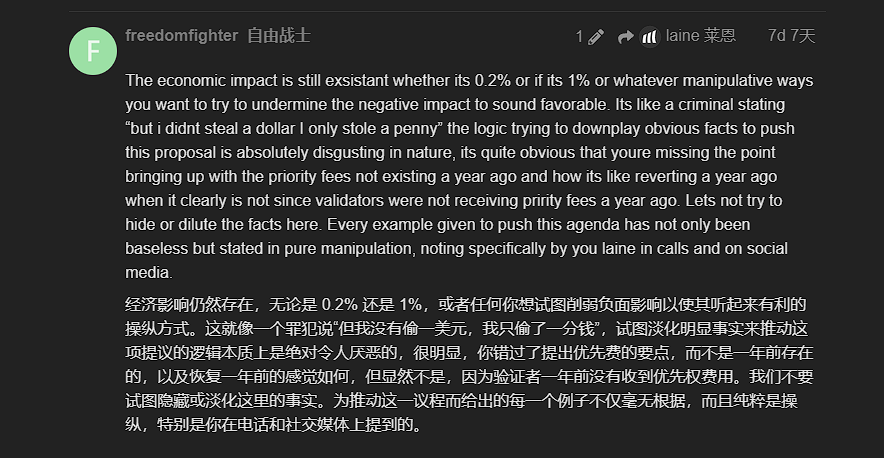
Validator Laine claimed the net inflationary impact was “0.2%,” but failed to cite his data sources. His statement drew rebuttal from member Freedomfighter: “The economic impact still exists, whether it’s 0.2% or 1%, or whatever manipulated way you try to downplay the negative effects to make it sound favorable. It’s like a criminal saying, ‘But I didn’t steal a dollar—I only stole a penny,’ trying to minimize clear facts. The logic used to push this proposal forward is absolutely disgusting.”
Beyond inflation concerns, the biggest issue highlighted is the governance limitations exposed by this voting process. In October 2023, the Solana community voted on governance rights, with 71% supporting “validators only.” During this proposal’s debate, members noted that validators were both the primary beneficiaries and held disproportionate voting power. Thus, this became a vote where “a small group decided the fate of millions”—unfair to other participants in the Solana ecosystem. Once set as precedent, future proposals may increasingly serve validator interests alone.
Risk of Artificial Volume Inflation
Under the previous 50% burn model, there was little incentive for validators and traders to collude on fake transactions to inflate fees. With 100% of priority fees now going to validators, however, such collusion becomes highly likely—leading to artificial transaction volume, which could distort fee markets and degrade network performance due to prioritization of fraudulent activity.
Additionally, critics warn this new distribution mechanism may exacerbate wealth concentration—large validators earning more fees can further widen the gap with smaller nodes, accelerating centralization risks across the network.
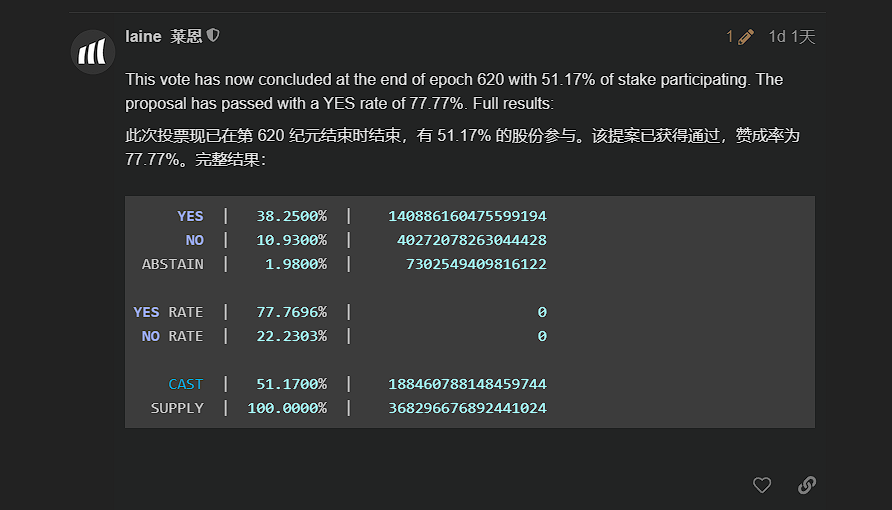
Ultimately, despite widespread controversy, the proposal passed smoothly. However, PANews notes that voter turnout reached just 51.17%, barely above majority. In reality, only 38.25% of total eligible votes supported the proposal, while 10.93% opposed it. Nearly 49% abstained. The actual long-term impact of allocating 100% of priority fees to validators remains uncertain. But judging from the contentious debate, Solana’s governance process clearly faces serious challenges.
By comparison, the Uniswap Foundation is currently conducting a similar vote on its fee switch mechanism—one that has undergone over three months of rigorous process including temperature checks (community discussion), preliminary signaling votes, code audits, and on-chain voting. Perhaps Solana’s governance community could learn from Uniswap’s example to better protect token holders from decisions controlled by a privileged few.
Join TechFlow official community to stay tuned
Telegram:https://t.me/TechFlowDaily
X (Twitter):https://x.com/TechFlowPost
X (Twitter) EN:https://x.com/BlockFlow_News
 PANews