








Understanding ENS V2: Extending Ethereum Mainnet Domain Services to L2
TechFlow Selected TechFlow Selected
Understanding ENS V2: Extending Ethereum Mainnet Domain Services to L2
ENS V2: Lower fees, more flexible domain service.
 Navigating Web3 tides with focused insights
Written by: TechFlow
With the right timing, even an old tree can bloom anew.
Yesterday, ENS (Ethereum Name Service)—a project long supported by Vitalik but relatively dormant—announced its V2 version on its official Twitter, expanding its domain services to Layer 2 (L2) networks.
Amid growing expectations around ETH ETF approvals, ENS's token has surged 60% over the past month. Launching a new product amid this momentum is a natural strategic move.
What benefits and implications will supporting ENS domains on L2 bring? We reviewed ENS’s new technical whitepaper to find out.
Why Support L2?
ENS has clearly noticed the decline in Ethereum mainnet activity and the rising popularity of L2s—this shift in user behavior is one of the primary motivations behind the upgrade.
Additionally, through years of technical development, ENS now supports CCIP-Read, which allows name resolution processes to query off-chain data. This means domain resolution is no longer limited to on-chain Ethereum data—it can pull information from other systems, including L2s and external databases.
Simply put, CCIP-Read expands possibilities for your domain—you’re free to decide where and how to resolve and manage it, not just on Ethereum’s mainnet.
Technically enabling domain support on L2, combined with shifting user trends, makes ENS’s direction clear.
More importantly, Ethereum’s mainnet (L1) has become a bottleneck for ENS expansion due to high transaction fees and limited throughput. Every registration, renewal, or update on ENS incurs significant gas costs, increasing user burden and limiting broader adoption.
With ENS V2, users can delegate domain resolution to L2 or other external systems—enjoying lower fees and faster speeds while choosing the setup that best fits their needs.
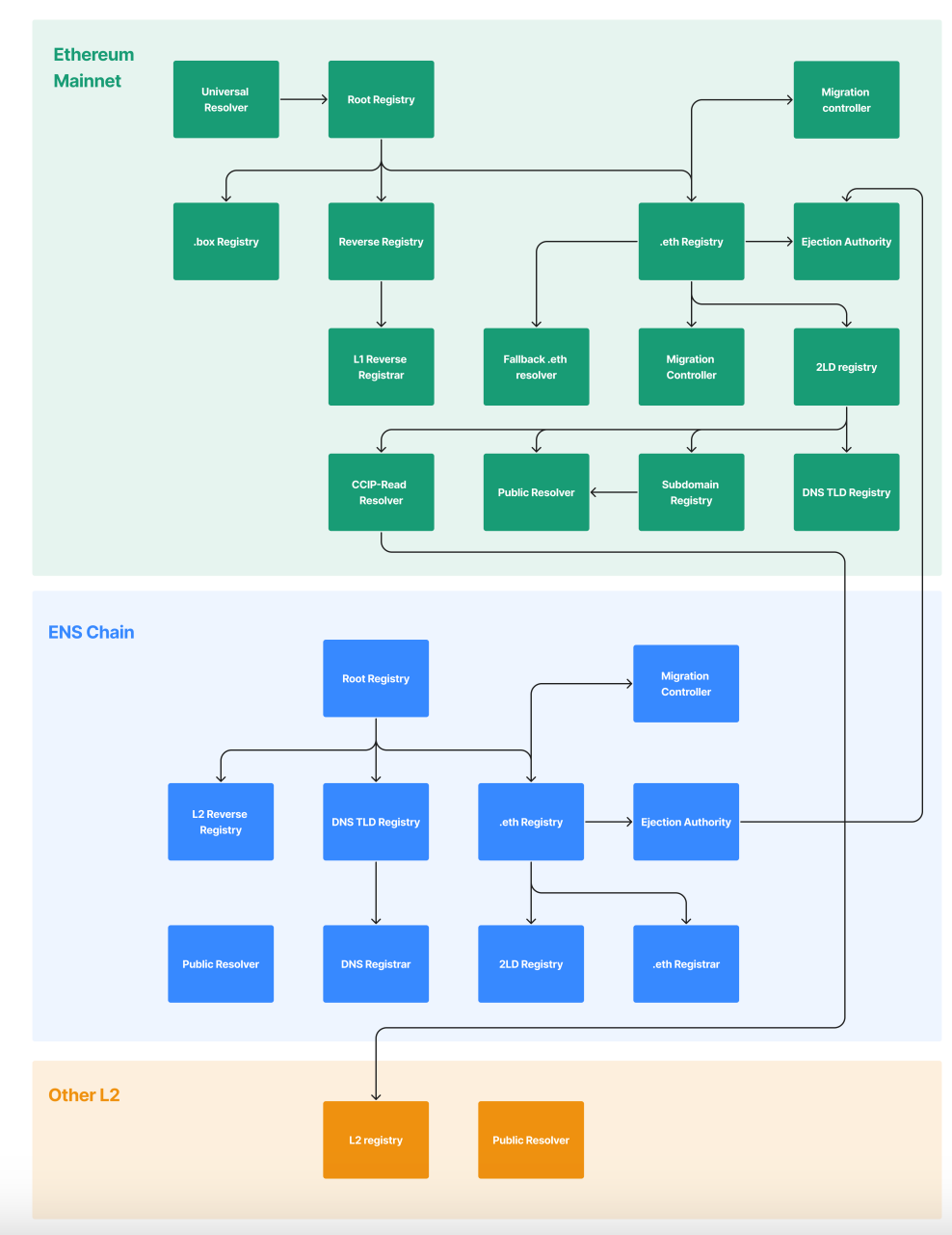
ENS V2: Lower-Cost, More Flexible Domain Services
To understand how ENS V2 works, let’s first review its core components.
ENS allows you to map complex Ethereum addresses (e.g., 0x1234...abcd) to simple, memorable names (e.g., alice.eth). This way, when sending cryptocurrency or interacting with decentralized applications (dApps), you only need to remember a name—not a long string of characters.
But what powers all of this?
Registry: A system that records all domain names, indicating each domain’s owner and the resolver responsible for translating it into an address or resource.
Resolver: When you enter a domain name, the resolver translates it into the corresponding Ethereum address or other resources (like an IPFS content hash).
Registrar: The entity managing domain allocation. It handles registration, renewals, and updates.
In ENS V1, all these components operate on the Ethereum mainnet, meaning every registration or update requires paying high gas fees. This increases user costs and limits scalability.
ENS V2 introduces improvements across these three key components to solve V1 limitations and enhance flexibility and scalability.
New Hierarchical Registry Architecture
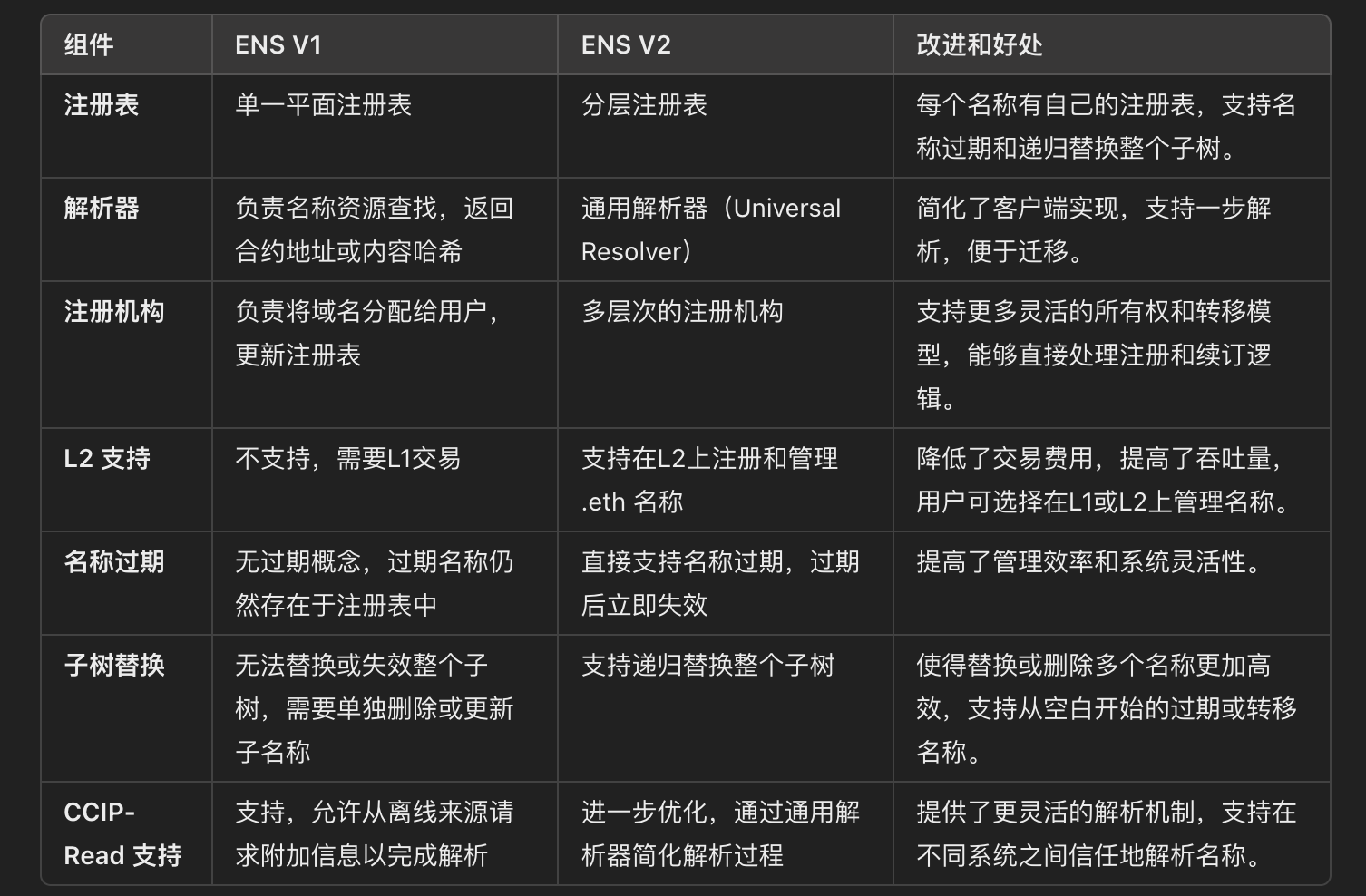
In ENS V2, the registry adopts a hierarchical structure. Each domain has its own registry managing subdomains and resolvers. Benefits include:
-
Name Expiry Support: Expired domains are immediately removed from the registry, simplifying management.
-
Efficient Subtree Management: Entire subtrees can be recursively replaced or deleted, streamlining management of multiple domains.
Universal Resolver
ENS V2 introduces a universal resolver that simplifies the resolution process. Users call a single resolve method, and the resolver handles internal logic automatically. This simplifies client implementation and enables a smooth migration path for existing users.
L2 Support
ENS V2 allows users to delegate domain resolution to L2 networks or other external systems. This enables users to benefit from lower fees and higher speeds on L2 while maintaining flexibility in configuration. This change significantly reduces transaction costs, improves system throughput, and enhances user experience.
TL;DR summary:
How to Migrate to V2?
Clearly, ENS V2 offers users a more efficient and cost-effective domain service. We may soon see a wave of domain squatting on L2 platforms.
However, to access these new features, existing ENS users must migrate their domains from V1 to V2.
According to the official technical documentation, the ENS team will first deploy all ENS V2 contracts on both L1 and L2. Initially, these contracts will have temporary permissions—for example, disabling registration and renewal functions—to ensure a smooth migration process.
After initial deployment, a synchronization step will occur: existing .eth second-level domains (2LDs) will be registered on L2, and ownership transferred to a migration contract.
Then, users can choose to migrate their domains to either ENS V2 on L1 or L2:
-
Migrating to L2: Users transfer their ENS V1 name to a system contract, which then creates or transfers the ENS V2 name on L2. During this process, the L1 resolver continues reflecting the status of unmigrated names, ensuring uninterrupted resolution.
-
Migrating to L1: Users can opt to keep their domains on L1 for stronger security and availability guarantees. The migration process is similar, with the system ensuring synchronized updates to resolvers and registry data on L1.
Through these steps, ENS V2 provides a seamless migration path, allowing users to easily transition to the new system and enjoy lower fees, faster speeds, and more flexible domain management.
However, the current migration roadmap is still in planning stages—exact timelines will depend on official announcements.
Finally, domain services aren’t typically seen as a hot sector. The recent price surge in ENS is largely driven by its correlation with ETH’s beta narrative. Yet with product upgrades and deeper integration across L2s, there’s now another reason to extend this outperformance cycle.
By moving to L2, ENS slashes domain registration costs and boosts speed—potentially triggering a new wave of domain grabbing. Lower fees may encourage more users and developers to secure desired domains early, expanding ENS’s user base.
Meanwhile, the launch of ENS V2 could act as a catalyst for $ENS token appreciation. Reduced transaction costs and improved efficiency will attract more users and developers, increasing demand for $ENS. Furthermore, as ENS expands across L2s, new use cases and integrations will unlock additional value-capture opportunities.
Join TechFlow official community to stay tuned
Telegram:https://t.me/TechFlowDaily
X (Twitter):https://x.com/TechFlowPost
X (Twitter) EN:https://x.com/BlockFlow_News
 深潮TechFlow


