Decrypting Korea's Crypto Market: Upbit Holds World's Second-Largest Trading Volume, with Youth Showing Greater Enthusiasm for Cryptocurrency Than Stocks
TechFlow Selected TechFlow Selected
Decrypting Korea's Crypto Market: Upbit Holds World's Second-Largest Trading Volume, with Youth Showing Greater Enthusiasm for Cryptocurrency Than Stocks
Revealing the development trends of South Korea's cryptocurrency community through data.
 Navigating Web3 tides with focused insights
Author: DeSpread

1. Introduction
1.1. The Importance of Community
A cryptocurrency project's community is more than just a collection of users and investors—it is one of the key factors determining a project’s success or failure. The importance of community cannot be overstated, as blockchain technology and projects built on it are fundamentally centered around decentralized governance.
Decentralized governance involves both teams and communities jointly deciding the future of a project, including decisions on tokenomics, roadmaps, and development priorities. If a team ignores its community and operates opaquely, it will breed suspicion, create uncertainty, and spread FUD (Fear, Uncertainty, Doubt), ultimately undermining the foundational value of the entire project.
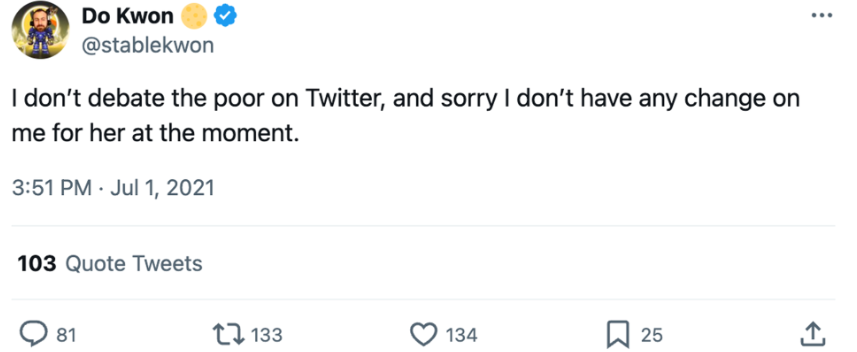
Do Kwon, founder of Luna, frequently ignored many questions raised by the Luna community regarding the LUNA-UST mechanism, even explicitly stating on Twitter that he does not debate with "beggars." Moreover, he consistently dismissed inquiries about how to prepare $300 million in Anchor Protocol interest payments, calling them "questions not worth answering," which further fueled community fears of Luna’s insolvency. In hindsight, the cost of ignoring community feedback proved extremely high.
Community participation and feedback play a vital role in project development and in meeting market demands and expectations. When project teams actively engage in community communication, they can significantly enhance transparency and credibility. Community members also serve as highly effective promoters who help spread awareness of a project’s value and commitments, making substantial contributions to user base growth. The recent trend of new projects offering community airdrops as rewards stems directly from recognizing the importance of community engagement to rapidly attract participants.
1.2. Focus on the Korean Market
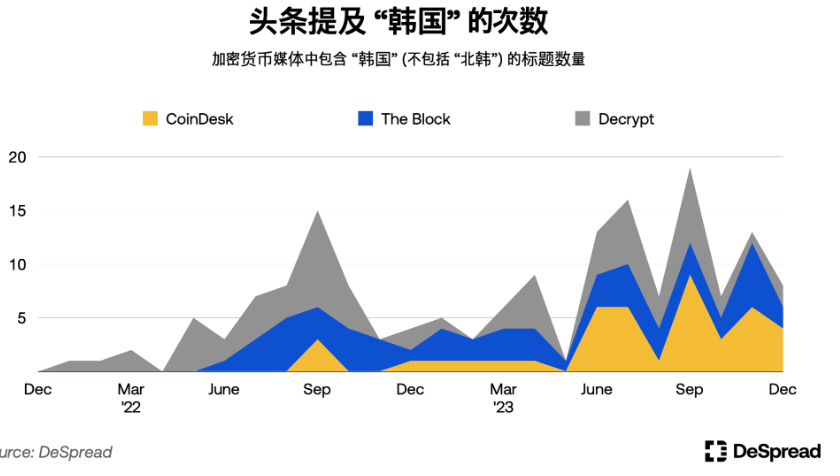
Over time, Korea’s position and visibility within the cryptocurrency industry have steadily increased. An analysis of mentions of “Korea” (excluding North Korea) in major international media headlines confirms growing global interest in Korea’s crypto market. The peak in late 2017 was primarily driven by articles about Luna and Do Kwon, but starting in late 2023, we see increasing coverage of government regulation and broader Korean market trends, indicating that Korea has become one of the focal points of global attention.
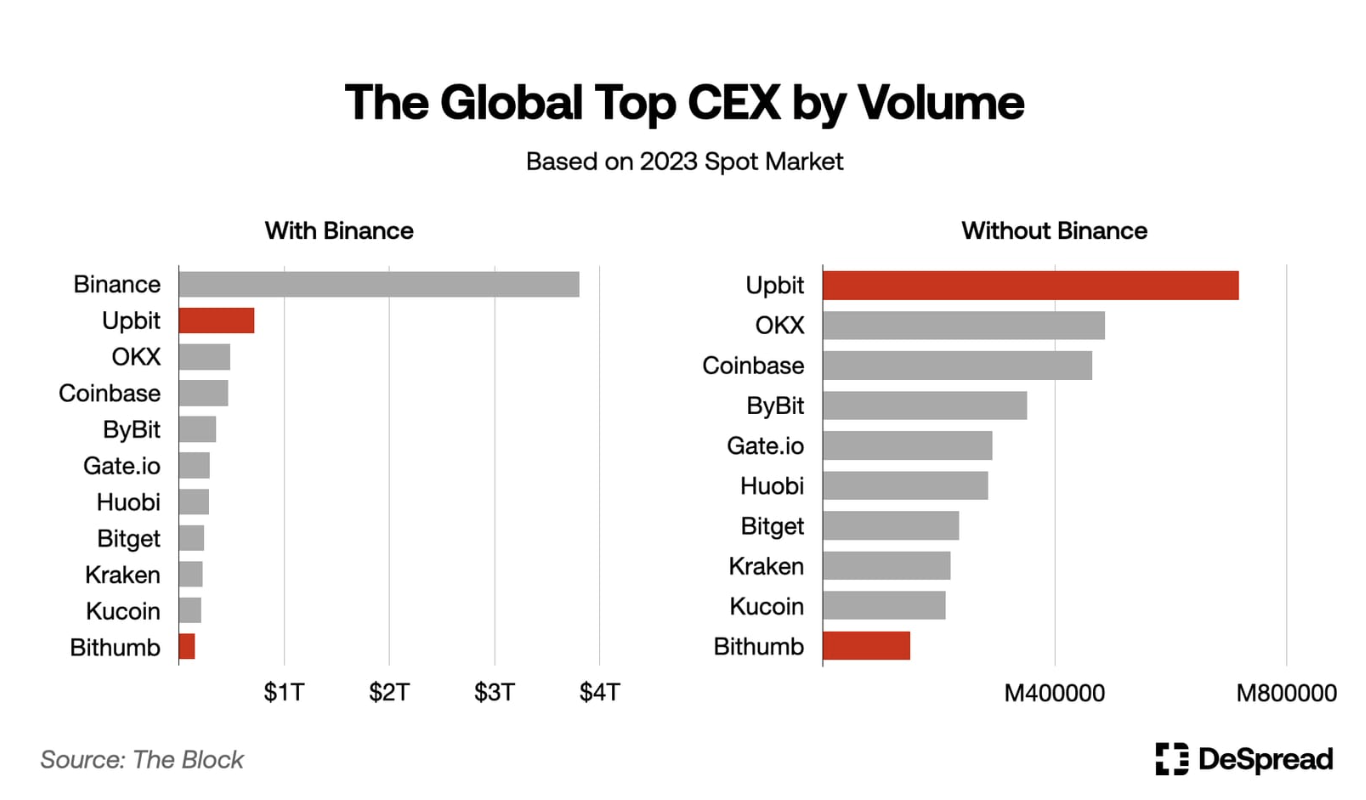
Additionally, as introduced in our previous report (DI - 01: Centralized Exchanges in Korea), Korean exchanges rank among the highest globally in trading volume. As shown in the chart above, Upbit ranked as the world’s second-largest spot market in 2023, behind only Binance.
Korean exchanges tend to trade non-mainstream cryptocurrencies (such as Bitcoin and Ethereum), and their influence extends significantly even to larger-cap altcoins. For example, Stacks (STX), a Bitcoin Layer 2 project, saw 90% of its global trading volume occur on Korean exchanges on August 5, 2023. Similarly, BLUR, the token for Ethereum’s largest NFT marketplace, accounted for 60% of its global trading volume on Korean exchanges on January 4, 2023. These figures underscore the importance and global impact of the Korean market.
Identifying community trends within specific markets is essential to understanding their characteristics. This report takes that approach, aiming to conduct an in-depth analysis of Korea’s cryptocurrency community. It focuses primarily on understanding Korea’s crypto community in 2023—its topics of discussion and the correlation between community interests and market trends.
2. Korean Cryptocurrency Community Platforms
2.1. Telegram
Telegram is an international messaging service with approximately 800 million monthly active users (MAU) worldwide and is the most active platform among Korean users engaging with on-chain products. With features such as large group chats, broadcast channels, notifications, and bots, community operations on Telegram go far beyond simple peer-to-peer messaging.
There are numerous topic-specific Telegram channels, covering areas like airdrop information, exchange announcements, DeFi news, trading signals, and research. Based on our estimates, there are at least 500 Korean-language cryptocurrency-related channels currently active.
Projects typically maintain official Telegram channels and chat rooms, enabling users to receive real-time updates and interact with other community members. Telegram also supports multiple languages, facilitating easy communication with global communities. The convenience of forwarding and referencing messages across channels makes it an efficient information-sharing tool.
2.2. KakaoTalk Open Chat Rooms
KakaoTalk is Korea’s most widely used messaging app, with 48 million MAUs as of the end of 2023, making it the top-ranked app in the country. With a population of 51.32 million, it is safe to say nearly all Koreans use KakaoTalk. Given its broad adoption across age groups, cryptocurrency communities also utilize KakaoTalk’s open chat rooms for discussions. These open chat rooms, a feature within KakaoTalk, allow users with shared interests to create dedicated spaces.
Crypto-related open chat rooms are primarily composed of general investors and holders, most of whom focus on coins listed on Korean centralized exchanges. Compared to Telegram, these communities tend to emphasize price movements and market analysis, offering greater accessibility and a more diverse participant base, though participants are generally less proficient in using on-chain services.
However, KakaoTalk open chat rooms are limited to 1,500 members, offer fewer message-forwarding capabilities, and lack robust bot functionality or sub-channel creation. Additionally, KakaoTalk has relatively few international users, making it a highly localized community platform.
Due to these technical limitations and user characteristics, KakaoTalk presents several shortcomings for community management. Overall, the quality and professionalism of discussions within KakaoTalk’s crypto communities appear somewhat lacking.
2.3. Coinpan
Coinpan is one of Korea’s largest cryptocurrency community websites. According to Similarweb data, it had 5.3 million MAUs as of the end of 2023—surpassing Bithumb, Korea’s second-largest exchange by trading volume, which reported approximately 4.7 million MAUs as of December 23. On March 27, 2023, Coinpan’s free discussion forum recorded 8,636 posts in a single day, making it one of Korea’s most active communities.
Common post types on Coinpan include profit/loss sharing, news, and investment arguments, with most discussions centered on coins listed on centralized exchanges like Upbit and Bithumb, promoting investments in specific tokens. The profit/loss section often features users sharing screenshots from exchanges to verify gains, including claims of profits from futures trading on overseas platforms.
On Coinpan, users can compare cryptocurrency prices across various exchanges, including Bithumb, Upbit, Coinone, Coinbit, Korbit, and Binance, and access information on Korean premiums and trading volumes. However, certain message boards and features require login credentials or minimum community engagement levels, creating barriers to entry for casual users.
2.4. DCInside
DCInside is one of Korea’s most popular online community sites, often referred to as Korea’s Reddit, celebrated for its anonymity and free-flowing discussion culture. DCInside organizes content into themed bulletin boards called “Galleries,” allowing users to browse based on personal interests.
Several Galleries on DCInside are dedicated to cryptocurrency, including prominent ones for Bitcoin, altcoins, NFTs, and general crypto topics. These spaces focus on sharing information and discussing investments in coins listed on centralized exchanges like Upbit and Bithumb, with little to no discussion of on-chain activities.
These communities are typically highly speculative, dominated by subjective opinions and short-term profit-seeking behavior, often lacking objective information. Discussions about on-chain technology or long-term project value are relatively rare, with most attention focused on short-term gains from price swings of specific tokens.
While these traits may limit the professional depth and information quality of DCInside’s crypto Galleries, the platform remains a useful window into the interests and behaviors of Korean crypto investors.
2.5. X (Twitter)
X (formerly Twitter) is one of the most widely used platforms in the global cryptocurrency community, serving as the primary channel for communication and information sharing among industry participants.
However, Korean crypto communities are less active on Twitter compared to global averages. Data (as shown in the latter part of this article) indicates that the number of Korean crypto-related Twitter users and tweets is significantly lower than in Japan—possibly due to Twitter’s relatively low popularity as a platform in Korea.
Despite lower activity levels, Korean crypto Twitter users exhibit diverse interests, including experts in specific projects, technical analysts, seasoned investors, speculators, meme coin enthusiasts, and specialists in DeFi and NFTs. Notably, investors focused on fundamental analysis and research are particularly active on this platform.
In Korea, Twitter also lags behind Telegram in timeliness. Within the Korean crypto community, news spreads fastest and discussions are most intense on Telegram, while information dissemination on Twitter tends to be slower. However, compared to other platforms, Twitter hosts a higher proportion of users engaged in on-chain activities.
2.6. Discord
Originally designed for gamers, Discord has recently gained widespread adoption among cryptocurrency communities. Its main feature is server-based community organization, where each project or organization can create its own server, allowing users to join and engage with specific communities.
In the crypto space, Discord is primarily used to build project-specific communities. Many projects operate their own Discord servers to share updates, development progress, airdrops, governance votes, and facilitate member interactions.
However, because Discord is tightly focused on individual projects, general investment advice or broad market trend discussions are relatively scarce. Additionally, the isolated nature of each server makes cross-server information sharing difficult.
Discord offers rich features such as voice chat, screen sharing, role assignment, and bot integration, making it a powerful tool for community management. Developers, in particular, benefit from GitHub integrations that deliver code update alerts and enable technical discussions.
Compared to global usage, Discord sees lower adoption in Korea, partly because it remains unfamiliar to many Korean users. Language barriers also raise the threshold for general users to participate in global communities. Furthermore, the widespread use of Telegram and KakaoTalk in Korea contributes to Discord’s relatively low penetration.
2.7. Naver Cafe
Naver is Korea’s largest website and offers a community service called Naver Cafe. As one of Korea’s most popular and longest-running community platforms, it is also used by cryptocurrency communities. Naver Cafe crypto groups typically emphasize price chart analysis and investment information sharing, especially for altcoins listed on Korean centralized exchanges, reflecting Korean investors’ preference for short-term profits over foundational crypto principles.
While Naver Cafe benefits from being highly accessible and familiar to users, it falls short in terms of expertise and information reliability. Although many successful investment stories and recommendations can be found, most are speculative and lack objective evidence. Additionally, due to limited connections with global communities and predominantly Korean-language discussions, conversations about overseas projects or global trends remain limited. However, in recent years, rising interest in DeFi, NFTs, and on-chain activities (such as airdrops and liquidity farming) has led to increased related activity on Naver Cafe.
So far, we have outlined the key characteristics of Korea’s cryptocurrency communities across various platforms, each with unique traits in user base, interests, and discussion culture. In the following section, we will use this foundation to dive deeper into data, exploring the hottest topics within Korea’s crypto community in 2023 and their market impact.
3. 2023 Korean Community Trends
3.1. Google Trends
Google Trends is a service provided by Google, the world’s largest search engine, offering insights into the relative search frequency of specific keywords within defined timeframes and regions. Google Trends expresses search volume as a relative index, with 100 representing the peak search level during the analyzed period. By leveraging keyword analysis via Google Trends, we can identify topics of interest among Korean investors and users and compare them with other countries.
3.1.1. Comparison Between Stocks and Cryptocurrencies
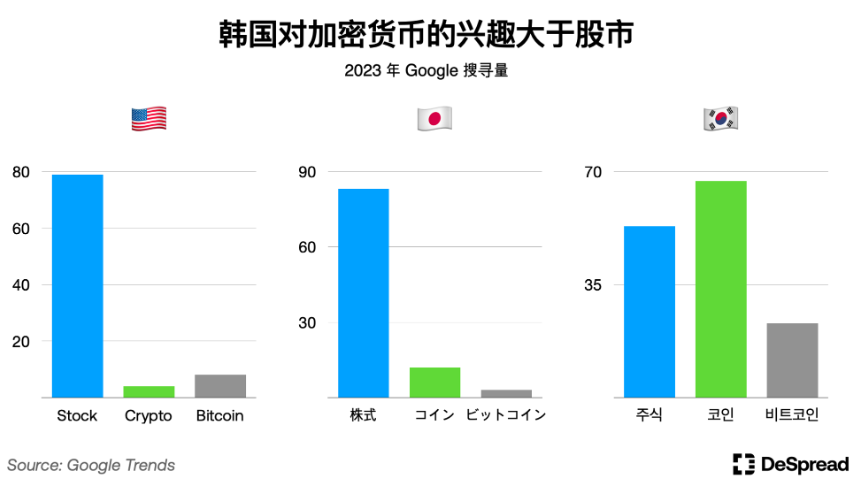
- Korea’s Love for Cryptocurrency
-
Stocks and cryptocurrencies are the two most common investment vehicles in the U.S., Japan, and Korea. Comparing search volumes for “stocks” versus “cryptocurrency,” Korea shows significantly higher interest in crypto. In the U.S., searches for “stock” outnumber those for “crypto” by about 20 times; in Japan, “shares” (株式) outpace “coin” (コイン) by roughly 7 times. Only in Korea does “coin” (코인) surpass stocks by about 25% in search volume.
-
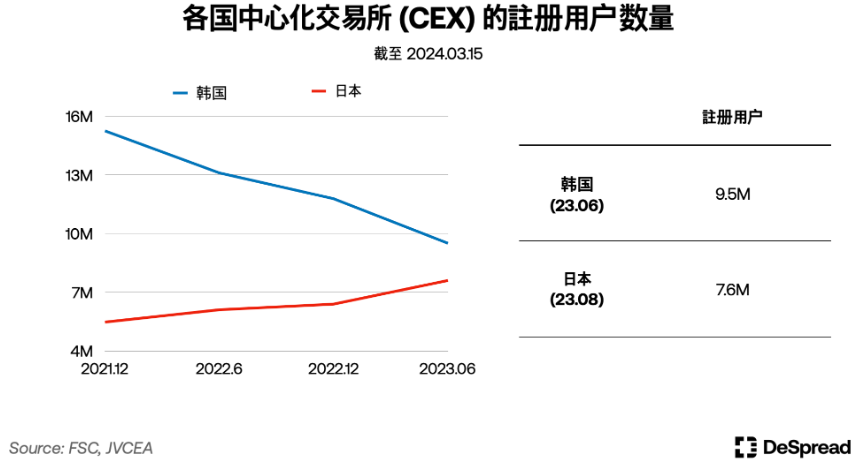
This difference is also evident in actual investor numbers. As of 2022, South Korea had approximately 14.41 million stock investors (28% of the population) holding at least one share, while around 6.27 million people (12% of the population) held exchange accounts for cryptocurrency. In contrast, Japan recorded about 6.3 million registered accounts at centralized exchanges in December 2022, amounting to just 5% of its population.
-
- Korea vs. Japan
-
Japan shows lower interest in cryptocurrency compared to stocks, a gap also visible in trading volumes. Comparing last May’s combined trading volume of Japan’s top five exchanges against Upbit alone reveals a massive disparity: Japan’s top five totaled $4 billion, while Upbit exceeded $27 billion. Source.
-
According to CoinGecko, Japanese exchange volumes are concentrated in Bitcoin and Ethereum, contrasting sharply with Korea’s altcoin-focused market. Nevertheless, as shown in the chart above, data from the Japan Virtual and Cryptoasset Exchange Association (JVCEA) shows steady growth in registered exchange accounts, indicating strong market potential.
-
3.1.2. Interest in Representative Exchanges Across Countries
-
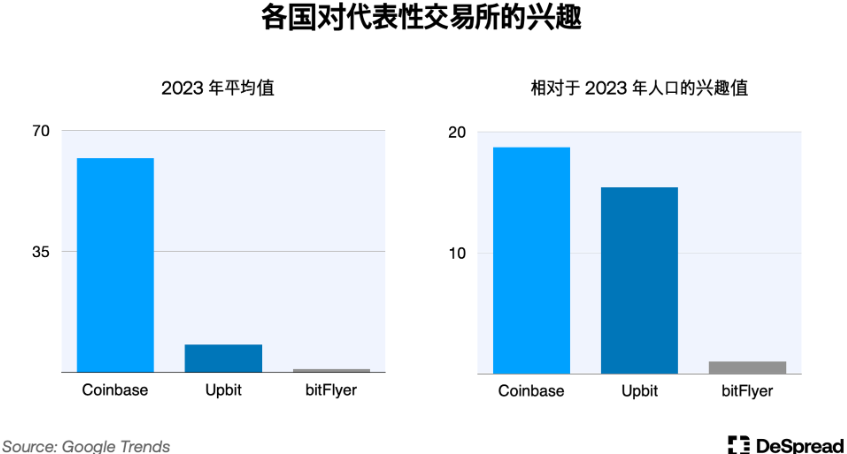
Definition of Representative Exchanges: Centralized exchanges are integral to the blockchain and crypto industry, serving as the easiest entry point for investing in crypto and a gateway for converting on-chain users. Coinbase, Upbit, and bitFlyer represent leading exchanges in the U.S., South Korea, and Japan, respectively. We analyzed their keyword search trends to gauge national interest in cryptocurrency and centralized exchanges.
-
High Relative Interest in Korea: While Coinbase leads in absolute search volume, when adjusted for population size, Upbit and Coinbase show very similar levels of relative interest, indicating high adoption rates of crypto exchanges in Korea. In contrast, Japan’s bitFlyer ranks low in both absolute volume and per capita interest, suggesting relatively low exchange usage.
-
National Characteristics of Crypto Environments: The U.S. features an active crypto trading environment centered around Coinbase, which serves users globally. By the end of 2022, Coinbase had over 100 million KYC-verified users—exceeding Korea’s total population. In Korea, as of mid-2023, centralized exchanges reported 9.5 million registered accounts and about 6 million active users. In Japan, as of August 23, there were 7.6 million registered accounts—fewer relative to its population size.
3.1.3. Comparison Between Centralized Exchanges and On-Chain Keywords
-
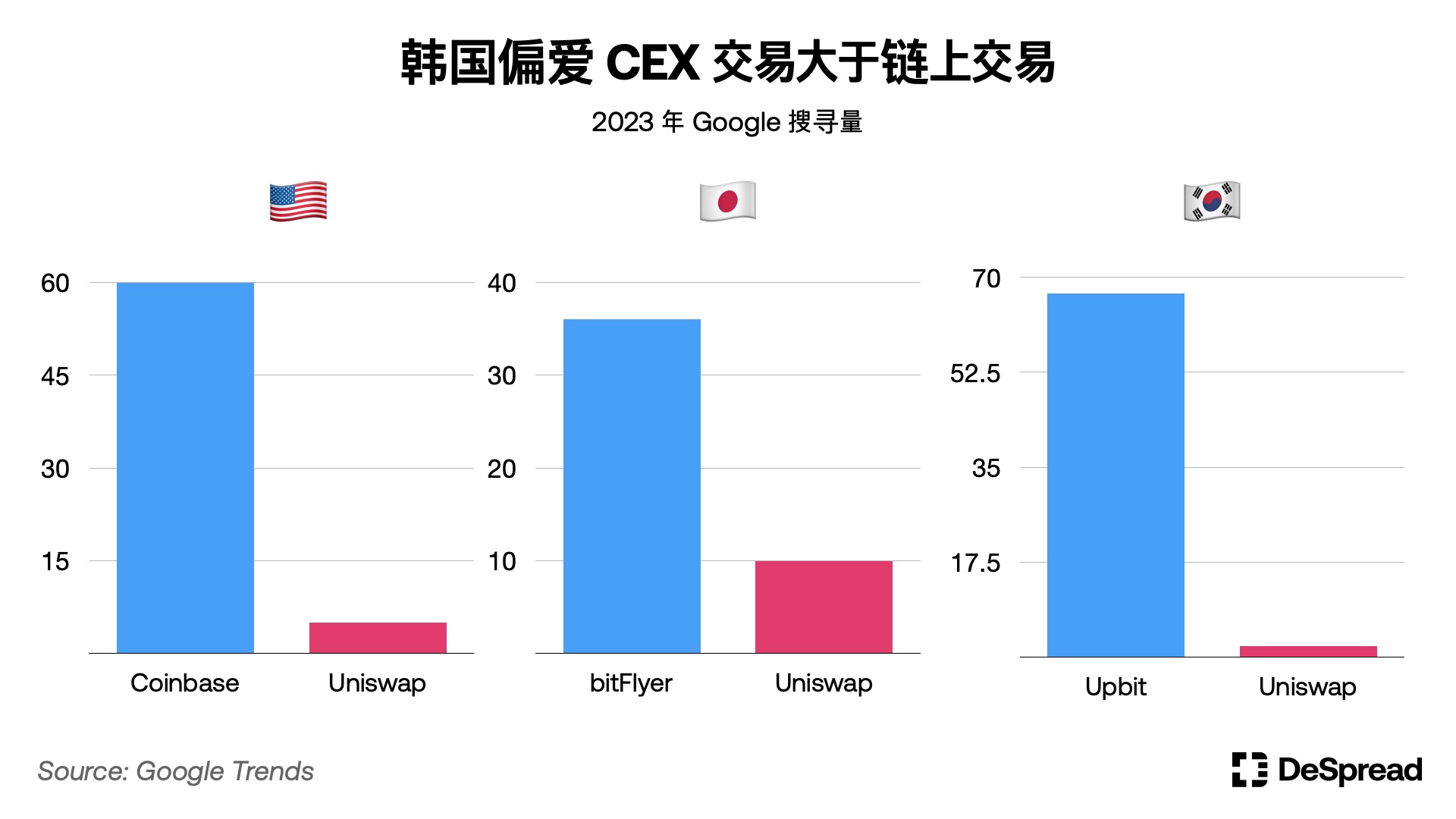
Benchmarking On-Chain Trading Interest: On-chain trading activities present much higher barriers than centralized exchanges. To indirectly assess national interest in on-chain trading, we analyzed keywords related to on-chain activities versus those tied to centralized exchanges.
-
Interest in On-Chain Trading: As an indirect proxy for on-chain interest, we selected Uniswap, a leading decentralized exchange (DEX), and compared it with each country’s representative centralized exchange. Relatively speaking, the U.S. shows higher interest in on-chain trading than Japan, which in turn exceeds Korea. Despite active crypto investment in Korea, interest in on-chain trading remains low. Japan’s apparent high interest in Uniswap appears inflated due to extremely low interest in bitFlyer.
-
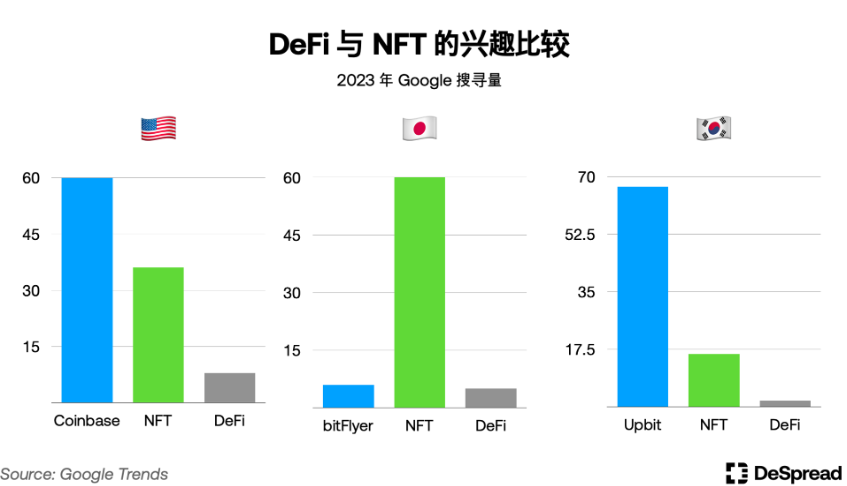
NFTs and DeFi: NFT and DeFi are two keywords most representative of on-chain activity. Both the U.S. and Korea show higher interest in NFTs than DeFi, likely because NFTs are easier for average users to grasp and involve frequent airdrop opportunities that make participation simpler. Japan shows notably higher interest in NFTs than in centralized exchanges, indicating a relatively active domestic NFT market.
-
Developer Ratio and On-Chain Interest: According to Electric Capital, global crypto developer distribution shows North America accounting for 28% of the total, while East Asia and the Pacific—including Korea—account for 11%. Though exact figures for Korea alone are unavailable, the proportion of protocol developers in Korea appears very small relative to its trading volume, suggesting Koreans are more enthusiastic about trading via centralized exchanges than developing on-chain technologies.
Overall, Korea exhibits high interest in cryptocurrency investment and trading, but relatively low engagement with on-chain activities such as NFTs and DeFi. Conversely, the U.S. shows stronger interest in on-chain applications, while Japan maintains a relatively vibrant NFT market.
3.2. Telegram Cryptocurrency Communities
We analyzed messages posted in 2023 across 110 Korean-language cryptocurrency announcement channels on Telegram. To filter out promotional content and non-community-driven posts, our analysis excluded corporate channels and those merely sharing news headlines. This approach allows us to understand the most popular Telegram channels among Korean crypto investors, trending topics, and emotional dynamics over the past year.
3.2.1. Activity Analysis
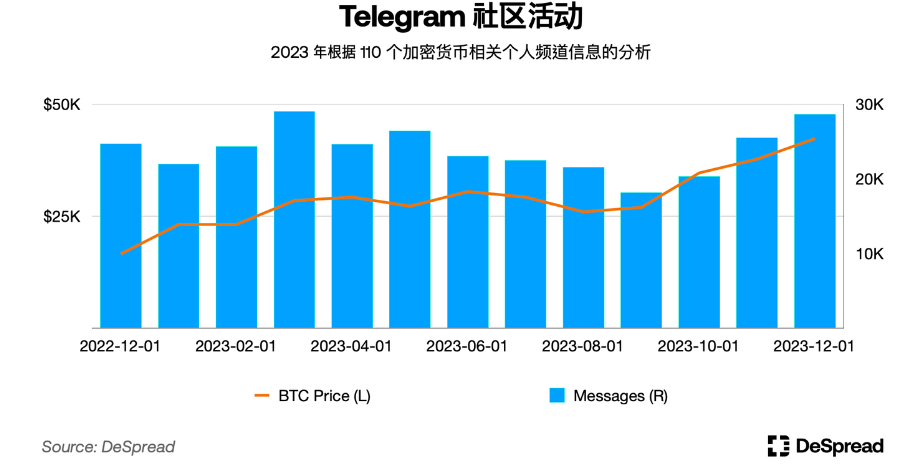
The chart above compares Bitcoin’s price in 2023 with the monthly message count from 110 Korean crypto community channels.
-
Bitcoin Price and Community Activity: Generally, channel activity increases during periods of rising Bitcoin prices. Particularly from October to December 2023, when Bitcoin surged, message counts rose sharply, indicating that price volatility stimulates investor interest and drives increased information sharing and discussion.
-
Channel Activity During Bear Markets: In August and September 2023, as BTC prices declined, message volume in these channels also dropped. During bear markets, investor engagement tends to wane, resulting in quieter community activity.
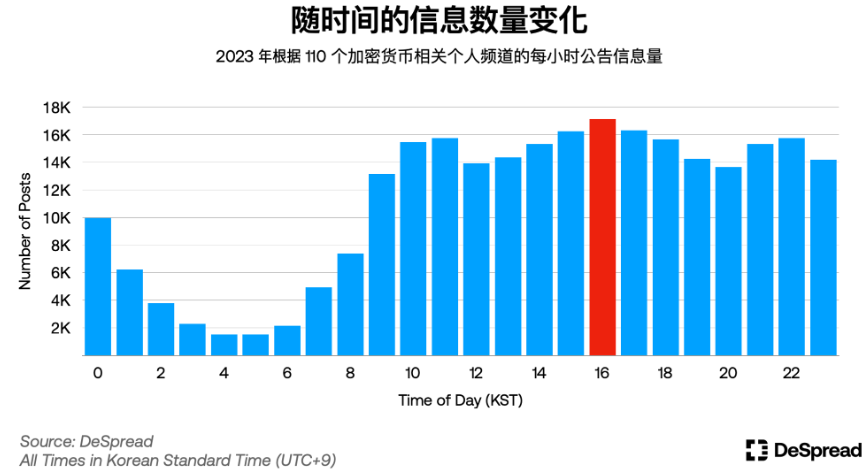
- Peak Hours: Analyzing message volume by time of day, we found peak activity occurs between 4 PM and 5 PM Korea time. Message volume begins rising around 9 AM, remains elevated until 11 PM, with the busiest period between 2 PM and 6 PM, peaking at 4 PM. Activity is lowest between 2 AM and 6 AM. Overall, this pattern mirrors daily life rhythms in Korea. Interestingly, despite stock market closing at 3:30 PM or workers returning home after 6 PM, community activity persists, reflecting the 24/7 nature of the crypto market.
3.2.2. Keyword Trend Analysis for 2023
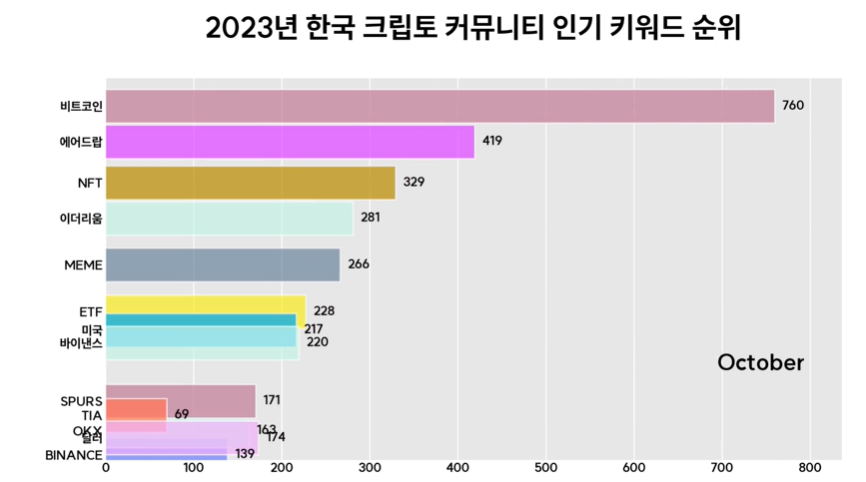
Analyzing the most frequently mentioned keywords across 110 Korean crypto Telegram channels in 2023, the top terms were “Bitcoin,” “NFT,” “Airdrop,” and “Ethereum.” Interestingly, although Google Trends showed Korea’s interest in NFTs lagging behind countries like the U.S. and Japan, NFTs ranked highly in Telegram communities. We speculate this is due to many projects continuously using free NFT airdrops as marketing tools.
Overall, investors show strong interest in getting things for free, and Telegram’s relatively large on-chain user base likely amplifies this trend. Next, we examine the most discussed keywords month by month in Korean communities.
January: Focus on Macroeconomic Uncertainty
In January, macroeconomic keywords such as “CPI,” “FOMC,” and “interest rates,” along with New Year–related terms like “year-end settlement,” dominated the rankings. This highlights how economic uncertainty and recession concerns influence the crypto market.
February & March: Airdrops and USDC Depeg
In February, the collapse of Silvergate and SVB, followed by USDC’s depeg in March, caused significant market downturns. However, the NFT marketplace Blur’s token airdrop in February and Arbitrum’s airdrop in March successfully captured community attention and revived market sentiment. Blur’s airdrop helped challenge OpenSea’s dominance, while Arbitrum’s encouraged users to adopt its ecosystem dApps, boosting on-chain activity. As shown in the chart, “ZK Sync” also rose in prominence during February and March, reflecting anticipation for future airdrops.
April: Meme Coin Hype and Sui
In April, meme coins led by “PEPE” sparked another wave of speculation. The frog-themed PEPE token surged over 80x in just three days, quickly becoming a focal point. Meanwhile, the mainnet launch of SUI, a next-generation Layer 1 blockchain platform backed by Meta, attracted strong interest from the crypto community. Notably, SUI became the first cryptocurrency to debut simultaneously on all five major Korean exchanges.
May: BRC-20 Token Standard and Political Regulation Issues
In May, the BRC-20 token standard for the Bitcoin network gained widespread attention. BRC-20 leverages the Ordinals protocol to inscribe data on Bitcoin, resembling NFTs but differing from ERC-20. Despite drawbacks—such as requiring new inscriptions to transfer tokens or needing offline indexers to track wallet balances—BRC-20 is seen as a novel experiment showcasing Bitcoin’s ecosystem expansion potential.
Additionally, political regulatory issues surrounding Kim Nam-Kook reignited community debate. Rep. Kim Nam-Kook was accused of holding and trading billions of won worth of cryptocurrency, sparking controversy over public officials’ crypto investments. The issue surfaced during a live committee session when his trading activity was caught on camera. Combined with his prior involvement in delaying crypto tax legislation, allegations of conflict of interest arose. In response, an amendment to the Public Officials Ethics Act was proposed and passed, requiring all lawmakers and senior officials to disclose their crypto holdings starting December 14, 2023.
June: Consecutive CeFi Platform Collapses
In June, the simultaneous collapses of two major Korean CeFi platforms—Haru Invest and Delio—shocked the industry. These platforms had attracted investors with high promised returns, but suddenly halted withdrawals overnight due to opaque fund management and poor partner selection. Investigations revealed Haru Invest suffered heavy losses during the FTX crash, triggering a chain reaction that led to Delio’s downfall. Reported losses reached up to 130 billion KRW, and the company is now under bankruptcy administration.
This incident highlighted the risks of opaque operations and weak risk management in CeFi platforms. Particularly notable was Delio holding a license from the Financial Services Commission, underscoring the challenges still facing institutional trust in crypto. Within Korean communities, the event intensified debates over CeFi versus DeFi, with DeFi gaining favor as an alternative due to its transparent, on-chain nature.
July: Ripple Wins Partial SEC Lawsuit / Worldcoin Launch / Attention Turns to Japan
In July, Ripple secured a partial victory in its lawsuit against the U.S. Securities and Exchange Commission (SEC). A U.S. District Court ruled that Ripple’s sales of XRP to retail investors did not violate securities laws—a decision many believed could reshape future debates on crypto asset classification. Following the verdict, XRP’s price surged, drawing significant attention from Korea’s large base of XRP holders.
Meanwhile, Worldcoin, supported by Sam Altman, CEO of OpenAI (known for ChatGPT), launched globally. Worldcoin uses iris scanning to verify unique human identities for token distribution. Korean communities debated its privacy implications and potential as a solution to distinguish humans from AI. In Korea, Worldcoin was listed on Bithumb, Korbit, and Coinone.
The keyword “Japan” also gained traction. In July, Japan hosted WebX Tokyo, its largest blockchain conference, prompting Korean discussions on Japan’s crypto policies.
August: Curve Hack / Sei Mainnet Launch / Bitcoin ETF Approval Hopes
In August, the CRV hack shocked the crypto community. A vulnerability in Curve Finance, a major decentralized exchange, resulted in over $50 million in lost funds. Concerns grew over potential cascading liquidations, as CRV had been used as collateral across multiple DeFi protocols. Fortunately, CRV’s price recovered post-event, avoiding worst-case scenarios. Still, community trust inevitably suffered.
Sei’s listing also drew attention. Upon mainnet launch, Sei successfully
launched on major international exchanges like Coinbase and Binance, followed by listings on all five major Korean exchanges, generating strong anticipation. Its investor-friendly tokenomics, including a 25% airdrop to the community, were seen as key advantages.
At the same time, Korean communities began expressing hopes for Bitcoin spot ETF approval in August. Applications from institutions like BlackRock and Fidelity raised optimism about growing institutional interest. However, the SEC delayed decisions again in September, triggering community concern.
September: KBW and Friend Tech
The Korea Blockchain Week (KBW) 2023, held from September 4 to 9 in Seoul, was Korea’s largest blockchain event. It attracted industry leaders such as Vitalik Buterin (co-founder of Ethereum), Jeremy Allair (CEO of Circle), and Arthur Hayes (CIO of Maelstrom Fund), who delved into deep discussions on blockchain. Korean blockchain projects also participated, presenting their visions and achievements.
Join TechFlow official community to stay tuned Telegram:https://t.me/TechFlowDaily X (Twitter):https://x.com/TechFlowPost X (Twitter) EN:https://x.com/BlockFlow_News
 @DeSpreadTeam