









Exploring Three Key Design Decisions of Bitcoin Layer 2 Solutions
TechFlow Selected TechFlow Selected
Exploring Three Key Design Decisions of Bitcoin Layer 2 Solutions
Bitcoin's Layer 2 solutions focus on key design elements such as bridging BTC, inheriting Bitcoin's security, and handling data availability.
 Navigating Web3 tides with focused insights
Author: @momir_amidzic
Translation: Baihua Blockchain

When considering Layer 2 solutions for Bitcoin, I start with a simplified model focused on three key design decisions:
How to bridge BTC?
How and to what extent is Bitcoin's security inherited?
How is data availability (DA) handled?
1) Bridging BTC
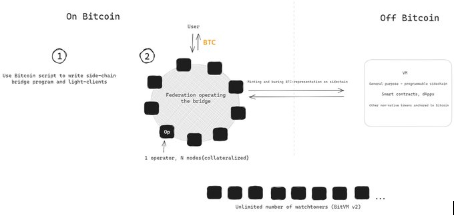
BitVM Bridge: A trust-minimized bridging solution with a 1/N trust assumption should be the optimal approach. However, there is currently no concrete bridge specification, and several unresolved (hopefully solvable) issues remain—such as multisig operators needing to pre-provide liquidity. Optimistically, we might see BitVM bridges emerge in at least 12 months, under base assumptions within 24 months.
Decentralized Bridges: Economically secure bridges like XCLAIM are generally safe but lack scalability. In contrast, statistically secure bridges—such as large rotating multisig networks—currently appear to offer better trade-offs.
Centralized Bridges: Although suboptimal, they represent a simple and straightforward solution. Many current Bitcoin sidechains rely on custodial bridges.
2) Inheriting Bitcoin’s Security
This is where things get truly interesting.
BitVM Programs: In theory, BitVM programs can enforce rules even for tokens that exist solely on sidechains rather than natively on Bitcoin. This not only enables trust-minimized bridging via BitVM but also makes actual rollups on top of Bitcoin feasible. That said, technical risks are significant, and practical implementations seem distant.
PoS Sidechains Combined with Babylon: Another option is building PoS sidechains integrated with Babylon. Specifically, Babylon is the first solution enabling trustless staking of Bitcoin, using BTC as an economic security layer for new PoS chains—adding utility to BTC in a manner similar to how Eigen allows ETH to serve as economic security for new middleware and infrastructure.
Merged Mining: Merged mining is another alternative. However, traditional merged mining has inherent limitations—for example, it cannot force miners to perform certain actions. Research into hybrid mechanisms could prove promising, such as requiring miners to stake on the sidechain to increase their participation while granting the sidechain slashing capabilities.
3) Data Availability (DA)
Why is DA critical? If we're discussing optimistic designs like BitVM, users must be able to access data to challenge and prove malicious transactions.
Bitcoin itself has constraints—it can store only 4MB every 10 minutes—making it unsuitable as a DA layer. Not to mention the uncertainty in costs and the unpredictability of whether data can be included in the next block.
Can Bitcoin have rollups without Bitcoin-guaranteed DA?
DA is a widely discussed topic in the Ethereum community, with some community leaders insisting that anything relying on external DA isn't a true Ethereum rollup.
By the same logic, anything using non-Bitcoin DA isn't a Bitcoin rollup. Yet, Bitcoin sidechains may need to compromise here and adopt more pragmatic alternatives—such as leveraging Ethereum DA, Celestia, Eigen DA, or DA secured by staked BTC (via Babylon).
Final point: What would be best for Bitcoin L1 when selecting a settlement layer?
In the long run, as Bitcoin's mining rewards dwindle, miners will increasingly depend on organic fees or secondary revenue streams. In other words, to sustain high hash power, Bitcoin needs to develop a sustainable fee market. Given this, the solution most beneficial to Bitcoin L1 security is surprisingly merged mining.
Specifically, neither BitVM (combined with external DA) nor Babylon brings additional transaction fees to Bitcoin miners. The former, as an optimistic design, requires execution on Bitcoin only in rare dispute cases, while the latter increases demand for BTC as an asset but does not enhance the security of Bitcoin's PoW.
Merged mining aligns strongly with enhancing Bitcoin security because it requires miners to compete for L1 block production in order to build sidechain blocks and earn sidechain rewards. In other words, winning the next Bitcoin block is a prerequisite for constructing the next sidechain block.
In summary, with these simple modules, you can already create 18 distinct sidechain combinations. Assuming no restrictions when combining different modules, my personal favorite—and one potentially achievable within the next two years—is the following configuration:
BTC bridged via BitVM
Security derived either from BTC PoS via Babylon or through innovative merged mining approaches extending Bitcoin PoW security
Reliance on external DA, such as Ethereum or DA provided by Babylon

Join TechFlow official community to stay tuned
Telegram:https://t.me/TechFlowDaily
X (Twitter):https://x.com/TechFlowPost
X (Twitter) EN:https://x.com/BlockFlow_News
 IOSG Ventures









