








Understanding Initia: A Plug-and-Play, Easily Customizable Full-Stack Modular Rollup Network
TechFlow Selected TechFlow Selected
Understanding Initia: A Plug-and-Play, Easily Customizable Full-Stack Modular Rollup Network
Intia has both L1 and L2 functionalities.
 Navigating Web3 tides with focused insights
By TechFlow
The secondary market remains calm, while airdrop farming and new project hunting grow increasingly desperate.
Whenever a new project emerges for interaction, countless tutorials appear overnight, drawing massive crowds rushing in. Driven by FOMO, hunters fear missing out on the next big airdrop.
Amid this frenzy, this week’s standout star is undoubtedly Initia (@initiaFDN).
Within just a few days, crypto Twitter has been flooded with Initia interaction guides and project overviews. Some KOLs even joked about holding back tutorials—such intense attention could turn what might have been a generous airdrop into a meager one due to overcrowded competition.
Why all the FOMO around Initia? The most attractive factor is clearly its elite funding pedigree.
In February this year, Initia raised $7.5 million in a seed round led by Delphi Ventures and Hack VC, with notable angel investors including Cobie, Nick White, and Smokey participating.
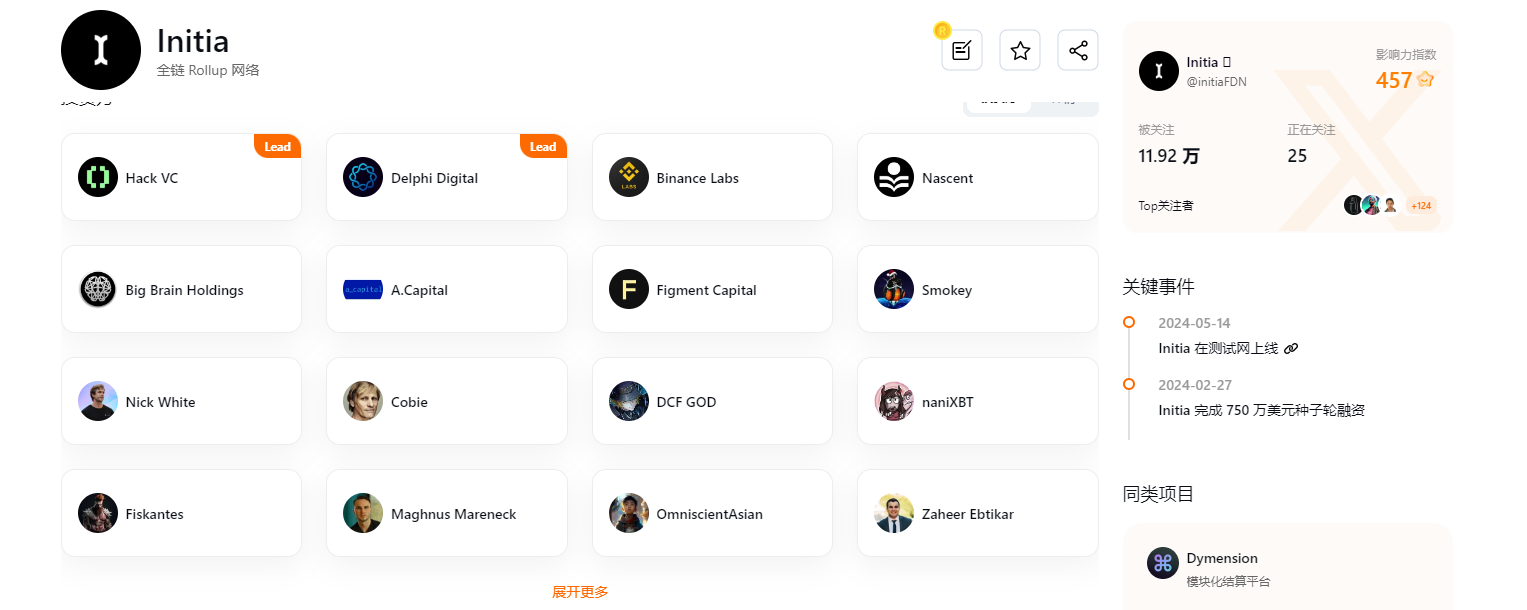
More recently, Rootdata revealed that Binance Lab also participated in the project’s funding round.
You might argue that memes dominate current market focus, but clearly, projects with such prestigious backers won’t go unnoticed—especially when high airdrop expectations are involved.
Yet as everyone focuses on top-tier funding, there's been little clear, accessible explanation of what Initia actually does.
L1, L2, modular, omnichain… Initia seems to carry every trending label, making it hard to grasp how these concepts fit together.
Is this just another homogenous project riding the wave of popular narratives, or does it offer genuine innovation?
After closer inspection, we found it’s not simply another L1 or L2 competing on specs. Rather, it functions more like a glue and lubricant for all chains—expanding the circle of friends and improving user experience.
So, can Initia carve out a space for itself amid fierce infrastructure competition?
More Chains, More Modules, More Anxiety
To answer this, let’s first look at the problems in today’s crypto market.
Everyone says they’re building infrastructure. While this construction boom has enriched the ecosystem, it’s also caused decision paralysis.
And two main culprits behind this confusion are L2s and modularity.
L2BEAT data shows there are currently 52 live L2s, with another 41 under development…
Which chain should you use? Which rollup fits best? How do you combine different modules to optimize performance or cost? In this fragmented tech landscape, every choice feels like an expedition.
Clearly, the more chains and modules there are, the greater the anxiety—and the worse the user experience. You’re likely facing these issues:
-
Complex Management: Managing multiple chains, configuring RPCs for each, maintaining separate wallets for non-EVM chains, using various bridges, paying gas in different tokens, and relying on multiple explorers for monitoring.
-
Fragmented Liquidity: Funds locked across different chains cannot move smoothly between them, limiting capital efficiency and accessibility.
The goal was to make things easier for users, but instead we’ve ended up with a fragmented, siloed landscape.

Therefore, whether from a speculative narrative standpoint or a practical problem-solving perspective, we clearly need an interconnected approach to ease this experiential anxiety and operational burden.
So now you can easily understand what Initia aims to do:
Instead of trying to pick one winner from a sea of chains, build an ecosystem capable of uniting and connecting them all.
Main Lobby L1, Private Suite L2
So how exactly does Initia create this interconnected ecosystem? Is it an L1 or an L2?
Simply put, think of it as a modular rollup network compatible with all chains, where each rollup can interoperate—accessing and communicating with one another.
Thus, Initia serves both L1 and L2 functions.
A bit confusing?
Let’s break it down with a familiar analogy—staying at a hotel.
Imagine you've booked a suite at the Initia Hotel. When you arrive to check in, here’s what happens:
First, you go to the front desk. Staff verify your identity, assign your room and keycard access, explain check-in and check-out rules, and confirm your room is available.
Second, your suite meets your needs—say, an ocean view. Another guest books a family suite tailored for kids’ entertainment. Everyone gets their own private space designed for specific purposes.
Third, guests in different rooms belong to the same hotel and follow the same standards. You can easily visit others via room numbers, hallways, and signage—no “walls between rooms.”

Now you should understand Initia’s product design:
First, Initia has an L1 acting like the hotel lobby—the orchestration layer responsible for security, coordination, and resource allocation.
Second, Initia hosts many independent Rollup L2s—like private suites—officially called Minitias. Each application gets its own L2: finance, gaming, social networks, etc. These operate independently while staying tightly connected to the L1.
Third, although each Minitia L2 is independent, shared design standards enable cross-chain interoperability, allowing seamless data and asset exchange. Hence, Initia defines itself as a network that "weaves together different rollups."
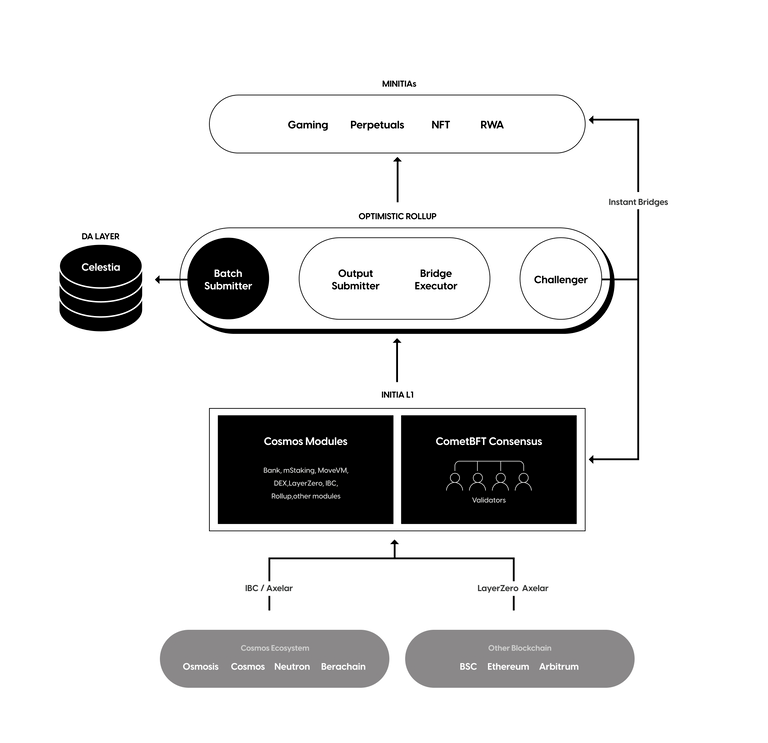
At the technical level, Initia leverages Cosmos, Celestia, and OP-rollup technologies to build this "front desk and suites" architecture:
-
Initia L1: Built on Cosmos, integrating core modules such as banking, staking, virtual machines (MoveVM, WasmVM), decentralized exchange (DEX), LayerZero, IBC, and more. It supports multiple blockchain technologies and optimized data processing. Using Comet BFT consensus ensures transaction security and consistency across the network.
-
Data Availability Layer (DA Layer): Celestia provides data storage and validation, ensuring transparency and reliability. The Batch Submitter batches transactions and submits them to Celestia to optimize speed and cost. The Output Submitter and Bridge Executor assist with cross-chain transactions and interoperability, enabling secure and efficient transfer of data and assets across blockchains.
-
Optimized Rollup: As part of an Optimistic Rollup, the Challenger monitors and verifies all on-chain transactions, ensuring correctness and challenging invalid ones.
-
Minitias (Independent L2 Networks): Each Minitia focuses on a specific application. Instant Bridges provide immediate bridging services, enabling fast and secure asset transfers between Minitias.
-
External Ecosystem Communication: Through Inter-Blockchain Communication (IBC) and Axelar, Initia achieves efficient cross-chain interoperability with the Cosmos ecosystem and other blockchains such as BSC, Ethereum, and Arbitrum.
With this architecture, Initia delivers a highly modular, secure, and scalable blockchain platform. It simplifies user experience in multi-chain environments and enhances developers’ ability to build applications. This design reduces operational complexity while significantly boosting system-wide liquidity and interoperability.
Move-In Ready, Plug-and-Play Suite Amenities
This setup already enables connectivity among L2s, but each Initia L2 Rollup has additional unique features.
Back to our hotel analogy: when you enter your room, you don’t need to buy furniture, bring toiletries, or install a wardrobe—the essentials are already provided. You just move in and use them.
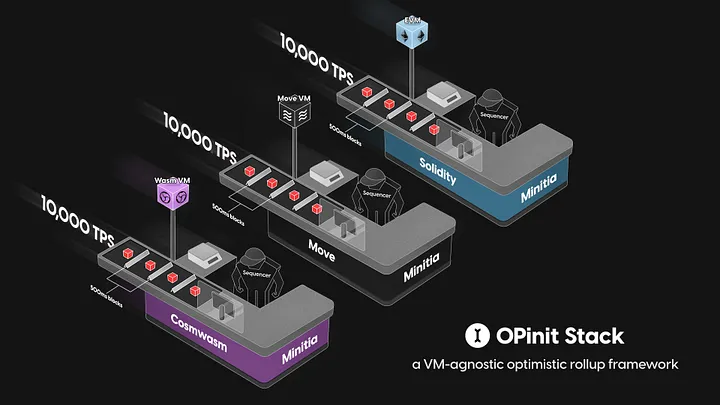
Likewise, every Minitia is a fully equipped L2 environment, allowing applications to move in instantly and become plug-and-play appchains—no need to reinvent the wheel from scratch.
Specifically, key built-in components include:
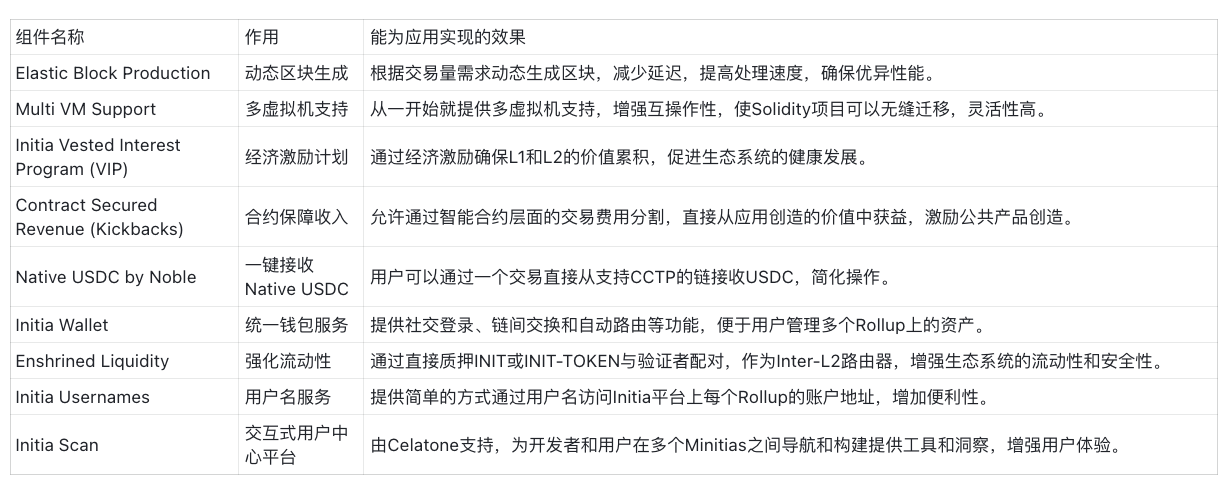
Thanks to these plug-and-play components, each Minitia offers an ideal environment tailored to specific applications. This design lowers barriers for developers, accelerates deployment and time-to-market, and allows builders to focus on innovation rather than infrastructure.
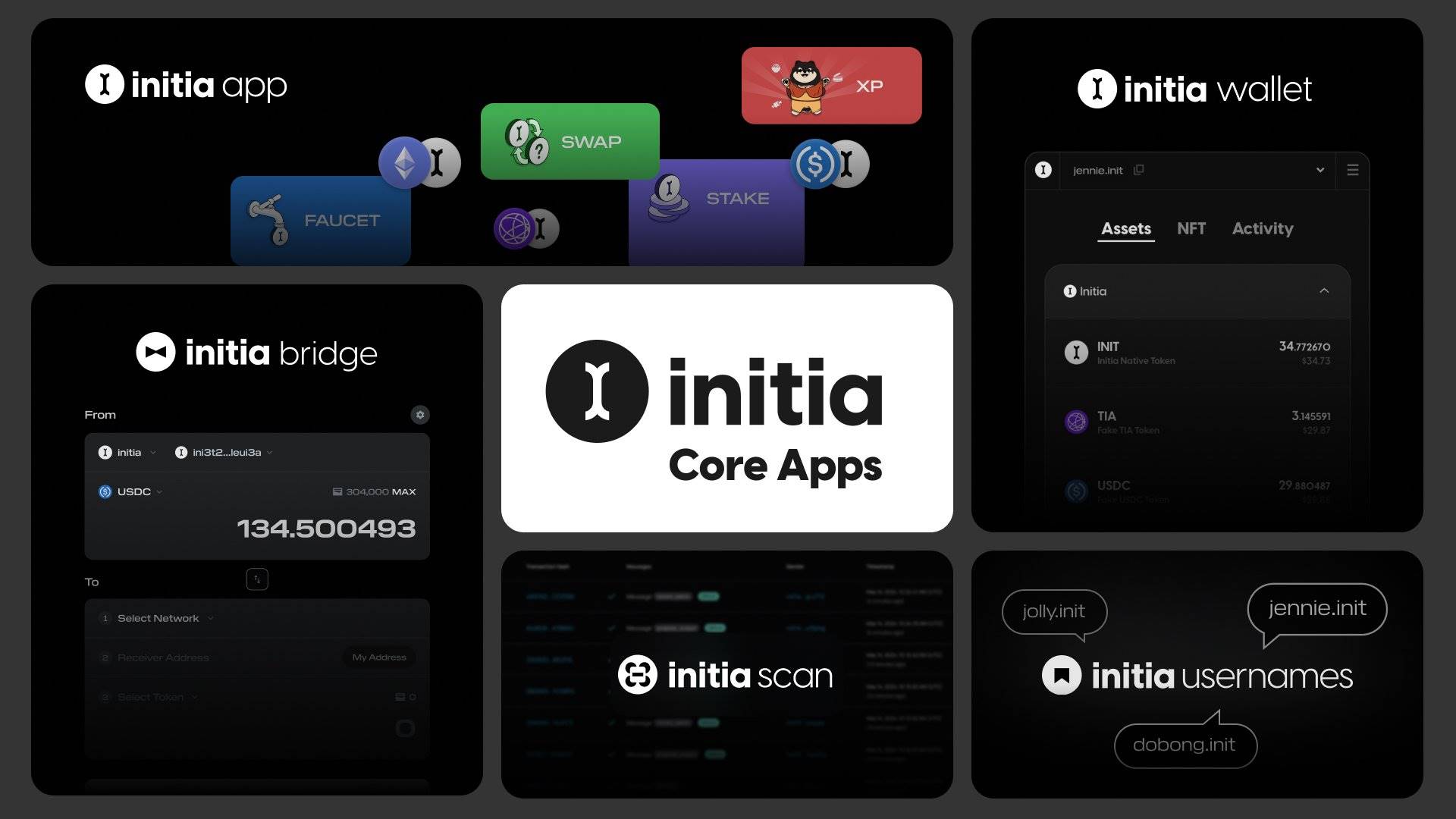
Notable Ecosystem Projects and Interactions
Although still in testnet phase, Initia already has several ecosystem projects collaborating closely. Key ones include:
-
Blakwing: A modular blockchain focused on offering non-liquidation leveraged trading for long-tail assets via Limitless Pools. Blakwing has raised $4.5 million in seed funding and quickly attracted over $50 million in total value locked (TVL). Users can earn up to 89% annual percentage return (APR) by depositing assets.
-
Lunch App: Aiming to become the central hub for Web3 activities within and beyond the Initia ecosystem. The platform reduces friction through social login and biometric transaction signing. Users can participate in on-chain activities across all Minitias via a single mobile app.
-
Tucana: An intent-centric liquidity layer, DEX, and L2 perpetual contracts chain optimized for traders, unifying trades across modular networks. Tucana offers lightning-fast execution and customizable logic.
-
MilkyWay: Building a modular chain to secure the ecosystem and developing the first liquid staking token (LST) for Celestia. MilkyWay recently closed a $5 million seed round, boasts over 156,000 milkTIA holders, and has achieved $26.5 million in TVL.
-
Contro: A market maker solving low liquidity and high fees. Its Gradual Limit Order Book (GLOB) ensures fair and scalable markets. Users gain unique clearing prices without relying on traditional liquidity providers. Contro will debut with prediction markets, offering fair and scalable on-chain betting.
-
Civitia: A fully on-chain gamified social experiment where users claim land, earn yield, and compete for global dominance. It seamlessly blends SocialFi and DeFi elements for a unique experience.
Additionally, with Initia’s testnet launch, users can currently download wallets, claim testnet tokens, stake, follow social media, and complete various tasks—earning NFTs upon completion.
Interested readers can visit the official Initia Chinese Twitter account and follow the official guide for instructions.
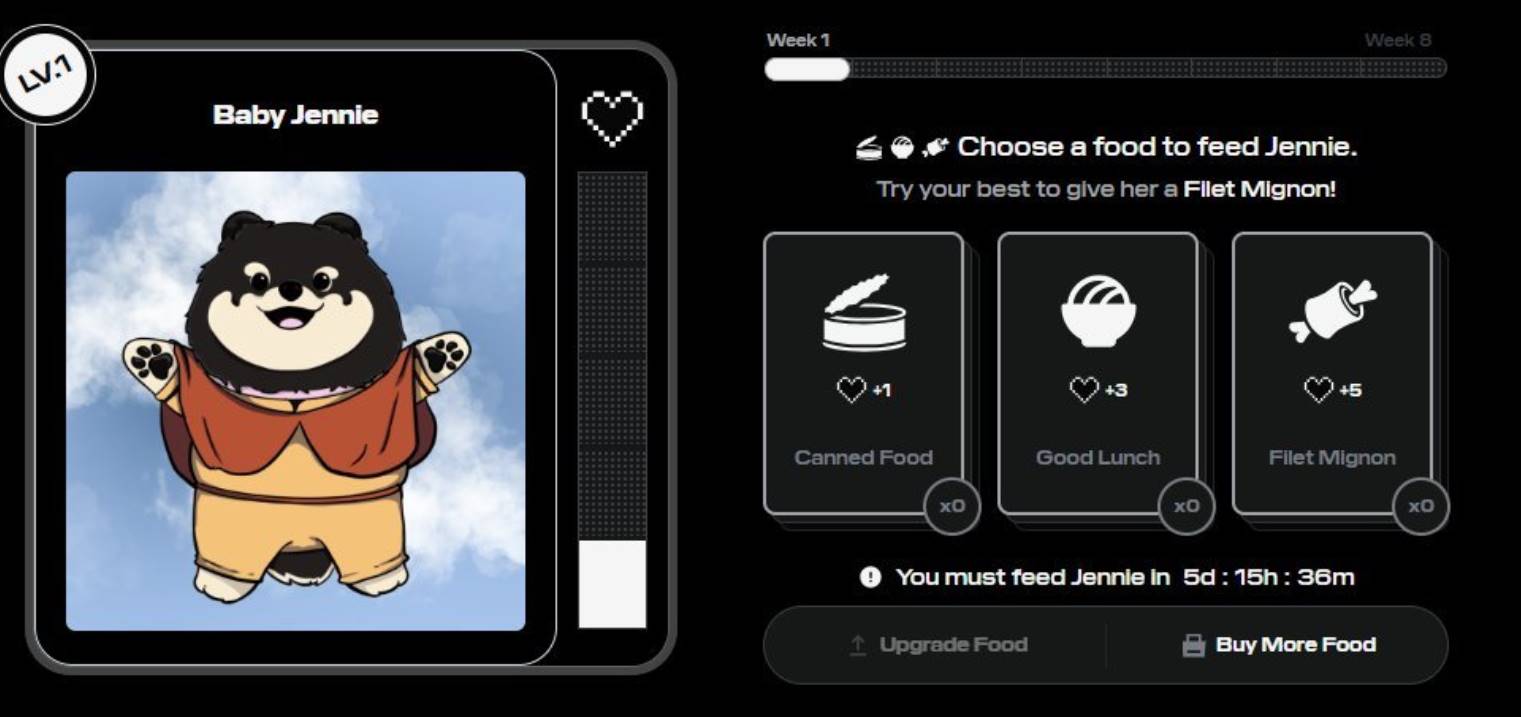
Airdrop farming is competitive, and projects like Initia will inevitably attract more hunters. But for well-funded projects with compelling narratives that address real market pain points, making maximum effort within one’s capacity remains the best path to expected returns.
Join TechFlow official community to stay tuned
Telegram:https://t.me/TechFlowDaily
X (Twitter):https://x.com/TechFlowPost
X (Twitter) EN:https://x.com/BlockFlow_News
 深潮TechFlow


