








Stacks Nakamoto Upgrade: A Butterfly Ready to Emerge
TechFlow Selected TechFlow Selected
Stacks Nakamoto Upgrade: A Butterfly Ready to Emerge
We can continue to monitor Stacks and observe whether it can truly become a Bitcoin L2, effectively utilizing the still-dormant BTC as a smart contract platform.
 Navigating Web3 tides with focused insights
Disclaimer: The content of this report reflects the author's views and is for reference only, not as advice to buy or sell tokens or use protocols. Nothing in this report constitutes investment advice or should be construed as such.
New Possibilities Emerging on the Bitcoin Network
In early 2023, the introduction of "Ordinals" to the Bitcoin network sparked a new debate over how block space should be used. That May, surging demand for BRC-20 tokens briefly overwhelmed Bitcoin’s network capacity, forcing Binance—the world’s largest centralized exchange—to temporarily halt Bitcoin withdrawals.
The term "Ordinals" comes from the word “ordinal,” meaning “sequential numbers.” It refers to a protocol created in January 2023 by Casey Rodarmor that modifies Bitcoin scripts to attach arbitrary data to the smallest unit of Bitcoin—“sats” (satoshis). Because inscriptions allow text, images, audio, video, and code to be stored directly on the Bitcoin blockchain, a wave of PFPs and NFTs has naturally emerged on Bitcoin, similar to what exists on Ethereum (Learn more).
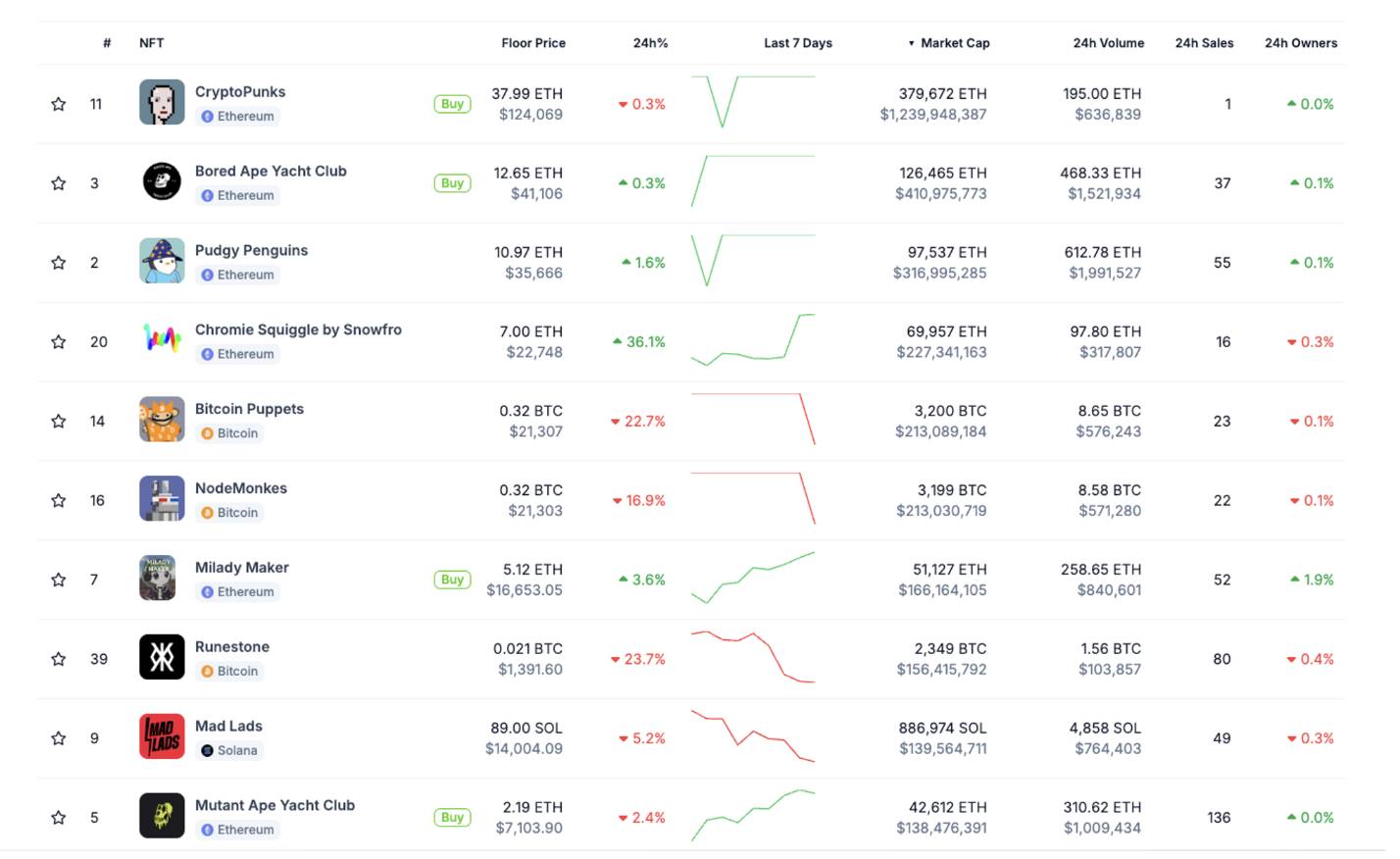
Top 10 NFT collections by market cap as of April 24; Source: Coingecko
Now, over a year after the emergence of Ordinals, three NFT projects built on Bitcoin have entered the top 10 NFT collections by market cap globally (NodeMonkes, Runestone, and Bitcoin Puppets), demonstrating Bitcoin’s potential as a viable smart contract platform.
Bitcoin L2 and Stacks
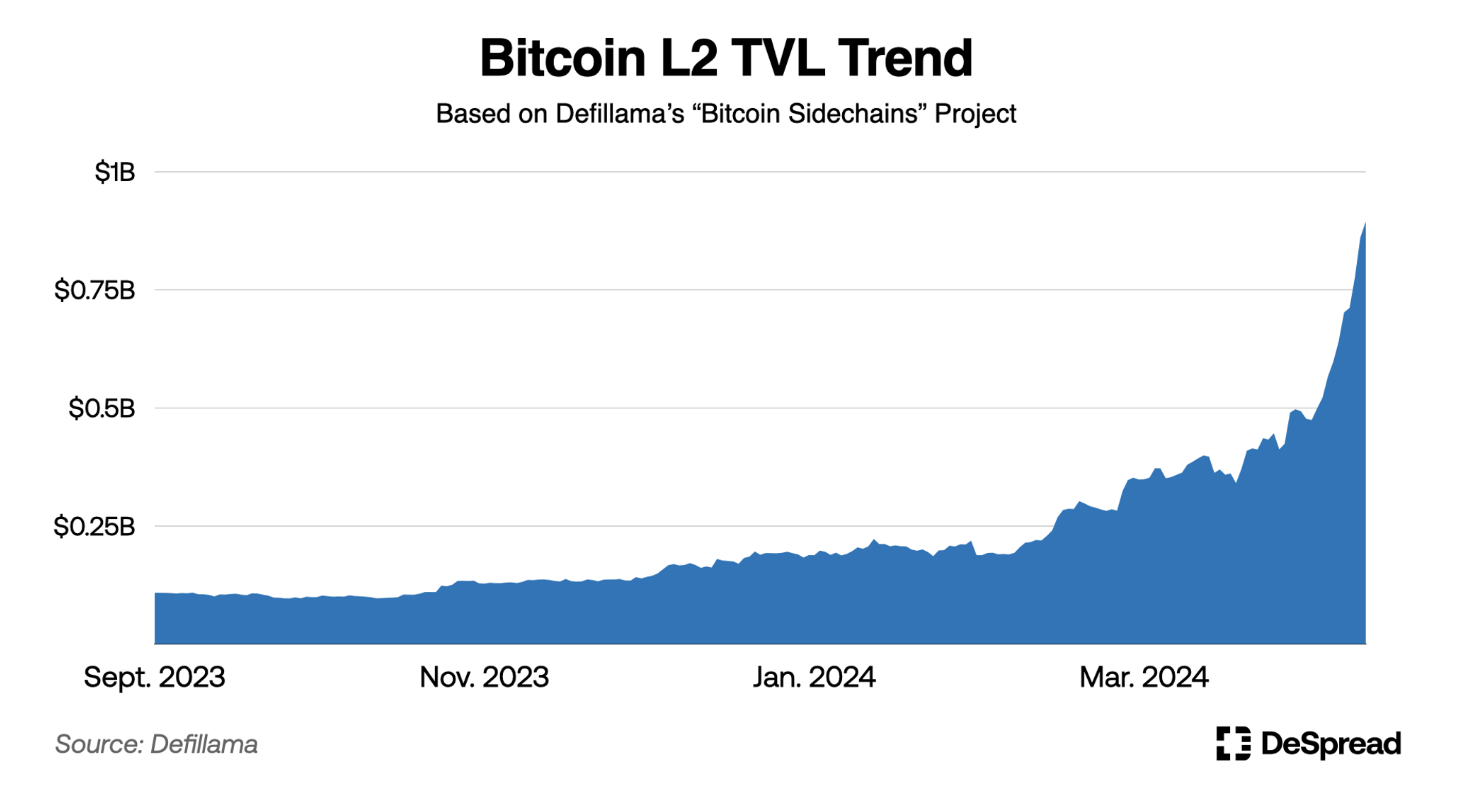
This momentum has also triggered a surge in Layer 2 (L2) projects on Bitcoin. According to DefiLlama, at the time of writing (April 15), 11 projects are categorized as “Bitcoin sidechains” with a total TVL approaching $900 million. While debates continue about whether these projects truly treat Bitcoin as their L1, the rapidly growing TVL and number of projects reflect increasing market interest in the Bitcoin narrative.
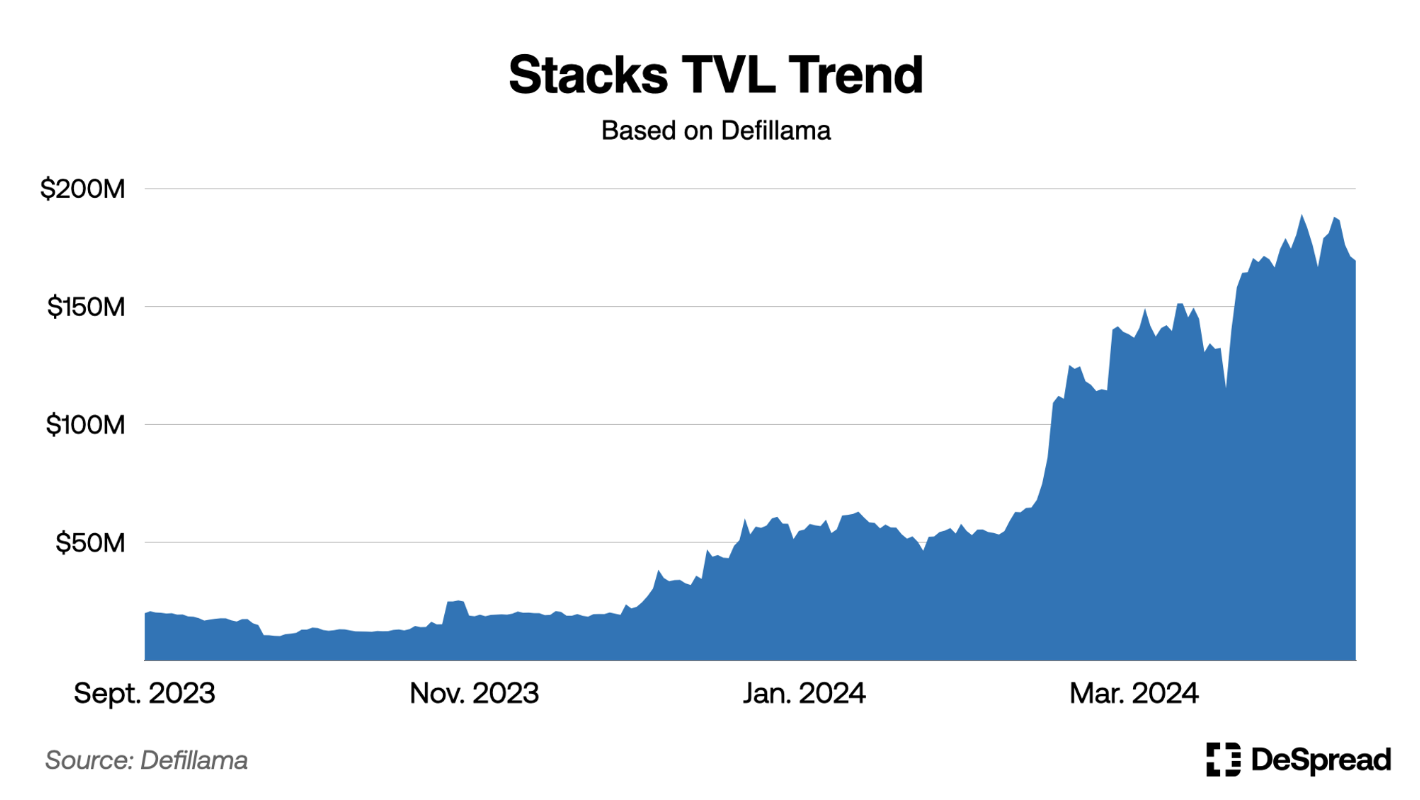
Among them, Stacks stands out for its recent developments. Not only is it an OG project launched in 2017, but since 2021 it has aimed to bring smart contracts to the Bitcoin network. Below, we explore Stacks’ current status and its upcoming major upgrade—“Nakamoto Upgrade.”
The Beginning of Stacks – Blockstack

Munib Ali’s TED talk video from 2016; Source: TEDx Talks
In 2017, Dr. Muneeb Ali completed his degree, published the whitepaper for Stacks (then called Blockstack), and successfully raised $52 million through a token sale on CoinList. Prior to that, he and his early team had already built a protocol and application named Onename directly on Bitcoin L1, enabling decentralized identities and profile pages on the Bitcoin network. These experiences helped shape the vision for Stacks in 2017 and motivated the team to create a more powerful platform.
Blockstack observed that the existing internet relies too heavily on centralized data storage and management, so it aimed to leverage blockchain technology to build a decentralized web where users own their data, creating a blockchain layer that allows developers to easily build dApps—similar to Ethereum.
In 2019, Blockstack’s ecosystem token, Stacks (STX), received approval from the U.S. Securities and Exchange Commission (SEC) under Regulation A+, raising $23 million. This was the first token sale approved by the SEC, drawing significant market attention.
From 2018 to 2020, the Stacks team focused on building solid infrastructure. Stacks is a cross-chain consensus blockchain seamlessly integrated with Bitcoin, designed to enable programmability on Bitcoin. The team also developed Clarity, a custom programming language for Stacks. During this period, Stacks secured funding from prominent investors including Union Square Ventures, Harvard Endowment, Winklevoss Capital, and Naval Ravikant.
Stacks 2.0
“I believe Bitcoin is the best, most decentralized monetary layer. Right now, 1% of all Bitcoin in circulation exists on Ethereum as wrapped Bitcoin (wBTC), which shows there’s demand for using Bitcoin within smart contracts. Instead of wrapping Bitcoin on some smart contract platform, why not bring smart contract functionality directly to Bitcoin?” — From ‘Bitcoin DeFi? It’s a Thing, Says Stacks Founder Muneeb Ali,’ Decrypt.
In January 2021, Blockstack launched the Stacks 2.0 mainnet, rebranding to the Stacks network. As highlighted in Muneeb Ali’s interview, Stacks 2.0 was designed to bring smart contract capabilities to Bitcoin without modifying Bitcoin itself. The chain inherits Bitcoin’s decentralization and security while adding smart contract functionality to improve scalability.
Proof-of-Transfer (PoX)
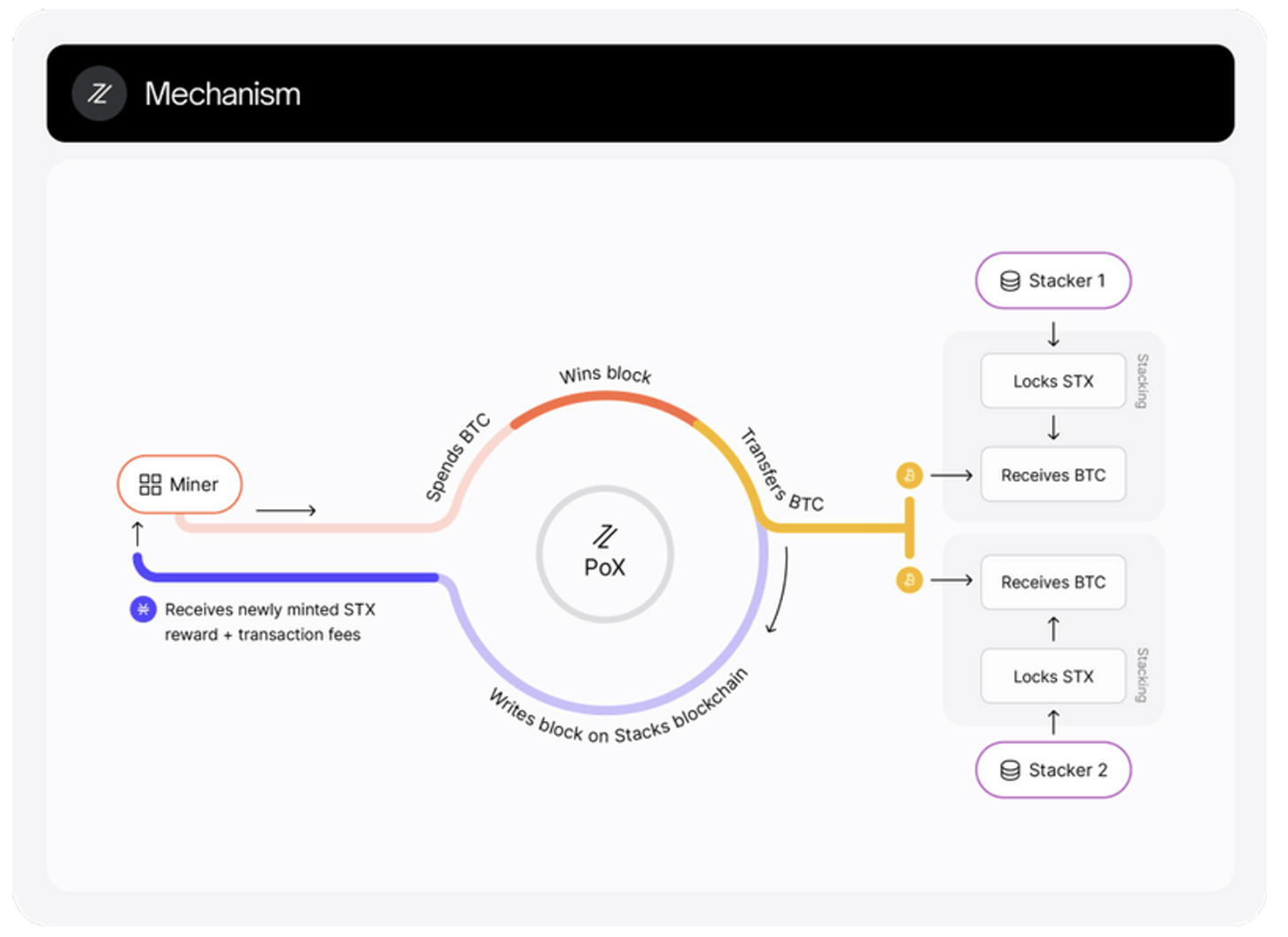
Proof-of-Transfer process; Source: stacks.co
Stacks' consensus mechanism—Proof-of-Transfer (PoX)—can be seen as an extension of Proof-of-Burn and is key to inheriting Bitcoin’s security. Proof-of-Burn is a consensus mechanism in PoW environments where miners “burn” cryptocurrency to mine.
Unlike Proof-of-Burn, where miners burn Bitcoin, in PoX, miners send Bitcoin to STX holders participating in the Stacking process. Miners can participate in mining by running Stacks nodes, which use the Bitcoin network as an anchor chain to generate and mine blocks. The PoX mechanism works as follows:
- Registration: Miners register as candidate miners by submitting consensus data to the network.
- Commitment: Registered miners participate in mining by sending Bitcoin to STX token holders.
- Election: A Verifiable Random Function (VRF) selects a miner; the elected miner creates a new block on the Stacks blockchain.
- Assembly: The selected miner creates the block and receives STX tokens as a reward.
The elected miner must record the hash of all new transactions on the Stacks chain into a Bitcoin block, completing the incentive system for both Bitcoin miners and Stacks participants (Stackers) via PoX. The “Stacking” operation is similar to “Staking” in Proof-of-Stake (PoS) networks, except that Stacking locks up STX to earn BTC rewards from the anchor chain. The specific roles of miners and Stakers are shown below:
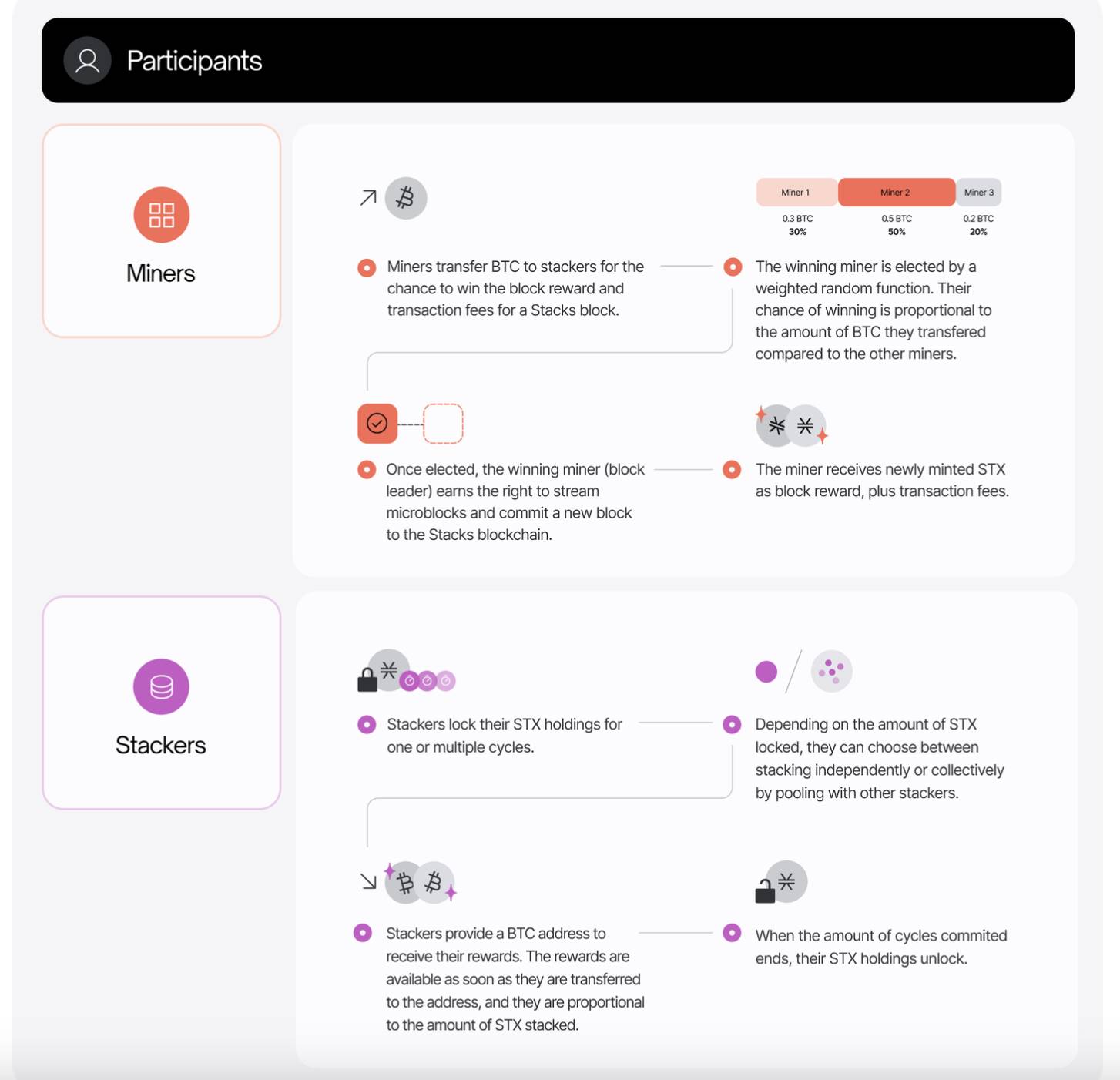
Roles of Miners and Stakers; Source: stacks docs
[Miner]
- Miners send BTC to Stakers to earn transaction fees and block rewards on Stacks.
- The probability of being selected via VRF depends on the proportion of BTC sent by each miner.
- The elected miner wins the right to create a new block and stream microblocks on the Stacks chain.
- The elected miner receives STX and transaction fees as block rewards.
[Stacker]
- Stackers lock their STX for a fixed period.
- They can choose to Stack independently or pool with other Stakers.
- Stackers provide their BTC address to receive BTC rewards, with odds proportional to the amount of STX locked.
- Locked STX will be unlocked after the predetermined locking period ends.
Is Stacks a Bitcoin L2?
The significance of Stacks 2.0 lies in enabling smart contract functionality on Bitcoin with the launch of its mainnet and the introduction of PoX. However, labeling Stacks as an L2 on Bitcoin remains controversial.
- Stacks 2.0 has its own native token and independent security budget, distinct from Bitcoin.
- Security budget: Refers to resources allocated to maintain network integrity, including mining rewards, operational costs, and network fees.
- Unlike traditional L2s in Ethereum and other ecosystems, assets are not deposited into or withdrawn from validators on L1.
Due to these factors, it’s difficult to classify Stacks 2.0 as a traditional L2. Yet, it’s also hard to call it a sidechain because all Stacks transactions must eventually settle on the Bitcoin network. This unique architecture led Stacks co-founder Muneeb Ali to describe it as “Layer 1.5” during a Decrypt interview in 2021.
Since Bitcoin wasn’t originally designed as a smart contract platform, efforts to introduce smart contracts or enhance scalability differ significantly from those on Ethereum and EVM chains. For deeper insights into distinguishing Bitcoin L2s, refer to Spartan Group’s December 2023 article, ‘BITCOIN LAYERS - Tapestry of a Trustless Financial Era.’
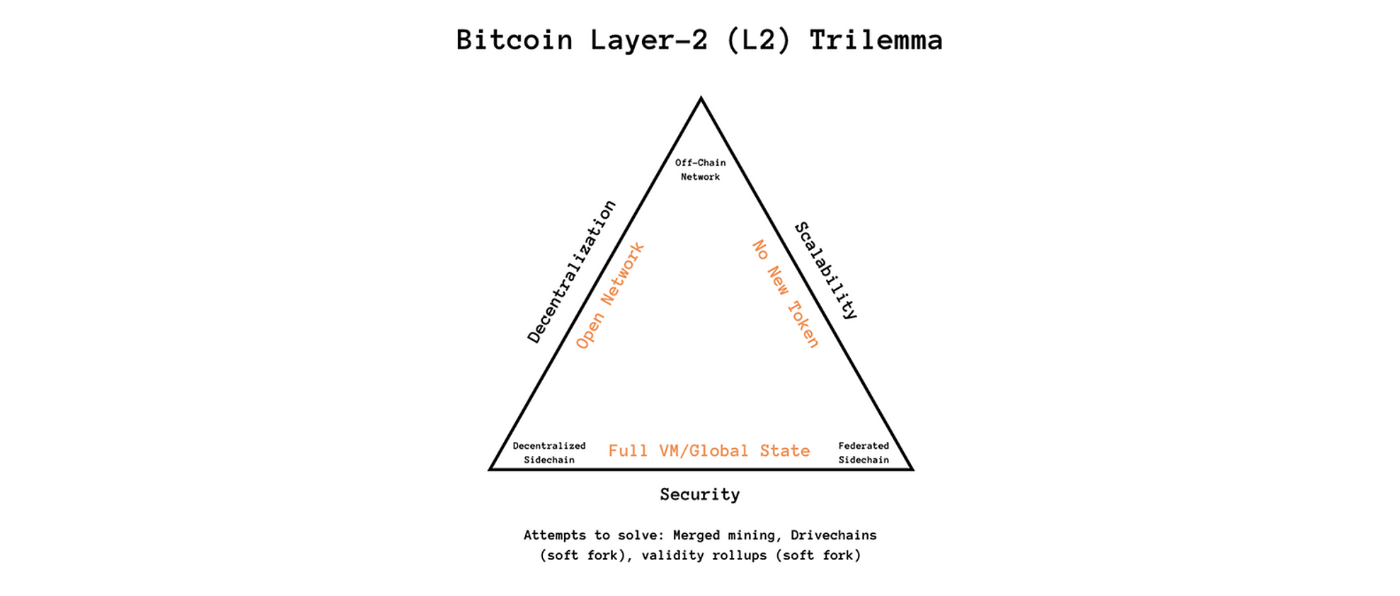
The Bitcoin L2 trilemma; Source: BITCOIN LAYERS — Tapestry of a Trustless Financial Era
As shown above, the Bitcoin L2 trilemma includes:
- Open Network: An open network rather than a consortium model.
- No New Token: No new token introduced.
- Full VM/Global State: Adoption of “Global State” instead of limited off-chain contract forms.
Stacks satisfies conditions 1 and 3 but not condition 2. In contrast, the Lightning Network satisfies 1 and 2 but fails condition 3 due to its use of “local consensus,” recording transactions on a peer-to-peer network separate from the main chain.
Towards Stacks 3.0: The Nakamoto Upgrade
Current Issues with Stacks
While Stacks’ unique architecture enables it to function as a smart contract platform on Bitcoin, it also introduces several challenges:
- Security Model
- Stacks has an independent security budget, defined by BTC payments from Stacks miners, differing from Bitcoin’s.
- This makes chain security highly dependent on Stacks miners’ budgets, increasing potential security risks.
- Performance and Scalability
- The connection between Stacks and Bitcoin (e.g., PoX) enhances decentralization and security but limits on-chain performance and scalability.
- Specifically, the block creation process tied to miner elections links Stacks’ block generation cycle to Bitcoin’s, resulting in high transaction confirmation latency.
- This is not only a UX flaw but also a root cause of difficulties in developing Stacks dApps.
- MEV Issues
- Bitcoin miners with significant hash power can censor commitment transactions (BTC transfers for STX mining) from other Stacks miners in their mined Bitcoin blocks, ensuring they capture Stacks rewards and fees.
Main Goals and Design Changes
Primary Objectives
The Nakamoto release is a planned major upgrade to the Stacks chain this year, aiming to resolve the above issues and enhance performance and security.
- Fast Blocks
- Transaction confirmation time reduced from tens of minutes to seconds.
- After the Nakamoto upgrade, separating the miner election process from block generation allows miners to produce multiple blocks before the next election.
- Transaction Security via Bitcoin Finality
- Transactions on Stacks are secured by Bitcoin’s hashing power.
- This means transactions settle on Bitcoin, guaranteeing immutability on the most secure network.
- Enhanced MEV Resistance
- Improves BTC bidding mechanism for STX rewards to mitigate MEV during miner elections.
- Changes the miner election algorithm so Bitcoin miners no longer gain advantages as Stacks miners.
Changes to Block Production and Stacker Roles
Previously, the ratio of Stacks blocks to Bitcoin blocks was fixed at 1:1, causing slow block production and confirmation times.
With the Nakamoto upgrade, a new “Tenure-based block production” mechanism will accelerate block generation. Stacks blocks will no longer correspond 1:1 with Bitcoin blocks. Instead, during a miner’s tenure (within one Bitcoin block interval), multiple Stacks blocks can be generated. This reduces block confirmation time to around 5 seconds, greatly improving scalability.
These newly generated Stacks blocks will be validated by Stakers. Previously, Stakers only contributed economic security by locking STX. After Nakamoto, Stakers become signers responsible for validating, storing, signing, and propagating every Stacks block produced during a miner’s tenure. The relationship between miners and Stakers is illustrated below:
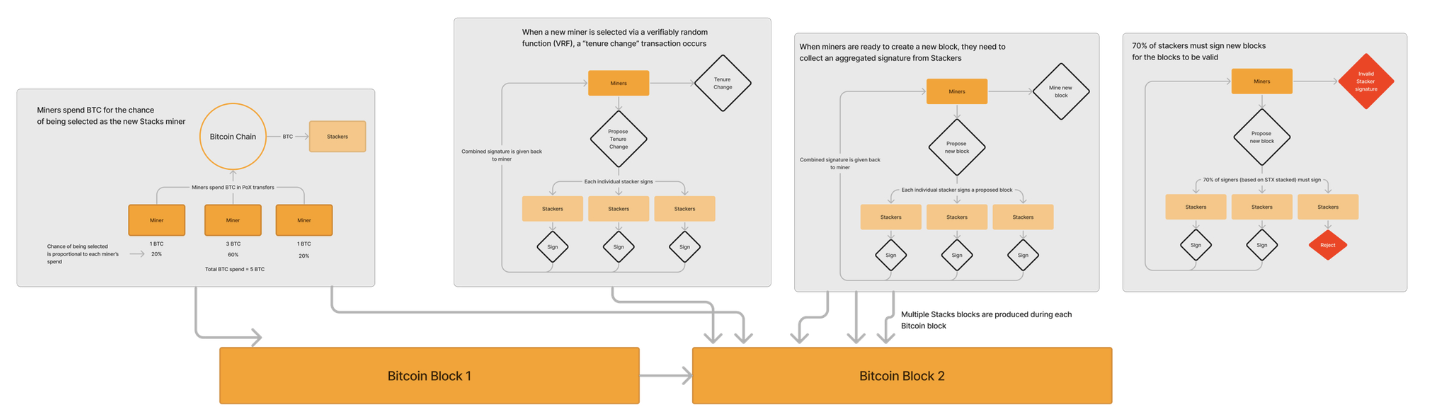
How miners and Stakers (or signers) interact post-Nakamoto; Source: stacks docs
- Miners send BTC to Stakers to participate in the Stacks miner election process.
- When a new miner is elected, a “tenure change” transaction grants them a new tenure.
- During block creation and validation, miners must collect signatures from Stakers every second.
- Block validation requires signatures from at least 70% of Stakers.
As shown, miners need Staker signatures to create the next block, and Stakers must perform signing operations to earn rewards under PoX and unlock their staked STX.
Changing Chain Structure for Bitcoin Finality
During tenure changes (miner elections), signers (Stackers) prevent miners from arbitrarily forking the Stacks chain by only signing the latest block. This means Stakers supervise miners, verify previously generated blocks, and ensure new blocks are built on the latest state.
Additionally, when miners submit transactions (tenure change transactions), they must include an indexed block hash containing the hash of the first Stacks block recorded during the previous miner’s tenure and the block’s own hash. This ensures the state of the Stacks blockchain is recorded in Bitcoin blocks, with each successive miner continuing this work, continuously anchoring Stacks history onto the Bitcoin network.
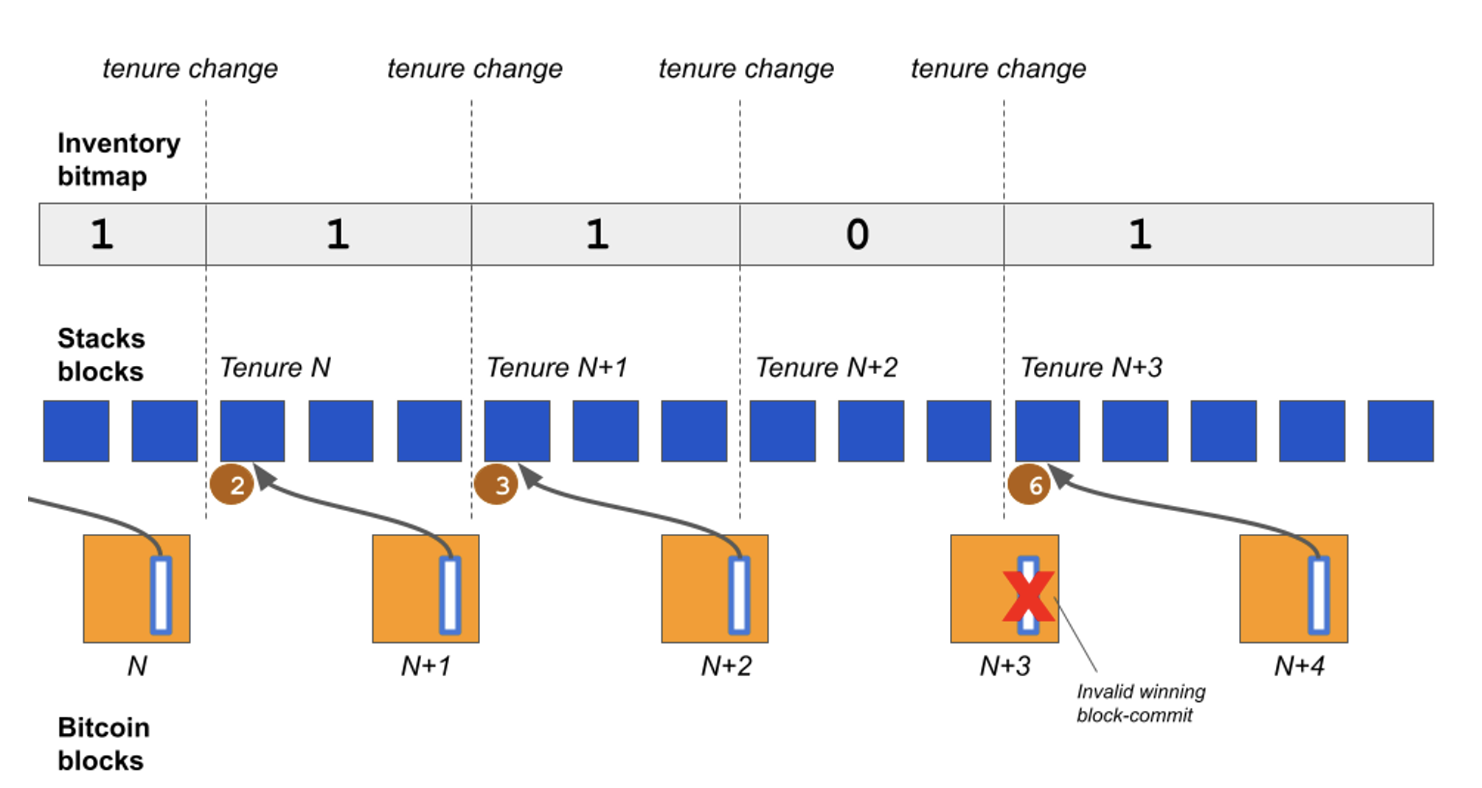
Relationship diagram between Bitcoin blocks, Stacks blocks, and tenure bitmaps; Source: stacks docs
Thus, as shown in the figure, transactions submitted during period N on the Stacks chain are only written into Bitcoin blocks during period N+2—meaning three tenure changes must occur before reversing a Stacks transaction becomes as difficult as reversing a Bitcoin block. From a user perspective, the chain structure resembles familiar L2s: transactions confirm in seconds, while settlement on Bitcoin takes about 30 minutes.
This system also brings positive changes to Stacks’ security budget. Block validation requires signatures from at least 70% of Stakers, raising the effective security budget to up to 70% of staked assets. Once transactions achieve finality on Bitcoin, the security budget effectively reaches 51% of Bitcoin’s mining power.
In summary, the post-Nakamoto Stacks mechanism:
- Miners must include an indexed block hash with the first block hash from the prior tenure when submitting tenure change transactions.
- Signers force miners to generate the next block based on the last signed block from the previous tenure.
- Transactions submitted in tenure N are written into Bitcoin blocks in tenure N+2, achieving Bitcoin finality.
After the Nakamoto upgrade, Stacks will see dramatically faster transaction speeds while achieving Bitcoin-level finality, ensuring data immutability. For users, this means faster confirmations; for the system, it means becoming closer to a true Bitcoin L2 that inherits Bitcoin’s security.
Solving Bitcoin MEV Issues
Prior to Nakamoto, MEV issues on Stacks occurred mainly as follows: Bitcoin miners with substantial hash power (e.g., F2Pool) could censor commitment transactions submitted by other Staking miners within Bitcoin blocks, adjusting their BTC bid amounts to ensure they captured block rewards and fees. This behavior reduced BTC rewards for Stakers and undermined trust in the mining process.
The Nakamoto upgrade introduces several new miner selection criteria to improve fairness in block mining.
- Recent Block Participation by Miners
- Miners must have participated in at least 10 of the most recent blocks to be eligible for selection during tenure change.
- This promotes stability in the miner community and prevents attempts to steal blockchain rewards.
- Median of Past Bids Method
- The probability of being selected is calculated based on the median of all BTC bids recorded in the past 10 blocks.
- This prevents miners from gaining block rewards by submitting outlier bids.
- Absolute Bid Total
- The miner selection process uses stable economic standards based on the absolute sum of bids, rather than volatile variables influenced by immediate mining conditions.
By introducing these anti-MEV measures, the Nakamoto upgrade will enhance transparency and trust in the Stacks blockchain mining process.
Nakamoto Upgrade Roadmap
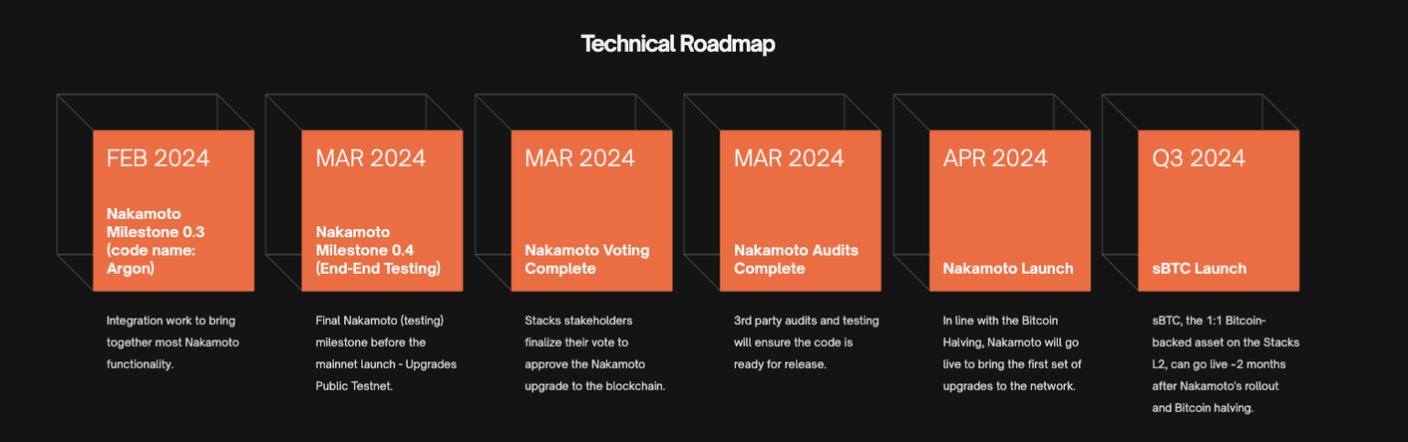
Nakamoto Upgrade roadmap; Source: nakamoto.run
Since the release of the sBTC and Nakamoto whitepapers at the end of 2022, the Stacks Foundation and developers have been working extensively on the Nakamoto upgrade. As shown above, since February 2024—when Nakamoto features were finalized and integrated into the testnet (Nakamoto Milestone 0.3, codename Argon)—progress has been ongoing. The first phase of the Nakamoto upgrade has already launched on mainnet, with subsequent phases rolling out gradually.
The Nakamoto upgrade consists of two phases, each involving a hard fork. The process is split into “Instantiation” and “Activation” stages, allowing time for final adjustments like bug fixes before full feature activation, minimizing disruptions from chain environment changes.
Original Plan
- Phase One: Instantiation (Starting April 22)
- POX-4 (an upgraded version of the Proof-of-Transfer mechanism) and most Nakamoto code will be deployed, but features remain inactive.
- Provides at least two Stacking cycles for signers and partners to register POX-4 contracts. This period verifies correct block validation by registered signers before proceeding to activation.
- Phase Two: Activation (Expected between May 15–29)
- Deploys the full Nakamoto update—including signer-based systems, fast blocks, and Bitcoin finality—and activates Nakamoto rules.
- Nakamoto rules define the overall logic distinguishing pre- and post-upgrade states.
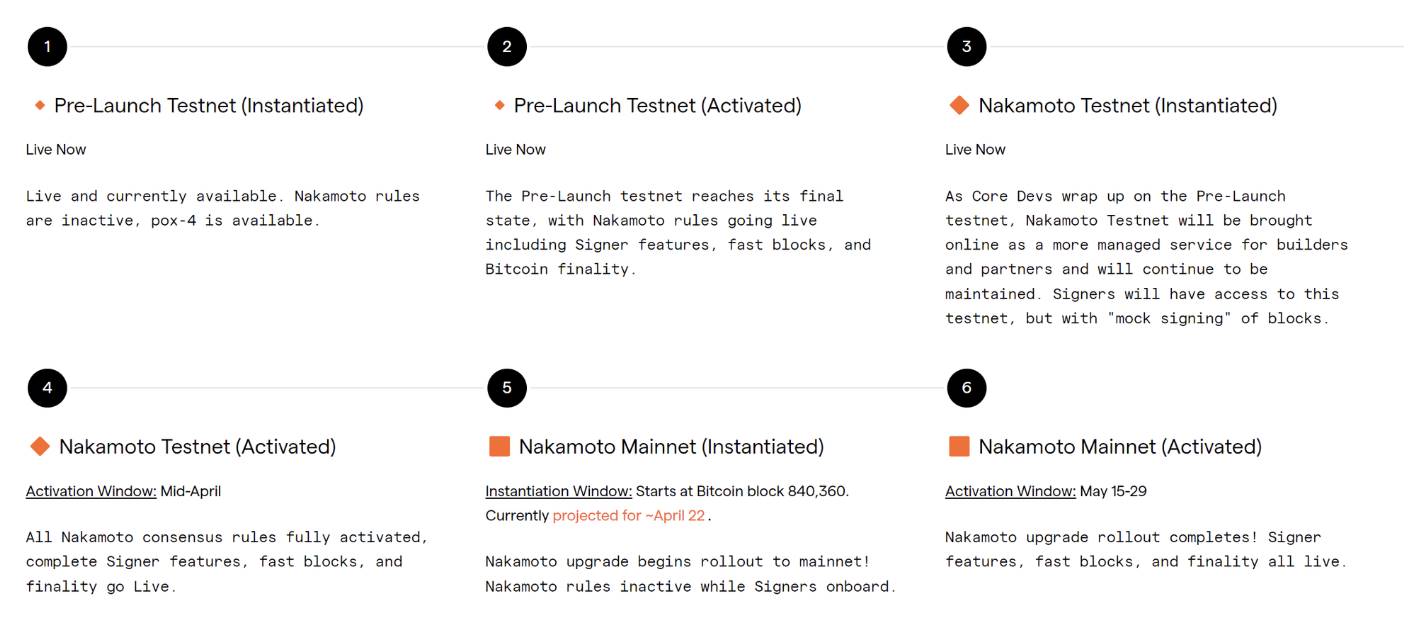
Nakamoto Release Schedule; Source: Nakamoto Launch: Testnet and Mainnet Rollout Overview
Updated Timeline
Phase one (Instantiation) began on April 22. Assuming no critical bugs are found, phase two was initially expected to start mid-May. However, after initiation, flaws were discovered in the Signer Resiliency/Recovery system, prompting the Stacks Foundation to announce a revised plan on May 1. Key updates:
- The initial activation phase included only a basic signer recovery system.
- An advanced signer recovery system was originally scheduled for deployment by end of 2024, after activation. But progress during instantiation revealed the need for advanced recovery earlier.
- Therefore, an additional 8 weeks of development will precede activation: recovery system code completion by July 15, Nakamoto version activation on August 28.
- Work items
- Enhance miner recovery from signer timeouts and errors
- Improve procedures for signer response and key loss scenarios
- Refine miner tenure creation and extension methods
- Improve prevention of network uncertainty and flash block handling
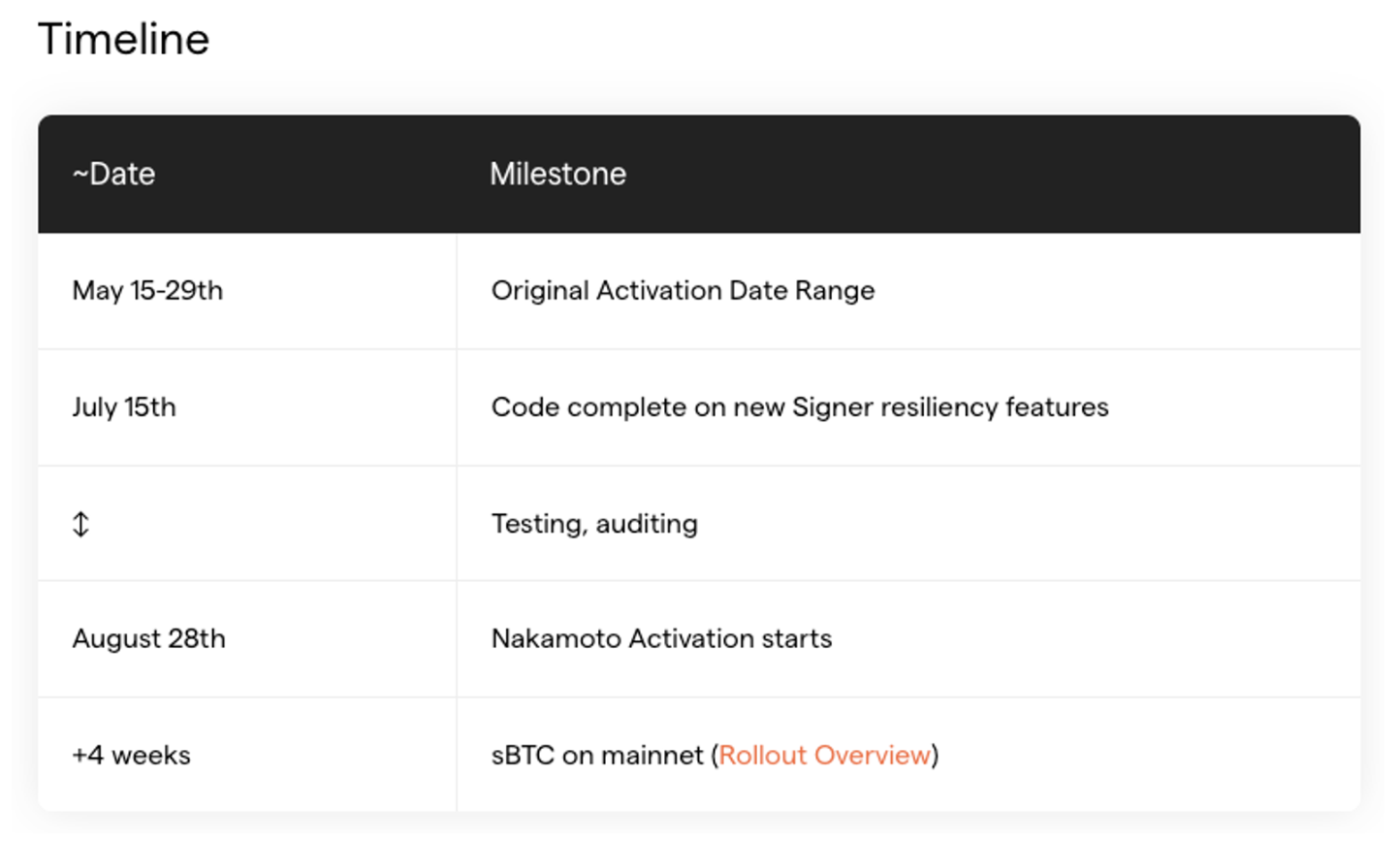
Revised Nakamoto Release Timeline; Source: stacks.org
Under the revised plan, code development will finish by July 15 (8 weeks later), and the activation phase—originally planned for mid-May—will begin approximately three months later on August 28. The good news is that the sBTC upgrade, originally scheduled for Q3, will not be delayed and is expected to follow four weeks after activation begins.
sBTC – The Final Piece for a True L2
The Nakamoto upgrade is expected to fully activate in May, aiming to drastically improve Stacks’ performance and achieve Bitcoin finality for Stacks blocks. However, to truly become a Bitcoin L2, Nakamoto is only half the journey.
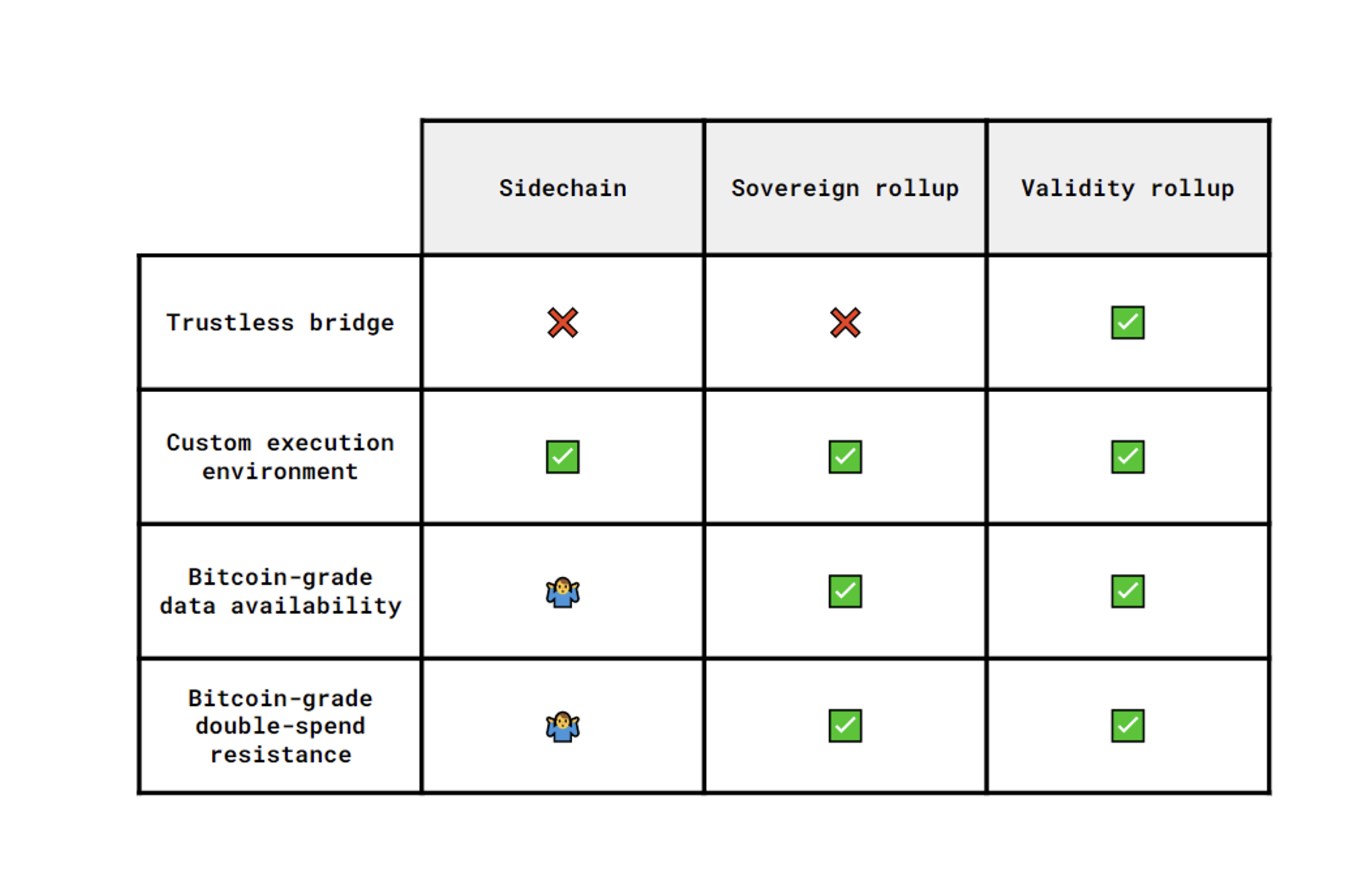
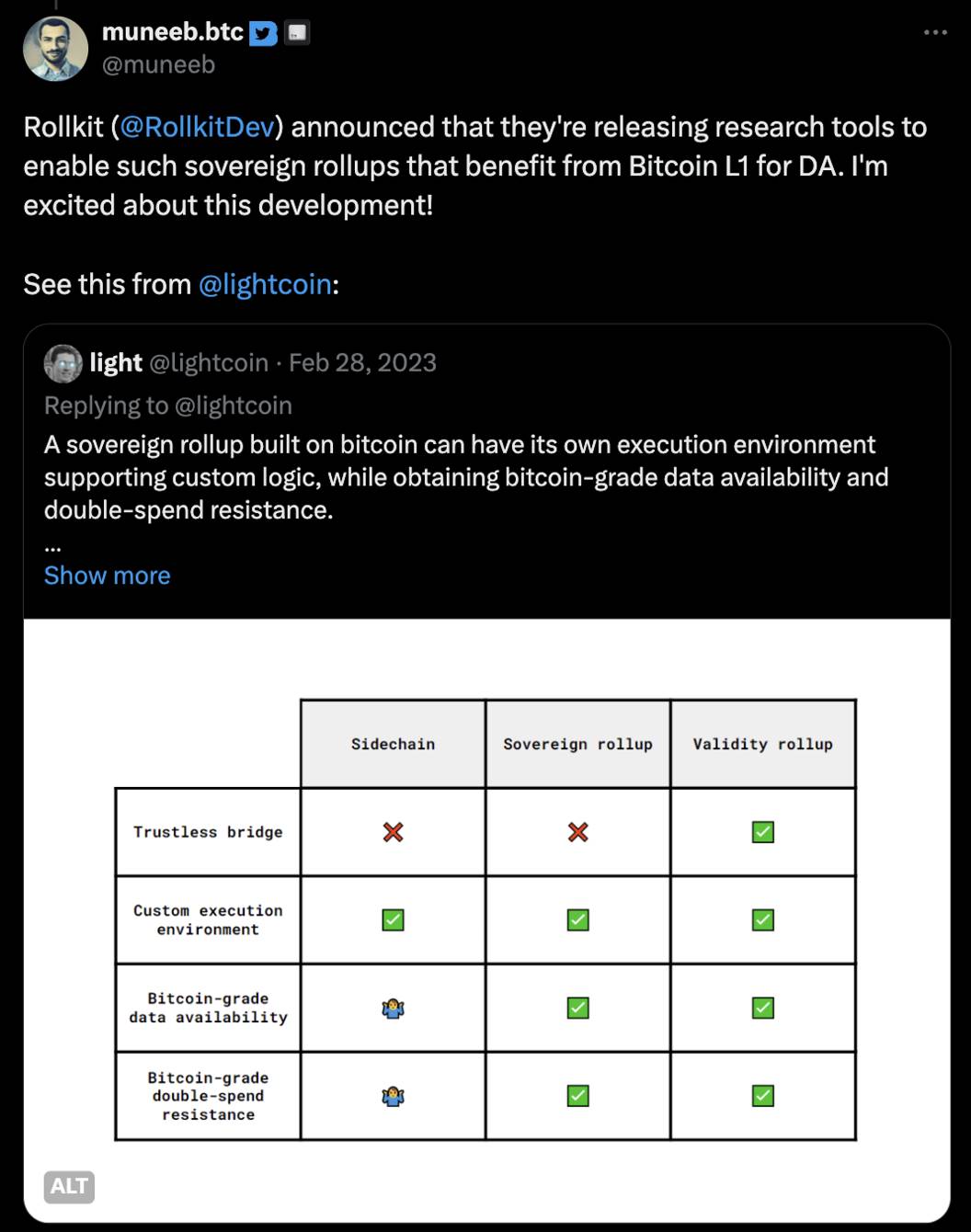
Criteria for distinguishing Bitcoin L2s; Source: light tweet
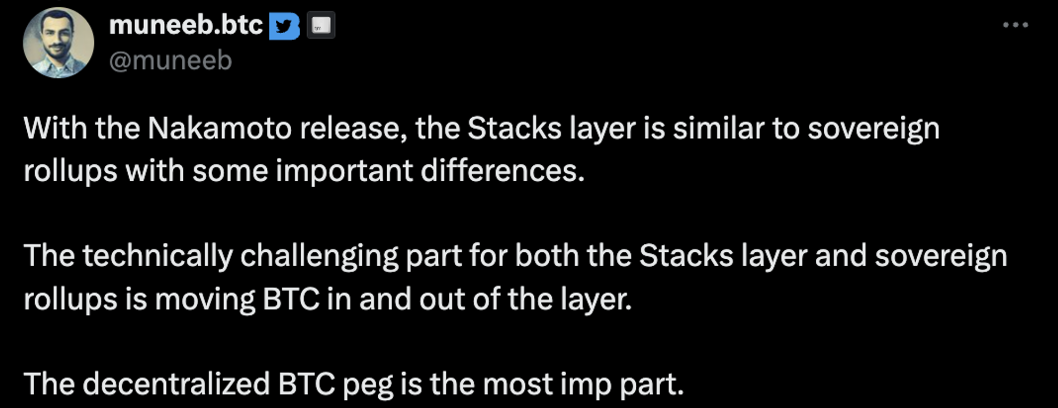
Post-Nakamoto, Stacks will resemble a Sovereign Rollup environment. But only by bringing Bitcoin’s native asset BTC onto the chain and utilizing it can Stacks function as a true Bitcoin smart contract platform and L2. As Stacks founder Muneeb Ali noted in a tweet, moving BTC in and out of a Bitcoin Layer is the hardest part, and sBTC represents the closest solution to a trustless bridge—a decentralized public group of signers enabling BTC pegging without modifying Bitcoin L1.
sBTC bridges BTC assets between Bitcoin and Stacks based on two core principles:
- 1:1 Redeemability: sBTC and BTC can always be redeemed at a 1:1 ratio unless the Stacks chain halts.
- Open Membership: Anyone can join the sBTC protocol; no centralized entity controls BTC.
Previously, assets like xBTC and aBTC existed on Stacks, similar to wBTC on Ethereum, but relied on centralized custodians and multisig bridges. In contrast, sBTC uses Stakers as a group of signers under the Proof-of-Transfer mechanism to achieve trustless BTC bridging.
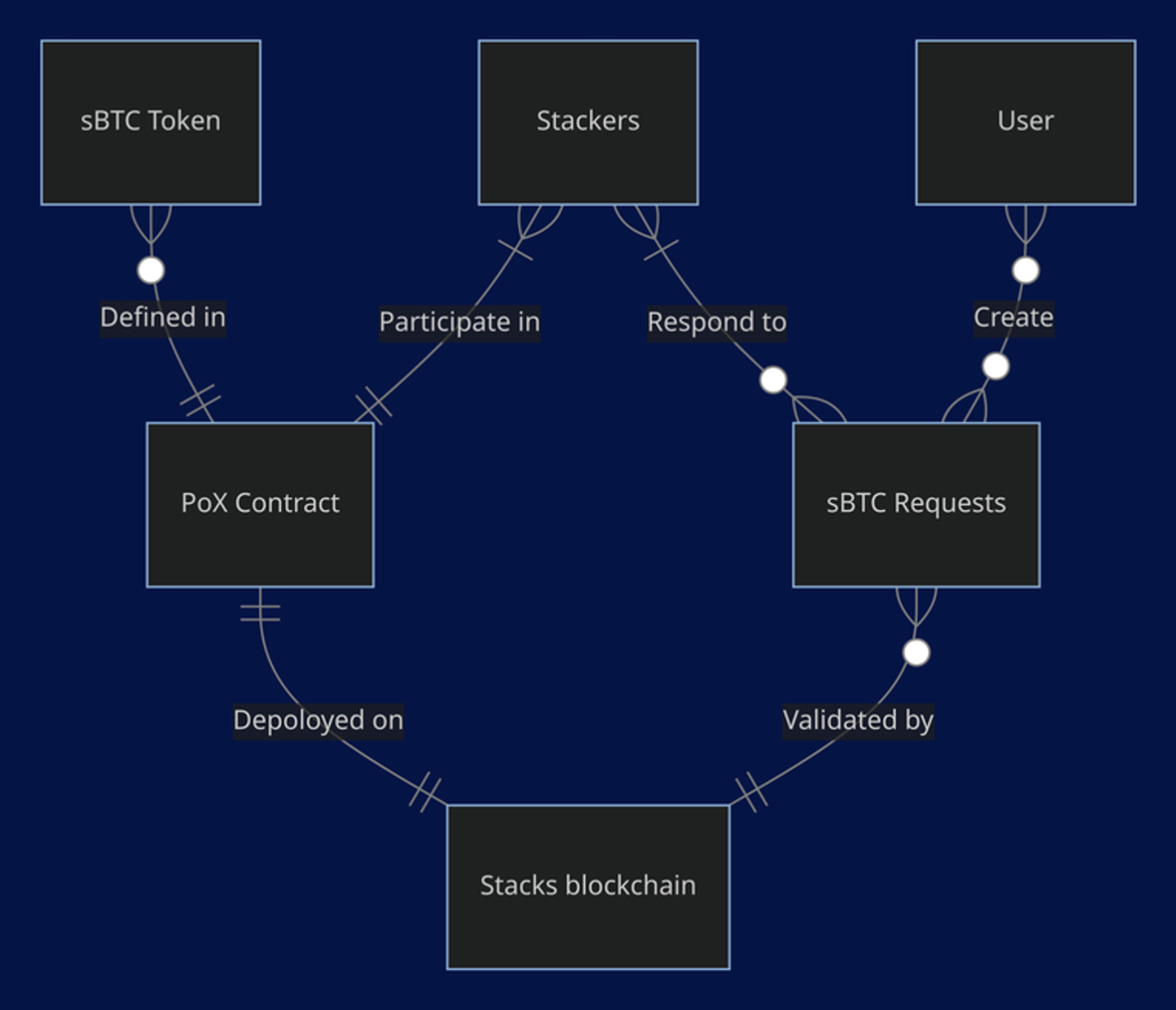
How sBTC works (1); Source: stacks docs
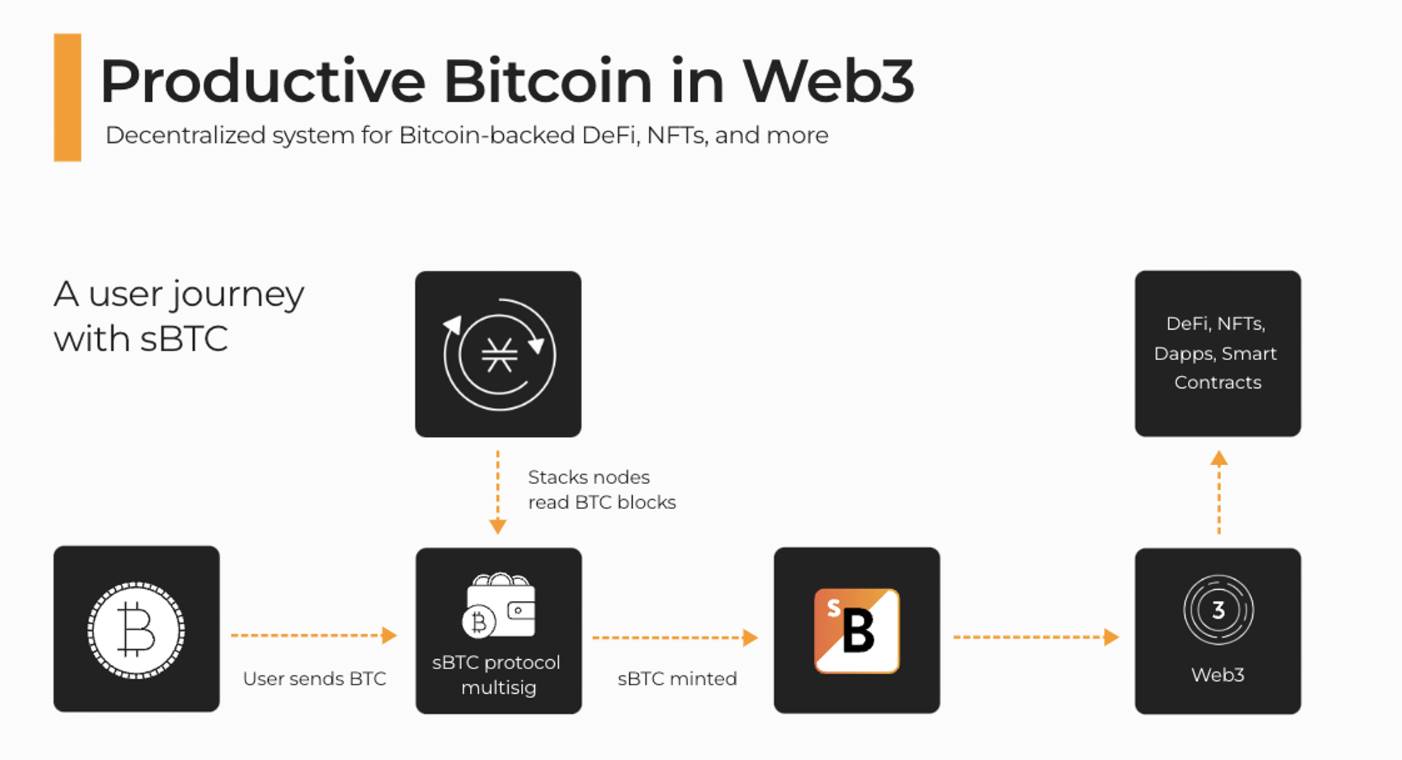
How sBTC works (2); Source: sbtc.tech
The sBTC update is planned for Q3 2024. Together, the Nakamoto upgrade and sBTC represent pivotal milestones in Stacks’ ambitious goal to become Bitcoin’s preferred smart contract platform. We can continue watching Stacks to see if it truly evolves into a Bitcoin L2 and unlocks the potential of the vast amount of dormant BTC.
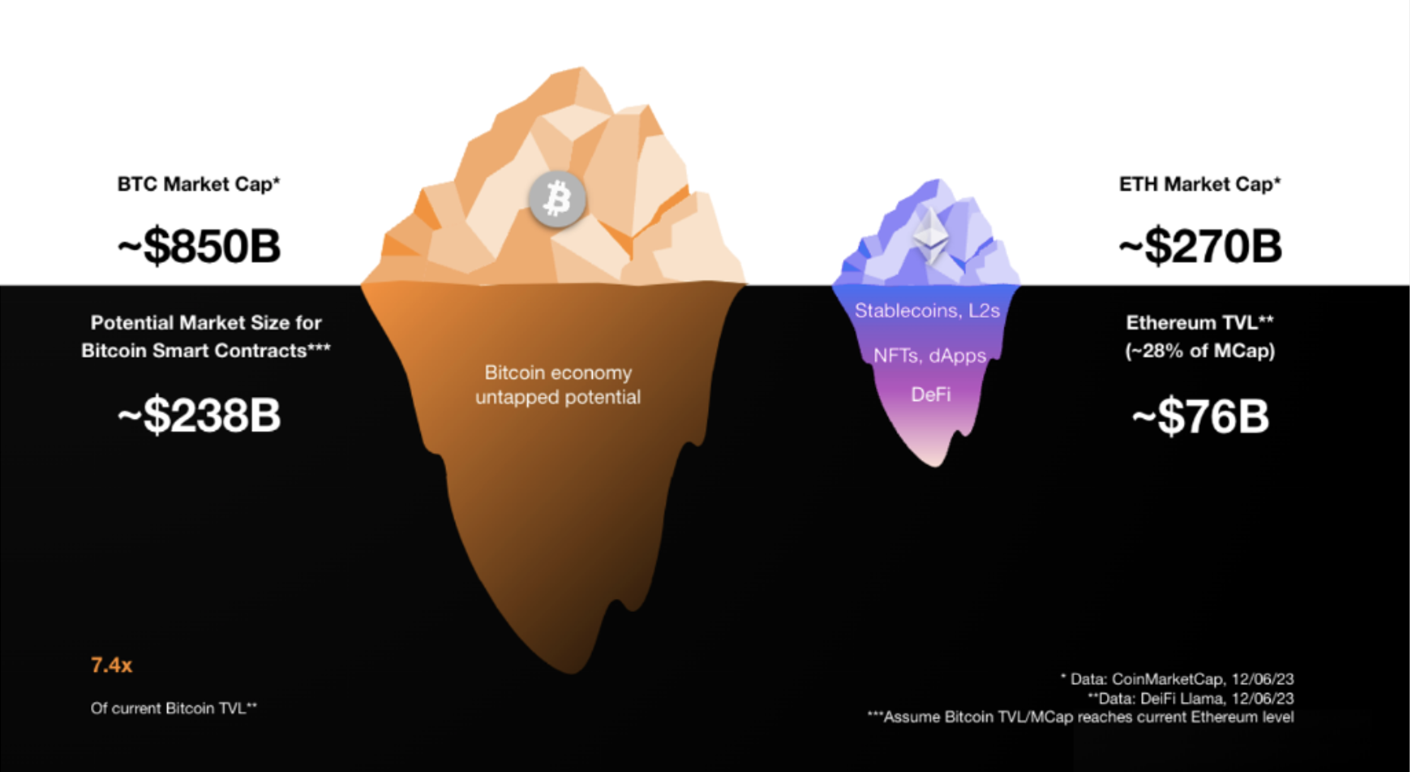
Source: BITCOIN LAYERS — Tapestry of a Trustless Financial Era
<References>
- Stacks docs
- Stacks: A Bitcoin Layer for Smart Contracts
- sBTC: Design of a Trustless Two-way Peg for Bitcoin
- Jeff Benson and Daniel Roberts, Bitcoin DeFi? It’s a Thing, Says Stacks Founder Muneeb Ali, Decrypt
- Katelyn Peters, Blockstack (Stacks): What it is, How it Works, FAQ, Investopedia
- muneeb.btc tweet
- light tweet
- Stacks, A Showcase For Stacks Nakamoto Release Transactions
- Stacks, What’s Next for Stacks After Nakamoto Upgrade
- The Spartan Group, Bitcoin Layers: Tapestry of a Trustless Financial Era
- Mitchell Cuevas, Nakamoto Activation: 8 Weeks of Additional Development Time Expected, Stacks Foundation
Join TechFlow official community to stay tuned
Telegram:https://t.me/TechFlowDaily
X (Twitter):https://x.com/TechFlowPost
X (Twitter) EN:https://x.com/BlockFlow_News
 @DeSpreadTeam


