








Binance Labs Invests, A Deep Dive into Stacks Lending Market Zest
TechFlow Selected TechFlow Selected
Binance Labs Invests, A Deep Dive into Stacks Lending Market Zest
The business model hasn't seen significant innovation, but the Stacks ecosystem has considerable market potential, coupled with investment from Binance Labs, making it具有一定关注价值.
 Navigating Web3 tides with focused insights
By Nan Zhi, Odaily Planet Daily
On May 13, Zest Protocol announced the completion of a $3.5 million seed round led by Tim Draper and participated by Binance Labs. The protocol leverages Stacks' Nakamoto upgrade and cross-chain asset sBTC to deliver fully native lending services on the Bitcoin network. Given that Binance Labs has made only a handful of investments in the Bitcoin ecosystem in recent years, does Zest stand out? In this article, Odaily Planet Daily breaks down Zest's business model.
Understanding Zest
Founded in 2021, Zest launched the prototype of Zest Protocol in Q2 2023 and completed auditing in Q4. It will launch native Bitcoin lending services aligned with Stacks’ upcoming Nakamoto upgrade.
Zest’s Lending Model
Existing lending solutions on Stacks largely rely on centralized entities, where lenders are typically trusted committees or custodial consortia. These models lack transparency and incur additional fees from centralized intermediaries, making lending economically inefficient.
The upcoming Nakamoto upgrade for Stacks addresses these centralization issues, enabling Zest Protocol to build truly native Bitcoin-based lending. But what exactly is the Nakamoto upgrade?
Nakamoto is a milestone upgrade for Stacks that reduces block times to approximately 5 seconds (down from ~10 minutes or more, previously synced with Bitcoin). It also introduces sBTC—a secure, efficient wrapped version of Bitcoin natively integrated into Stacks’ consensus mechanism. Previously, depositing BTC functioned like depositing funds with a centralized institution, receiving a similarly named token issued separately on the network. With the upgrade, sBTC enables decentralized, trustless two-way pegging, allowing BTC to move freely between the Bitcoin mainnet and Stacks.
With this upgrade, Stacks gains high BTC liquidity and improved network performance. Zest will leverage this liquidity to power its lending operations. Users can bridge native Bitcoin to obtain sBTC and deposit it into Zest pools to earn yield.
Zest’s BTC liquidity is divided into two types of pools: lending pools and earn pools. The former operates similarly to conventional lending models using a pool-to-pool structure, where users borrow or lend within designated currency pools and pay or receive interest accordingly.
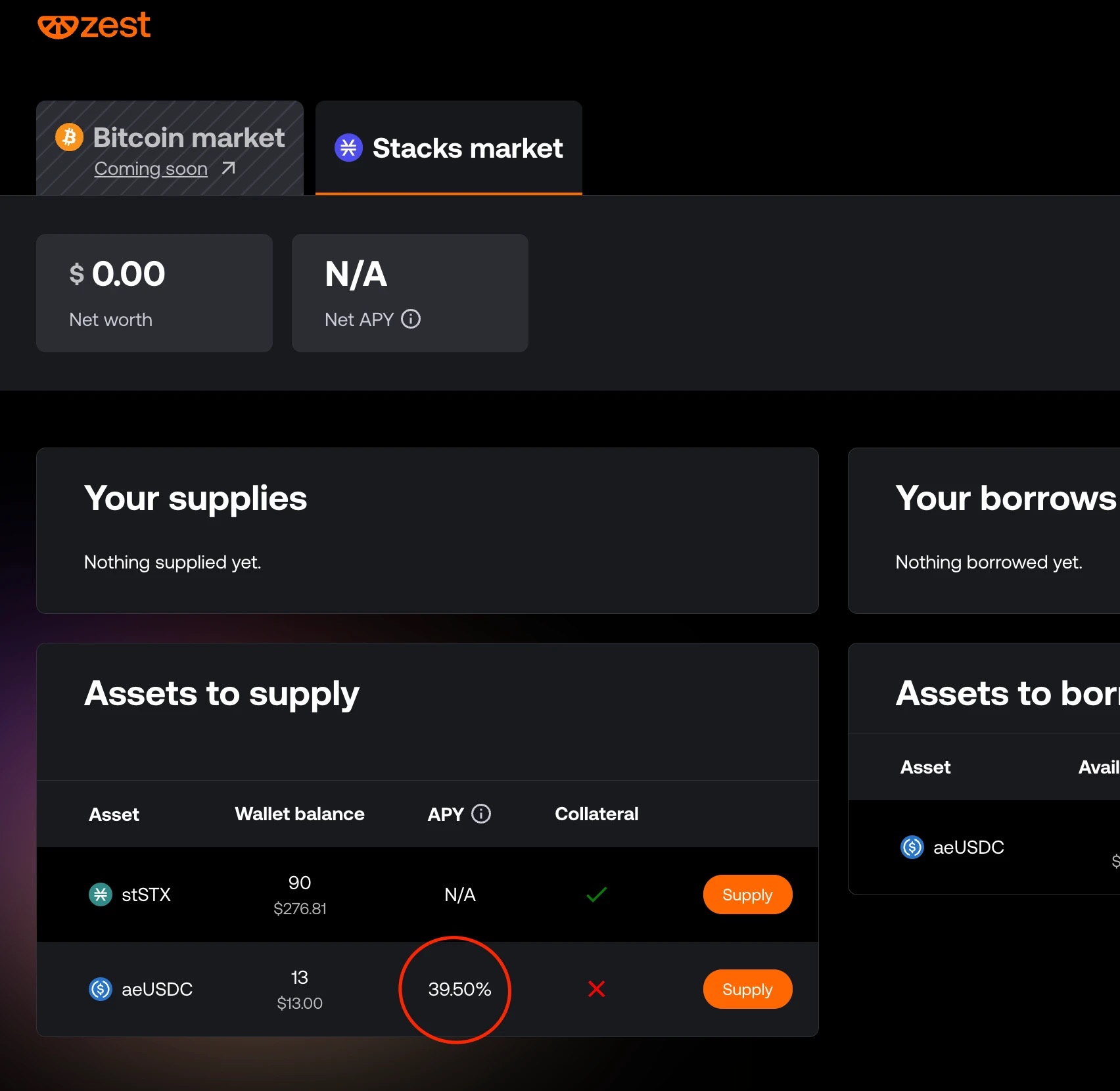
In the earn pool, users participate solely as lenders. Zest introduces a third-party role—Pool Delegates—who are credit specialists responsible for launching and managing liquidity pools. These delegates conduct due diligence and negotiate loan terms with borrowers. They assess borrowers’ reputation, expertise, and track record to determine appropriate loan conditions. Once a borrower and delegate agree on interest rates and collateral ratios, the delegate funds the loan from their managed pool.
Borrowers in the earn pool are limited to institutional participants such as market makers accepting Bitcoin payments, exchanges, centralized lending platforms, miners, and enterprises. Borrowers must first contact a pool delegate, join a permissioned whitelist, create a dedicated loan vault, deposit assets, and then submit a loan request. Notably, the earn pool allows borrowers to extend loans—by signing a new contract before repayment is due, they can roll over the loan upon paying accrued interest.
Funding Overview
On May 13, Zest Protocol closed a $3.5 million seed round led by Tim Draper, with participation from Binance Labs, Trust Machines, Flow Traders, Hyperithm, Bitcoin Frontier Fund, DeSpread, Tykhe Block Ventures, Asymmetric, Primal Capital, Gossamer Capital, and Scimitar Capital. This marks its first and only funding round to date.
Binance Labs has been selective in its Bitcoin ecosystem investments. Recent examples include BounceBit on April 11 and Babylon on February 27 this year, with earlier involvement in Lorenzo Protocol at the end of 2022—highlighting the rarity of such investments.
He Yi commented on the investment: "Zest Protocol’s technology meets the needs of Bitcoin holders and borrowers, unlocking programmability and interoperability potential for Bitcoin. At Binance Labs, we’re always looking for industry pioneers—we look forward to seeing how Stacks’ Nakamoto upgrade accelerates Zest Protocol’s growth."
Tycho Onnasch, founder of Zest Protocol, said: "We aim to redefine Bitcoin lending. We're here to complete a long-overdue mission—moving the Bitcoin lending market on-chain, where it belongs."
Conclusion
While Zest’s business model isn’t groundbreaking, its integration with the underdeveloped yet highly watched Stacks ecosystem offers significant market potential. Combined with the endorsement from Binance Labs, Zest warrants attention.
Join TechFlow official community to stay tuned
Telegram:https://t.me/TechFlowDaily
X (Twitter):https://x.com/TechFlowPost
X (Twitter) EN:https://x.com/BlockFlow_News
 Odaily







