Who's leading the SocialFi race: Friend.tech, Farcaster, or Phaver?
TechFlow Selected TechFlow Selected
Who's leading the SocialFi race: Friend.tech, Farcaster, or Phaver?
Friend.tech has once again sparked market frenzy with its V2 version—can it finally escape the SocialFi Ponzi trap?
 Navigating Web3 tides with focused insights
Author: HAMSTER
Last year, Friend.tech led the SocialFi sector for a time. However, due to uncertainty around its token launch and the unsustainable nature of its "Fi" attributes, it eventually cooled down. Recently, the platform has reignited market enthusiasm with its innovative V2 version. Can Friend.tech now escape the Ponzi trap commonly associated with SocialFi?
V1 Flaws Analysis
Friend.tech's main feature revolves around accessing exclusive content or interactions via "keys," whose pricing follows a "bonding curve" mechanism—prices increase exponentially as more keys are purchased. The specific formula is a quadratic equation: the price of the next key = (current number of keys)2 / 16000 × 1 ETH.
The original intent of this model was to create a speculative environment where early buyers could enter at low prices, and rising participation would gradually push prices upward, incentivizing early investment and market activity. However, both buying and selling incur a 10% fee, making it difficult for new users to join at higher price levels. Especially when the market nears saturation, the cost for newcomers becomes prohibitively high—they require over 20% price growth on subsequent keys just to profit, posing a significant challenge to long-term sustainability. Moreover, Friend.tech’s bonding curve is excessively steep, introducing substantial risk. When user engagement declines, key values can plummet rapidly, potentially triggering market collapse.
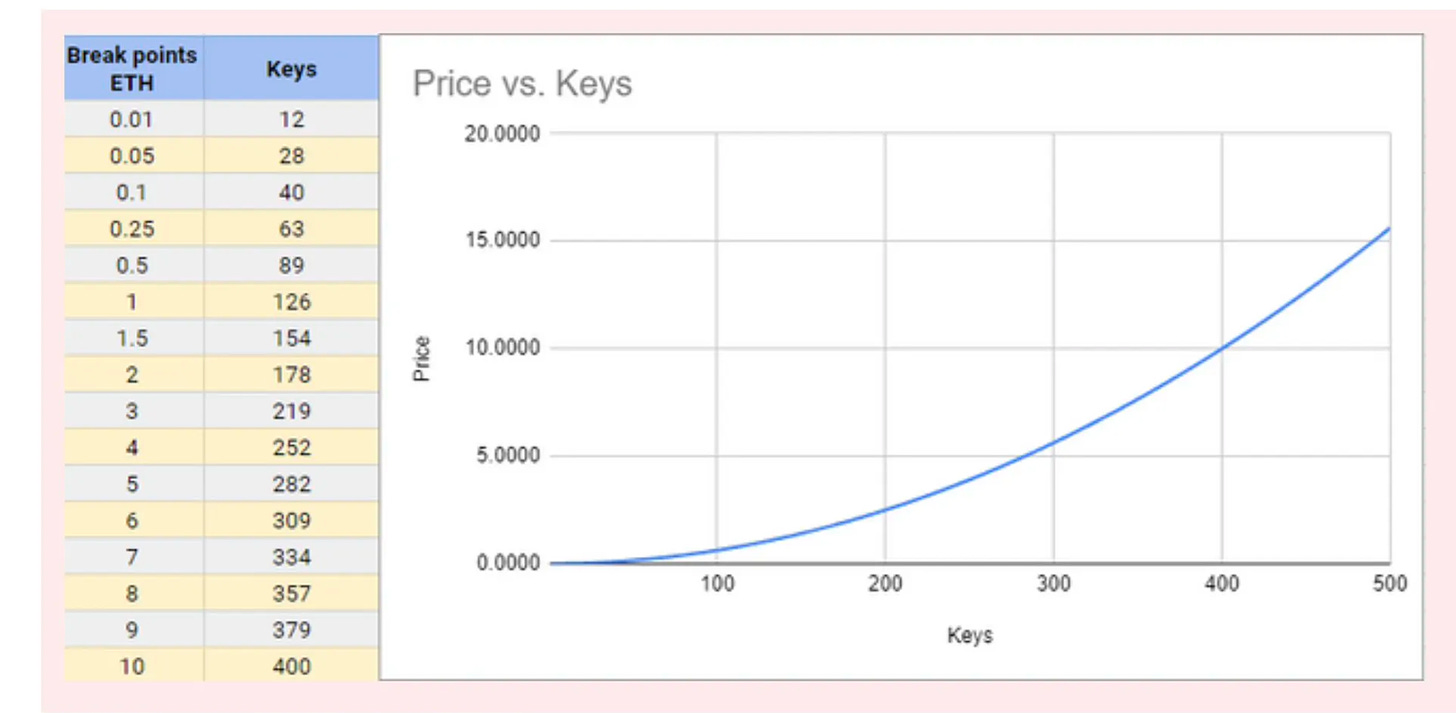
Image source: Mirror (Based on Toschi)
While the bonding curve model encourages early participation, it does not inherently support long-term stability or sustained user engagement. Initially, community members supported each other, creating a (3,3) cooperative spiral. But once market instability occurred or some users secretly sold their keys, the expected positive feedback loop quickly reversed, reducing community activity and diminishing the platform’s overall appeal and vitality—this explains why the FT community eventually quieted down.
V2 Mechanism Breakdown
Friend.tech v2 introduces several innovative features and an enhanced token model aimed at boosting user engagement and platform utility. A standout addition is the "Money Club" feature—a space similar to a paid community where each new member pays an increasingly higher entry fee. This design strengthens monetization while promoting active interaction and enhancing content creators’ value. Each Club’s president is elected by key holders and is responsible for managing the club and appointing moderators, increasing community autonomy and engagement.
To overcome challenges faced in v1, v2 introduces a new points system and customizable curve functionality, allowing users to create personalized mechanisms based on their level of participation. This flexibility helps meet diverse user needs and improves overall satisfaction and activity.
Additionally, Club transactions only accept FRIEND tokens, with a 1.5% fee applied to every transaction. This fee structure creates an additional revenue stream for the platform and may also help moderate trading activity, curbing potential speculation.
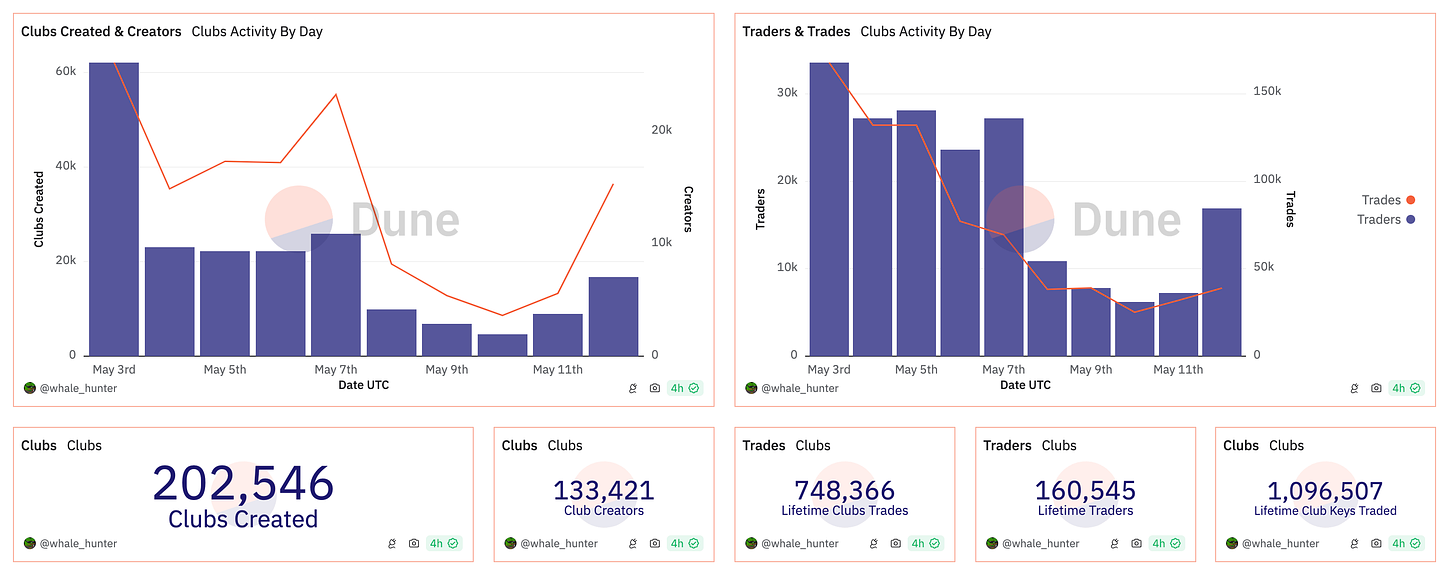
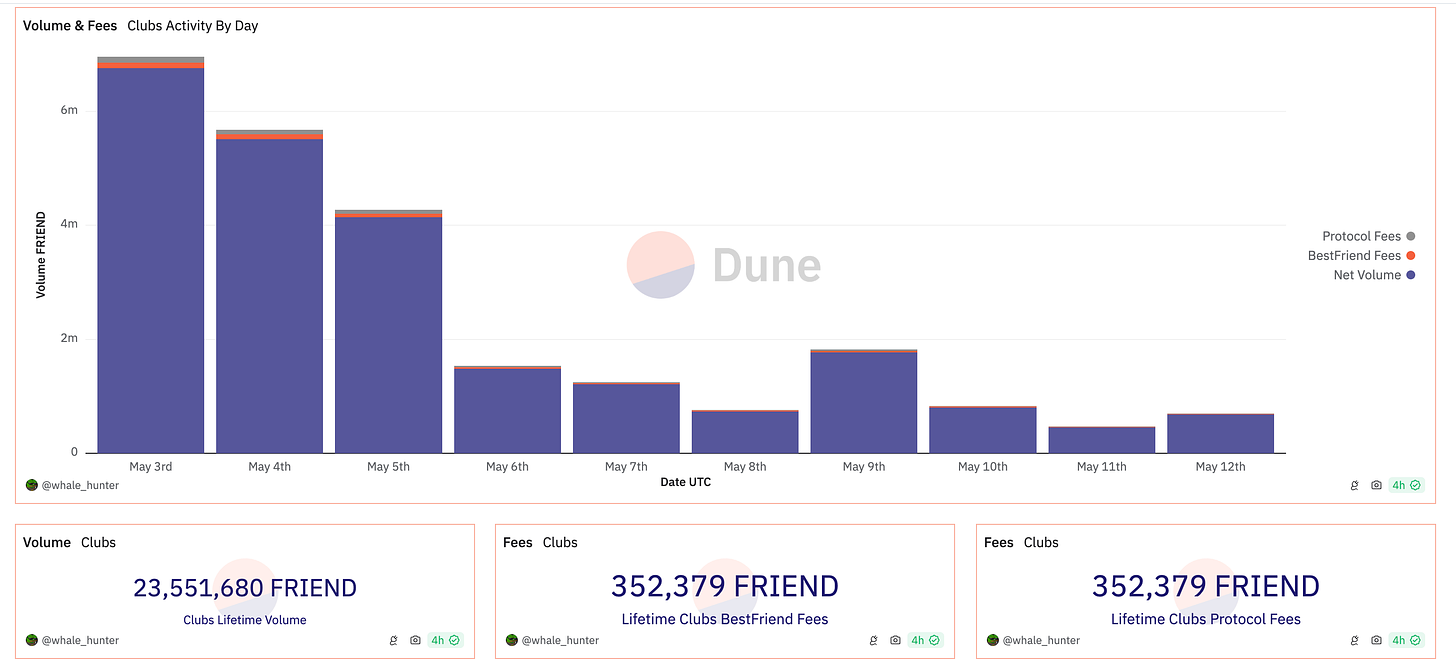
Image source: Dune (msilb7 & whale_hunter)
As of writing (May 13), Dune dashboard data shows that 202,000 Clubs have been created within Friend.tech, with 160,000 users participating in Club transactions and a total trading volume of 23.55 million FRIEND tokens (worth approximately $51.1 million at current market prices). Notably, users could initially claim only 10% of their $FRIEND airdrop; the remaining 90% required joining at least one Club to unlock. Thus, the surge in Club trading activity was significantly driven by this claim rule.
Overall, the v2 launch brought considerable growth to FT. However, observing daily trading volume reveals that Club transactions are gradually declining.
Where Lies the Fundamental Challenge of SocialFi?
From Friend.tech’s data and market response, it's clear that initial expectations around token airdrops drove massive TVL and interaction. Yet, after token listing and airdrop claiming, trading volumes declined and users left—the core pain point for most SocialFi projects.
This challenge can be broken down into two aspects:
1) User Retention: Attracting and retaining users remains a major hurdle for SocialFi platforms. These platforms often require users to understand complex concepts like blockchain technology and token economics, which presents a barrier to entry for those unfamiliar with crypto. Even within the crypto-native audience, balancing "Fi" incentives with genuine social experience is difficult. Furthermore, shifting users from traditional social media platforms—boasting vast user bases and strong network effects—to new decentralized alternatives is inherently slow and challenging.
2) Economic and Tokenization Model: Sustainable economic models are essential for SocialFi development. Traditional social platforms rely heavily on advertising revenue, whereas SocialFi aims to redistribute value directly to users and creators through social tokens and NFTs. Designing and maintaining balanced tokenomics that deliver real value without causing inflation or exploitation is critical. Friend.tech’s model shows that while a steep bonding curve may generate short-term wealth, high-priced keys are unlikely to yield sustainable economic returns. If user growth or protocol data stagnates or declines, speculative demand for expensive keys collapses.
For long-term success, SocialFi projects must innovate to solve these issues—delivering better user experiences while building economic models that continuously attract and incentivize participation. Over time, only platforms that effectively integrate social functionality with financial incentives will stand out in a competitive landscape and achieve genuine growth and user loyalty.
Innovative Attempts by Other SocialFi Projects
Farcaster: Prioritizing Social Attributes
Farcaster has not issued a platform token, yet its ecosystem has seen a proliferation of memecoins. Its design highlights strengths in building a decentralized social network. First, Farcaster allows users to maintain continuity of their social graph across different applications, preserving identity and connections even when switching between apps. This greatly reduces centralized control and ensures users retain ownership of their data. Additionally, Farcaster’s open-source, permissionless architecture encourages developer innovation and integration of new features, offering greater flexibility and user-driven experiences. Users and developers can freely build and expand the network, making Farcaster a highly modular and composable platform. In contrast, Friend.tech’s economic model reveals certain flaws—such as lack of value return for token holders and overreliance on speculative mechanics—that may hinder long-term growth. Farcaster’s design enables it to adapt more effectively to user needs and market changes, fostering a fairer and more sustainable social environment.
Phaver: Emphasizing Incentives for Contribution and Engagement
Phaver enables users to share and consolidate interactions across protocols (such as Lens Protocol and Farcaster), providing broader engagement and stronger social influence. Moreover, Phaver’s non-custodial and permissionless design gives users greater freedom to control their social graphs and data, free from constraints imposed by centralized platforms.
Phaver also launched the $SOCIAL token to enhance ecosystem engagement and reward mechanisms. Users earn points through active contributions on the platform, which can be redeemed for $SOCIAL tokens during specific events. Additionally, holding $SOCIAL tokens increases users’ credit ratings and monthly withdrawal limits, granting them more platform privileges and early access to new features.
Compared to Friend.tech’s economic model, Phaver places greater emphasis on incentivizing user contribution and participation. Through tokenization, it strengthens community activity and user stickiness. These design choices give Phaver a competitive edge in the SocialFi space, particularly in building decentralized, user-driven social networks.
Final Thoughts
While examining Friend.tech and the broader SocialFi space—particularly regarding economic sustainability and user retention—we also observe innovative efforts from platforms like Farcaster and Phaver. These projects employ unique mechanisms aiming to solve low engagement and imbalanced economic models.
Although these designs are theoretically appealing, whether they truly outperform Friend.tech—or can sustainably balance "Fi" and social elements over the long term—remains to be seen. Ultimately, which model best harmonizes financial and social characteristics to meet user needs is still an open question.
Join TechFlow official community to stay tuned
Telegram:https://t.me/TechFlowDaily
X (Twitter):https://x.com/TechFlowPost
X (Twitter) EN:https://x.com/BlockFlow_News
 @ChainFeedsxyz