Tether Increases Lobbying Spending Amid Escalating War of Words with Ripple and Growing Regulatory Pressure
TechFlow Selected TechFlow Selected
Tether Increases Lobbying Spending Amid Escalating War of Words with Ripple and Growing Regulatory Pressure
Will Tether, the issuer of USDT, face a regulatory black swan event?
 Navigating Web3 tides with focused insights
By Weilin
In recent days, Tether CEO Paolo Ardoino and Ripple CEO Brad Garlinghouse have been locked in a multi-day war of words. After Garlinghouse suggested that Tether would be the next target of U.S. SEC regulatory action, Ardoino swiftly pushed back with strong rebuttals.
In reality, the current U.S. regulatory environment is imposing stricter compliance demands on stablecoin issuers. On April 17 this year, two U.S. lawmakers introduced the Lummis-Gillibrand Payment Stablecoin Act, marking the latest legislative and regulatory development for stablecoins. In late April, S&P Global Ratings noted that if the U.S. Senate’s proposed stablecoin bill passes, it could encourage banks to enter the stablecoin market and potentially weaken Tether’s dominant position.
As the issuer of USDT—the stablecoin with an overwhelmingly large market share—could Tether face a regulatory black swan event? Judging from a series of recent moves by Tether, the company appears well-prepared. Beyond expanding its business footprint to diversify revenue streams, Tether is significantly ramping up its lobbying efforts.
Clashing Over Regulation: Ripple Says Its View Based on U.S. Regulatory Trends
On May 10, Ripple CEO Brad Garlinghouse stated on the podcast “World Class” that following the collapse of FTX, the imprisonment of former CEO Sam Bankman-Fried (SBF), and more recently the conviction and sentencing of former Binance CEO Changpeng Zhao (CZ), Tether is likely the next major crypto firm targeted by the U.S. SEC.
“Do I think there will be another black swan event? Absolutely, 100%. I just don’t know exactly what it will be,” Garlinghouse said. “The U.S. government is going after Tether—that’s obvious to me.”
Garlinghouse acknowledged Tether as “a very important part of the ecosystem,” adding, “I don’t know how to predict what kind of impact it might have on the entire ecosystem.”
Such direct speculation angered Tether CEO Paolo Ardoino, who launched a fierce counterattack on May 13 via a post on X. “A CEO who doesn’t understand the facts, leading a company under SEC investigation, has launched a competing stablecoin and is spreading fear about USDT,” Ardoino wrote. “The truth is that Tether leverages blockchain transparency and collaborates with law enforcement agencies worldwide to remain compliant.”
Ardoino shared examples of Tether’s policies, actions, and cooperation with U.S. and global law enforcement agencies. “Since inception, Tether has worked with 124 law enforcement agencies across over 40 countries to freeze more than $1.3 billion—mostly linked to fraud, hacking, and money laundering—and approximately $1.6 million tied to terrorist financing. In the past 12 months alone, Tether voluntarily assisted law enforcement in blocking 198 wallet requests (90 of which were with U.S. authorities). Over the past three years, we’ve blocked 339 requests (158 involving U.S. agencies).”
Responding to Tether’s statement, Ripple’s Garlinghouse replied later on May 13 via X: “(My comments) weren’t an attack on Tether… My point is that the U.S. government has made clear its intent to tighten oversight over dollar-backed stablecoin issuers, so as the largest player, Tether is naturally on their radar.”
New U.S. Senate Stablecoin Bill Poses Potential "Exit" Risk for Tether?
Underlying this public dispute is the new stablecoin regulatory bill introduced by U.S. lawmakers in April. The stablecoin market is currently valued at around $150 billion, with Tether’s USDT accounting for approximately $106 billion. The market is projected to surpass $2.8 trillion by 2028, making any regulatory shift highly significant for investors.
Stablecoin legislation is not new. Draft bills were passed in early 2023 but never enacted. However, on April 17, Senators Cynthia Lummis (R-WY) and Kirsten Gillibrand (D-NY) introduced the Payment Stablecoin Act of 2024. Gillibrand called it a “landmark bipartisan legislation creating a clear regulatory framework for payment stablecoins that protects consumers, fosters innovation, strengthens the dominance of the U.S. dollar, and preserves the dual banking system.”

Senators Cynthia Lummis and Kirsten Gillibrand at the 2022 DC Blockchain Summit
This proposal aims to bring oversight and transparency to the $150 billion stablecoin industry and could become the first major U.S. cryptocurrency legislation. It would also make it easier for state and federally regulated banks to custody digital assets on behalf of clients.
The bill would allow non-depository trust companies (non-banks) to issue stablecoins as long as the nominal value of all their tokens remains below $10 billion. According to the bill text, larger stablecoin issuers must be “authorized national payment stablecoin issuers”—i.e., depository institutions. If enacted, companies like Circle (issuer of $33 billion USDC) or Paxos ($1.35 billion PAXD) would have two options: operate through state-level non-banks or become federally or state-authorized depository institutions. All other forms of stablecoin issuance—including algorithmic payment stablecoins—would be prohibited.
Moreover, the bill includes an extraterritorial clause, meaning it applies to foreign-based companies like Tether. Tether is headquartered in the British Virgin Islands, creating a delicate regulatory situation. While USDT circulates widely among U.S. investors and exchanges, Tether claims it does not serve U.S. customers directly since it doesn’t issue tokens to them. The U.S. Treasury seeks congressional authority to pursue stablecoin issuers like Tether, concerned that criminals use dollar-backed tokens to conceal transactions.
In recent years, U.S. regulators have made various attempts at crypto legislation—some focused on stablecoin rules, others on defining when digital assets are securities versus commodities, thereby determining whether the SEC or CFTC holds jurisdiction. Last year, two such bills passed the House Financial Services Committee, but the Senate took no action due to lack of enthusiasm from Senate Banking Committee Chair Sherrod Brown (D-OH). However, in a recent Bloomberg interview, Brown indicated for the first time he might be open to stablecoin legislation.
Diversifying Operations: Tether Significantly Increases Lobbying Spending
Meanwhile, Tether’s financial performance in Q1 2024 has been outstanding. In the first quarter alone, Tether reported unaudited “financial results” of $4.5 billion in revenue and $11.4 billion in net assets. In 2023, the company posted a net profit of $6.2 billion, potentially making it the most profitable company in the crypto space today.
In comparison, Coinbase—the largest U.S. cryptocurrency exchange—falls short. It reported full-year 2023 revenue of $3.1 billion and a profit of $95 million, with Q1 2024 net income reaching $1.2 billion.
With abundant capital, Tether is now seeking growth beyond stablecoins. Last month, the company announced a strategic reorganization, expanding into three new areas: Bitcoin mining, artificial intelligence (AI), and education. Simultaneously, it restructured operations into four independent divisions reflecting its broadening focus: (1) Finance, managing USDT and overseeing an upcoming digital asset tokenization platform; (2) Data, focusing on strategic investments in emerging technologies including AI and P2P platforms; (3) Energy, dedicated to Bitcoin mining and energy-related projects; and (4) Education, supporting educational and leadership initiatives.
According to Tether CEO Ardoino, the company has doubled its workforce over the past year to about 100 employees. As of May 14, DefiLlama data shows USDT still holds 69% of the stablecoin market share, though its dominance faces challenges. For example, analysis by payments giant Visa and enterprise blockchain data platform Allium Labs found that Circle’s USDC processed 178.6 million transactions in April 2024, surpassing USDT’s 173.9 million monthly transactions.
The aforementioned bill presents a major opportunity for non-bank players like Coinbase and Ripple, potentially positioning them as top beneficiaries. Coinbase went public in April 2021 and saw its stock rise 274% over the past 12 months, driven by the crypto market recovery. Circle has also filed a confidential S-1 with the SEC, signaling plans for a future IPO. As co-issuers of USDC, both companies split investment income from its $33 billion collateral pool 50/50. Should Tether lose market share due to the new legislation, these firms stand to gain first.
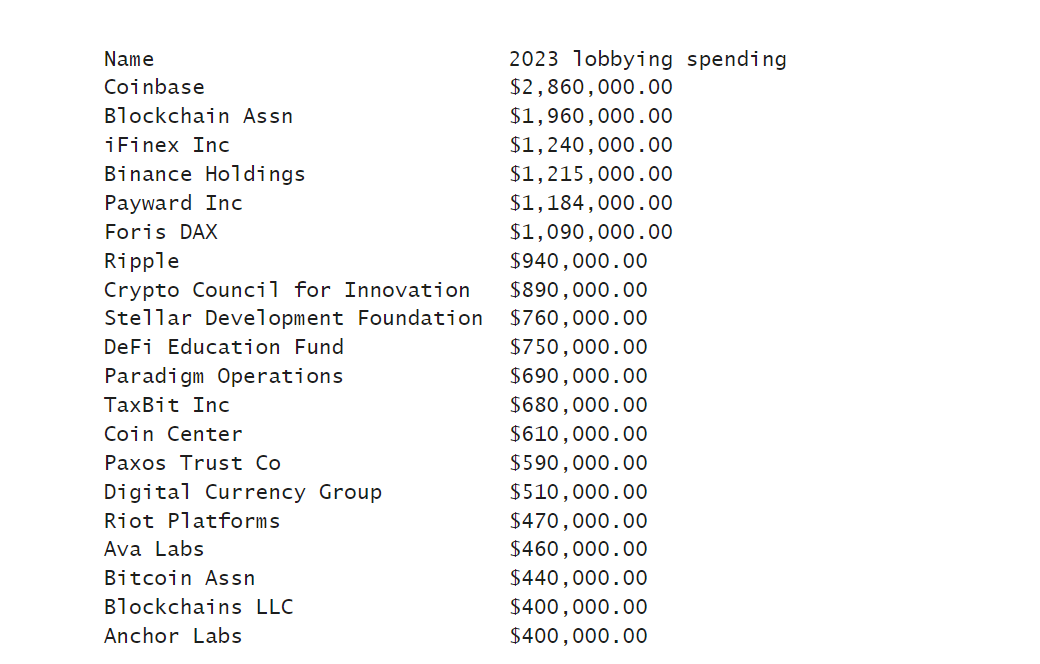
To navigate the increasingly stringent regulatory landscape, Tether is making sustained efforts. Beyond operational adjustments, it is investing heavily to promote broader recognition and understanding of cryptocurrencies among regulators. According to OpenSecrets, a nonprofit tracking political spending, iFinex—the parent company of Tether—increased its lobbying expenditure by over 150% in 2023, reaching $1.2 million. This surge elevated iFinex to the third-largest spender in the crypto sector, trailing only Coinbase and the Blockchain Association.
Join TechFlow official community to stay tuned
Telegram:https://t.me/TechFlowDaily
X (Twitter):https://x.com/TechFlowPost
X (Twitter) EN:https://x.com/BlockFlow_News
 PANews