The 2.0 Era of Blockchain Interoperability: Chain Explosion and Chain Abstraction
TechFlow Selected TechFlow Selected
The 2.0 Era of Blockchain Interoperability: Chain Explosion and Chain Abstraction
Compare the representative projects of the three major chain abstraction solutions: NEAR, Particle, and Polygon.
 Navigating Web3 tides with focused insights
Written by: ZHIXIONG PAN
It might sound exaggerated, but the pace of new application innovation may not even match the speed at which new public blockchains are emerging.
Recently, with the maturation of modular blockchains and RaaS (Rollup-as-a-Service), "use-case-specific chains" have rapidly proliferated. For instance, DePIN, AI, or financial applications each require their own independent blockchain networks. Additionally, many financial or comprehensive institutions are launching their own chains (e.g., HashKey Chain and Base).
Moreover, Bitcoin Layer 2 solutions have been launching densely over the past two months, including Citrea, BOB, Bitlayer, and Merlin Chain. Lastly, there's the evergreen topic of "performance," now being driven by parallelized virtual machines (and Parallel EVMs), such as Monad, MegaETH, and Artela.
For ordinary users, managing assets and applications across multiple chains has become increasingly painful—let alone needing to keep some Gas (transaction fees) reserved on every chain for emergencies.
Over the past few years, the popularity of cross-chain bridges has partially addressed liquidity issues, sometimes categorized under the broader theme of "interoperability." However, truly aggregating this liquidity and seamlessly connecting all these experiences would be a milestone achievement.
This is where the new concept and narrative of "chain abstraction" emerges—also seen as "Interoperability 2.0" or the ultimate form of such products.
Three Approaches
Precisely because of these usability challenges, blockchain interoperability has become increasingly important. But users don't care about using "cross-chain bridges" per se—they want to fulfill specific needs, such as trading certain assets or using particular applications.
When dealing with just a few chains, users can barely manage cross-chain bridges and multi-chain assets manually. But with the growing competition among numerous chains and the fragmentation of applications and liquidity, expecting users to securely manage their assets themselves is completely unrealistic. Feedback like "I've completely lost track of which assets I've staked on which chains and protocols" is commonly heard in the community.
Users don't want to understand what a "chain" is—they only care about what they can do with it. Therefore, "needs" should be what users focus on, while hiding the complexity of "chains" beneath those needs—that’s how a regular user naturally perceives things.
Because cross-chain bridges fail to meet users' demands for unified asset management and direct application usage, the concept of "chain abstraction" has emerged as another critical milestone within the "interoperability" discourse.
Numerous teams are already focusing on "chain abstraction" and offering solutions. Overall, these projects share similar modules and architectures, yet differ significantly in emphasis—falling into at least three representative categories: signature networks, universal account layers, and cross-chain bridge aggregators.
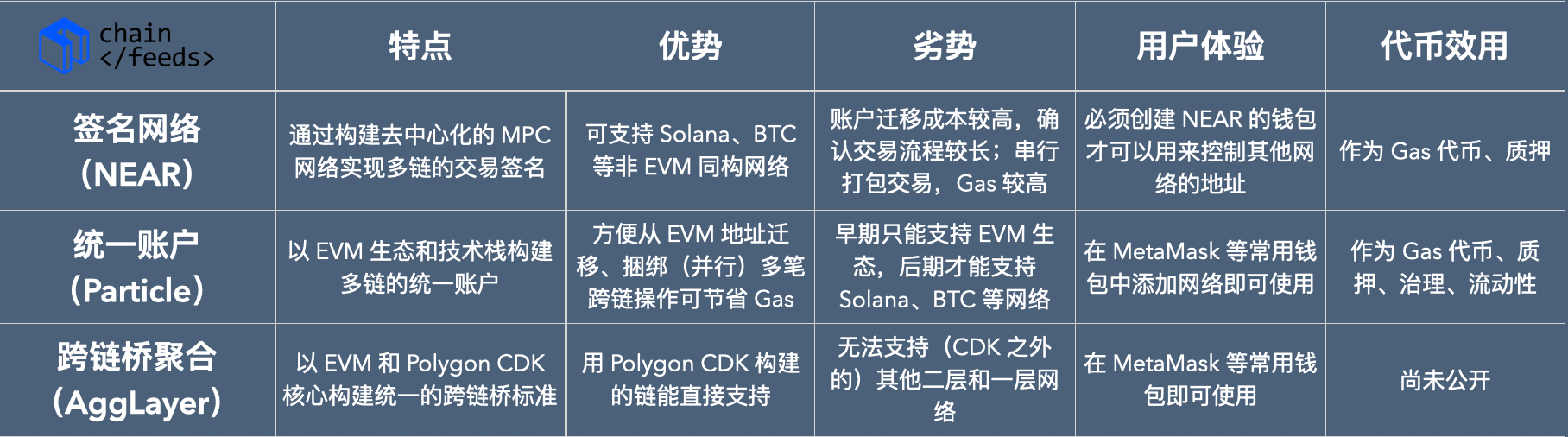
In fact, it's quite intuitive: chain abstraction solutions typically require users to have a unified account that can submit transactions across multiple chains, solve Gas fee delegation, and enable cross-chain messaging. Beyond these common components, different solutions emphasize distinct independent modules based on their unique characteristics.
NEAR focuses on building a decentralized network using MPC nodes to enable multi-chain signing, while Particle prioritizes the EVM ecosystem, initially supporting the more widely adopted EVM-based public chains. Others, like Polygon and Optimism, focus more on unifying cross-chain bridges and centering on their own RaaS ecosystems, serving only L2s built with CDK or OP Stack.
Signature Network: NEAR
The signature network approach was proposed by NEAR and is known as "Chain Signatures." The core of this technology allows addresses generated on the NEAR chain to serve as users’ primary accounts, while accounts and transactions on other chains are signed via a decentralized Multi-Party Computation (MPC) network and then submitted to the target chains.
Additionally, NEAR introduced a module called Multichain Gas Relayer (multi-chain Gas relay), which primarily functions to pay transaction Gas fees on behalf of users, solving the problem of requiring native tokens from various chains during cross-chain transactions. Currently, this functionality supports paying Gas fees using NEAR or NEP-141 tokens on NEAR, but does not yet support broader Gas abstraction.
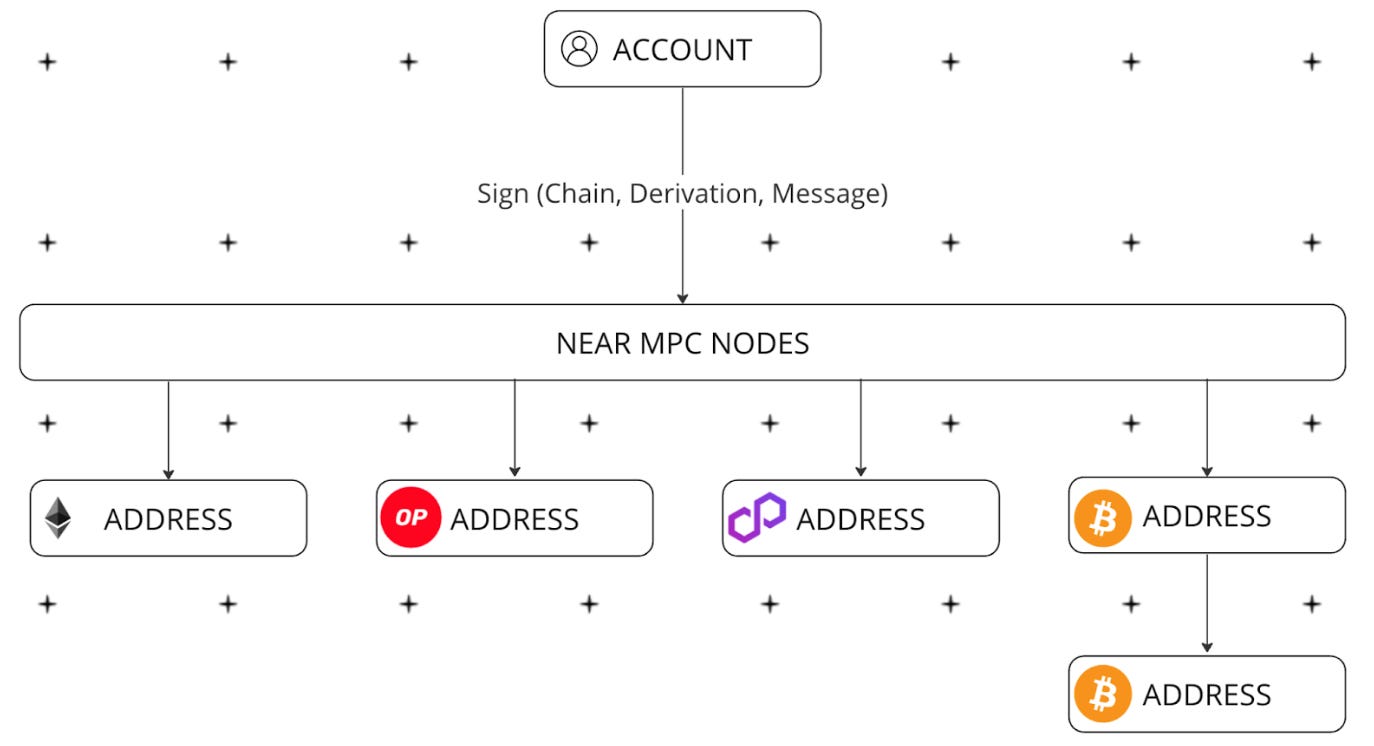
The fundamental reason behind this design is that NEAR is not an EVM-compatible chain. However, as everyone knows, the current market is still dominated by EVM-homogeneous chains, which vastly outnumber others. Thus, interoperability with EVM chains can only be achieved through an MPC network.
This leads to several user experience issues:
-
High migration cost: Users from the Ethereum ecosystem cannot directly migrate (e.g., using MetaMask) to the NEAR ecosystem; they must create entirely new accounts on NEAR.
-
Longer transaction confirmation times: Since EVM multi-chain wallets created via NEAR are EOAs (externally owned accounts, i.e., key-pair-based wallets), the process of queuing and signing multiple cross-chain transactions (at least authorization + execution) requires users to wait longer for confirmations. Moreover, because these are separate transactions, their combined Gas costs cannot be optimized.
From a token utility perspective, NEAR’s native token will serve as the Gas token throughout the chain abstraction process, meaning users must spend NEAR to cover all associated Gas costs.
Universal Account: Particle Network
Particle Network’s approach places greater emphasis on the account itself, using an independent blockchain network to orchestrate states and assets across other chains. More plainly, users can access assets and applications across all chains using just a Particle Network address—referred to by Particle as a Universal Account.
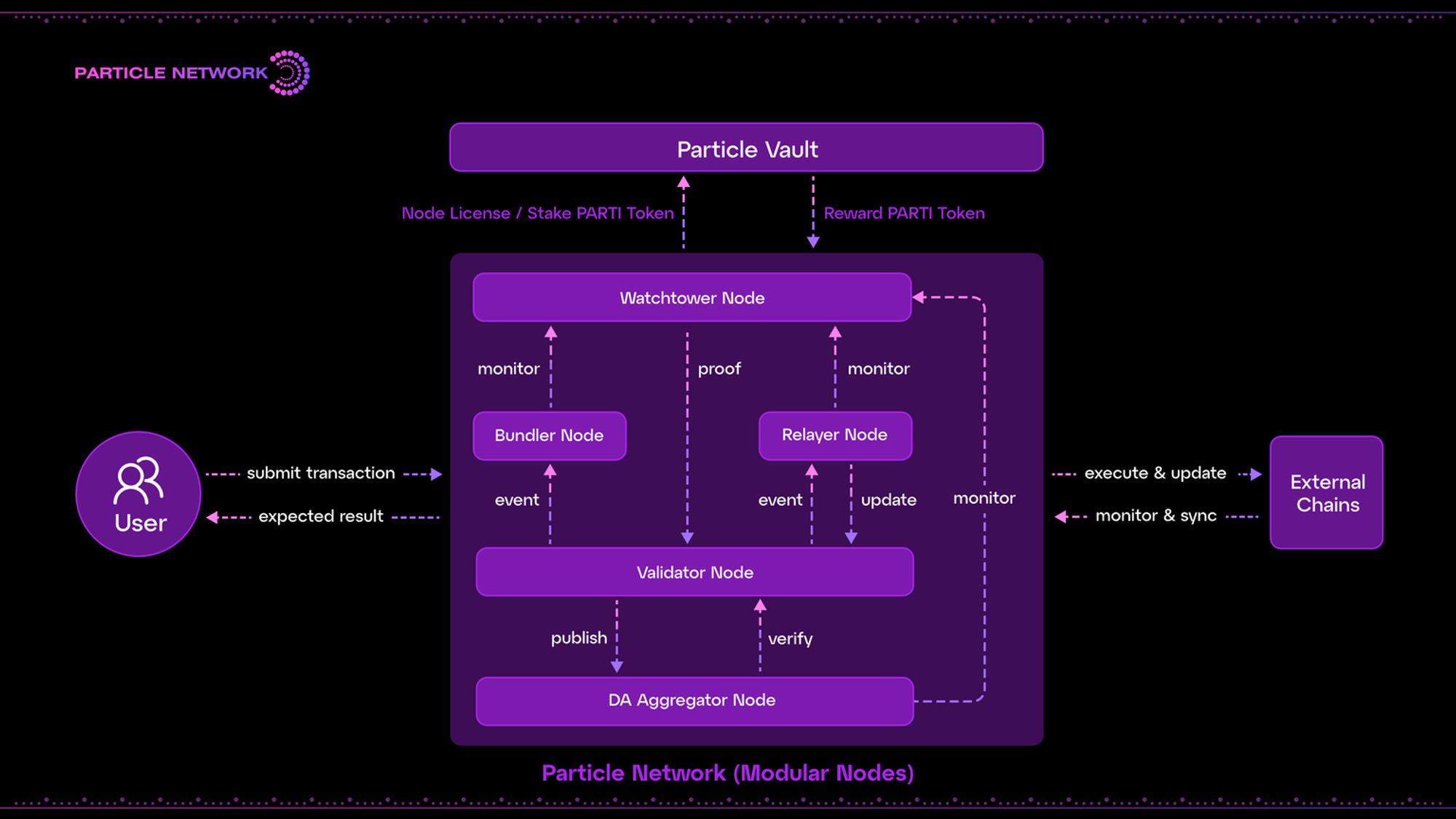
As for message relaying—i.e., transmitting messages across different chains—Particle’s L1 relies on its own Relayer Nodes to monitor the execution of UserOps on external chains. However, since the underlying architecture remains EVM-based, supporting non-EVM-homogeneous chain addresses may require additional modules, such as an MPC network similar to NEAR’s.
This represents a major difference: unlike NEAR, Particle Network’s design prioritizes EVM compatibility first. Its native address is inherently an EVM address, making integration with any EVM-based chain, application, or wallet extremely straightforward.
From a user’s standpoint, this EVM-first approach enables seamless migration of existing EVM ecosystem accounts—essentially adding a new network in MetaMask, just as simple as adding Optimism or Arbitrum in the past.
Consider a scenario that even heavy or Web 2.5 users would strongly relate to: USDT distributed across several chains—say, 100 USDT on Chain A, 100 on Chain B, and 100 on Chain C. When a user wants to buy an asset on Chain D, it becomes very cumbersome. Although all these USDT belong to the user, the fragmented nature of assets severely hampers usability. Consolidating them onto one chain isn’t just about finding bridges and waiting—it also requires preparing Gas in different native tokens. With Particle L1’s Universal Account, users can pool purchasing power from across chains and make one-click purchases of assets on any chain, choosing any token as Gas. The underlying mechanism is illustrated below.
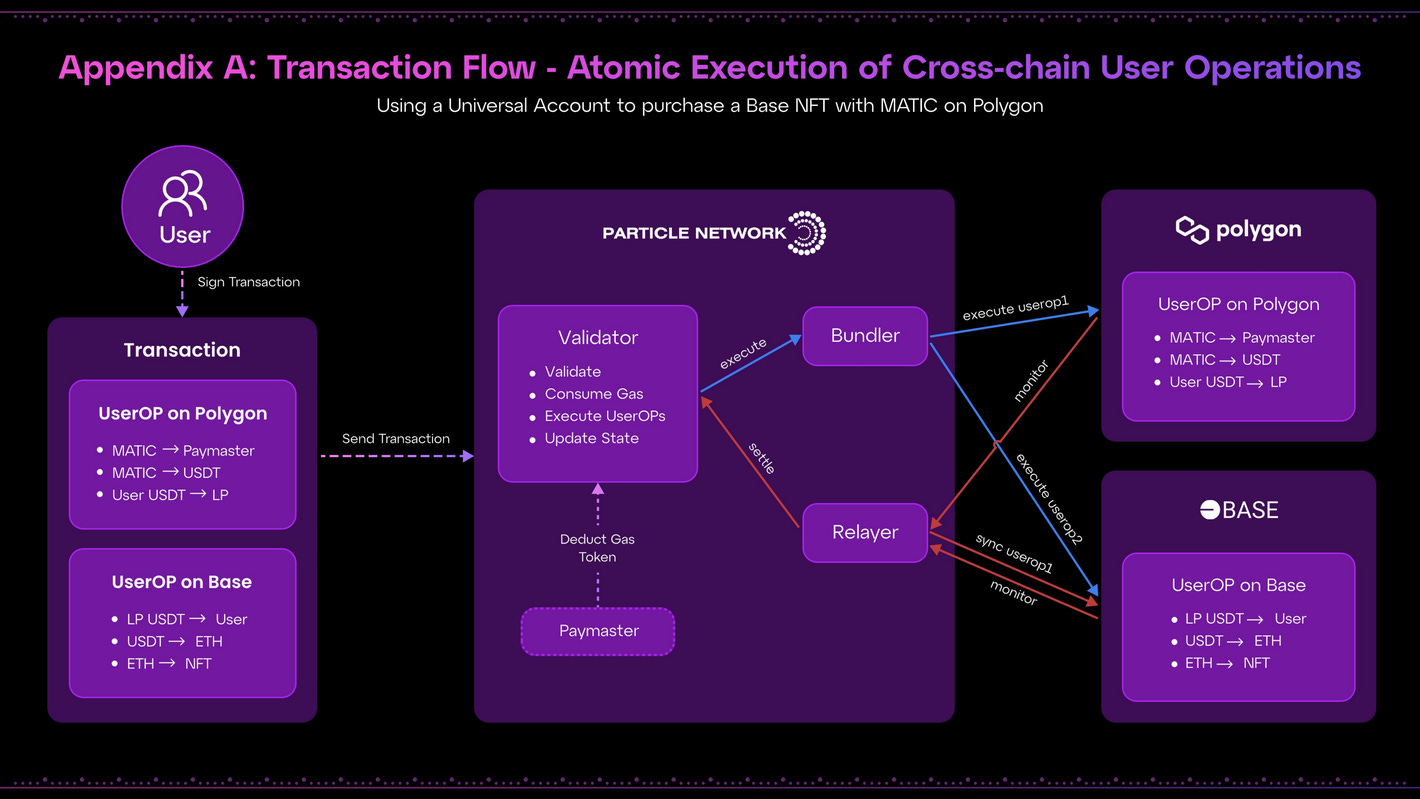
Another key distinction between Particle and NEAR lies in transaction granularity and the ability to batch-sign and execute transactions. Users can bundle multiple transactions together, reducing both the number and time required for signatures, while also saving Gas in complex transaction scenarios.
Particle has designed multiple use cases for its $PARTI token. For regular users, the most direct utility is using $PARTI as Gas for the Universal Account to perform transactions on any blockchain. Even without $PARTI, users can choose other tokens for Gas payment—but regardless of the payment token used, $PARTI will always be consumed. For the ecosystem, Particle L1 features five node roles (see figure below). Users can stake $PARTI to become nodes, participate in network consensus, and earn additional rewards. Furthermore, $PARTI can serve as an LP token within the Particle Network, enabling participation in cross-chain atomic swaps and earning trading fees.
Cross-Chain Bridge Aggregation: Polygon AggLayer
Two typical examples of the cross-chain bridge aggregation approach are Polygon AggLayer and Optimism’s Superchain. Both are architectural frameworks designed primarily around the Ethereum ecosystem.
Compared to traditional cross-chain bridges, AggLayer aims to standardize cross-chain bridge contracts, eliminating the need for independent smart contracts between each chain and Ethereum. In this framework, Ethereum serves as the central hub, with zero-knowledge proofs aggregating cross-chain information from all connected chains.

However, a challenge here is that other chains may not accept this standardized liquidity bridge contract, creating resistance when integrating new public chains—unless this framework gains widespread industry adoption as a standard. Viewed differently, AggLayer is essentially an added feature for teams building chains using Polygon CDK, meaning chains not built with CDK won’t have this capability by default.
Optimism’s Superchain is somewhat similar. It initially focuses on interoperability between Ethereum Layer 2s, especially since several teams are already using OP Stack to build additional Layer 2 networks. While this enables interoperability among them, the bigger challenge lies in extending this connectivity to a wider range of public blockchains.
Therefore, from a user experience perspective, both AggLayer and Superchain benefit from tight integration with the EVM ecosystem, allowing easy migration via MetaMask. However, they cannot connect to non-EVM ecosystems.
Summary
Despite their differing emphases, these approaches share a common goal: providing users with a simple and intuitive way to manage multi-chain assets and applications in a rapidly expanding blockchain landscape. Each team strives to maintain simplicity and clarity for users navigating complex multi-chain environments.
Looking at the three approaches: NEAR’s signature network centers on the NEAR chain and uses a decentralized MPC network for cross-chain signing. Particle Network’s universal account leverages the robust EVM ecosystem to enhance interoperability while connecting to more public chains. Polygon AggLayer focuses on optimizing interoperability within the Ethereum ecosystem by aggregating cross-chain bridges. Though their technical implementations and focal points differ, all aim to improve the convenience and reduce the complexity of cross-chain operations.
Yet I believe these technical choices will ultimately converge. They all aim toward the same end goal—enhancing user-friendliness and interoperability across the blockchain ecosystem. As technology advances and the industry further integrates, we may see increased collaboration and convergence, blurring the lines between these approaches. So right now, what matters most isn’t just technical selection or narrative—but early real-world deployment and letting users experience this new, fully aggregated cross-chain reality firsthand.
Join TechFlow official community to stay tuned
Telegram:https://t.me/TechFlowDaily
X (Twitter):https://x.com/TechFlowPost
X (Twitter) EN:https://x.com/BlockFlow_News
 @ChainFeedsxyz