Web3 AI Investment Insights: Finding the Most Mispriced Projects Amid Mainstream Hype
TechFlow Selected TechFlow Selected
Web3 AI Investment Insights: Finding the Most Mispriced Projects Amid Mainstream Hype
Web3 AI does not exist in isolation; understanding the broader industry context is crucial for decentralized projects competing against centralized ones.
 Navigating Web3 tides with focused insights
Author: Crypto, Distilled
Translation: TechFlow
The Web3 AI space is vast and often misunderstood. If you focus too much on technical details, you might miss major opportunities. If you only focus on price, you may end up holding nothing more than conceptual products without substance.
Fortunately, a single simple factor drives most outcomes.
Before diving into this key insight, let’s clarify something important.
Many mistakenly equate complexity with quality, especially in the Web3 AI space. Yet in reality, simplicity often leads to the best results. In the chaotic AI industry, simple and direct approaches are not only practical—they’re essential.
This is why I adopt Occam's Razor—the principle that among competing hypotheses, the simplest one is usually the best.
Consider the elegance of Einstein’s equation e=mc², involving just three variables yet explaining vast cosmic phenomena—this demonstrates the power of simplicity when understanding complex systems.
I distill the key driver behind Web3 AI into one critical consideration: "the flow of attention in the mainstream AI industry." In this sense, Web3 AI is merely traded as a proxy for general progress in AI.

Let’s break it down step by step.
In recent years, major breakthroughs in AI have drawn significant attention. This has created strong momentum for crypto projects focused on AI. While the convergence of AI and cryptocurrency shows great potential, many practical challenges remain. Valuation methods are also unclear.
This is why mainstream narratives often overshadow crypto-centric ones.
-
How do we assess the negative externalities of centralized AI?
-
How important is AI "decentralization"?
-
How do we evaluate great technologies that haven’t yet found product-market fit?
A bottom-up approach is extremely difficult. Instead, a top-down approach is often more straightforward and effective. This method starts by analyzing where attention flows in the mainstream AI industry. More important than choosing which boat to ride is identifying which wave to follow.

How powerful is broad attention toward AI?
Can it outperform entire markets? In some cases, yes.
Despite real bottlenecks, many AI tokens outperformed $BTC and $ETH, as well as major AI stocks like $MSFT and $NVDA, particularly in Q4 2023.
This performance is largely attributed to two factors:
-
Broader cryptocurrency market performance
-
AI-related news headlines
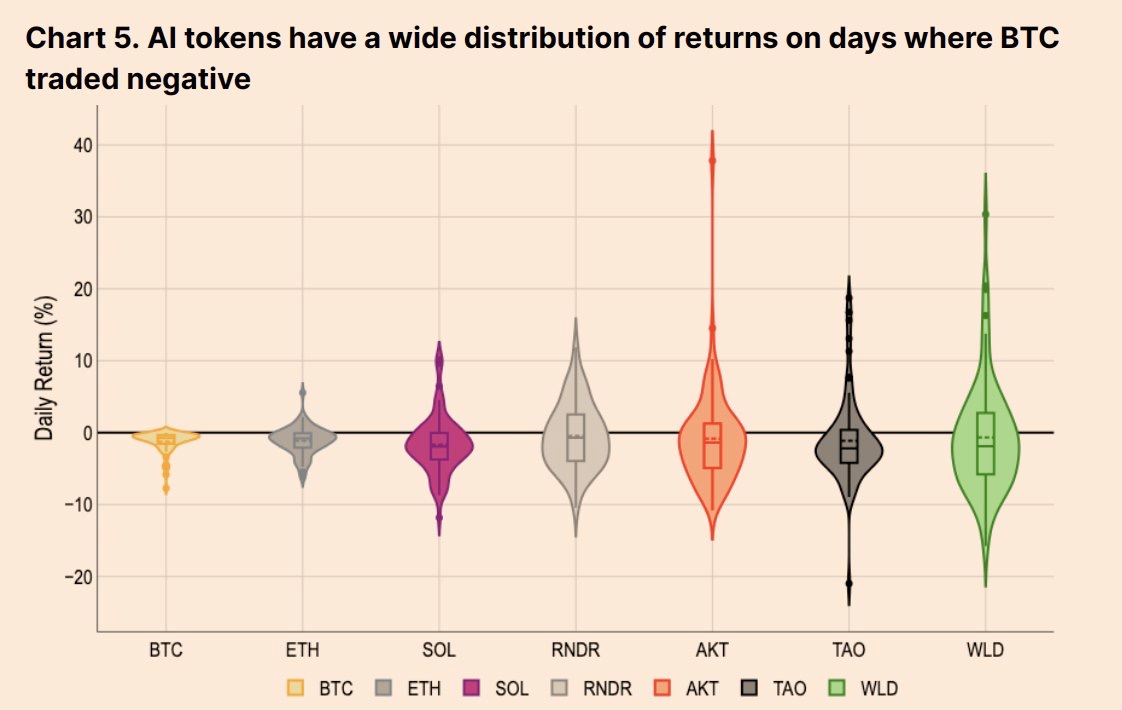
The chart below shows the distribution of AI token performance during periods when $BTC was declining.
How can we use this insight?
-
First, identify the key drivers advancing the broader AI industry.
-
Second, pinpoint crypto sub-sectors aligned with this attention.
-
Finally, identify the most "mispriced" projects within these categories.
(Note: this assumes a bull market is underway)
For example, GPU-focused projects like $RNDR surged ahead of $NVDA's GTC event in March. Similarly, when open-source AI models became trendy, projects like $TAO performed exceptionally well.
During these shifts, core technology often remains relatively unchanged. The real differentiator is the focus of mainstream attention, which amplifies valuations.
The ultimate example—$WLD
Coinbase recently provided compelling evidence supporting this theory. A prime example is $WLD, demonstrating how closely AI tokens track AI headlines.
For instance, after Sam Altman promoted $WLD on December 15, the token surged 50%. When OpenAI launched Sora on February 15, 2024, $WLD tripled in price—even though $WLD made no direct announcement on Twitter. At its peak, $WLD reached an $80 billion valuation—nearly matching OpenAI’s $86 billion valuation in February—highlighting the massive influence of broad AI attention on market movements.

Conclusion:
In short, Web3 AI does not exist in isolation. Understanding the broader industry context is crucial for decentralized projects competing against centralized ones.
While Web3 AI projects are novel, they are not yet as viable as their centralized counterparts. Therefore, mainstream AI narratives will likely continue to drive market trends. Pay attention to real-world AI developments to anticipate trends in both AI and crypto markets.
But remember, high risks are involved. With high promises but limited real adoption, risk management and caution are essential.
This article is not financial advice.
Join TechFlow official community to stay tuned
Telegram:https://t.me/TechFlowDaily
X (Twitter):https://x.com/TechFlowPost
X (Twitter) EN:https://x.com/BlockFlow_News
 @DistilledCrypto