MKR's Phoenix-like Rebirth: New Public Chain, RWA Stablecoin, and the Spark Lending Unicorn
TechFlow Selected TechFlow Selected
MKR's Phoenix-like Rebirth: New Public Chain, RWA Stablecoin, and the Spark Lending Unicorn
Is MakerDAO's strong performance during bear and bull markets due to its solid fundamentals, or the success of shifting narratives?
 Navigating Web3 tides with focused insights
Author: IOSG Ventures
TL, DR:
-
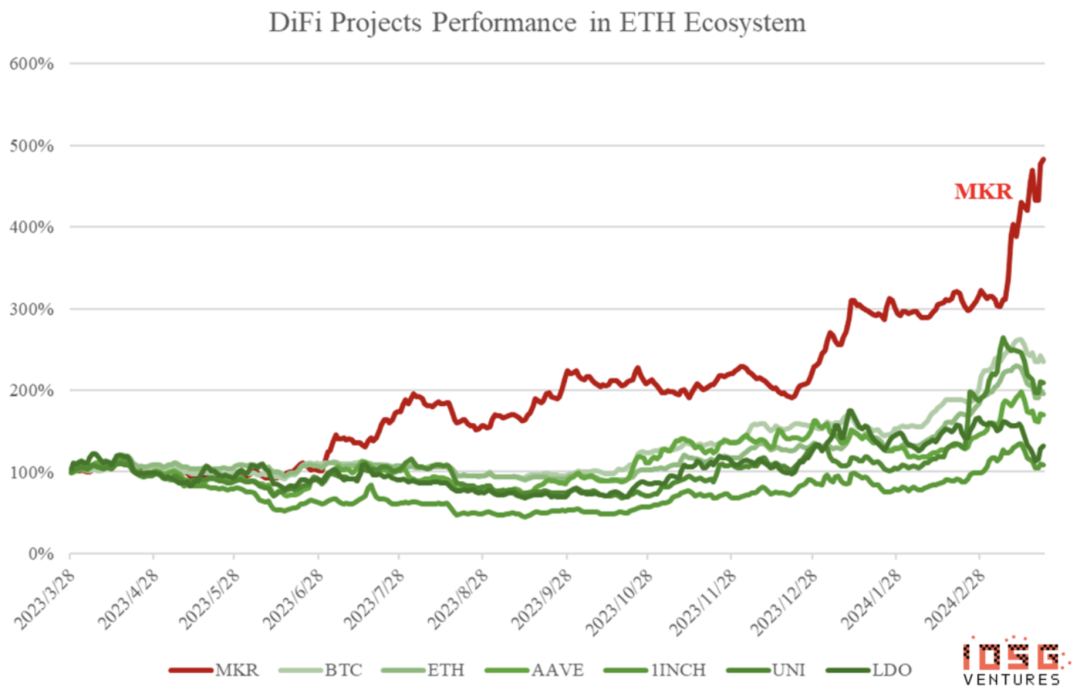
Over the past year, MakerDAO has outperformed BTC, ETH, and other DeFi protocols. While most DeFi participant tokens rose around 200%, MKR's price surged approximately 500%.
-
MakerDAO’s success stems from its solid fundamentals and diversified business model, excelling in both RWA and crypto markets. Amid uncertain macroeconomic conditions in traditional finance and unclear prospects in the DeFi sector, we believe MKR’s dual-domain business positioning enables it to withstand risks while achieving substantial returns.
-
Positive market sentiment and the Endgame roadmap signal future growth, further amplified by the launch of MakerDAO Endgame: Launch Season.
-
Challenges facing Endgame include balancing innovation with risk and ensuring stakeholders understand its objectives. It introduces a new tokenomics model, governance framework, and clear development roadmap to enhance growth potential, risk resilience, and broader adoption.
-
We believe that despite operational streamlining, its core business focus remains largely unchanged. The revenue impact may not be immediately significant, but internal communication costs could decrease while improving each unit’s professionalism and operational efficiency.
-
We believe effective execution of Endgame is crucial for MakerDAO to continue leading the future DeFi landscape. The impact of the roadmap and MakerDAO’s commitment to innovation will determine its long-term success trajectory.
Background
During the last bear market, few cryptocurrencies held strong—Maker (MKR) was undoubtedly one of them. While other blue-chip assets fluctuated, Maker not only preserved its value but also achieved remarkable growth, doubling from March to October 2023. This exceptional resilience demonstrates its ability not just to survive adversity, but to thrive under difficult conditions.
But Maker’s appeal isn’t limited to bear markets. As the crypto market turned bullish at the start of 2024, Maker’s price climbed from 1,400 to 2,000. That momentum didn’t stop there; after announcing the highly anticipated Endgame plan on March 13, the price surged to 3,000. Such a spike implies that holding MKR over the past year could have yielded up to five times return!
So what is the secret behind MakerDAO’s strength in both bull and bear markets? Is it solid fundamentals or a shifting narrative driving this success? Most intriguingly, what exactly is MakerDAO Endgame, and what should we expect moving forward? This article aims to answer these questions and reveal the forces enabling MakerDAO to stand out in the volatile cryptocurrency market.
MakerDAO: A Resilient DeFi Pioneer Bridging Crypto and Real-World Assets
In the fast-evolving DeFi space, MakerDAO has distinguished itself through strategic navigation of two key trends: integrating real-world assets (RWA) and staked Ethereum (stETH). This strategy not only strengthens its position within decentralized finance but also highlights its resilience and adaptability.
Staked Ethereum (stETH) Integration
Within the crypto domain, MakerDAO has locked approximately 600,000 wrapped staked ETH (wstETH) via its core protocol and subsidiary Spark. This major integration positions MakerDAO as the third-largest entity by total value locked (TVL), reaching $11.67 billion (with $8.67 billion in Maker and $3 billion in Spark), trailing only Lido’s $34 billion and Eigenlayer’s $11.801 billion. Unlike Lido and Eigenlayer, which focus on staking and restaking services, MakerDAO’s DeFi business model goes beyond simple asset staking.
By locking stETH, MakerDAO effectively uses these assets as collateral to mint its native stablecoin DAI. This process allows MakerDAO to earn revenue through stability fees (interest rates) charged on loans backed by stETH. As Ethereum yields fluctuate, MakerDAO adjusts its risk parameters and interest rates to ensure system stability while generating income. This approach converts Ethereum’s volatility and yield into a steady revenue stream, reinforcing its leadership in the industry.
RWA Strategy
In June 2023, MakerDAO integrated U.S. Treasuries into its portfolio—a move signaling its intent to diversify income sources using RWAs. Essentially, when a high-yield, low-risk alternative exists, Maker’s governance body is unwilling to hold inefficient and “risky” USDC on its balance sheet. This decision not only positions MakerDAO as a leader in the RWA segment within the crypto industry but also significantly boosts its revenue.
RWAs—including tangible assets like real estate and bonds—have become a significant part of MakerDAO’s income, contributing about 60% of its fee revenue. The inclusion of U.S. Treasuries has proven successful, enhancing revenue stability and pushing annual earnings above $100 million.
According to a report from Steakhouse, in 2023, about 56% of revenue—totaling 76.3 million Dai—came from real-world assets (RWA). Further analysis shows that 83% of RWA income was concentrated in the second half of the year, coinciding with rising 10-year federal interest rates.
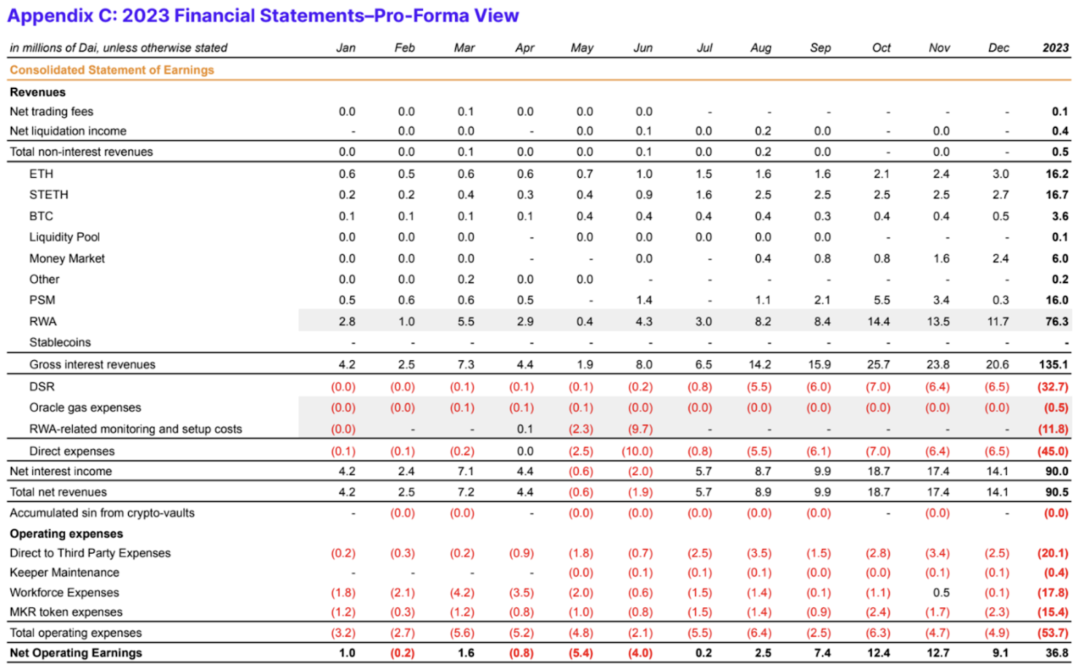
Source: Steakhouse
MKR: An All-Weather Crypto Asset
MKR performs well across different market environments due to its strategic allocation in both RWA and crypto lending markets. In high-interest-rate environments, MKR demonstrates strong adaptability, benefiting from its RWA investments—unlike other cryptos that may suffer under such macroeconomic pressure. When rates fall, liquidity increases, and the crypto market enters a bull phase, MakerDAO is expected to leverage its strengths in native crypto operations, particularly crypto lending.
Thus, MakerDAO skillfully navigates market cycles, focusing on crypto lending during bull markets and optimizing RWA yields during bear markets, securing its status as a robust all-weather crypto asset.
The chart below reaffirms Maker’s asset allocation strategy. When the Federal Reserve rate peaked at around 5% in October 2023, Maker allocated the largest portion of its assets to RWA-related holdings, earning returns from Treasuries and other credit-linked products.
As rates began to decline due to increased confidence in the Fed’s inflation control, Maker strategically shifted toward crypto-related areas.
Current macro conditions are far from clear: with the U.S. Bureau of Labor Statistics reporting inflation figures below analyst expectations (March 2024 CPI at 0.4%, versus an expected 0.3%), expectations for Fed rate cuts continue to be delayed or even suppressed. JPMorgan CEO Jamie Dimon even mentioned the risk of rates rising above 8%. High interest rate environments provide greater profit opportunities for RWA projects. Maker is likely to benefit again from its RWA initiatives.


Source: https://dune.com/queries/3569610/6008265
Valuation Expansion: Market Recovery and Narrative Evolution After Endgame Launch
The previous section emphasized MKR’s solid business model and impressive profitability, laying the foundation for understanding its valuation. However, MKR’s price surge cannot be attributed solely to financial performance—earnings estimates rose from $500 million in April 2023 to $1.5 billion in March 2024, yet the price increased fivefold.
A closer look at data from Makerburn reveals another critical piece of the story: valuation expansion. From June to August 2023, MKR’s price-to-earnings ratio (P/E) hovered between 10 and 15. By September 2023, it began climbing, reaching around 20 by February 2024, then sharply jumping above 30 by the end of March 2024.
What drove this remarkable valuation expansion?

Source: https://makerburn.com/#/charts/revenue
Market Environment Recovery
In our December 2023 article, we highlighted the beginning of the sixth crypto bull market, now over a year in progress—details can be found in our analysis. This phase has boosted activity across various DeFi projects, driven by enhanced market activity and growth expectations. The anticipated increase in interactions and transaction volume is not merely speculative; it’s observable across the DeFi landscape. Projects like Balancer, Synthetix, Sushiswap, and Curve Finance are experiencing significant multiple expansions, a trend confirmed by Token Terminal data.
However, MKR’s extraordinary journey of valuation expansion is not solely a product of market dynamics—especially its P/E ratio estimate surging to 30 by March 2024. The full launch of MKR Endgame in early March 2024 marked a pivotal moment, propelling its valuation to new highs and distinguishing its growth trajectory from broader market trends.
This prompts us to dig deeper: What exactly is Endgame, why does it inspire such high expectations, and how does it support the significant increase in MKR’s valuation multiples?
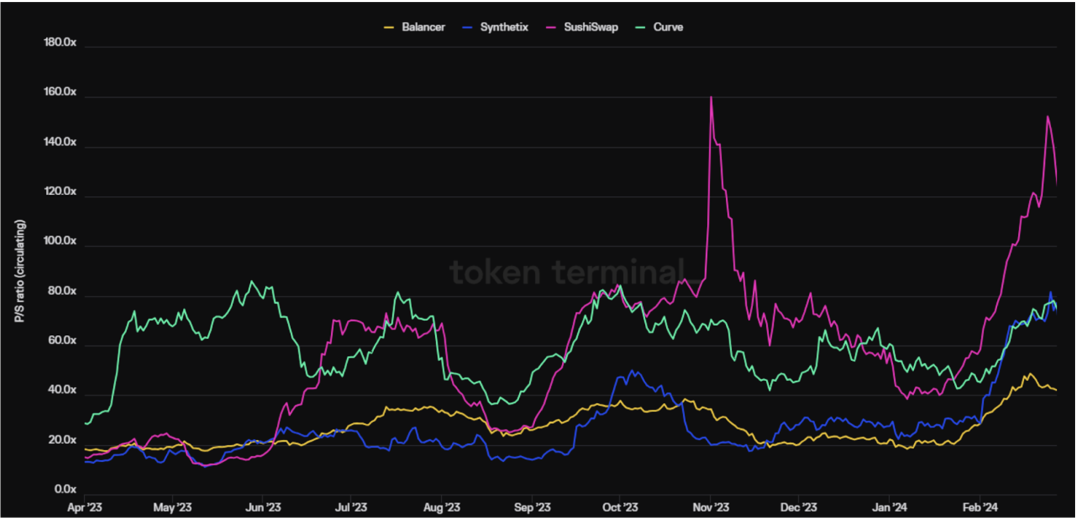
Source: https://tokenterminal.com/terminal/metrics/ps-circulating
MakerDAO Endgame: The Ultimate Plan for Operational Efficiency, Clarity, and Risk Isolation
4.1 Background: Challenges Facing MakerDAO
-
Operational inefficiency: Despite widespread DAO adoption in crypto projects, operational efficiency remains problematic. MakerDAO has faced significant challenges, including rejected proposals aimed at centralizing operations to improve efficiency. Communication barriers have also made it harder for members to understand voting and activities.
-
Intensifying competition: Competition within the DeFi ecosystem is growing fiercer, exemplified by MakerDAO’s public clash with Aave. In response to Aave launching its stablecoin GHO, MakerDAO countered by supporting Spark’s development and partnering with Morpho to build new lending pools. These moves highlight the intense competitive landscape in DeFi and raise questions about the durability of MakerDAO’s competitive moat in a rapidly changing market.
-
Shifting risk controls: Recently, MakerDAO’s Dai Savings Rate (DSR) experienced significant fluctuations, rapidly rising from 5% to 16%, pulling back to 13%, and ultimately adjusting to 10% by late April—challenging community expectations for stable and predictable interest policies. Additionally, expanding the D3M limit to 2.5 billion DAI and collaborating with Morpho to create a USDe pool reflect a strategic shift toward higher risk tolerance. These actions resemble hedge fund strategies more than traditional central banking, showing MakerDAO’s efforts to counter external DeFi competitors—even if it comes at the cost of foundational stability.
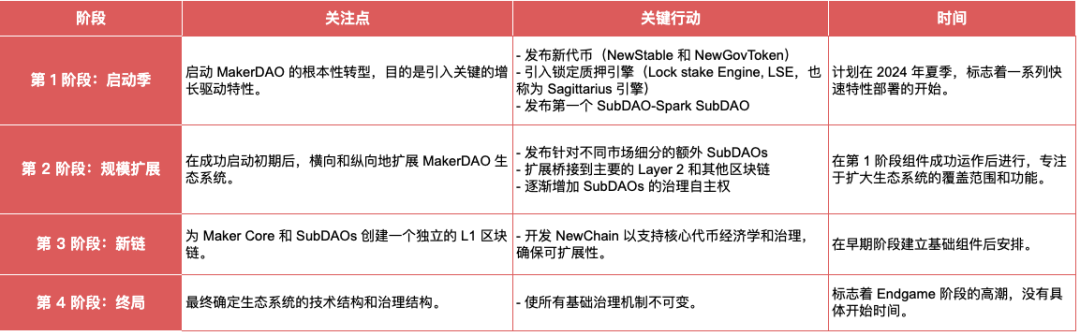
To address these challenges while preserving its decentralized nature, MakerDAO introduced the Endgame framework in Q3 2022, with its initial phase launching in Q1 2024. The framework aims to enhance MakerDAO’s scalability, risk resilience, and user engagement.
4.2 What’s in the Roadmap
Key Changes:
-
Maker Core will have no direct relationship with operations—even Dai lending occurs through Spark (a SubDAO).
-
Endgame introduces two types of SubDAOs: primary SubDAOs, including AllocatorDAO and FacilitatorDAO, and secondary SubDAOs known as MiniDAOs. Primary SubDAOs receive large token allocations, primarily distributed through Genesis farming for employee bonuses and ongoing incentives based on later proposals. MiniDAOs follow the same Genesis farming model but differ in specific distribution strategies across various farming channels.
-
Endgame includes key updates to MKR usage: it allows purchasing liquidity pool tokens to better align Maker Core with SubDAO interests; new MKR will be minted annually to support SubDAOs and employee incentives; and a new module locks MKR for governance participation and rewards, with partial destruction upon withdrawal.
The proposal is quite extensive, filled with technical details. However, the key improvements and considerations can be summarized into the following categories:
4.2.1 Business Side
1. Incentivizing Long-Term Participation
-
MKR as Collateral: Using MKR as collateral in the Sagittarius engine is a major change. As part of Maker Endgame, this enables MKR to serve as collateral, incentivizing long-term staking with rewards and penalties to strengthen stability and governance within the Maker ecosystem.
-
Rewards and Penalties: Unlike previous models, the Sagittarius engine introduces a 15% slashing penalty upon unstaking, promoting stability and aligning holder incentives with the ecosystem’s sustainability.
2. Risk Management Mechanisms
-
Hard Liquidation Ratio: Set at 200%; if breached, vaults are liquidated.
-
Soft Liquidation Ratio: A preventive threshold of 300%; if not restored within a week, vaults are liquidated.
-
Risk Control: The hard and soft liquidation triggers in Maker Endgame aim to protect all stakeholders—MKR holders and DAI users—by ensuring the system remains well-collateralized and resilient to market volatility. However, introducing endogenous collateral brings significant risks. Price swings could trigger a death spiral of MKR selling pressure, further increasing its volatility as collateral.
4.2.2 Operational Side
1. SubDAO
-
Relationship with Maker: SubDAOs are autonomous organizations within the Maker ecosystem, each with their own governance token and area of focus. For example, the Spark SubDAO focuses on lending and DeFi products, operating at scale alongside Maker’s infrastructure.
-
Relationship with MakerCore: The relationship between MakerCore and SubDAOs has changed. MakerCore exits front-end maintenance, focusing instead on allocating DAI through these SubDAOs. MakerDAO provides SubDAOs with credit lines to ensure sufficient liquidity. MakerCore sets risk parameters—including acceptable collateral types and over-collateralization requirements—to safeguard DAI stability. In exchange, MakerDAO earns deposit fees from DAI managed by SubDAOs, creating a symbiotic system with strong liquidity and revenue generation.
-
Value Distribution: Value is shared between SubDAOs and MakerDAO through a designated inflation mechanism, allocating a portion of new MKR to SubDAOs. These SubDAOs commit to reinvesting in MKR and DAI, boosting market liquidity and the ecosystem’s monetary value. This distribution depends on the amount of MKR/DAI liquidity pool tokens staked, aligning incentives between Maker and its SubDAOs.
Distribution of New Stability Tokens (NST)
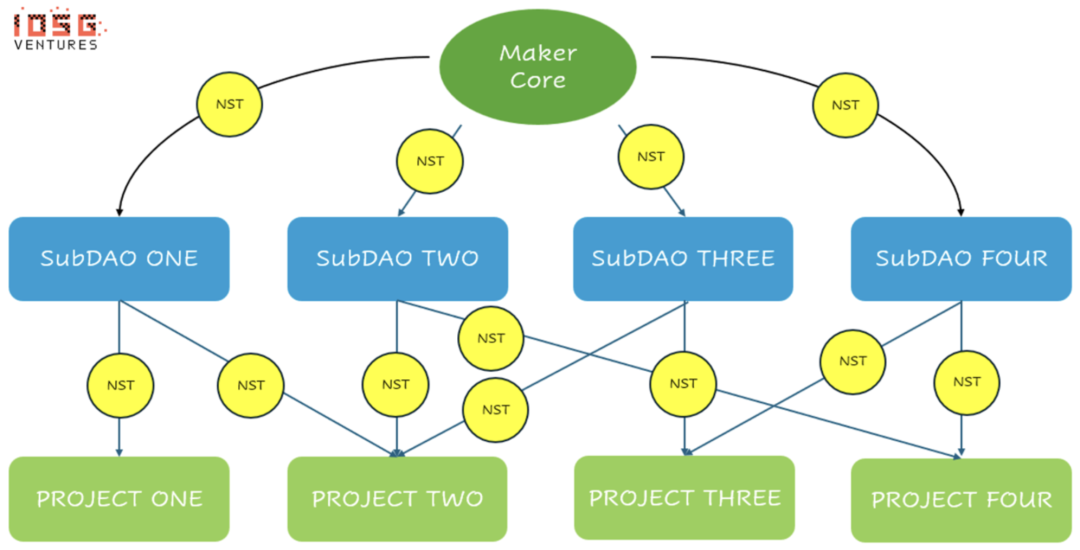
Profit transfer and distribution
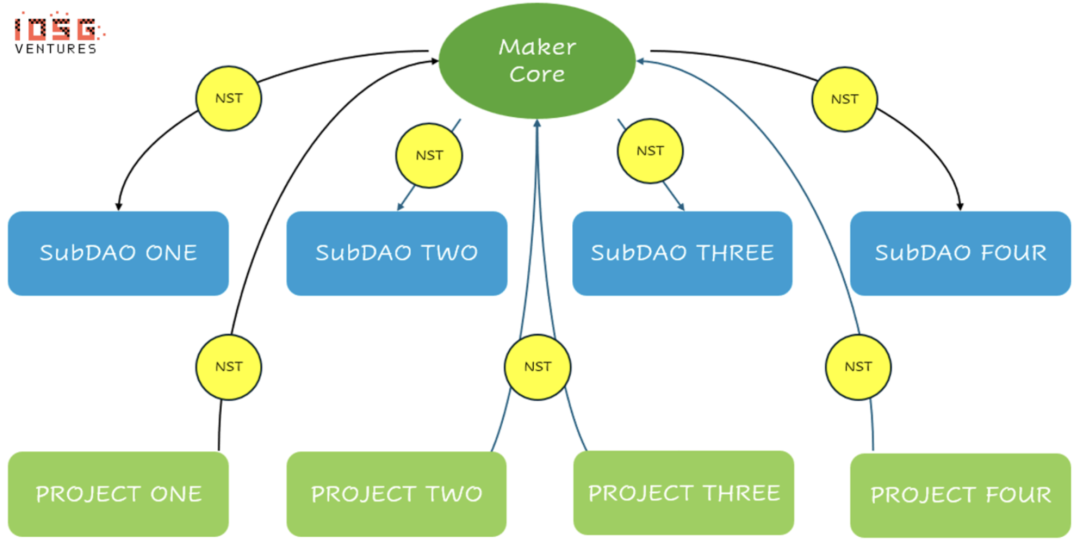
2. SubDAO Categories
AllocatorDAOs:
-
Can directly generate DAI from Maker.
-
Authorized to allocate DAI within the DeFi ecosystem after approval from Maker Core.
-
Provide entry points for new participants into the Maker ecosystem.
-
Capable of creating miniDAOs to increase autonomy and flexibility.
MiniDAOs:
-
An experimental concept with no practical examples so far.
-
Designed to offer a more independent structure option for AllocatorDAOs when needed.
FacilitatorDAOs:
-
Responsible for organizing and managing internal mechanisms across different DAOs and Maker Core.
-
Handle aspects including community management, product development, and legal compliance.
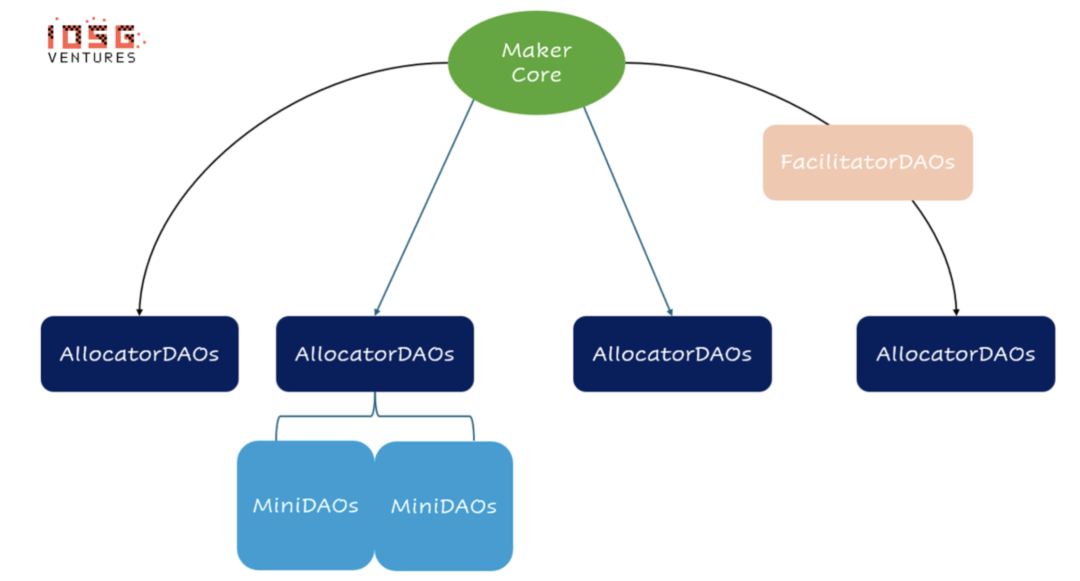
Structure of Different DAOs
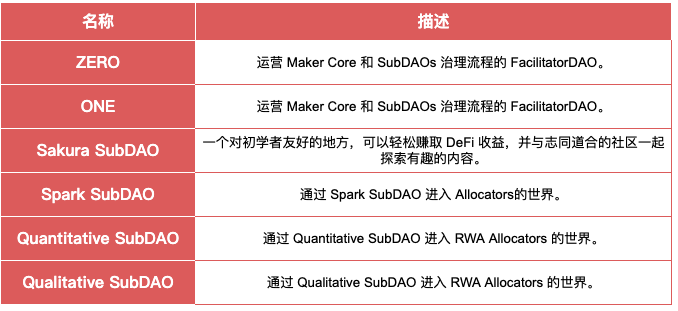
List of SubDAOs
4.2.3 Risk Isolation:
MakerDAO’s Endgame manages risk through a clearly defined operational and governance structure that maintains consistency within the Maker ecosystem. This structure outlines the roles of MKR holders, Maker Core, and SubDAOs, focusing on capital flow and asset allocation management. MKR holders, especially Aligned Delegates, play a crucial role in setting governance practices that ensure unified and consistent decision-making across the entire ecosystem.
Maker Core implements these governance decisions by channeling capital into Allocator Vaults within established risk parameters. This process helps mitigate financial risk by preventing excessive concentration of capital management and enabling decentralized capital oversight through collaboration with Arrangers.
By introducing SubDAO governance tokens, MKR is placed in a safer position—it only needs to intervene in extreme systemic disruptions (e.g., massive depegging) that SubDAO governance tokens themselves cannot resolve. SubDAOs thus act as firewalls between actual operations and Maker Core.
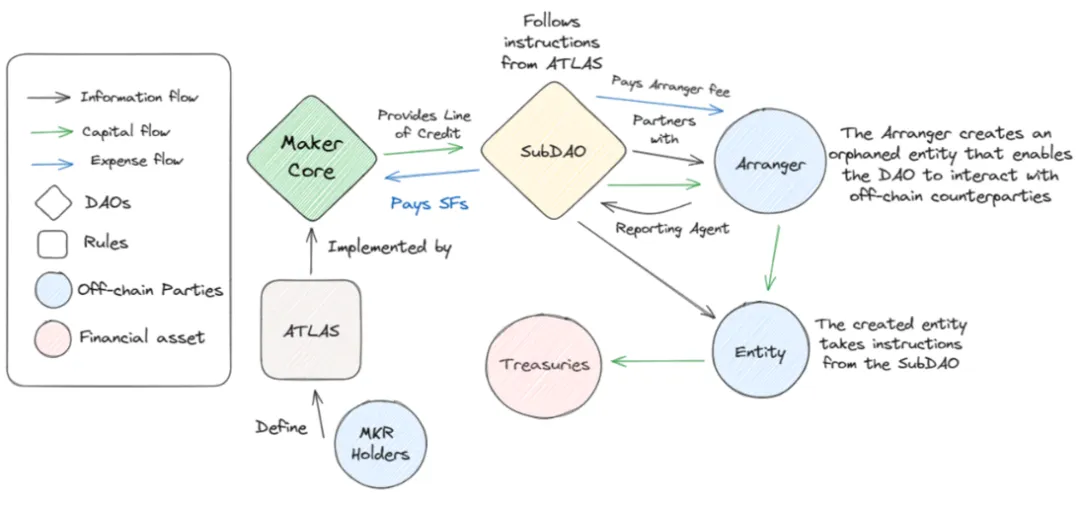
Source: Steakhouse
4.3 Phases:
Such a narrative is undeniably grand and unprecedented, and this process will unfold in four stages.
Bottom Line: The Dawn of a New Era or Just Repackaging the Old?
-
Tokenomics: The shift in MKR tokenomics warrants closer scrutiny. Plans to use MKR as collateral and allow governance participation via zero-interest ETH loans introduce new risk factors. Additionally, a proposed annual inflation rate of approximately 6% could have unforeseen consequences for token value.
-
Simpler or More Complex: While MakerDAO’s ultimate strategy presents a thoughtfully designed evolutionary plan, it also reveals a notable drawback. Although transitioning to Maker Core is visionary, it appears to overemphasize long-term goals at the expense of immediate action, creating a gap between strategic planning and current implementation. Moreover, changes to the governance structure introduce another layer of complexity, prompting participants to question whether this new approach simplifies the system or makes it more complicated in disguise.
-
Business Essence Unchanged After Rebranding: Despite changes in operational structure, MakerDAO still fundamentally operates in its familiar domain of crypto lending, particularly through the Spark protocol. Similarly, in RWA, its business hasn’t changed significantly in the short term. This raises concerns about true business innovation, as the plan doesn’t detail future initiatives. It leaves much of the roadmap to imagination, suggesting the strategic focus is on refining existing operations rather than exploring uncharted commercial paths. At least at this stage, its business remains centered on DeFi lending/borrowing and RWA. Therefore, we cannot yet determine whether the launch of this ultimate plan represents mere rebranding or delivers genuine added value.
-
Higher Risk or Safer: SubDAOs serve as firewalls between Maker Core and actual operations. Yet simultaneously, Maker is taking bolder steps. The market perception of MakerDAO has shifted—from being seen as a stable central bank to increasingly being viewed as a risk-taking entity striving to stay competitive. This perceptual shift reflects a reassessment of DAI’s risk profile, leading to MKR’s repricing in line with broader market trends. This transformation underscores the delicate balance MakerDAO faces between innovation and maintaining foundational stability.
Conclusion
MakerDAO’s outstanding performance over the past year validates its robust all-weather business model, adept at navigating volatile crypto markets. Its strategic pivot to leverage RWAs during high-interest periods and focus on crypto markets during bull runs highlights its superior business acumen compared to other blue-chip tokens. With unparalleled revenue-generating capability—producing roughly $230 million in annual revenue—MakerDAO stands at the pinnacle of financial efficiency in DeFi.
Driven by positive market sentiment, MakerDAO’s valuation expansion highlights the potential for continued P/E ratio growth. The introduction of the MakerDAO Endgame roadmap further fuels this momentum, signaling a brighter future ahead.
However, the vision of Endgame is not without challenges. Success hinges on striking a delicate balance between innovation and rigorous risk management—especially as MKR takes on a collateral role. Implementing such an ambitious plan requires exceptional communication to secure stakeholder buy-in.
While Endgame introduces a streamlined operational model, it does not deviate from MakerDAO’s core essence. Given that its business model is arguably among the best, a radical transformation may not be necessary. It aims to enhance and expand the established framework rather than pursue new risky ventures in the short term.
Looking ahead, MakerDAO’s ability to alleviate these concerns and demonstrate the tangible benefits of Endgame will be critical. Effective execution could further cement its leadership in DeFi, presenting a stronger, more user-centric platform ready to navigate the dynamic world of crypto.
The ultimate measure of Endgame’s success will be its impact—can it deliver on its promises, enrich stakeholder returns, and uphold MakerDAO’s status as a beacon of resilience and innovation in decentralized finance? For now, the launch of this plan seems overwhelmingly beneficial—clarifying roles, increasing specialization across domains, and isolating certain risks. Perhaps this is merely the end of the prologue, with competition among major DeFi projects set to intensify. Only time will tell, but the journey ahead is undoubtedly promising.
Join TechFlow official community to stay tuned
Telegram:https://t.me/TechFlowDaily
X (Twitter):https://x.com/TechFlowPost
X (Twitter) EN:https://x.com/BlockFlow_News
 IOSG Ventures