The Next L2 Rising Star in Capital's Favor: An Analysis of Morph's Technical Logic and Ecosystem Positioning
TechFlow Selected TechFlow Selected
The Next L2 Rising Star in Capital's Favor: An Analysis of Morph's Technical Logic and Ecosystem Positioning
If Base and Blast are like rising newcomers with strong momentum, then Morph and others are like promising rookies that could bring entirely new variables to the L2 space.
 Navigating Web3 tides with focused insights
Author: Terry
What is the real battleground for Ethereum L2?
The Ethereum ecosystem has always been at the heart of crypto narratives—whether it was the ICO frenzy in 2017, the DeFi summer of 2020, the subsequent NFT wave, or today's crowded L2 landscape.
Yet while there are now countless L2 projects flooding the market, the Ethereum ecosystem itself is becoming increasingly fragmented. As a result, the fundamental question—what problem should Ethereum L2 actually solve—has become murky and difficult to define. This ambiguity has now become a critical challenge that all L2 projects must confront in the next phase of competition.
An Increasingly Crowded L2 Landscape
As one of the most fiercely contested sectors in Ethereum, L2 competition has long resembled a high-pressure battlefield.
From a data perspective, the L2 sector over the past year can be clearly divided into two phases, with mid-October 2023 as the turning point:
-
According to L2BEAT statistics, prior to October 2023, the total value locked (TVL) across the L2 sector had long stagnated around the $1 billion mark;
-
After October 2023, TVL began a rapid ascent from $1 billion, soaring to the $4 billion level within just six months—an increase of 300%;
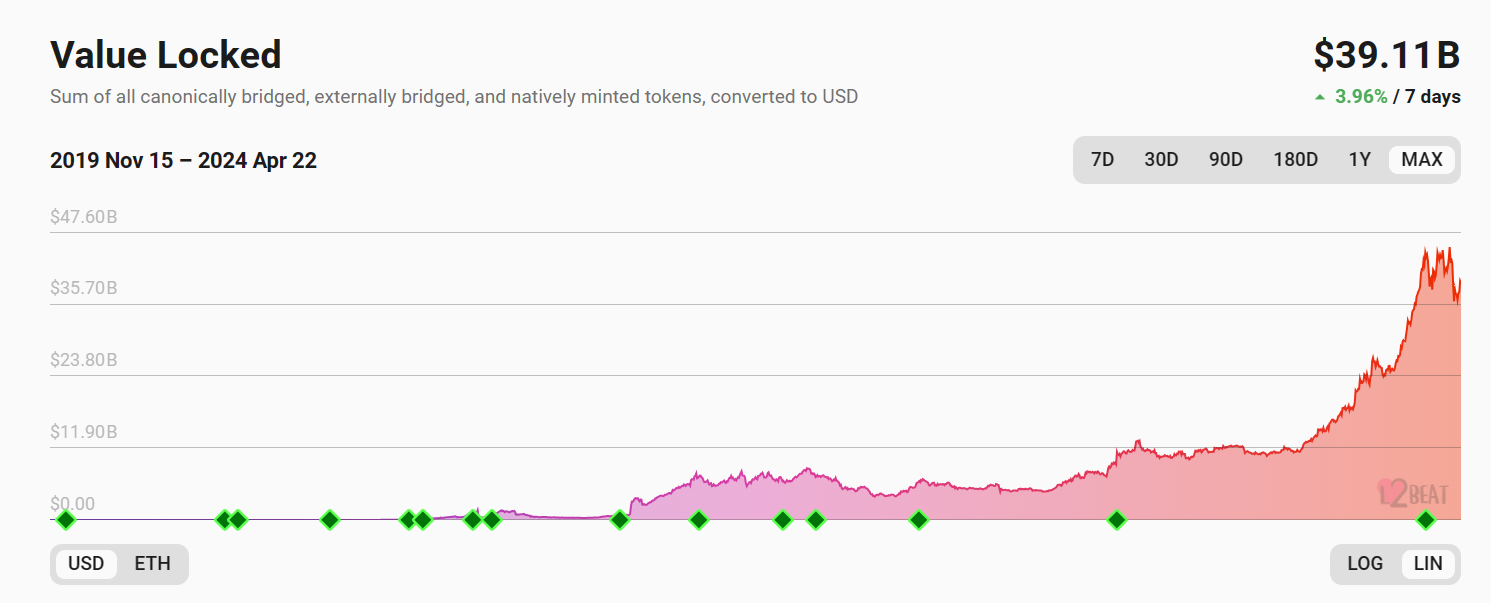
Even when measured in ETH terms, the growth in L2 TVL since October 2023 has accelerated significantly—breaking through the previous ceiling of 70,000 ETH and reaching an all-time high of 1.25 million ETH. In just half a year, this represents an 80% increase.

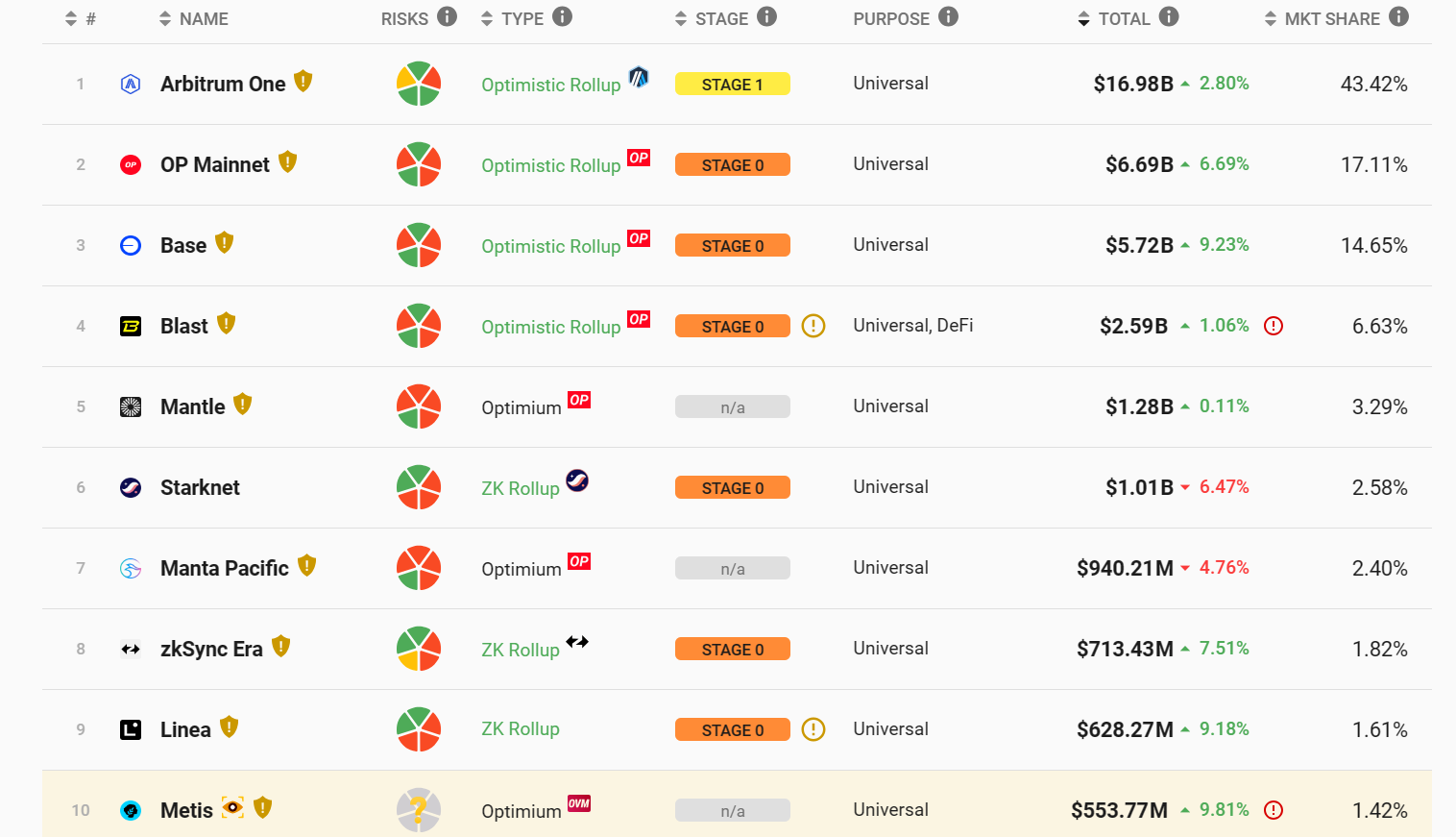
In terms of technology, L2 projects primarily rely on two mainstream scaling solutions: Optimistic Rollup and ZK Rollup. Among them, OP-based projects dominate the market:
There are 10 L2 projects with TVL exceeding $500 million, seven of which belong to the broader OP ecosystem. Their combined market share exceeds 85%, far surpassing the less than 15% held by ZK-based projects.
Moreover, the top five positions are entirely occupied by OP-based projects. The leading OP project, Arbitrum (nearly $17 billion), dwarfs the leading ZK project (around $1 billion) by a factor of 17. Thus, so far, the L2 race remains firmly led by OP-based chains, while ZK projects continue playing catch-up.
Now let’s look beneath the surface—at the shifting dynamics between new entrants and established players over the past year.
First, Arbitrum launched its token on March 23, 2023, directly pushing the overall L2 TVL past the $1 billion threshold and elevating the sector’s equilibrium range to around $1 billion. However, until the end of 2023, it struggled to break beyond this plateau.
Meanwhile, the rise of Ordinals and Bitcoin-centric narratives drew attention away from Ethereum L2s. Coupled with the resurgence of heterogeneous blockchains like Solana, the developmental bottlenecks facing L2s reignited industry-wide debates about Ethereum and its Layer 2 roadmap.
In particular, the proliferation of L2s built on scalability principles has already led to new issues such as liquidity fragmentation and mutual incompatibility—causing Ethereum’s narrative momentum to stall.

That changed in November 2023 with the arrival of Blast—the biggest disruptor yet. Leveraging staking yields, airdrop expectations, and an invite-only model, Blast achieved over $500 million in TVL within just five days, quickly overtaking veteran L2 stars like zkSync and Starknet. Its growth was nothing short of explosive:
By the time of writing, its TVL had reached $2.6 billion in under six months—ranking fourth among L2s, behind only Arbitrum ($17B), Optimism ($6.7B), and Base ($5.72B).
Additionally, Optimism’s OP Stack “Superchain” vision gave birth to flagship projects like Base in 2023, accelerating the trend toward “one-click chain deployment” and modularity. According to incomplete data from Coin98 Analytics, by the end of last year, the OP Stack ecosystem already included more than 20 L2 sub-projects (including testnets).
At the same time, other L2 projects have also ramped up their own superchain initiatives:
-
Arbitrum launched Arbitrum Nova—a network designed specifically for gaming, social apps, and high-throughput DApps—and introduced Arbitrum Orbit, an open-source toolkit enabling developers to deploy and create their own L3 chains;
-
zkSync unveiled ZK Stack, a modular open-source framework for building custom ZK Rollups;
-
At EthCC Paris, StarkWare co-founder Eli Ben-Sasson announced that Starknet will soon launch Starknet Appchains—application-specific chains that developers can launch using the Starknet stack, offering customization and decentralization;

Notably, the Dencun upgrade activated on Ethereum’s mainnet on March 15 dramatically reduced gas fees for transactions and transfers on L2s. The cost reduction and efficiency gains were immediately visible—OKLink data shows that after Dencun, L2 transaction fees dropped by over 80%, with actual costs falling below $0.10 and often even below $0.05.
Against this backdrop, entering 2024 and fueled by the expanding modular narrative and Data Availability (DA) concept, an increasing number of fragmented and isolated L2s are emerging as the new trend. Many projects are now considering launching their own L2 or L3 chains. This inevitably makes the Ethereum L2 space even more crowded, exacerbating homogenization.
Therefore, finding a differentiated competitive edge has become the key to breaking through in the second half of the L2 race.

A New Path Forward for the L2 Sector
From this perspective, the Dencun upgrade is far from the endgame for the L2 battle. The market is calling for a new paradigm for Ethereum L2.
In this context, new variables in the L2 space are beginning to emerge—including Ethereum L2 newcomers like Morph, which have drawn growing market attention since late last year. Many astute Web3 investors have already sensed the massive opportunities hidden within:
-
In November 2023, Blast raised $20 million in funding, with participation from Paradigm and Standard Crypto;
-
On March 3, 2024, Taiko, a zkRollup-based Ethereum Layer 2 network, closed a $15 million Series A round led by Lightspeed Faction, Hashed, Generative Ventures, and Token Bay Capital, with participation from Wintermute, Amber Group, OKX Ventures, GSR, and others;
-
On March 20, 2024, Ethereum L2 Morph raised $20 million (including a $1 million seed round), backed by top-tier VCs including Dragonfly Capital, Pantera Capital, Foresight Ventures, The Spartan Group, and MEXC Ventures;
-
On March 26, modular L2 Reya Network secured $10 million in funding from prominent VCs including Coinbase Ventures, Wintermute, and Fabric Ventures; on April 9, HashKey Group announced the launch of HashKey Chain, an Ethereum L2 leveraging ZK-proof technology to offer users low-cost, efficient, and developer-friendly on-chain solutions;
Amid this intensifying competition, market focus has shifted back to the Ethereum L2 space. Technical discussions around Ethereum are gaining renewed traction, especially around building a thriving application layer on L2—a dominant long-term narrative.
This article will use Morph as a case study to explore the new development paths these emerging players bring to the L2 sector—and what transformative impact they might have on the Ethereum ecosystem and the broader L2 landscape.
The "Racehorse Mechanism" Behind Decentralized Sequencers
As is widely known, sequencers control the order in which transactions are batched and submitted from L2 to L1. Currently, most L2 projects operate their sequencers in a centralized manner to provide faster transaction confirmation for users.
However, this approach carries significant risks—if a few centralized nodes go offline, the entire L2 network could suffer prolonged downtime. Moreover, these centralized sequencers may reorder transactions based on self-interest to maximize arbitrage profits, thereby capturing MEV value, delaying user transactions, or even censoring them altogether.
The advantages of decentralized sequencers are obvious—they eliminate single points of failure, preserve network decentralization, enhance security and stability, and allow sequencer revenue—the largest income stream in an L2 network—to be shared across the network’s builders.
Morph stands out as the first Ethereum L2 to implement a decentralized sequencer architecture at the foundational level. From day one, it has emphasized the importance of decentralized sequencing and designed a practical solution based on principles of high efficiency, low cost, scalability, and ease of maintenance:
In Morph’s operational model, a decentralized sequencer network allows multiple nodes (sequencers) to participate in transaction batching and ordering, rather than relying on a single controlling node.
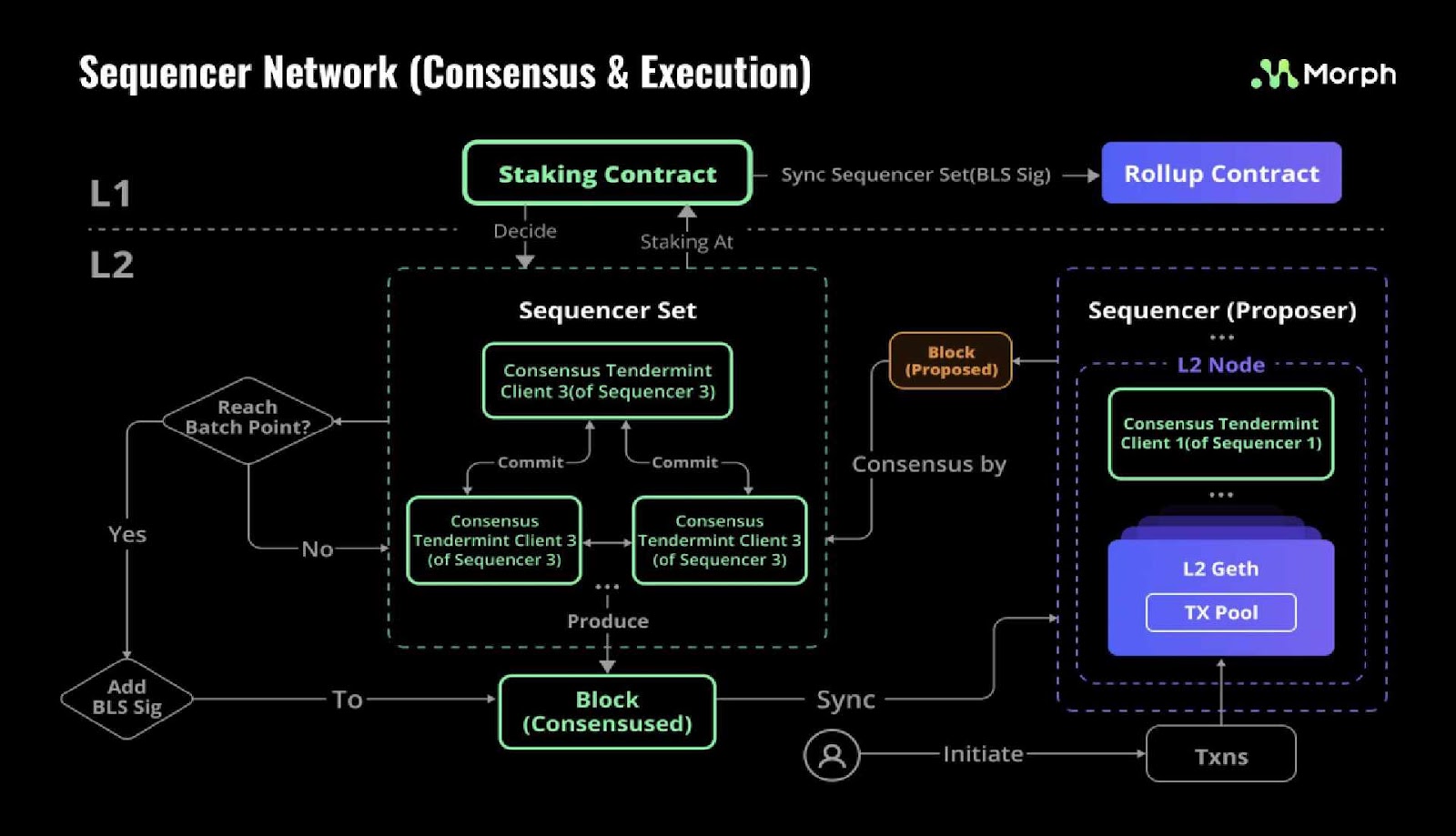
Beyond this, Morph’s decentralized sequencer design enables a grander potential vision: redistributing sequencer profits back to on-chain projects and DApp developers, fostering a wider variety of more proactive and user-centric on-chain products and experiences.
In other words, after collecting gas fees from users, Morph’s sequencer could redistribute profits according to predefined mechanisms to reward on-chain projects and DApps. This creates an entirely new incentive model—enabling fair and transparent rewards based on contribution, thus establishing a “community racehorse” competition mechanism. By treating sequencer fee revenues as a governance lever, Morph can organically incentivize individual DApps to contribute voluntarily to the health and growth of the entire ecosystem.
This fully leverages the strengths of different project teams, creating a highly market-driven competitive environment across DApps in areas such as marketing and innovative services—motivating contributors to jointly achieve sustainable ecosystem growth.
For example, if Morph ties incentives to metrics like gas consumption and active user count, developers would be indirectly encouraged to optimize their contracts for higher gas usage and greater user engagement—helping drive breakthrough adoption from zero to scale.
Theoretically, this design philosophy fosters “a hundred flowers blooming, a hundred schools contending”—low-cost empowerment for Morph to rapidly scale adoption and differentiation, while offering users diverse and efficient on-chain service scenarios.
Finally, project teams and DApps receiving sequencer fee revenue can further distribute these profits as incentives to various types of end-users to meet their operational needs. This gives each DApp an additional tool to engage users, while helping Morph achieve its goals of promotion and mass adoption—ultimately creating a “win-win-win” outcome.
According to official disclosures, Morph plans to launch its mainnet and activate decentralized sequencer functionality around mid-year. Given the current pace of L2 development, this may make Morph the first L2 network where developers and users can practically experience a live decentralized sequencer.
A Long-Term Framework Combining OP and ZK
As previously mentioned, nearly all mainstream L2 solutions today are derivatives of either Optimistic Rollup or ZK Rollup. When deciding between OP and ZK, DApps and project teams primarily weigh trade-offs between cost and security.
Most directly, Optimistic Rollups lack strong security guarantees but offer better Ethereum compatibility. Due to their optimistic fraud challenge model, they avoid the computational overhead of verifying L2 state most of the time, resulting in lower costs.
ZK Rollups, while extremely secure, suffer from inefficiency—they rely on mathematical proofs for objective security and don’t require dispute periods, but generating ZK proofs is currently slow and challenging, especially when aiming for EVM compatibility.
Although most OPRs haven't implemented interactive fraud proof systems—leaving users unable to respond when incorrect L2 states are submitted or to monitor malicious operator behavior—at least for now and likely for several years ahead, ZK Rollups remain economically uncompetitive for high-volume DApps.
Given this reality, many DApps prioritize cost savings over enhanced security—explaining why OP-based chains currently dominate. Hence, there’s a common saying in the L2 world: OP is the present, but ZK is the future—the ultimate destination for rollups and Ethereum L2.
But here lies the crux: as ZK Rollup technology evolves and achieves a better balance between economics and security, what happens to DApps originally deployed on OP chains? How do we address the technical and time costs of migration?
Precisely for this reason, combining Optimistic Rollup and ZK Rollup is seen as the future of Ethereum scaling. Morph innovatively proposes Responsive Validity Proof (RVP)—a hybrid approach that integrates the best of both worlds:
As a state validation method, RVP combines Optimistic Rollup with Validity Proofs, using ZK-proofs to verify state correctness. After L2 accepts a state change, if a challenge is raised, the sequencer must generate and submit a ZK-proof to L1 for verification within the challenge period. This design reduces verification complexity and theoretically shortens the challenge window from 7 days to just 1–2 days—enabling fast, secure, and low-cost transaction processing:
In traditional Optimistic Rollups, malicious sequencers have an incentive to launch DoS attacks on L1 to block challenges. But in RVP, since the sequencer generates the proof itself, this incentive disappears—effectively eliminating the issue and allowing much shorter challenge periods.
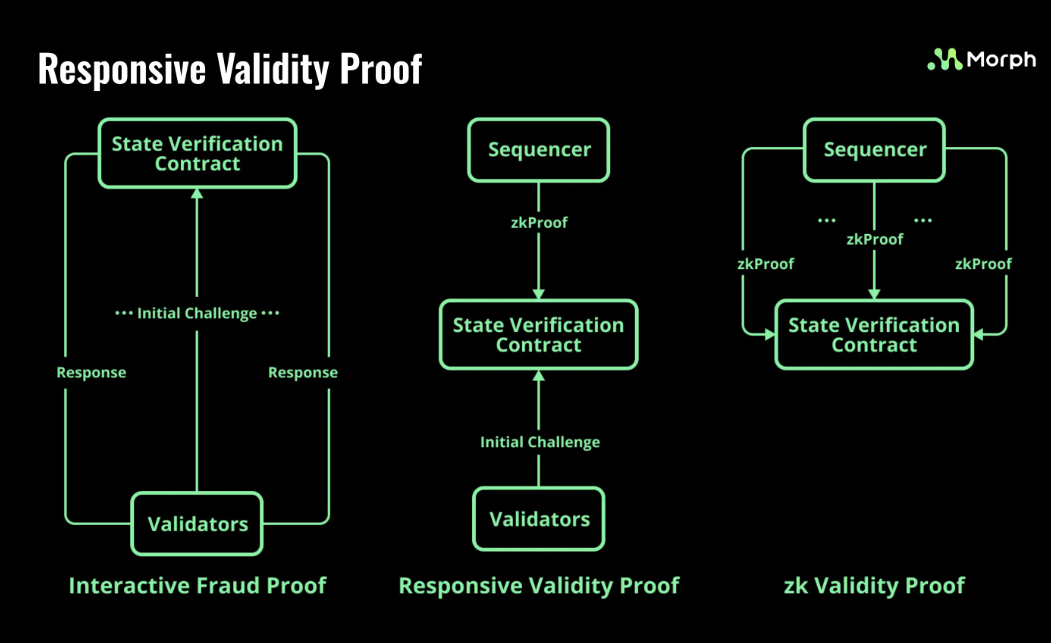
This can be understood as a unified solution—allowing DApps to start with a more economical configuration (OP), while retaining the flexibility to gradually strengthen security (via ZK Proof), without requiring major changes to existing infrastructure.
This highlights the architectural flexibility of Morph. Counterintuitively, just as alloys often outperform pure metals, Morph’s hybrid approach strikes an optimal balance between scalability, low cost, and high performance—cheaper than ZKRs while safer than most OPRs lacking permissionless fraud proofs.
Low-Cost & Low-Maintenance Through Modular Design
Additionally, from the perspective of attracting projects and DApps, migration barriers and usage costs are core competitive factors among different L2s.
Modularity is key here. Morph divides its architecture into three essential modules: the Sequencer Network responsible for consensus and execution; Optimistic zkEVM for settlement; and Rollup for data availability.
Morph adopts a design similar to Ethereum 2.0, separating consensus and execution clients to prevent invalid transactions from being included in blocks—thus avoiding unnecessary user gas losses.
Its rollup strategy maximizes efficiency—one transaction can include multiple batches, and one batch can contain multiple blocks. Additionally, leveraging ZK Proof compression, block content is optimized to effectively manage L1 data availability costs.
The Multiple Batch Submitters design allows each sequencer to take turns submitting batches to Ethereum, solving the single-point-of-failure issue associated with a single submitter, ensuring batch submission liveness, and incorporating incentive mechanisms to prevent transaction conflicts.

This modular collaborative architecture offers developers an attractive deployment option while enabling rapid adaptation to new standards, minimizing trial-and-error costs, and maintaining maximum alignment with Ethereum.
For instance, during major Ethereum upgrades like Dencun, Morph can efficiently integrate EIP-4844 and adopt new features immediately—achieving synchronized compatibility with Ethereum’s evolution. In contrast, standard rollups typically require mainnet hard forks or proxy contract upgrades, followed by extensive testing, before achieving seamless interoperability.
Taken together, if Arbitrum and Optimism are the reigning stars of the L2 scene, and Base and Blast are rising newcomers, then Morph resembles a promising rookie with immense potential.
Can Morph and Others Trigger a Second-Half Turnaround for L2?
Currently, new entrants like Morph are still operating on testnets and have not issued tokens, allowing for a relatively objective assessment of their competitive advantages and growth potential relative to other L2s.
As noted earlier, in today’s Ethereum L2 ecosystem, raw performance may no longer be the dominant narrative. Beyond scalability and performance improvements, the real challenge lies in attracting more developers, projects, communities, and market attention—building a vibrant ecosystem across AI, DeFi, NFTs, GameFi, etc.—to avoid the awkward situation of high valuations paired with stagnant on-chain activity.
Time feels cyclical—in 2021, we marveled at Axie Infinity sweeping Southeast Asia and bringing a fresh wave of Web3 users. Now in 2024, we’re back at square one. Amid relentless expansion, the Web3 world faces its own unique traffic dilemma—user saturation within the existing base, and immense difficulty attracting new users.
In this context, Morph’s positioning as a “consumer-grade L2” is particularly well-suited to meet this demand for growth. On one hand, consumer-grade use cases span a rich spectrum—from entertainment and leisure to on-chain asset ownership—allowing Morph to cover diverse areas through deepening ecosystem development.
On the other hand, the consumer market is vast. At a time when blockchain seeks mainstream breakthroughs, providing low-barrier, seamless experiences can serve as a gateway for massive Web2 users to enter the Web3 world.
Especially given the previously discussed long-term OP+ZK integration framework, the “racehorse mechanism” enabled by decentralized sequencers, and the low-cost, low-maintenance benefits of modular design—this combination essentially forms an internal L2 development solution driven by market forces, transparent allocation, and fair resource distribution.
First, the integrated OP+ZK long-term framework and modular design significantly reduce migration and development barriers for developers and DApps—offering an attractive deployment option, faster adaptation to new standards, lower trial-and-error costs, and stronger consistency with Ethereum.
On this foundation, developers may not need to modify a single line of code, maintaining high execution-layer compatibility with Ethereum—minimizing entry barriers on Morph. This means protocols from other chains, especially leading ones, can onboard quickly and enter a positive feedback loop.
Second, the “racehorse mechanism” behind decentralized sequencers fully unleashes the strengths of different project teams—creating a highly market-driven competitive environment across DApps in ecosystem building, marketing, and service offerings—motivating community builders to collectively achieve sustainable growth for Morph’s ecosystem.
Precisely because it’s still early in ecosystem development, Morph has recently launched a series of ecosystem initiatives and long-term plans:
-
On March 25, Morph announced the Sparkloom Builder Program—a four-month initiative featuring an online hackathon and incubator. The hackathon offers a $20,000 prize pool, with winners invited into the Morph incubator. Final incubator winners can receive up to $100,000 in funding and 30% of Morph’s total airdrop;
-
On April 9, Morph co-hosted the Hack.Summit Hackathon with BeraChain, Solana, and The Graph, offering workshops, lectures, and prizes across various Web3 application scenarios to accelerate technological development and real-world adoption;
-
On April 13, Morph partnered with OpenBuild, Chainlink, SNZ, EthPlanet, and MaskSolidity to host an offline Meetup & Mini-HackerHouse event in Shanghai, helping interested developers dive into Ethereum ecosystem development;
-
Additionally, Morph launched the Sparkloom Incubator Program, running from April 29 to June 30, targeting projects in AI, DeFi, GameFi, Infrastructure, NFTs, and middleware/tools. Winners will receive mentorship from institutions including Dragonfly, Pantera, LayerZero, The Block, Nansen, and Pyth; grants of up to $100,000 per project; 30% of initial airdrops; and full quarterly rebates of first-year sequencer fee profits;
These initiatives allow Morph to leverage existing crypto communities for low-cost, rapid growth from zero to one. From the end-user perspective, they also create effective C2E (“Contribution-to-Earn”) channels:
By aggregating diverse user groups from different on-chain protocols, Morph offers varied reward opportunities—rewarding contributions transparently. Regular users earn fair rewards simply by contributing to B-side-designed on-chain services (using protocols, holding positions, lending, etc.).
This gives institutions new ways to incentivize users and generate revenue, gives users diversified opportunities to share in sequencer fee profits, and helps Morph achieve its goals of ecosystem growth, promotion, and mass adoption—creating a true “multi-win.” If executed steadily, this could evolve into a powerful self-reinforcing cycle.
If “Web3 in 2022 was like Web2 in 2002,” then now may be the perfect time to build—with the key lying in unlocking consumer-grade use cases and drawing in ever more new users. Whoever captures the billions of future Web3 users will win the war.
Conclusion
Of course, new L2 solutions like Taiko and Morph are still in very early stages. For now, core teams remain focused on developing and refining foundational infrastructure. But with the L2 race heating up and major players like Coinbase and ConsenSys making strategic moves, the second half of the L2 era may already be underway.
All that’s past is prologue. From a macro perspective, if everything goes smoothly, whether it’s rising stars like Morph and Taiko or newcomers like Base and Linea, they could lay the groundwork for a new wave of DApps, new users, and ultimately drive growth in Ethereum’s ecosystem TVL—potentially charting a path entirely different from the previous L2/public chain boom.
Particularly, Morph’s integrative approach is stirring the waters. Through its fusion of OP and ZK frameworks, the “racehorse mechanism” powered by decentralized sequencers, and modular design enabling low cost and easy maintenance, it presents a compelling vision for L2 evolution—from self-sustaining cycles to positive feedback loops. The potential is vast—but so are the challenges.
Join TechFlow official community to stay tuned
Telegram:https://t.me/TechFlowDaily
X (Twitter):https://x.com/TechFlowPost
X (Twitter) EN:https://x.com/BlockFlow_News