Parallel EVM+ Engine: Exploring Infinite Blockchain Scalability and Realization of Large-Scale Applications
TechFlow Selected TechFlow Selected
Parallel EVM+ Engine: Exploring Infinite Blockchain Scalability and Realization of Large-Scale Applications
EVM+ enables mass adoption by seamlessly integrating EVM assets, protocols, and infrastructure, accelerating the convergence of cryptocurrency with mainstream applications.
 Navigating Web3 tides with focused insights
Author: YBB Capital Researcher Ac-Core
Introduction
EVM+ is an advanced paradigm specifically designed to advance the Ethereum Virtual Machine (EVM), better adapting it to the rapidly evolving crypto landscape. In this model, as Web2 innovations and productivity gradually integrate into Web3, practical technologies such as artificial intelligence, DePIN, and DeFi security are being rapidly incorporated into cryptographic applications. EVM+ offers a novel solution by seamlessly integrating EVM assets, protocols, and infrastructure—enabling large-scale application development and accelerating the convergence of cryptocurrencies with mainstream applications. It enhances blockchain scalability through native on-chain extensions combining EVM with WASM, and further optimizes processing capacity by supporting parallel EVM execution.
As explained by Techandtips123, parallel EVM is like task delegation at a party. Imagine preparing for a move where everyone has a role: A transports large items, B handles valuables, C manages item moving, and D takes care of cleaning and layout at the new place. This division of labor allows four people to complete the job together, significantly saving time and improving efficiency.
The concept of parallel EVM works similarly, distributing computational tasks across multiple execution units. On the Ethereum network, many participants simultaneously process different transactions—each transaction acting as an independent task, such as a transfer or token creation. Each participant independently processes one task within the EVM, much like standalone computer programs running on the blockchain. Once completed, the results are aggregated back into the network to form the final block. When a single executor cannot handle a high volume of transactions alone, speed drops and usability declines. Parallel EVM addresses this issue by allowing multiple executors to process different transactions simultaneously, enabling the network to handle more transactions faster, reducing congestion and associated costs.
A New "Layer" Concept
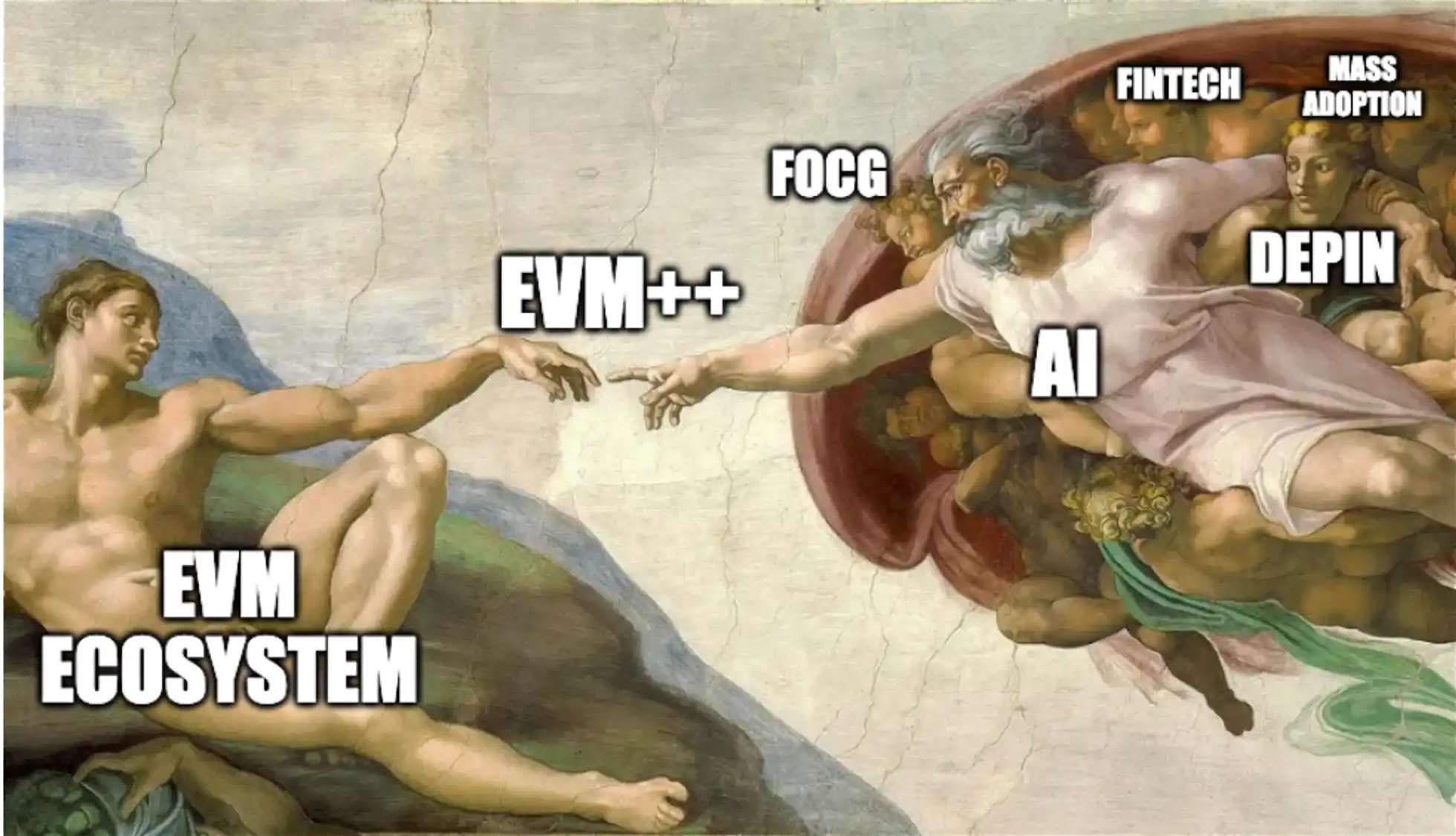
Image source: Artela — From EVM+ to EVM++
Vitalik Buterin pointed out: "L2s are for scaling, L3s are for custom functionalities such as privacy protection. In this vision, no one is aiming for 'scalability squared'; instead, there's a layer in the stack dedicated to helping applications scale, and another layer focused on fulfilling customized functional needs for different use cases."
In Vitalik’s vision for Ethereum, layers addressing non-scaling needs clearly play a crucial role. His perspective emphasizes the necessity for blockchain networks to support “custom functionalities.” For Ethereum, meeting this need might involve building a new layer, whereas Artela adds “native extensions” directly onto the base layer.
Regarding blockchains, functionality refers to the ability to support diverse applications. The Ethereum Virtual Machine (EVM), serving as the runtime engine for smart contracts, is the dominant model for realizing DApp functionality. Originally proposed by Ethereum, EVM is now adopted by numerous smart contract chains, commonly referred to as EVM-compatible or EVM-equivalent chains. However, current EVM implementations have proven limited in supporting extended DApp functionalities. The key challenge lies in expanding the functional boundaries within EVM chains. In practice, there are two directions for improvement:
● Replace EVM with a better virtual machine;
● Enhance EVM through supplemental extensions.
The first approach bypasses EVM limitations but requires abandoning EVM-based smart contracts. MoveVM and FuelVM are examples of this implementation. While more advanced virtual machines may be needed in the future, they will require considerable time to reach the same level of maturity and adoption as EVM.
The second approach introduces a new stack that enhances EVM through “extensions.” The goal is to push EVM capabilities beyond its original specifications while maintaining EVM equivalence. This method strengthens DApp functionality atop existing EVM infrastructure. Exploring EVM enhancements opens doors to exciting possibilities and sustained innovation in DApp functionality, bringing significant emerging breakthroughs.
Artela
EVM+ in the Artela Network
Artela’s mission is to create a foundational-layer blockchain network that meets the growing demand for large-scale decentralized applications. Artela’s innovative design enables developers to build native extensions modularly on top of the blockchain’s base layer, enhancing programmability. This approach allows developers to implement custom features in lightweight and dynamic ways, unlocking faster innovation and greater possibilities.
Artela features an extension layer that supports user-defined extension modules called Aspects, increasing programmability while ensuring compatibility with existing EVM smart contracts. Aspects allow developers to inject additional logic throughout the entire lifecycle of a transaction—processing transactions and related blocks beyond the scope of smart contracts.
Artela has built a highly scalable EVM+ network, leveraging Aspect programming (see Extension Link 1) to introduce WASM virtual machines on EVM-compatible networks. These VMs interoperate seamlessly, enabling dynamic addition and execution of on-chain extensions. EVM+ empowers developers to build high-performance protocols, modular DApps, and customize underlying functions for specific scenarios.
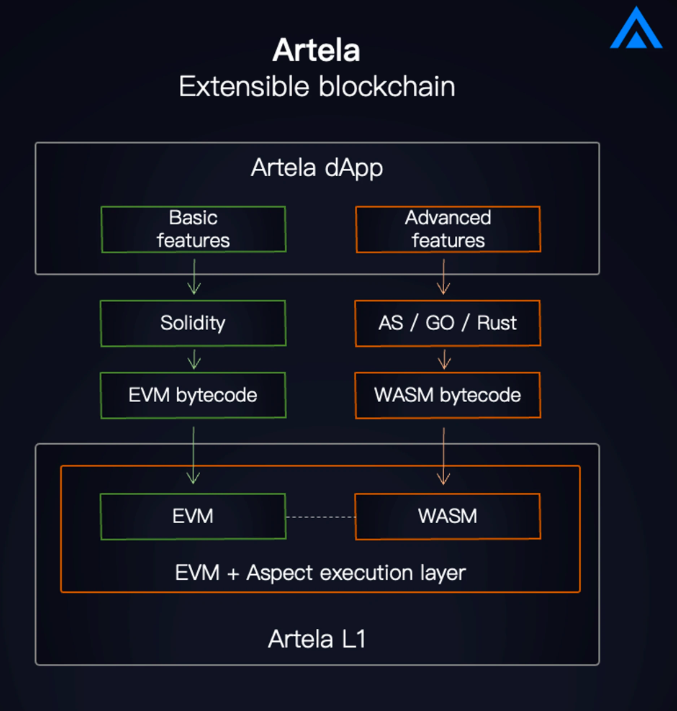
Image source: Artela Official
During DevNet and Public Testnet phases, Artela collaborated with community developers to explore the potential of the EVM+ network, resulting in imaginative use cases:
● Using WASM as an on-chain coprocessor to enable direct execution of AI agent algorithms and other high-performance modules on the blockchain, while ensuring seamless interoperability with EVM systems;
● Enabling autonomous world on-chain AI agents to create truly programmable, interactive NPCs on-chain;
● Optional real-time on-chain security modules allowing DeFi protocols to instantly detect and recover from suspicious transactions.
A new era is approaching—one capable of fully realizing on-chain protocols, artificial intelligence, and secure DeFi, while maintaining compatibility and interoperability with the EVM ecosystem.
From EVM+ to EVM++
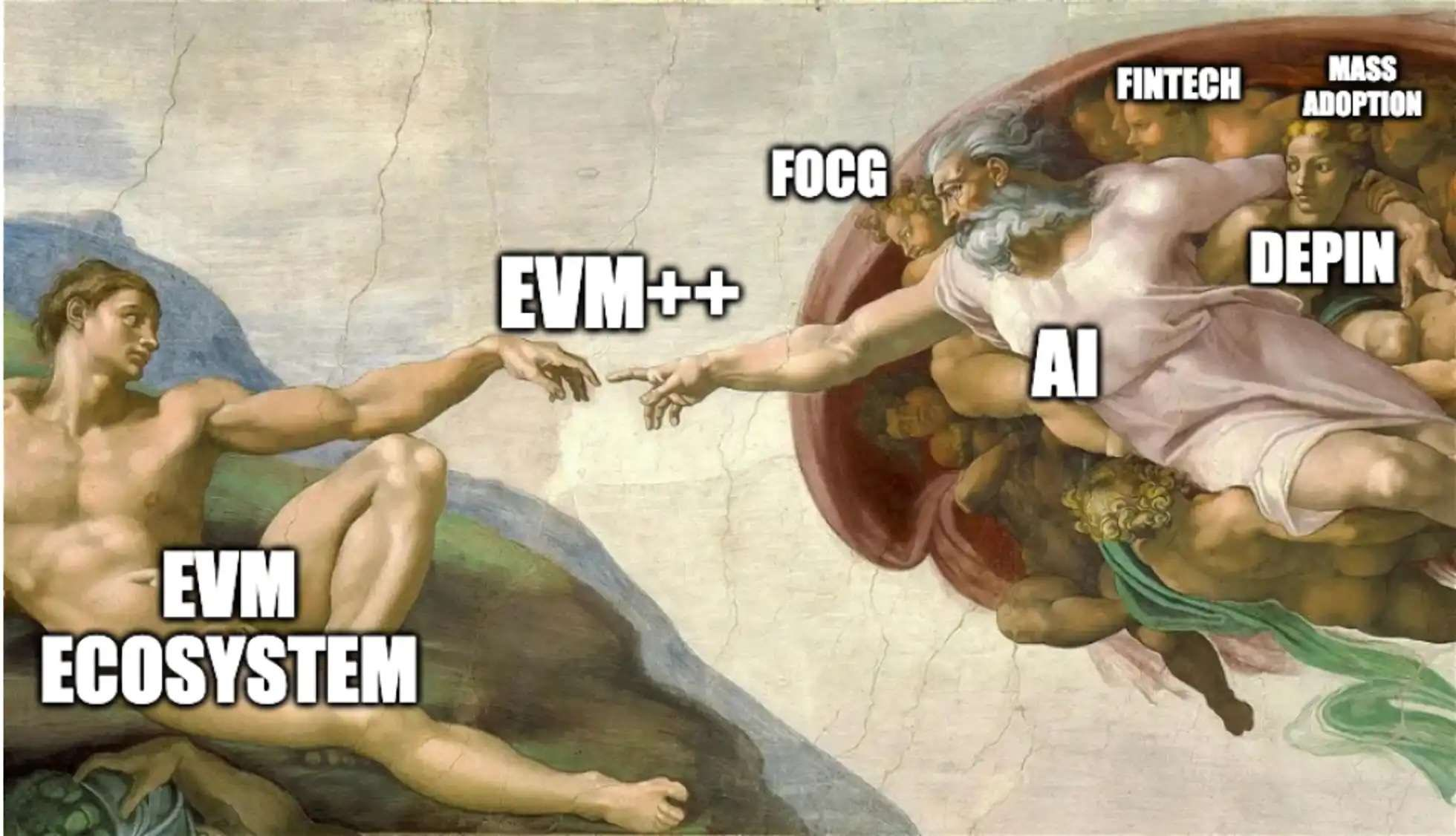
Artela’s vision is to build an infinitely scalable network—EVM+ is not the end goal but a starting point. Artela’s next step is EVM++, a parallel EVM+ network that fully unlocks the potential of scalable blockchains. EVM+ unleashes EVM’s scalability to adapt to a new crypto world where Web2 productivity and innovation, along with practical technologies such as AI, DePIN, and fintech, are rapidly integrating into DApps. EVM++ further amplifies EVM’s scalability, enabling this highly creative network to promote mass adoption of DApps and accelerate the integration of cryptocurrency with mainstream applications.
EVM++ Parallel Elastic EVM Network
Artela’s parallel EVM++ will be implemented in two phases.
Phase One involves parallel transaction execution under EVM+. Artela’s network not only achieves basic parallel EVM execution but also solves the complex problem of parallel execution under EVM+ Aspects—an extension program running on the WASM virtual machine that can be invoked during a transaction’s lifecycle.
In Phase Two, Artela will combine parallel capabilities with elastic computing to achieve elastic block space—a dynamic mechanism allowing DApps to maximize the benefits of parallel execution.
Overview of Parallel EVM
Artela’s horizontally scalable architecture is designed around parallel execution, using elastic computing to ensure scalability of network node computation power, ultimately achieving elastic block space.
● Parallel Execution: Transactions on Artela can be executed in parallel. The Artela network groups transactions based on dependency conflict analysis;
● Elastic Computing: Validator nodes support horizontal scaling. The network automatically adjusts validator compute nodes based on current load or subscription levels. The scaling process is coordinated by an elasticity protocol, ensuring sufficient elastic compute nodes within the consensus network;
● Elastic Block Space: Based on elastic computing, besides expanding public block space, large DApps with independent block space requirements can request dedicated elastic block space within the network.
"Elastic Block Space"
Elastic block space refers to dynamically expandable block space that provides protocol-guaranteed dedicated block space for DApps with high transaction throughput demands. By default, the public block space of a block is limited in capacity. When a DApp requests independent block space, the block adds extra space exclusively for transactions related to the DApp’s smart contract. As block space expands, validators must increase elastic execution nodes to scale corresponding processing capacity.
Elastic block space is a blockchain scaling mechanism that enables infinite scalability while preserving interoperability. Sharded blockchains, appchain networks, and Layer2s can also provide isolated block spaces, but isolation and block production are asynchronous. Elastic block space allows DApps with dedicated block space to interact synchronously via atomic transactions within the same block, eliminating the need for asynchronous cross-chain communication.
When a DApp on the Artela network requires high scalability, it can subscribe to elastic block space to manage increased throughput. Elastic block space and native extensions provide DApps on Artela with both scalability and customization capabilities.
Artela Enhances DApp Capabilities Through Native Extensions
By leveraging Aspect programming, developers can create native extensions (see Extension Link 2), incorporating custom functionalities into DApps across all blockchain base layers and combining them with existing EVM smart contracts to enhance DApp capabilities.
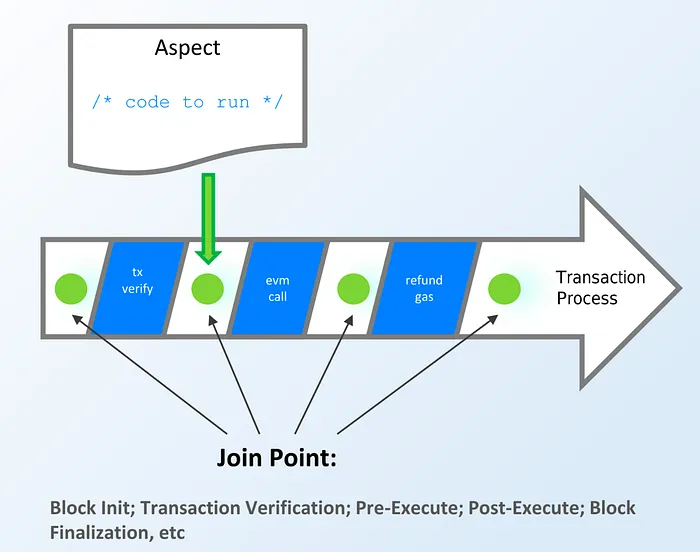
Image source: Joshua Esin
1. Enhanced Scalability:
One advantage of Aspect programming in Artela is its unparalleled scalability. Traditional smart contracts often face limitations when modifying or extending functionality. Artela’s Aspect programming overcomes this barrier by providing a modular and extensible framework. Developers can seamlessly extend existing contract functionalities without altering their core logic. This scalability paves the way for more agile and scalable dApp development.
2. Improved Security:
In the evolving field of blockchain security, Artela’s Aspect Programming introduces a paradigm shift. Unlike traditional white-box security measures, Aspect programming provides a complementary black-box security solution. Real-time monitoring, proactive risk mitigation, and runtime behavior analysis help establish a robust security framework, preventing vulnerabilities and ensuring protocol continuity.
3. On-Chain Intent Solvers:
Artela’s Aspect Programming introduces the revolutionary concept of on-chain intent solvers. Traditionally, users had to specify detailed function calls to execute transactions. With on-chain intent solvers, users can express desired outcomes in human-readable language, enabling a more intuitive and customizable experience. For example, a user could state their intent as “swap X ETH for Y USDC” without calling complex functions.
4. Just-in-Time (JIT) Operations:
JIT operations, a powerful concept widely used in various scenarios, gain flexibility through Artela’s Aspect Programming. Executing on-chain logic during the block lifecycle and combining it with smart contracts in atomic transactions opens possibilities for JIT liquidations, JIT LP management, and MEV-capturing AMM strategies.
5. Native Event-Driven Actions:
Native event-driven actions in Artela allow users to subscribe to real-time on-chain events and trigger atomic tasks. This feature helps maintain consistency between on-chain and off-chain states, enables asynchronous cross-chain message notifications, and enhances blockchain automation.
6. Full-Chain Gaming:
Artela’s Aspect Programming extends its impact into gaming, giving developers tools to enhance in-game asset programmability. With Artela, gaming equipment NFTs can be upgraded through programmability, ushering in a new era of multifunctional user experiences within game ecosystems.
7. On-Chain Microservices:
Artela enables the creation of public on-chain services on blockchain networks, facilitating collective maintenance and governance by different users and organizations. This model promotes resource sharing, collaborative innovation, reduces development barriers, and contributes to the growth of the decentralized finance ecosystem.
Built-in "Function Layer" for Decentralized Networks: Enhancing Blockchain Capabilities.
Artela’s programming model introduces a built-in “function layer” to blockchain networks—eliminating reliance on third-party networks or complex off-chain systems. This function layer extends the base layer’s native capabilities, including security protection, custodial functions, automation, and off-chain synchronization. Integrating this function layer marks a leap forward in protocol development and user experience for decentralized networks.
Conclusion
The foundational technology of Web3 is public blockchains, first introduced to the world by Satoshi Nakamoto’s Bitcoin network and later greatly expanded in functionality by smart contract platforms like Ethereum. Some view blockchains as decentralized data networks, i.e., distributed ledger technology. In reality, they are far more than just data layers.
Blockchains resemble computers more than ledgers or databases. Today’s challenge lies in designing better computers. The Artela blockchain is built on the Cosmos SDK with numerous engine-level improvements. Additionally, Artela is EVM-compatible, with its key innovation being the introduction of Aspect Programming to enable on-chain extensions. Beyond EVM, Artela adds a second virtual machine based on WASM to support multiple programming languages (assembly scripts, Rust, C, C++), accessing more on-chain resources. Thus, EVM serves general-purpose smart contracts, while the Aspect VM caters to application-specific extensions.
Extension Links:
Join TechFlow official community to stay tuned
Telegram:https://t.me/TechFlowDaily
X (Twitter):https://x.com/TechFlowPost
X (Twitter) EN:https://x.com/BlockFlow_News
 @YBBCapital