









Unboxing the Mystery: Tracing Token Issuance Projects' Airdrop Rules for "Gitcoin Donors"
TechFlow Selected TechFlow Selected
Unboxing the Mystery: Tracing Token Issuance Projects' Airdrop Rules for "Gitcoin Donors"
Gitcoin airdrop rewards used to require only donations, but now they depend on factors such as donation amount, donated projects, and funding rounds, serving more as one of the "weights" for project airdrops.
 Navigating Web3 tides with focused insights
Author: Biteye
Claiming airdrops via Gitcoin donations is like opening blind boxes. To help you make better decisions, Biteye has analyzed the airdrop rules of Optimism, Dmail, Namada, NIM Network, and Celestia.
All of these projects have distributed airdrops to addresses that participated in Gitcoin donations, though their rules vary slightly. See the comparison below.
Rule 1: Gitcoin donors receive airdrop directly, no restrictions on round or amount
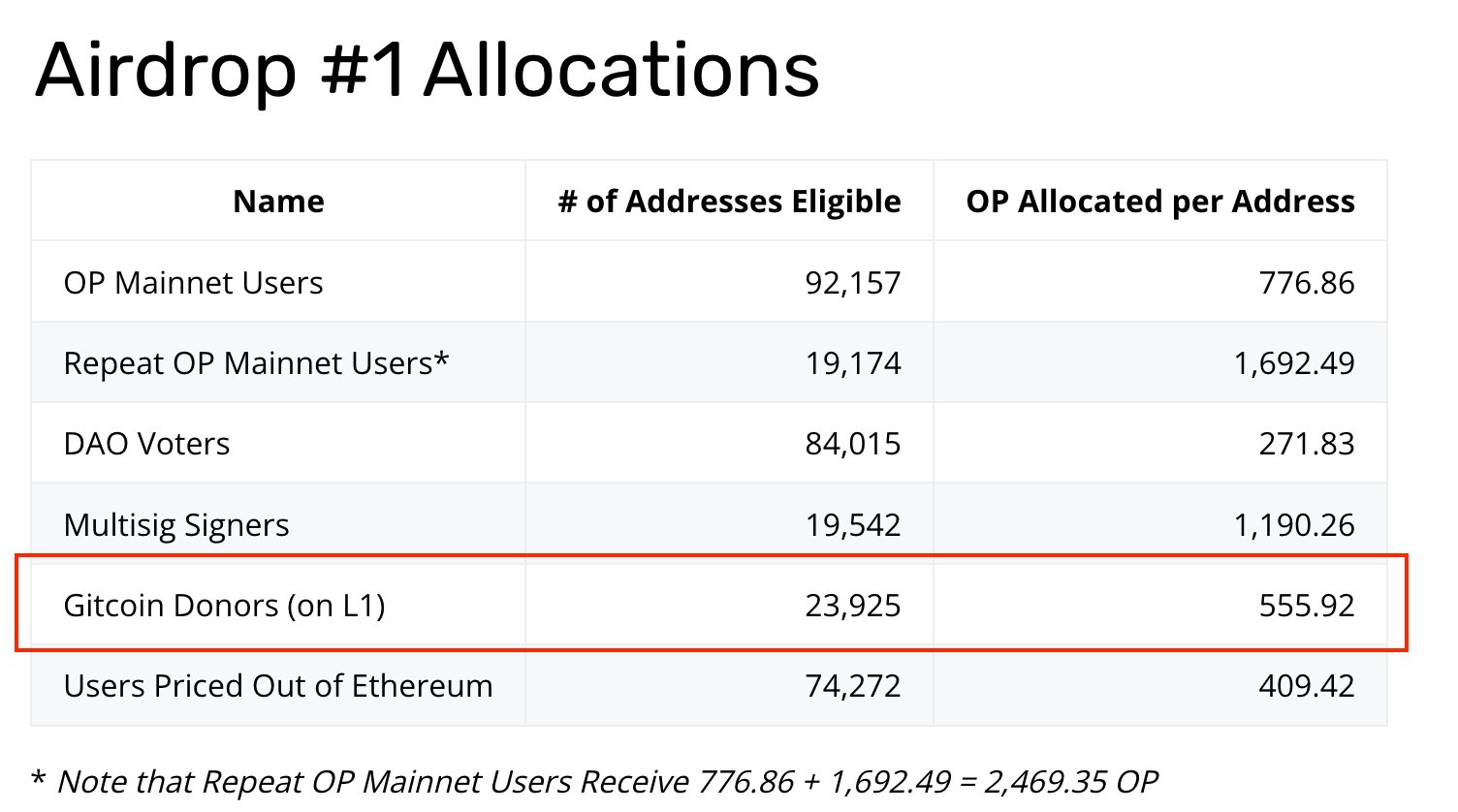
Optimism is an Ethereum Layer 2 network. In its first airdrop, it allocated 5% of the total OP supply to 248,699 addresses, including those who donated via Gitcoin.
The main requirement was having made an on-chain donation through Gitcoin on L1 before the snapshot, regardless of round or amount. Each qualifying address received 555.92 OP tokens, worth approximately $800 at launch—quite substantial.
Rule 2: Gitcoin donors receive tokens directly, with restrictions on round and amount
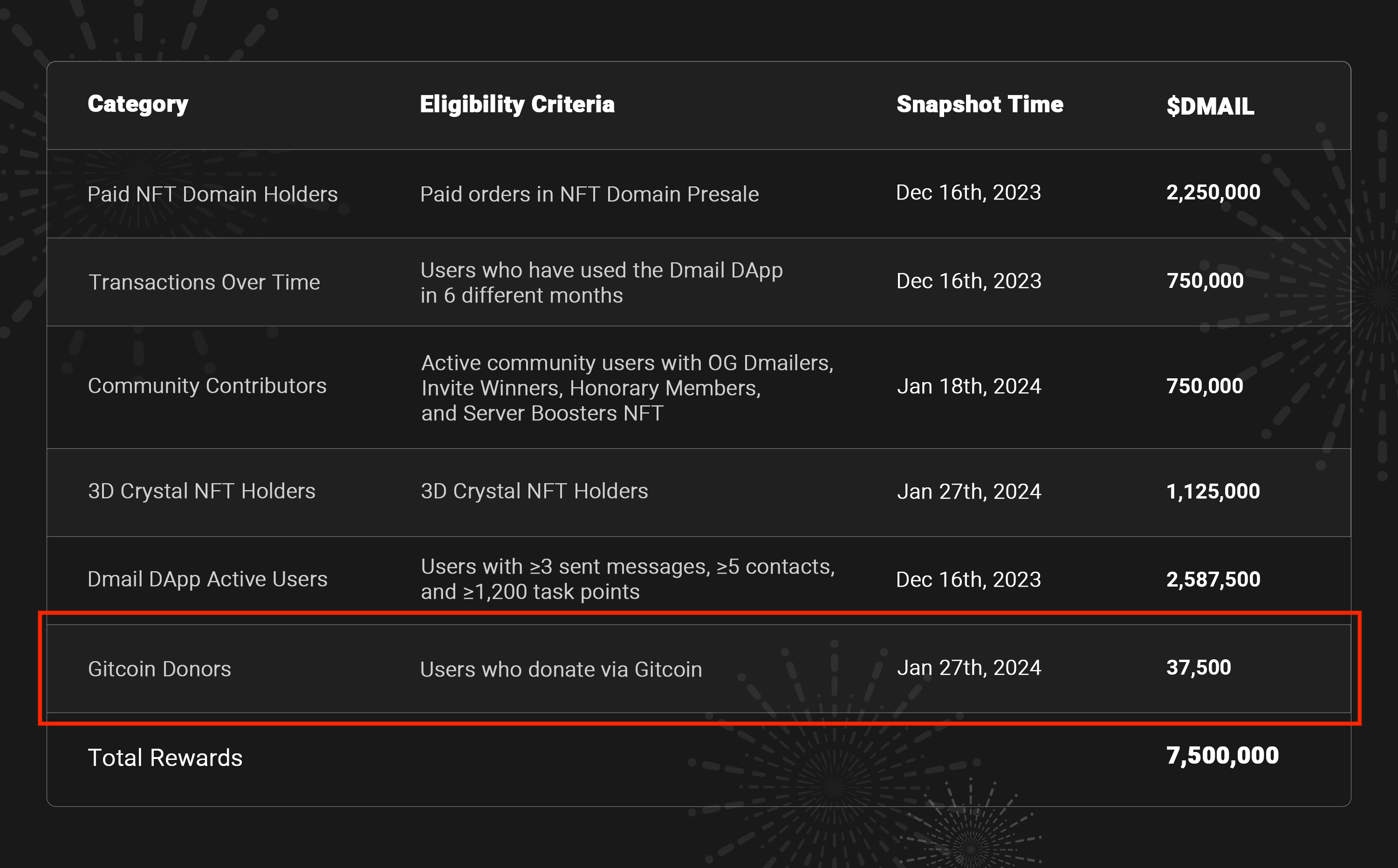
Dmail offers encrypted email services and distributed 7.5 million DMAIL tokens (3.75% of total supply) in its first-season airdrop.
All addresses that donated more than $5 to Dmail in the past two Gitcoin rounds received a portion of 37,500 DMAIL tokens. For ETH donations, the amount was converted into USD based on the exchange rate at the time (2268.26 USD/ETH).
Rule 3: Gitcoin donors receive tokens directly, restricted by round, with amounts ranked
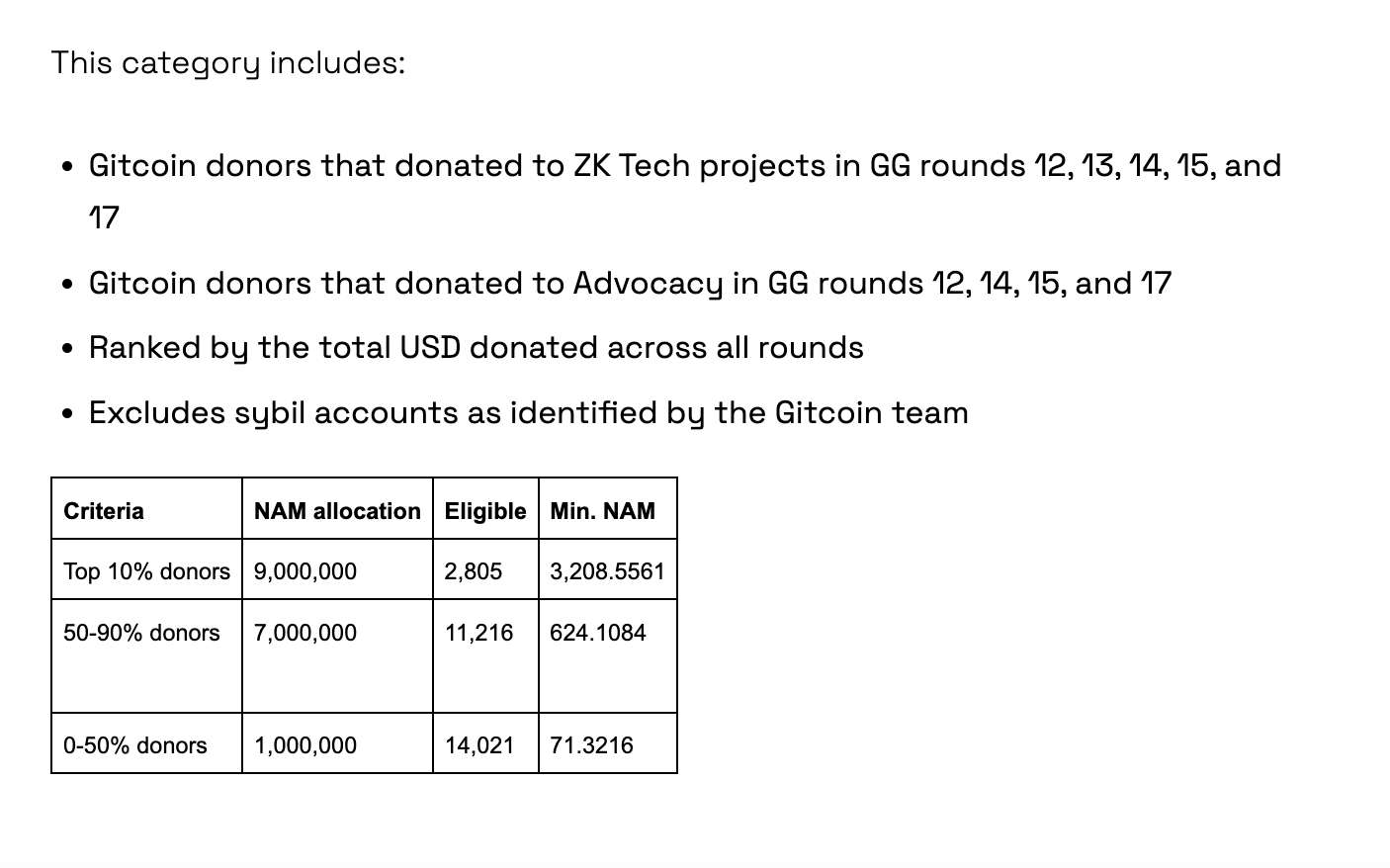
Namada is a Layer 1 blockchain for interchain asset proof-of-stake. It airdropped 65 million NAM tokens (6.5% of total supply) in the RPGF Drop, allocating 26% of this portion to donors supporting ZK Tech and Advocacy projects on Gitcoin.
Donors must have contributed to specific projects during designated rounds. Allocations were determined by ranking total donations per round, with the lowest qualifying tier receiving 71 NAM tokens.
Rule 4: Gitcoin donors receive tokens directly, but only for specific donation types
NIM Network is an AI gaming blockchain built on Dymension, which airdropped 90 million NYM tokens (9% of total supply).
The team airdropped tokens to 7,599 wallets that donated to specific open-source gaming, infrastructure, and software projects on Gitcoin. The exact distribution ratio remains undisclosed.

Rule 5: Gitcoin donations count as a scoring weight
Celestia is the first modular blockchain network. Its genesis airdrop distributed 60 million TIA tokens (6% of total supply), with one-third allocated to early participants of Ethereum rollups.
To measure on-chain activity, the official team applied weighted scores to certain behaviors, generating a final score (out of 23 points) tied to airdrop allocation. Gitcoin donors received 3 points toward their score.


Summary
Gitcoin donations represent positive on-chain engagement and may even qualify users for high-quality project airdrops—a classic case of small investments yielding big returns.
Notably, the entire airdrop ecosystem is becoming increasingly competitive. Gitcoin donations are no exception—the rewards aren't as generous as they once were. While previously any donation might have sufficed, now factors such as donation amount, chosen project, and contribution round matter significantly. More often than not, Gitcoin participation now serves merely as one of several weighting factors in a project's airdrop criteria.
Join TechFlow official community to stay tuned
Telegram:https://t.me/TechFlowDaily
X (Twitter):https://x.com/TechFlowPost
X (Twitter) EN:https://x.com/BlockFlow_News
 @BiteyeCN









