








Bitcoin Puppets Ultimate Guide: Everything You Need to Know from Culture to Products
TechFlow Selected TechFlow Selected
Bitcoin Puppets Ultimate Guide: Everything You Need to Know from Culture to Products
No roadmap, no promises, no board of directors.
 Navigating Web3 tides with focused insights
Text: KAYLAN SLINEY
Translation: TechFlow
Bitcoin Puppets is a collection of 10,001 unique PFPs hand-drawn by a 12-year-old child using MS Paint, now sweeping through Web3. At launch, its floor price reached 0.408 BTC (26,775 USD).
Yet what may seem to many as an unexpected, relatively overnight success has actually been years in the making. Let’s explore the intersection of culture, community, and cryptocurrency.
A Brief History
To respect the privacy of project founder Le Puppeteer Fou (hereafter referred to as "The Puppeteer"), we’ll keep this history as light and sweet as a Dunkin’ Donuts coffee.
Legend has it that The Puppeteer had long been an artist, previously favoring abstract portraiture. He first encountered several key Puppets during Ethereum NFT's original heyday on the Wassies by Wassies Discord server. They later formed their own private chat, and this growing circle of friendship became the foundation for the community we now know and love.
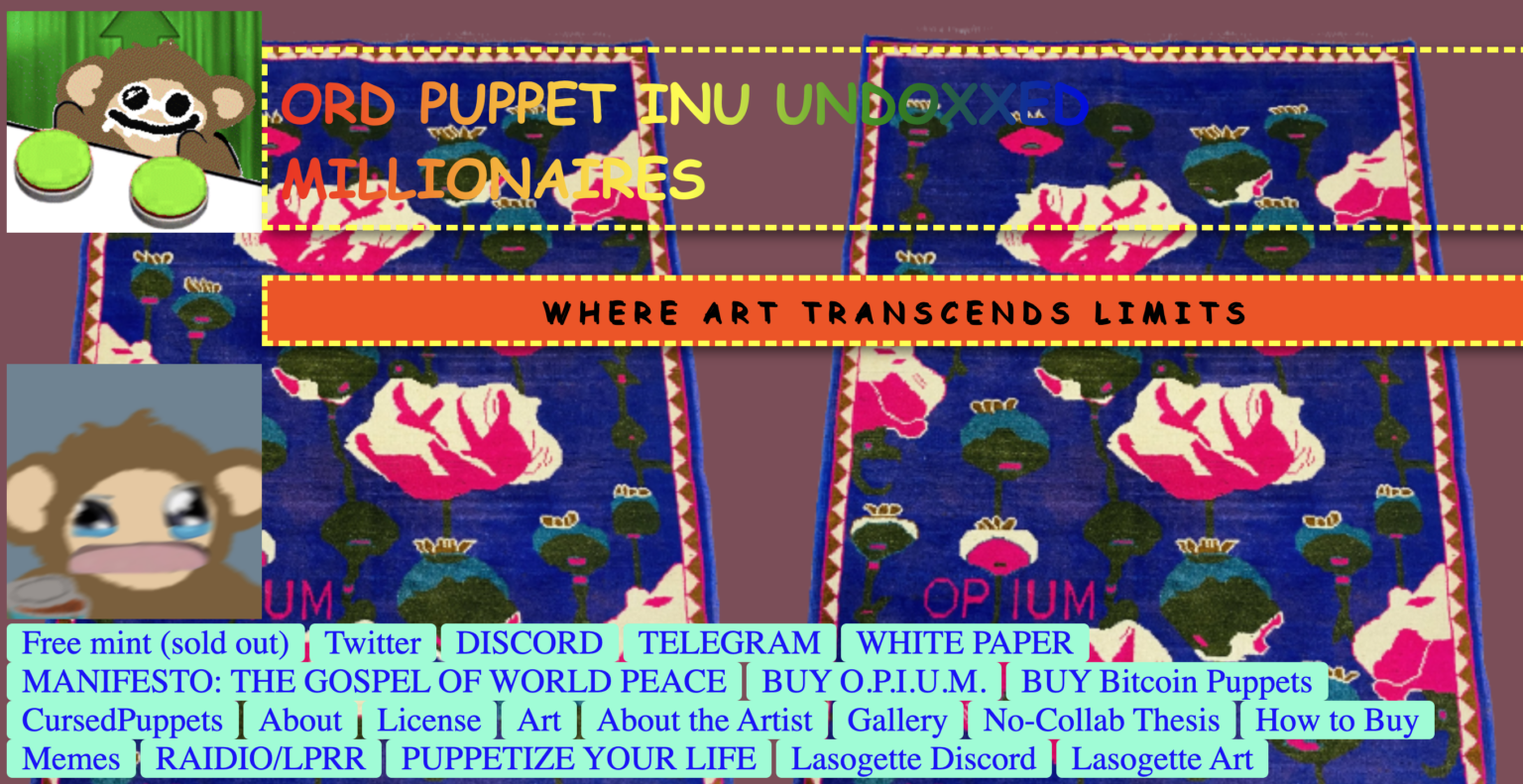
Prior to creating Bitcoin Puppets, The Puppeteer had already released collections such as Lasogette—a set of 7,777 generative PFPs with artistic aesthetics minted on the Ethereum network—and Ord Puppet Inu Undoxxed Millionaires (O.P.I.U.M.), an esoteric and absurd collection issued as Ordinals NFTs.
O.P.I.U.M. is widely considered a precursor to the Puppets, partly due to similarities between the two collections. But notably, that famous private Discord also made significant contributions to each project.
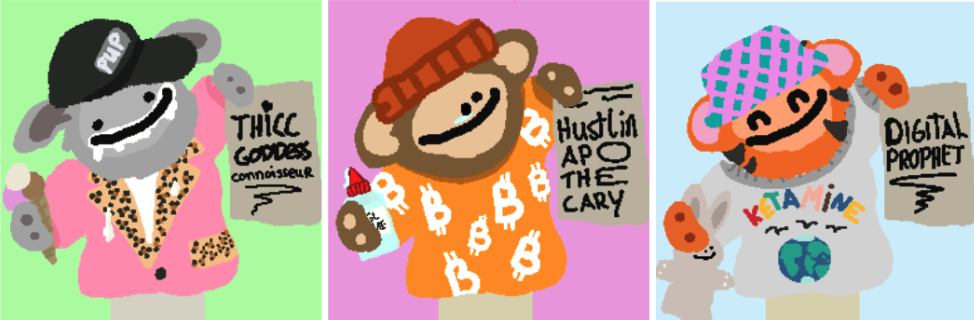
For example, everyone in the chat could submit text for signs held by O.P.I.U.M. puppets, resulting in traits like “Thicc Goddess Connoisseur,” “Hustlin Apothecary,” and “Digital Prophet.”
Designing the Puppets
When designing the traits of the Bitcoin Puppets, The Puppeteer continued involving his community. Throughout the process, he remained faithful to the pure whimsy, unfiltered creativity, and patented absurdity of the original O.P.I.U.M. collection.
A few examples:
-
The two chairs t-shirt trait was submitted by W4nkpire, the Puppets' “KomUNiTy MaNAgEr,” inspired by Michael Saylor’s rhetorical question about how many chairs one is sitting on (referring to full commitment to Bitcoin). The Puppeteer added a twist—making one chair red and the other blue—as a nod to the choice between pills in *The Matrix*.
-
The pink pipe trait references the work of BennyTheDev, who began developing the PIPE protocol after launching $TRAC. Some in the Discord started calling it the “trac pipe”—a play on “crack pipe.”
-
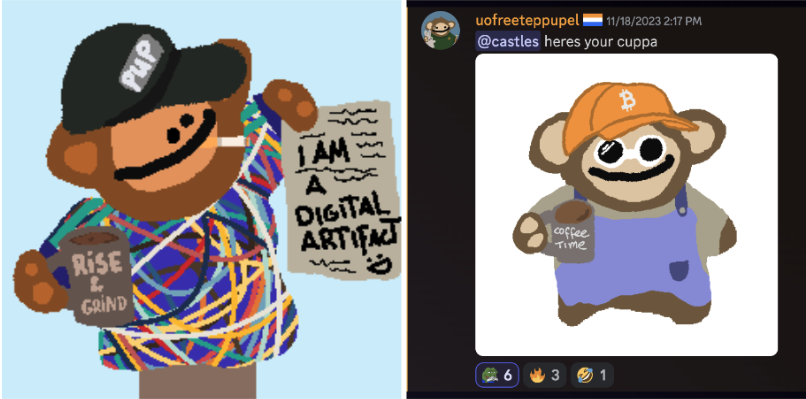
The “coffee time” mug trait originated from a moment reminiscent of the classic meme “What I Ordered vs. What I Got.” OG team member Hillshills ordered a physical mug labeled “Rise and Grind” to match her favorite O.P.I.U.M. trait. After a long and painful delivery, she received one disappointingly labeled “Coffee Time.” A new legend was born.

Initial Mint
The Puppets launched on January 3 via InscribeNow. Despite selling out quickly (with suspicions of bot activity), public reaction to the art was sharply divided. Even among supporters, opinions varied: some absolutely loved and deeply resonated with the collection’s art (including the cursed puppets), while others might not personally appreciate the edgy aesthetics but still recognized something special. Critics were openly dismissive.
Yet polarization only seemed to fuel fervor among believers. Early community members doubled down, buying more aggressively, while skeptics lingered across social media, infiltrating X Spaces.
But the Puppets’ price kept climbing steadily, encountering little resistance along the way—leaving doubters far behind.
Was this really so surprising?
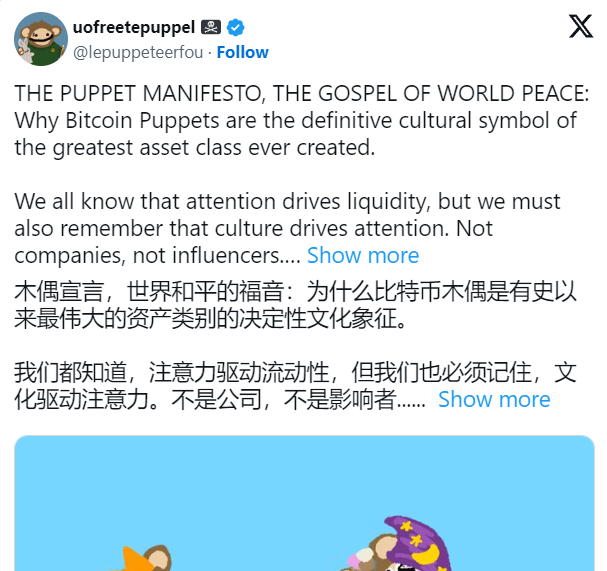
The Puppet Manifesto
Web3 is both ever-evolving and unpredictable, yet vulnerable to relentless “copy-paste” trends. With so many PFP projects aiming to “do it right,” they often end up replicating elements from past failures.
Often, PFP projects are designed and marketed to represent a “community,” even though no real community has had time to form, curate, or grow organically. Ten thousand strangers buying an image and expecting “price to go up” does not constitute a community. Some groups do find common ground and unite, and with enough attention, resources, and effort, may build something lasting. But too many others remain diluted collectives, weighed down by unfulfilled promises and unmet expectations.
The Puppeteer flips this script. No roadmap, no promises, no board. He neither thrusts himself into the spotlight nor vanishes into obscurity. Instead, he positions himself as a steady, supportive presence, allowing holders to shape connections around the art and each other in ways that feel natural. If you look closely, you’ll notice clever Easter eggs—like the middle-finger cursor on the website or the poetic oddities in the O.P.I.U.M. whitepaper—gentle reminders not to take things too seriously.
This complete and total rejection of expectations means everything ahead will be purely organic, community-driven, and filled with delightful surprises.
Let’s not forget the original crew who spent years building relationships, crafting sticky narratives, and accumulating lore. Their emotional investment in the founder, the project, and each other means the community framework existed long before “outsiders” arrived. Rooted in a narrative of mutual “no expectations,” newcomers are warmly welcomed—but never actively seek validation.
Send Them to Zero
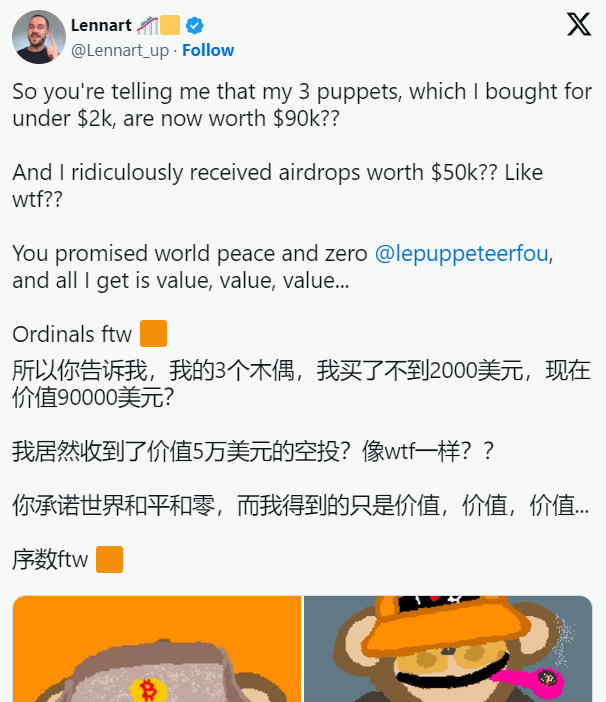
Amid endless hunger for Puppets, a counterintuitive slogan echoes through the halls of X: “Send them to zero.” It might sound like ironic mockery, but it’s actually a gentle reminder—we’re all on this train together until the end. It’s the internet’s only place where objective success is seen as failure.
Even as prices soar, the oft-repeated quip “I was promised zero!” reminds us that the Puppets carry no expectations for their holders—only art, fun, and good vibes. When they eventually hit zero (as all things must), one can only hope people enjoyed the ride.
No Partnerships, But Plenty of Derivatives
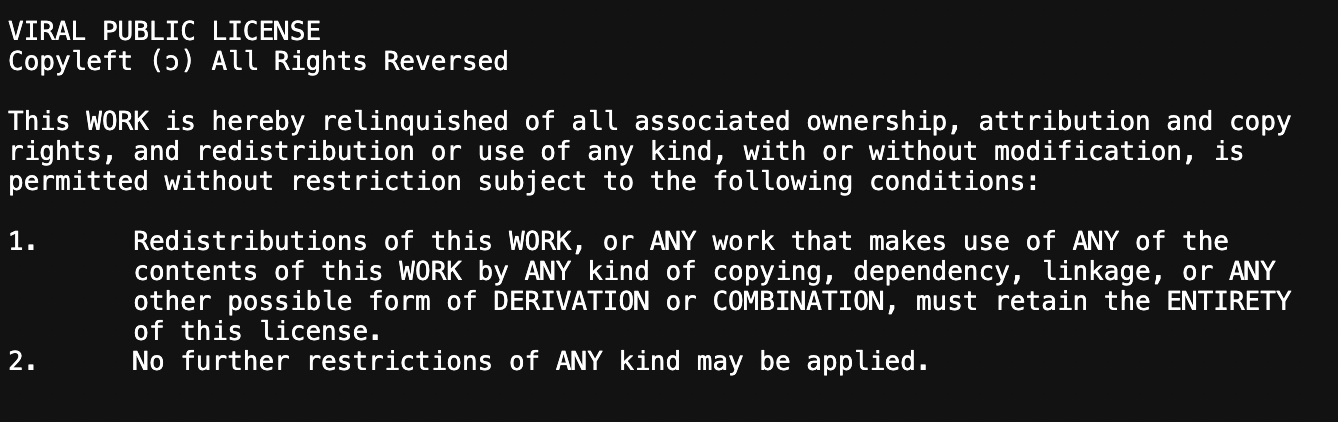
The Puppets operate under the VPL (Viral Public License), similar to the more familiar CC0 (Creative Commons Zero) license. VPL copyleft means anyone can use the artwork freely—for any purpose or creative endeavor—including products and derivative projects.
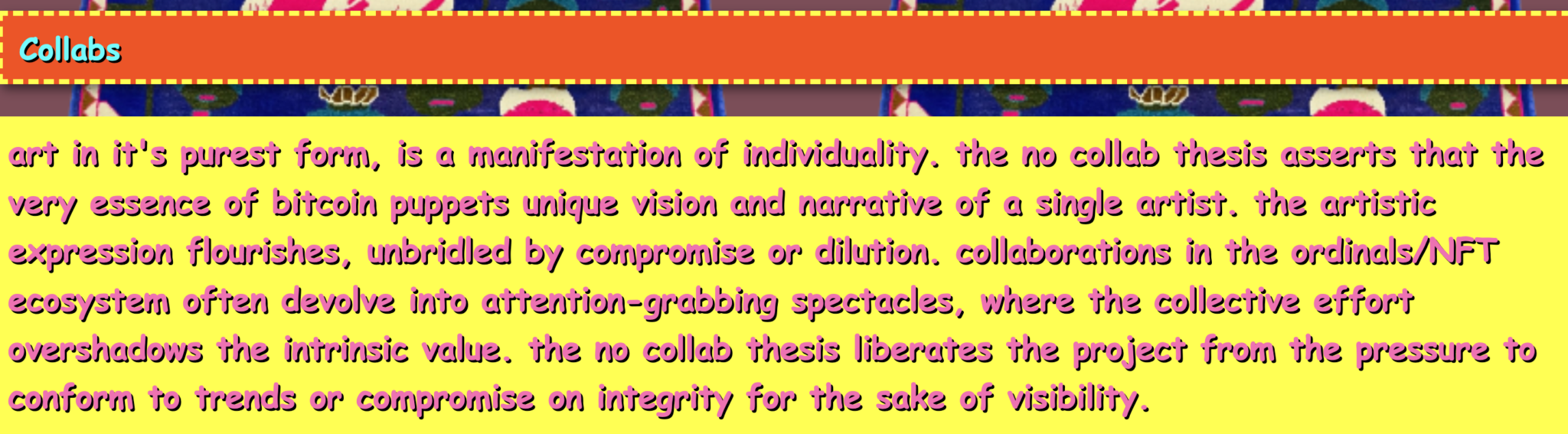
The Puppeteer firmly stands against official collaborations to prevent compromise, dilution, or commodification of the art.
Yet he not only allows but actively encourages broad usage of Puppet IP under VPL. Within their brief public life, Puppets have spawned countless derivatives. So far, some of the most notable include:
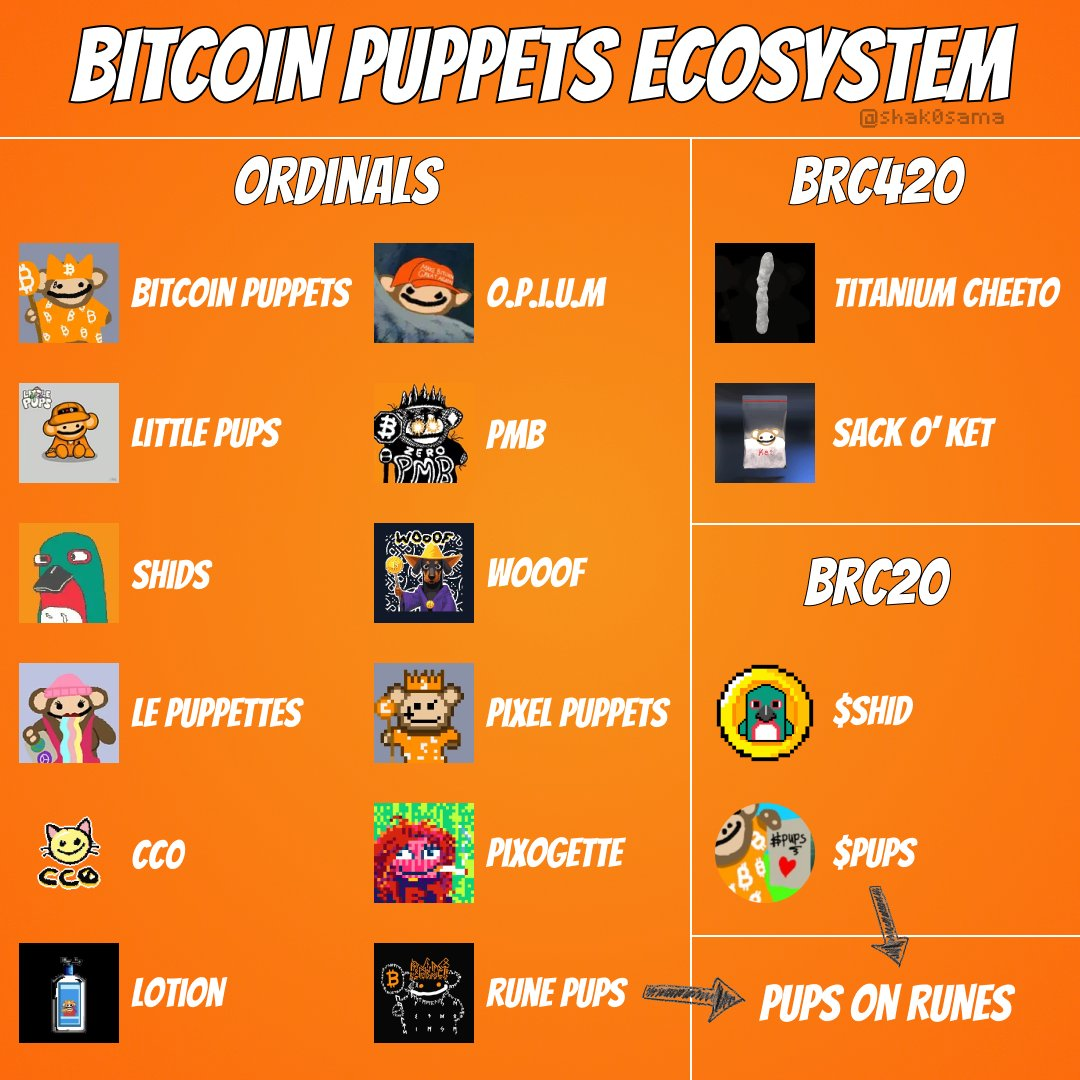
Each new derivative sparks excitement, promising to enrich the Puppet lore:
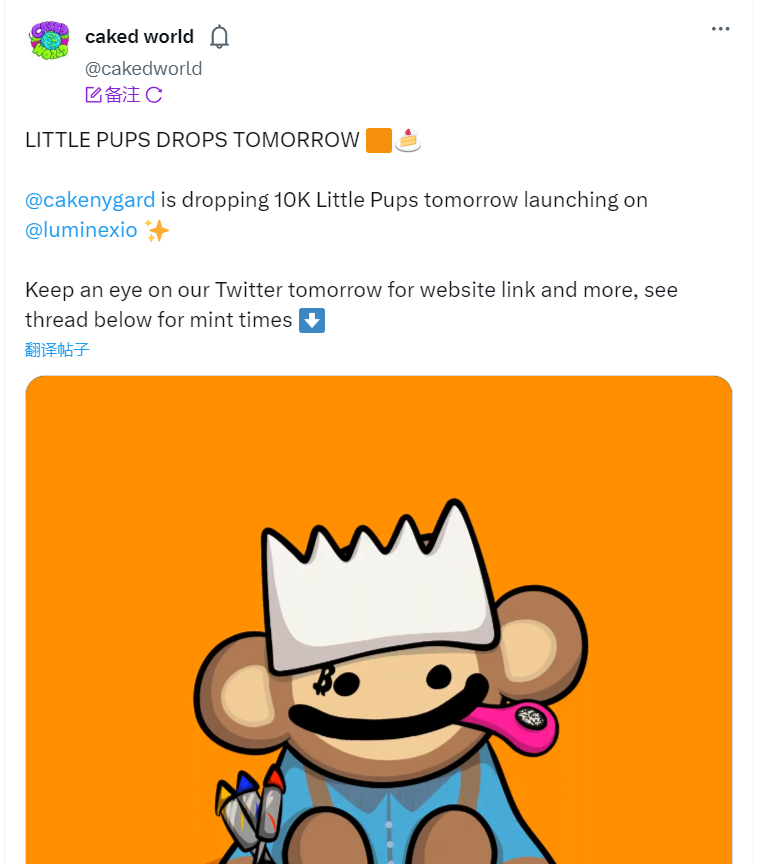
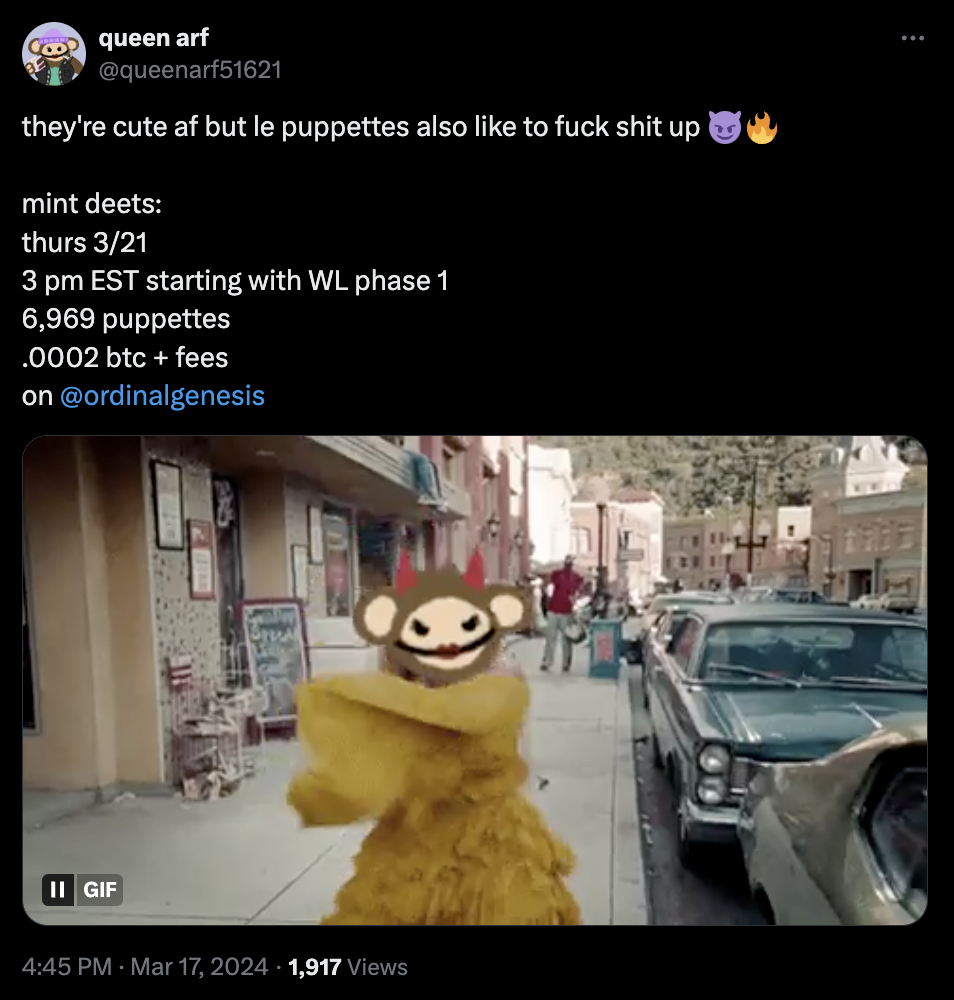
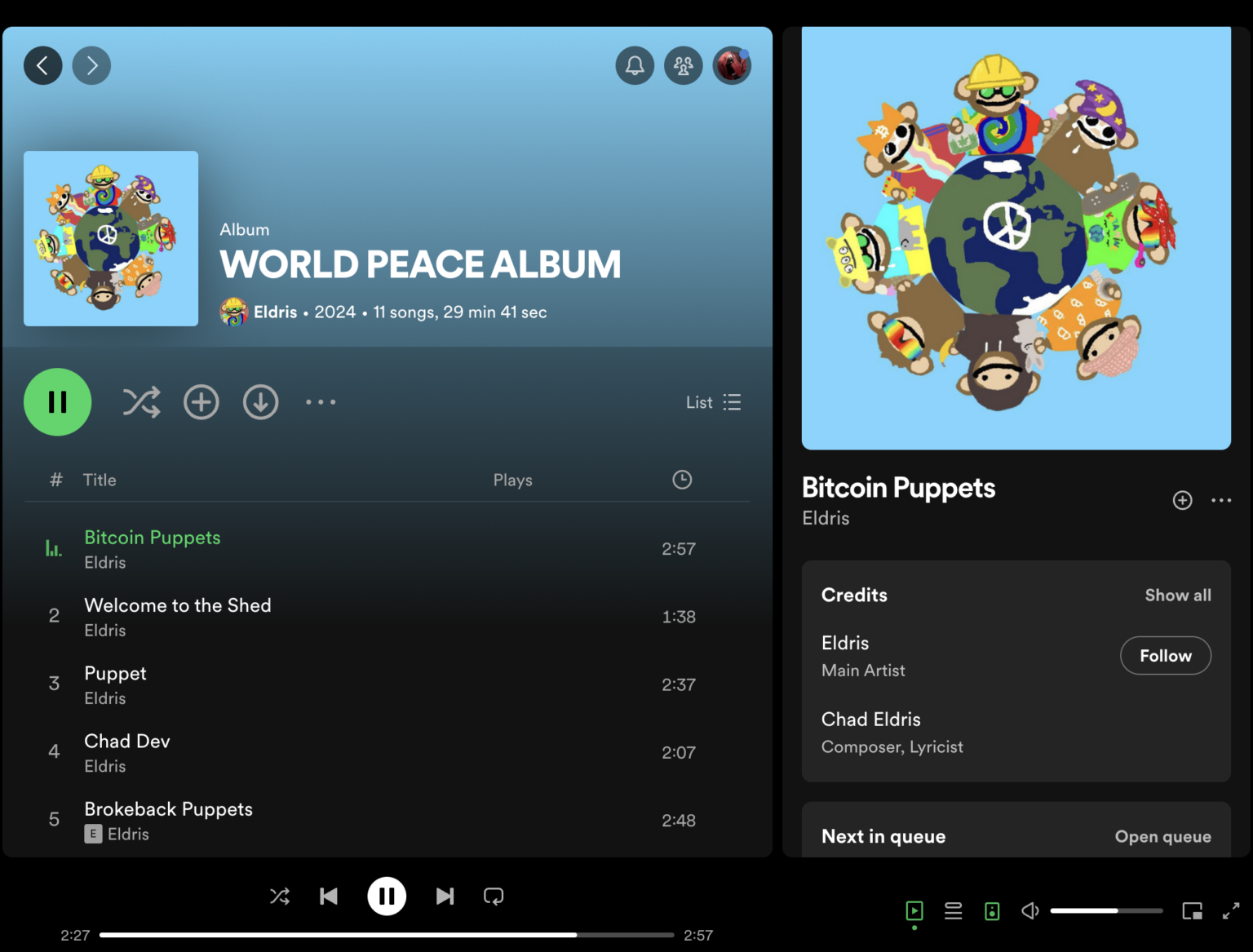
A Flood of Memes, Merch, and Playlists
Puppets have frequently been memed, merchandised, remixed, and turned into playlists—even full albums—all enthusiastically embraced by The Puppeteer and the wider community. The collection even inspired an AI-powered collaborative radio station created by Lukas Kalmar called Puppet PR Radio.
Community engagement goes beyond crafting top-tier memes and printing merch (though the stickers are particularly excellent). Members have gathered globally at events like ETH Denver and NFT.NYC, and are planning appearances at the 2024 Bitcoin event in Nashville, Tennessee.

Honorary Titles
Although The Puppeteer has made it clear he has no interest in traditional “project management,” we can’t help but notice how passionately he supports and participates in community activities.
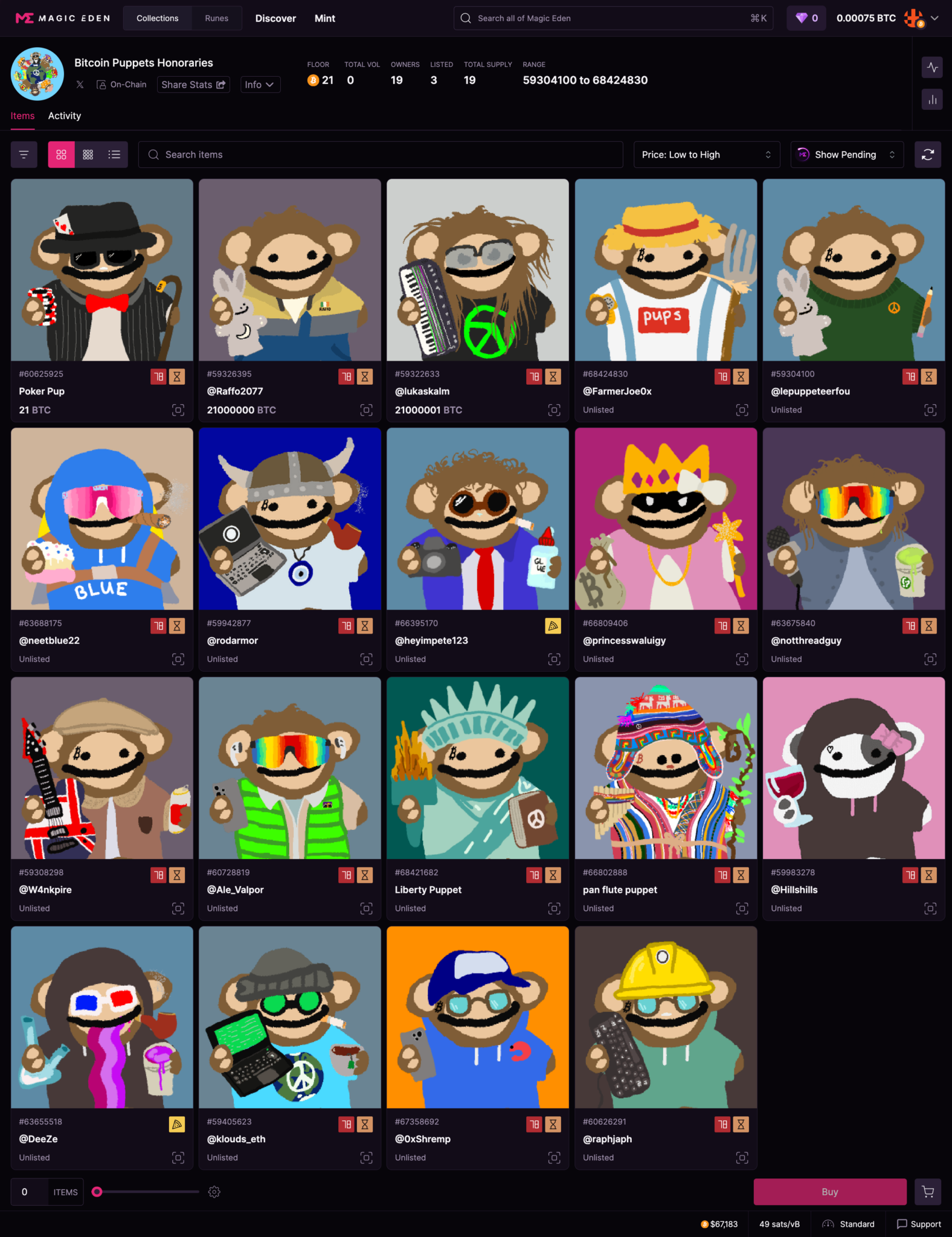
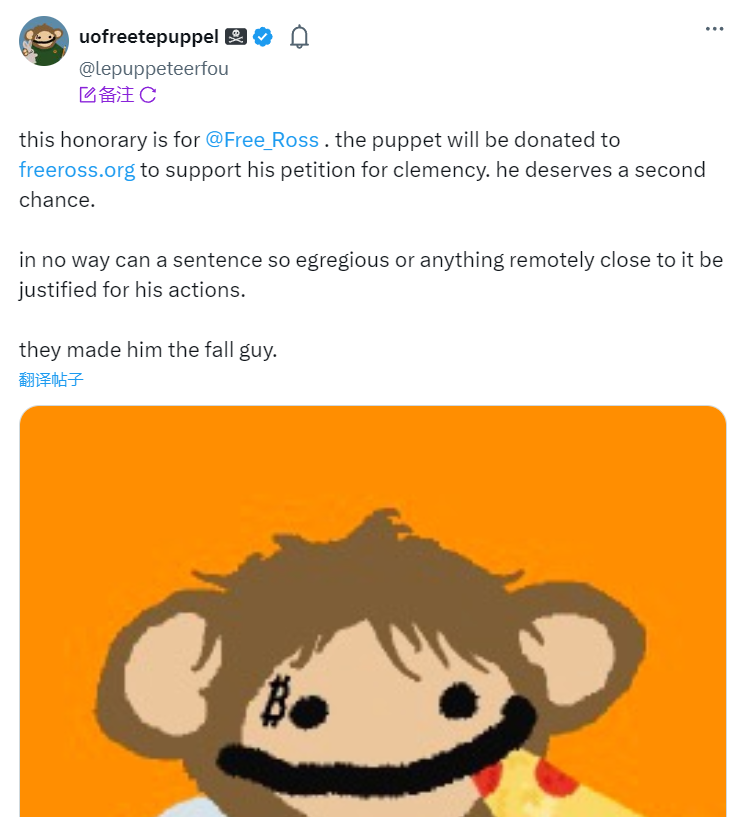
He has created an expanding series of one-of-one Puppet portraits honoring individuals he believes have contributed significantly to the Puppet community and/or the broader blockchain space, including Ordinals creator Casey Rodarmor and figures like DeeZe and ThreadGuy.
These portraits are mostly custom-made tributes crafted specifically for their recipients, though a few were created without a recipient in mind—eventually finding their rightful owners. Recently, The Puppeteer revealed a new batch of honorary Puppets on X, including custom pieces for Ansem and BGS.
$PUPS
The power of the Puppets has spilled over into fungible tokens. $PUPS launched as a meme coin with no roadmap, no utility—just memes. Initially a BRC-20 with a Solana bridge, $PUPS aims to migrate to the Runes network at the halving on April 19, under the ticker PUPS•WORLD•PEACE.
Though the project is neither affiliated with O.P.I.U.M. nor Bitcoin Puppets, it has been embraced by the ecosystem and welcomed by the Puppet community. To honor early Puppet holders, on March 17, 2024, a collection known as “Runes Puppets” (more commonly called “Runes Pups”) was airdropped to Bitcoin Puppet holders.
A portion of the PUPS supply (22.3%) is reserved for distribution to Runes Pups at migration—one of two rarity tiers, Common or Rare. Rare Runes Pups receive a multiplier bonus. The remaining supply (77.7%) will be distributed 1:100 to holders of BRC-20 and bridged Solana tokens.
Closing Thoughts
Centered on pure intent, Puppet culture offers an artistic expression that mirrors the volatility—and sometimes patent illogic—of crypto market finance. While they’re not without critics, and some may find their art crude, the Puppets proudly challenge conventional categorization, celebrating their creativity and (counter)culture. Oh, and they still want world peace.
At the time of writing, the Puppets are just three months old. In human years, that’s barely an infant lifting its head; in crypto years, an anxious teenager. There will surely be twists and turns in the coming bull run, but as a project that has already minted millionaires from a group built on “no expectations,” gratitude may be the most fitting response.
It will be fascinating to see how this collection and community continue to evolve—together or apart.
Join TechFlow official community to stay tuned
Telegram:https://t.me/TechFlowDaily
X (Twitter):https://x.com/TechFlowPost
X (Twitter) EN:https://x.com/BlockFlow_News
 @nftnow






