








ZKasino Accused of Soft Rug Pull: Over 10,000 ETH Forced to "Donate," Founder Slammed by Former Employer
TechFlow Selected TechFlow Selected
ZKasino Accused of Soft Rug Pull: Over 10,000 ETH Forced to "Donate," Founder Slammed by Former Employer
Questionable background behind high-valuation financing, investment firms accused of "inaction."
 Navigating Web3 tides with focused insights
Author: Nancy, PANews
Shortly after officially announcing a high-valuation funding round, Web3 entertainment platform ZKasino has been accused of running away with funds due to a series of questionable actions—unilaterally modifying information about "returning ETH," forcibly swapping users' staked ETH into its own tokens, and transferring over 10,000 ETH worth of user assets to yield-generating platforms. In response, the alleged investors have distanced themselves post-incident, while ZKasino dismissed community backlash as FUD rumors and has not addressed refund requests.
Forced donation and token swap of staked assets—official remains silent
On the evening of April 20, numerous community members reported that ZKasino removed the statement “Ethereum will be returned and can be bridged back” from its official Bridge Funds page, effectively blocking withdrawals. Meanwhile, the project quietly altered its whitepaper to reclassify user-staked assets as donations and unilaterally initiated an IDO, converting users’ real ETH deposits entirely into its native token $ZKAS.
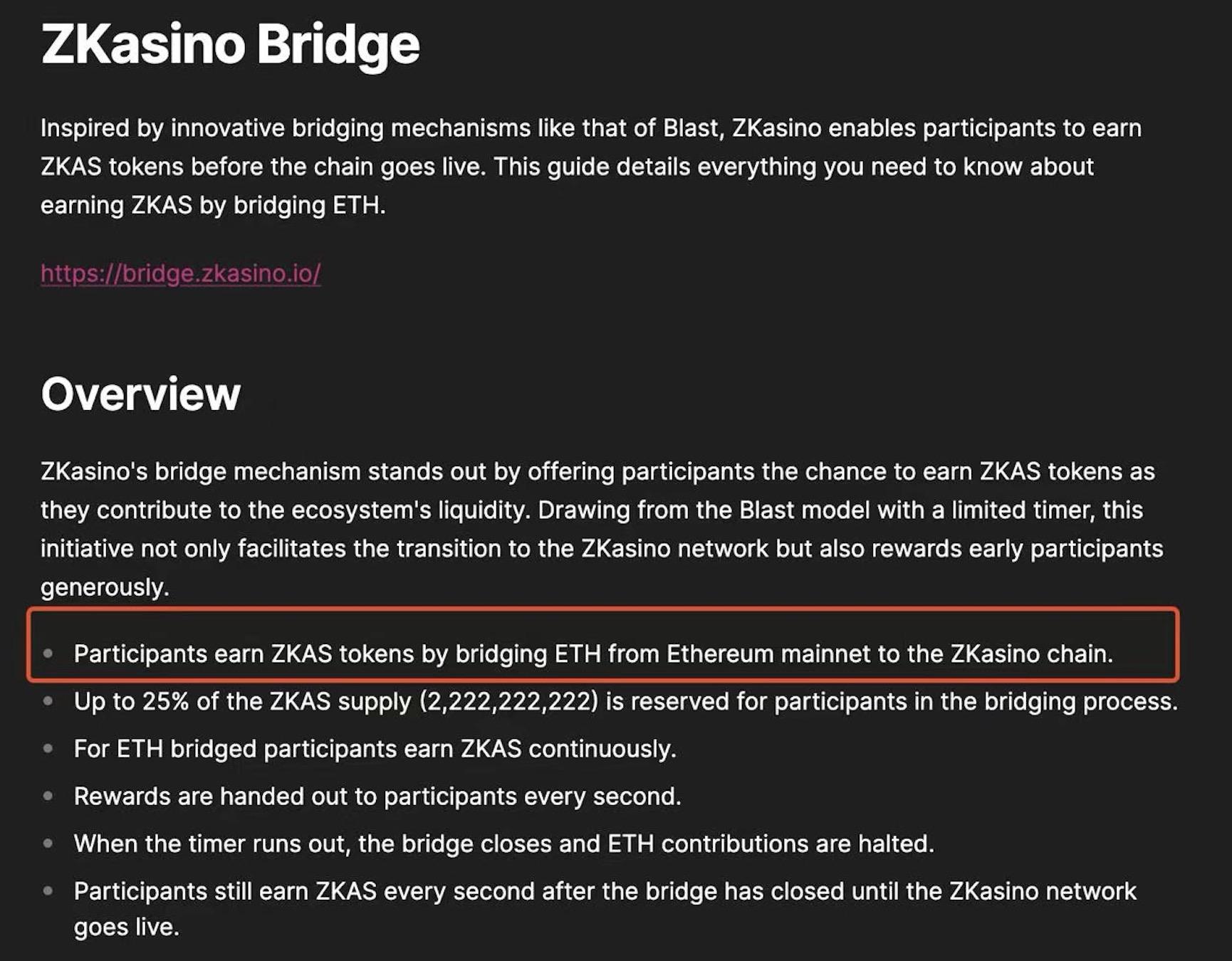
According to on-chain analyst EJing, on April 21, ZKasino transferred 10,515 ETH (worth approximately $33 million) deposited by over 10,000 users via the bridge to a multi-sig address and subsequently deposited them into Lido.
The move sparked outrage within the community, prompting organized维权 efforts—with Chinese-speaking维权 groups alone surpassing 2,000 members. KOL @0xTim_Hu, who previously handled domestic influencer outreach for the project, claimed on April 21 that he had filed a case in Dubai, though he was met with skepticism for failing to provide any official receipt.
Later that night, ZKasino did not directly respond to the whitepaper changes. Instead, it stated there were many FUD rumors circulating, but the ZKasino network would still launch—merely delayed due to exchange listings. While acknowledging external interference and FUD common in new technologies, the team emphasized focus on its mission. It framed skepticism as part of growth and reiterated plans to continue building, upgrading, and pushing updates for ZKasino Chain. Upon launch, EIP-3074 integration would revolutionize gameplay by eliminating the need for users to manage $ZKAS balances for gas fees, simplifying dApp interactions. ZKasino expressed excitement for the future and looked forward to sharing its journey with users.
Alleged fraud including data manipulation
In reality, much of ZKasino’s ability to attract such significant capital stems from the reputation of ZigZag—the first native DEX on zkSync—and institutional backing.
ZigZag reportedly raised $15 million in equity and $60 million in bonds, according to crypto KOL 0xAA. @0xTim_Hu also disclosed in a February tweet that ZigZag attracted investment from several marquee firms. However, in June 2022, ZigZag revealed it lost $20 million during the UST depeg event and admitted generating zero revenue throughout nearly a year of operations, leaving it financially insolvent. Subsequently, ZigZag launched an IDO and airdrop for its $ZZ token, which has since plummeted in value. CoinGecko data shows that as of April 22, $ZZ traded at just $0.03, down over 99% from its $3 IDO price. Last July, founder Kedar announced plans to raise $500,000 at a $10 million valuation for a new venture, promising partial airdrops to $ZZ holders—but the initiative never materialized.
Launched in January 2023, ZKasino shares team members with ZigZag, including founder Derivatives Monke. But in March this year, shortly after ZKasino launched its staking mining campaign, ZigZag abruptly turned against it.
Kedar publicly accused ZKasino of fabricating most of its revenue claims (ZKasino claimed over $9 million in first-year revenue) and warned users to avoid its IC0. He further stated that the announced $40 million ecosystem fund was fake and unlikely ever to be paid out in real funds.
Kedar added that incompetence and fraudulent behavior by certain team members contributed significantly to ZigZag’s operational struggles and lack of progress since inception. Notably, Derivatives Monke served as fundraiser and one of the 3-of-5 signers for the multisig holding ZigZag’s $15 million in funding. Those funds flowed into addresses controlled by Monke, yet ZigZag itself never had control over them—raising concerns that more money may have been stolen or diverted to ZKasino than previously known. Though Kedar requested $1 million in restitution from ZKasino, no compensation was provided. As such, he urged $ZZ token holders to seek their own recourse, asserting that Monke, as a former ZigZag team member, should be held accountable for investor losses. While Kedar currently lacks definitive proof of theft, he firmly believes Monke’s mismanagement caused substantial financial damage to ZigZag.
Additionally, Kedar noted multiple individuals have contacted him alleging non-payment or fraud by the ZKasino team. Several former employees and contractors reported unpaid wages. He also reached out to one of ZKasino’s listed investors, informing them of the revenue falsification—only to learn they hadn’t actually participated in the funding round. This suggests ZKasino’s financing and valuation claims are likely fabricated. Kedar warned that Monke has a history of forging Telegram and social media chat logs and might use similar tactics to deny allegations. He encouraged investors and other project founders to contact him directly for verification.
Regarding Monke’s dishonesty, chain sleuth ZachXBT had already highlighted related evidence last December amid the controversy involving Sebastien, former zkSync DeFi lead accused of stealing zkSync tokens. ZachXBT questioned why anyone would trust Derivatives Monke or his team, citing prior proven dishonesty—including evading payments owed to PancakesBrah (an anonymous account responsible for growth and business development at Friend.tech), staging a fake $200,000 giveaway, refusing to honor a bet payout to eGirl Capital partner @CL207, using grotesque videos of a murder to promote the casino (later apologizing and blaming an intern), and failing to compensate victims after team members fell victim to phishing attacks. Despite these accusations, Derivatives Monke denied all claims in a public statement.
Notably, ZigZag announced in April this year that it would shut down due to U.S. regulatory pressure—even though Kedar had claimed just over a month earlier that he would do everything possible to revive the project. Within less than a week, however, former ZigZag team members forked the codebase, bringing the previously shuttered zkSync Lite exchange back online—leading the community to reject the legitimacy of the shutdown.
Doubts over high-valuation funding; investors criticized for inaction
Amid revelations of revenue fabrication and fund misuse, ZKasino suddenly announced days later that it had closed a Series A round at a $350 million valuation—though it did not disclose the amount raised, only naming participants including MEXC, Big Brain Holdings, Trading_axe, Pentoshi, and Sisyphus. However, Big Brain Holdings clarified it had invested in ZigZag back in 2022 and suffered financial losses but had never invested in ZKasino and would neither receive nor accept any token allocations. While exchange MEXC did not deny involvement, in a response to TechFlow, it stated the project’s actions were unrelated to them and that they too were victims as investors.
The indifferent stance taken by these investors angered the community. Users pointed out that many joined ZKasino based on investor credibility, yet these institutions failed to clarify their involvement when the project was promoted and only distanced themselves once misconduct emerged. They also did not disclose relevant project details that could assist users in asset recovery. Additionally, KOLs involved in promoting the project became targets of widespread criticism.
This incident highlights the lack of rigorous due diligence in evaluating projects. As Dovey Wan, partner at Primitive Ventures, recently tweeted: ZKasino was eliminated from investment consideration due to clear ethical red flags. In venture decisions, psychological profiling, moral assessment, and scrutiny of founders’ motivations and intentions should carry equal weight to traditional due diligence.
Currently, several platforms have taken proactive steps regarding the suspected rug pull. For example, Ape Terminal—the ID0 platform through which ZKasino raised $2 million—has canceled ZKasino’s IDO and enabled full refunds for all participants. Binance has frozen the Binance accounts belonging to ZKasino’s founders.
Overall, ZKasino’s soft rug clearly exposes the hidden risks of capital loss lurking in crypto’s dark forest. Investors must recognize that indicators like association with well-known projects, high TVL, large user counts, or institutional endorsements cannot serve as reliable criteria for evaluating a project’s legitimacy. Moreover, given their influence and reach, investors and KOLs must exercise greater caution and professionalism when supporting or promoting projects.
Join TechFlow official community to stay tuned
Telegram:https://t.me/TechFlowDaily
X (Twitter):https://x.com/TechFlowPost
X (Twitter) EN:https://x.com/BlockFlow_News
 PANews











